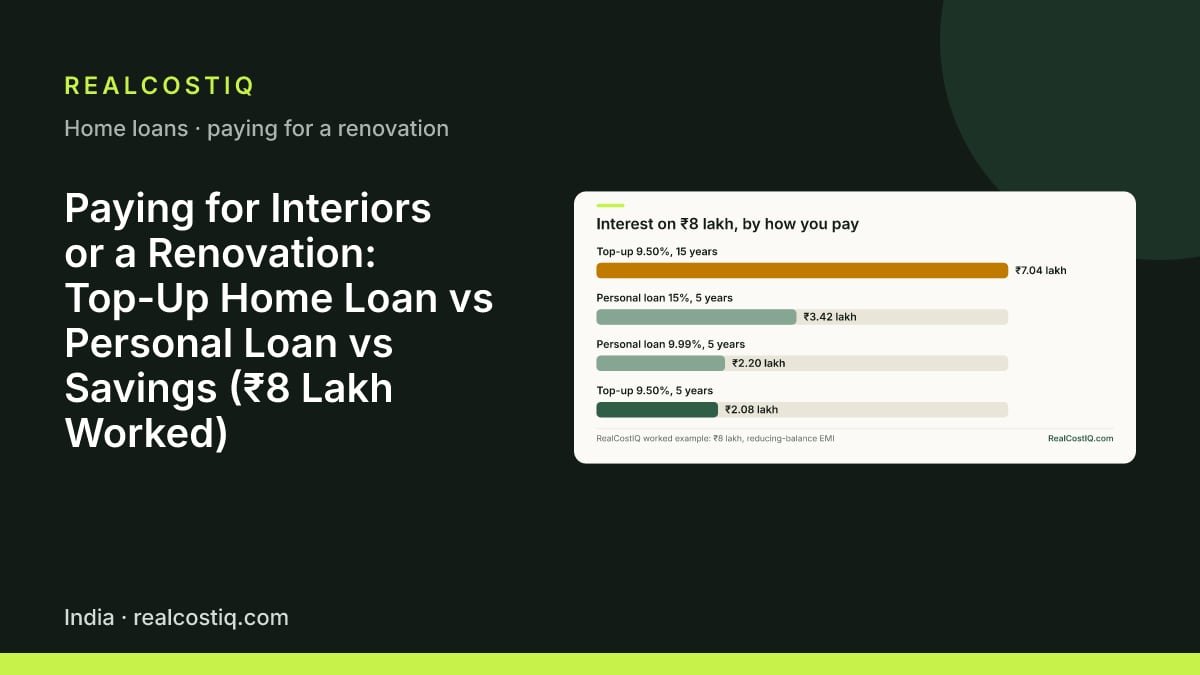
A renovation bill rarely arrives alone. The designer wants an advance. The carpenter wants a second payment before the wood is cut. The tiles come in a different week from the paint. By the time the work is done, ₹8 lakh has left your account in about six instalments. That is why this choice matters before you start. Pick the source of funds first, so every instalment is covered.
This post is only about the cost of paying for the work. It does not tell you how much a kitchen or a bathroom should cost. For that, use the home renovation cost calculator, the bathroom renovation cost calculator or the home interior design cost calculator. It also does not tell you what to do with your savings in general. It only shows the arithmetic of using them for this job.
How this was checked. On 28 October 2026 we read the home loan and personal loan rate pages of SBI, HDFC Bank, ICICI Bank and Axis Bank, and the home loan rate page of Bajaj Housing Finance. We also read the RBI's rules on prepayment charges and on the Key Facts Statement, and the RBI home page for the repo rate. Each page is listed under Sources with the date read. Where a bank does not print a top-up rate, we say so. We then use a stated assumption and show the range, rather than invent a quote.
The short version: one job, three bills
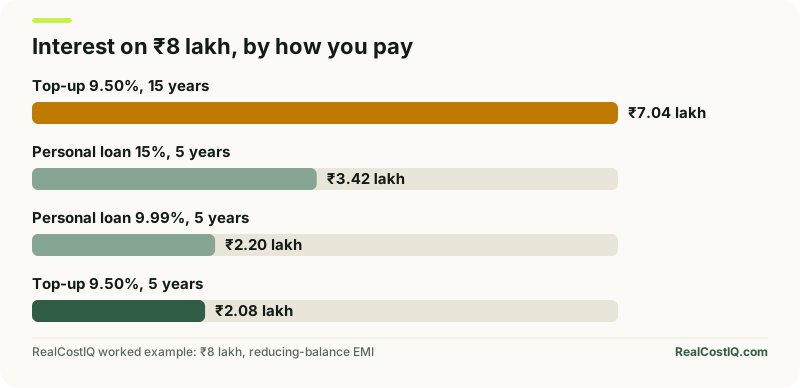
Take an ₹8 lakh interior job. Suppose you already have a home loan with 15 or more years left. We priced it four ways. The first is a top-up spread over 15 years. The second is a top-up you repay in 5 years. The third is a 5-year personal loan. The fourth is paying from savings. All EMIs below use the standard reducing-balance formula, the same one in the home loan EMI calculator. They are our own arithmetic on stated inputs. They are not offers.
| Option | Rate used | Months | EMI | Interest paid |
|---|---|---|---|---|
| Top-up, long tenure | 9.50% | 180 | ₹8,354 | ₹7.04 lakh |
| Top-up, repaid in 5 years | 9.50% | 60 | ₹16,801 | ₹2.08 lakh |
| Personal loan, 5 years | 9.99% | 60 | ₹16,994 | ₹2.20 lakh |
| Personal loan, 5 years | 12.00% | 60 | ₹17,796 | ₹2.68 lakh |
| Personal loan, 5 years | 15.00% | 60 | ₹19,032 | ₹3.42 lakh |
| Own savings | No loan rate | None | ₹0 | ₹0 paid, earnings lost |
Interest = EMI x months minus ₹8,00,000. Fees are shown separately below. The 9.50% top-up rate is our assumption; the personal loan rates are the bottom of the HDFC Bank and ICICI Bank ranges and two points above it.
Look at the two top-up rows. The rate is the same. The interest bill is not. It is more than three times higher when you stretch the top-up over 15 years. That gap is far larger than the gap between a top-up and a personal loan. The next sections explain why, and what each option needs from you.
What rates the banks actually print
Rates change often, and they depend on your profile. So we only quote what the bank's own page said when we read it. All were read on 28 October 2026.
- SBI: the home loan card on SBI's interest rate page shows 7.50% a year onwards, with effect from 15 October 2026. The page does not print a separate top-up rate.
- HDFC Bank: home loan rates are tied to the policy repo rate, which HDFC lists as 5.50%. Its page shows repo plus 2.50% up to 7.95%, which it totals as 8% to 13.45%. Its Xpress personal loan starts at 9.99% a year on a fixed rate, and the fee page lists a range of 9.99% to 24.00%.
- ICICI Bank: the home loan page showed a standard range of 8.75% to 9.65% for salaried borrowers on loans up to ₹35 lakh, valid till 31 October 2026. Its personal loans start at 9.99% a year. Its top-up page says the rate is set by the bank on a case basis and prints no number.
- Axis Bank: its home loan page shows rates of 8.00% to 8.85% for a score of 751 and above, and 8.20% to 9.10% below that. We found no printed top-up rate.
- Bajaj Housing Finance (not a bank): it prints a top-up range. For salaried borrowers it is 8.60% to 10.40%. For the self-employed it is 9.50% to 10.85%.
This tells you three things. First, the banks do not print one top-up number. You will be quoted a rate after they look at your loan. Second, the one printed top-up range we found starts about 1.1 points above the same lender's home loan floor (8.60% against 7.50% for salaried borrowers at Bajaj Housing Finance) and ends close to its home loan ceiling (10.40% against 10.25%). Third, the personal loan floor is about 9.99%, and the ceiling is far higher. So for the worked example we used 9.50% for the top-up as a middle case. We also show 8.60% and 10.40%, the edges of the Bajaj range, in the table in the next section.
Option 1: the top-up home loan
A top-up is an extra loan on a home loan you already have. ICICI Bank describes it as extra money against your existing home loan, for needs such as renovation and interiors. Its page also says there is no need for new collateral. The house you already pledged covers it.
What the top-up does well
- Lower rate. It is secured on your house, so the lender takes less risk than on a personal loan.
- Long tenure available. ICICI says the tenure depends on how long your existing home loan has left and on your eligibility. A longer term gives a smaller EMI.
- Floating rate, so you can prepay. The RBI's pre-payment directions say a lender cannot charge pre-payment fees on floating rate loans to individuals for non-business purposes. They apply to loans sanctioned or renewed on or after 1 January 2026. A renovation is a non-business purpose. This holds even if you prepay from other sources, with no lock-in period. RBI's list of withdrawn circulars now shows these directions as folded into its later consolidated Directions, whose current text we could not read, so confirm the clause in your own sanction letter and KFS.
What the top-up asks of you
- An existing home loan with a good record. ICICI says it looks at your repayment history and your existing loan details.
- Room under the loan-to-value limit. The new loan is added to what you still owe. The total must stay within the RBI's limits for the value of your home. Use the home loan top-up calculator to see how much room you have.
- Your house at risk. If you miss payments on a secured loan, the lender can act against the house. That is the price of the lower rate.
- A rate that moves. A floating rate follows the benchmark. The RBI home page showed the policy repo rate at 5.50% on 28 October 2026. If it moves, your EMI or your tenure moves with it.
The tenure trap
Here is the part most people miss. A top-up is often set to end when your home loan ends. If you have 15 years left, the default top-up runs 15 years. At 9.50% that is an EMI of ₹8,354 on ₹8 lakh. It feels small. But the interest is ₹7.04 lakh. That is 88% of what you borrowed.
You do not have to pay it that slowly. Because there is no pre-payment fee on a qualifying floating rate loan, you can pay ₹16,801 a month instead and finish in about 5 years. The interest then falls to about ₹2.08 lakh. You keep the choice: a small EMI in a tight month, a big one when cash is easy. A personal loan does not give you the same freedom by default, as the next section shows.
| Rate | 5-year EMI | 5-year interest | 15-year EMI | 15-year interest |
|---|---|---|---|---|
| 8.60% | ₹16,452 | ₹1.87 lakh | ₹7,925 | ₹6.26 lakh |
| 9.50% | ₹16,801 | ₹2.08 lakh | ₹8,354 | ₹7.04 lakh |
| 10.40% | ₹17,156 | ₹2.29 lakh | ₹8,794 | ₹7.83 lakh |
8.60% and 10.40% are the ends of Bajaj Housing Finance's salaried top-up range, read 28 October 2026. 9.50% is our middle case. Reducing-balance EMI.
Look at the table by rows and by columns. Moving down a row, from 8.60% to 10.40%, adds about ₹42,000 of interest over 5 years. Moving across, from 5 years to 15 years, adds more than ₹4 lakh. Tenure is the bigger lever by a wide margin.
Option 2: the personal loan
A personal loan is unsecured. It needs no property papers and no existing home loan. That makes it fast. HDFC Bank says a pre-approved customer can get funds in 10 seconds, and other customers in about 4 working days with documents verified. ICICI Bank offers up to ₹50 lakh and tenures up to 84 months.
What it does well
- Speed and paperwork. Useful when the contractor needs an advance this week.
- Fixed EMI. HDFC Bank lists its personal loan rate as fixed. Your EMI will not move with the repo rate.
- No claim on your house. Missing payments hurts your credit record and brings recovery action, but the house is not pledged.
- No dependence on a home loan. If your home is fully paid, or you have no home loan at the bank, this may be your only loan route.
What it costs
- A higher, wider rate. HDFC Bank shows 9.99% to 24.00%. Where you land depends on your credit record, income and the loan size. ICICI Bank's calculator offers rates from 9.99% to 15%.
- Fees on top. HDFC Bank lists processing charges of up to ₹6,500 plus GST, and stamp duty at actuals. On a smaller loan, a fixed fee weighs more.
- Short life. The longest tenure on these pages is 84 months. A shorter life means a bigger EMI, which is the reason it ends up cheaper in total than a long top-up.
- Early closure terms vary. The RBI's no-fee rule covers floating rate loans. HDFC Bank's page describes a programme (Golden Edge) that lets you close without a charge after 12 EMIs if you pay from your own money, but only for borrowers with an income of ₹75,000 or more and a loan above ₹15 lakh. So it would not cover an ₹8 lakh loan. Read this clause before you sign.
At 9.99% for 5 years, the EMI on ₹8 lakh is ₹16,994. That is only ₹193 a month more than the 5-year top-up at 9.50%. The total interest gap is about ₹12,000. If the personal loan rate is nearer 12% or 15%, the gap widens to about ₹60,000 and ₹1.34 lakh. So what matters is the rate you are actually offered, not the headline floor.
Option 3: your own savings
Paying from savings has no EMI and no application. It is not free, though. The cost is what that money would have earned if it had stayed where it was. We are not telling you where to keep your money. We are showing what the lost earnings look like, so you can set them next to a loan's interest.
Two reference points from pages read on 28 October 2026. SBI's page states that the savings bank deposit rate is 2.70% a year. IndusInd Bank's page lists fixed deposits at up to 7%. At those two rates, ₹8 lakh left for 5 years earns about ₹1.14 lakh and ₹3.22 lakh, with yearly compounding and before any tax. Your own account may pay more or less.
| Rate | After 3 years | After 5 years |
|---|---|---|
| 2.70% (SBI savings rate) | ₹66,565 | ₹1,13,992 |
| 7.00% (upper end, IndusInd FD page) | ₹1,80,034 | ₹3,22,041 |
Yearly compounding, before tax, on ₹8,00,000. Illustrative. Your own rate and tax will differ.
Here is the simple rule. Paying in cash is cheaper than a loan only when the money would earn less than the loan costs. A 9.50% loan costs more than a 2.70% account earns. But a 7% deposit is closer to the loan rate than many people expect. Tax on deposit interest is not counted here, and it will change the picture for you.
There is a second cost that has no rupee figure: being without a cash buffer. A renovation often runs over. If every spare rupee is in the walls, a medical bill or a job gap in the same year has nowhere to go. Many people keep some money back for this reason. That is a personal call, and we do not rank it.
Mixing them: part savings, part loan
You do not have to choose one. Suppose you put in ₹3 lakh of your own money and borrow ₹5 lakh as a top-up at 9.50%, repaid in 5 years. The EMI is ₹10,501. The interest is about ₹1.30 lakh. At the 2.70% savings rate, the ₹3 lakh you used would have earned about ₹42,700 over the same 5 years. Add them and the all-in cost is about ₹1.73 lakh.
Compare that with the full 5-year top-up at ₹2.08 lakh. The mix looks cheaper because the savings were earning less than the loan costs. If your savings are earning 7%, the picture is different, and the full loan may cost less than the money you lost. Run both numbers with your own rates.
A useful rule of thumb: on a 5-year top-up at 9.50%, each ₹1 lakh borrowed adds about ₹2,100 to your monthly outgo. On a 15-year top-up it adds about ₹1,044. On a 5-year personal loan at 12%, it adds about ₹2,224. Scale from there for a smaller or larger job.
How the cost grows with tenure
The chart below follows the interest on ₹8 lakh as the repayment period lengthens. The top-up line uses 9.50%. The personal loan line uses 12% and stops at 7 years, because that is as long as these personal loans run (up to 84 months).
| Years to repay | Top-up at 9.50% | Personal loan at 12% |
|---|---|---|
| 3 years | ₹1.23 lakh | ₹1.57 lakh |
| 5 years | ₹2.08 lakh | ₹2.68 lakh |
| 7 years | ₹2.98 lakh | ₹3.86 lakh |
| 10 years | ₹4.42 lakh | Not offered (84-month limit) |
| 15 years | ₹7.04 lakh | Not offered (84-month limit) |
Interest = EMI x months minus ₹8,00,000. Reducing-balance EMI. Assumed rates, not offers.
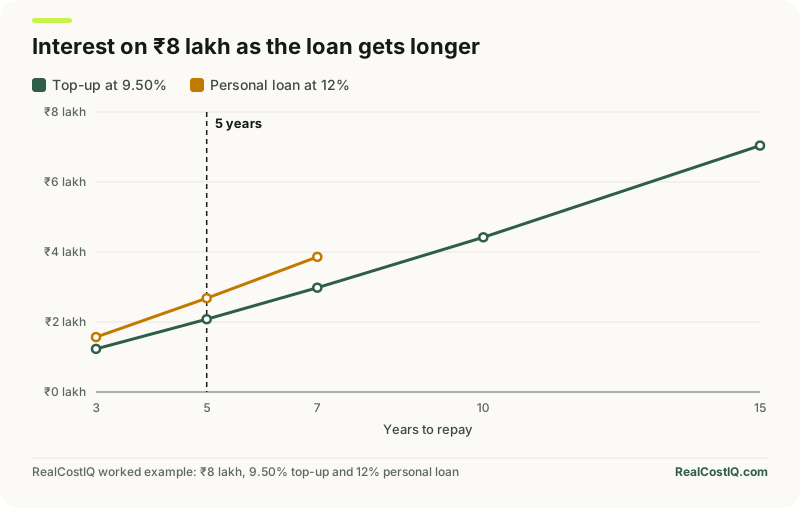
The lines tell one story. Each extra year costs more than the last in total interest, because you hold the money longer. A top-up held for 10 years costs more than a personal loan held for 7, even though its rate is 2.5 points lower. Read the chart before you accept the longest tenure on offer.
What to ask the lender before you sign
The RBI's Key Facts Statement circular of 15 April 2024 covers retail loans from banks and housing finance companies. RBI now lists that circular as withdrawn and folded into its later consolidated Directions, whose current text we could not read, so treat the details below as the 2024 wording. It requires a Key Facts Statement, or KFS, in a standard format and a language the borrower understands. It defines the annual percentage rate (APR) as the yearly cost of credit, including the interest rate and all other charges. The KFS must stay valid for at least three working days for loans of seven days or more. Use that window.
- Ask for the KFS for each loan. Put the two APRs side by side. A lower rate with a high processing fee can cost more than a slightly higher rate with none.
- Ask for the tenure in months, in writing. For a top-up, ask whether you can choose a shorter tenure than the home loan has left.
- Ask whether the rate is floating or fixed. This decides whether the RBI's no-fee prepayment rule applies, and whether your EMI moves.
- Ask what happens to your existing loan. On a top-up, find out whether the top-up is a separate loan account and whether the rate resets with the home loan.
- Ask for every fee. Processing fee, GST, stamp duty, insurance and any charge for early closure. The RBI says a lender cannot charge a pre-payment fee that was not disclosed in the sanction letter, loan agreement and KFS.
- Ask when the money comes out. A top-up may be paid out in one go. Check whether you can draw in stages so you do not pay interest on cash sitting idle.
How to choose, in rupee terms
We do not tell you which to pick. But here is how the numbers point, based on the rates and rules above.
- If you have a home loan with a good record and room under the limit, a top-up usually gives the lowest cost on a 5-year plan. Use the calculator to see the room, then ask for a shorter tenure or plan to prepay.
- If you need the money fast, or the home loan is with a different lender, a personal loan may be the only quick route. Check the fixed rate you are offered, not the floor. Add the fee.
- If you can cover the job from money that earns less than 9%, paying cash costs you less than a loan. Keep a buffer for the overrun.
- If your job may run over, work out which source you would use for the extra ₹1 lakh or ₹2 lakh. A line of credit you already have is better than a new application halfway through.
- If the tenure is the problem, ask for a short one and pay it. The saving from a 5-year plan over a 15-year plan is larger than any rate difference we found.
A top-up makes your home loan bigger. If you later sell, the balance is repaid from the sale. Your lender also holds the house as security for the larger sum. Before you borrow, run both loans together in the home loan EMI calculator so you see the combined EMI, not just the new one.
What this post does not cover
- Tax. Whether you can claim relief on interest paid on a top-up used for repairs depends on the tax law in force, and on how much relief you already claim on the home loan. We have not worked it. Check the current rule before you count any tax saving.
- Your exact rate. None of the banks printed a top-up number for us, so our top-up rates are labelled assumptions. Your offer may differ.
- Other sources of funds. Gold loans, builder finance, credit cards and loans from family are outside this post. We make no claim about them.
- Housing finance companies and other lenders. Apart from Bajaj Housing Finance's printed top-up range, we read only bank pages. NBFC and HFC rules differ in places.
- Which renovation is worth doing. We price the funding, not the job.
We tried to find a recent forum thread from Indian borrowers on this choice, to see what people ask. The search returned lender and news pages, not forum threads, and our usual forum site was not reachable. So this post quotes no forum comment.