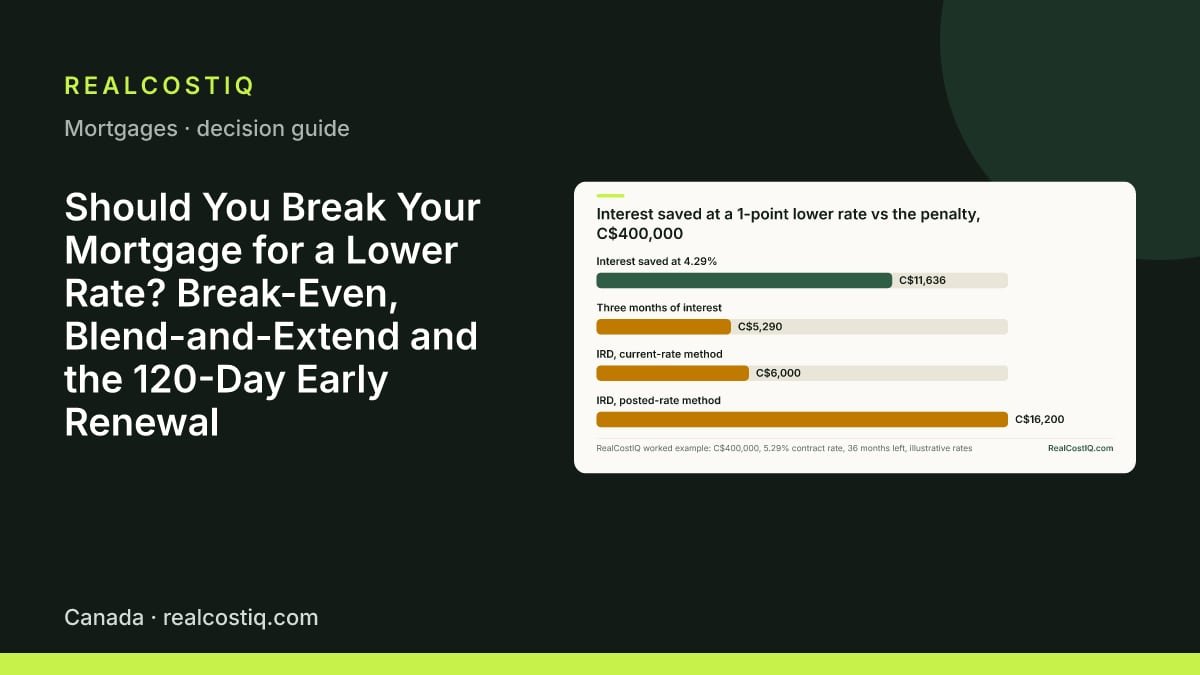
Rates have moved. Your fixed rate now looks high. A friend says you can get a lower one. You are on year two of a five-year term. So you wonder if you should break the mortgage and take the new rate. The answer is a simple comparison. How much interest would you save? And how much will the lender charge you to leave? If the savings beat the charge, breaking can pay. If not, wait, or look at a cheaper way to get a lower rate. This post works that comparison on one example and then shows the cheaper ways.
The example mortgage
We use round numbers. They are assumptions, not quotes. You owe C$400,000. Your contract rate is 5.29% on a five-year fixed term. You are two years in, so 36 months are left. You have 25 years of amortization left. (Amortization is the full time you have to pay off the loan. The term is only the part covered by your rate deal.) Fixed-rate Canadian mortgages compound twice a year, so we price the payments that way. At 5.29% your payment is about C$2,393 a month.
We do not cover how an IRD is built in detail. Our mortgage penalty calculator walks through a full IRD by hand. This post uses only the parts you need to decide.
Step 1: the penalty
Three months of interest
This is the easy part. Tangerine states the method: multiply your rate by your balance, divide by 12, then multiply by 3. First National also uses three months of interest for its adjustable-rate loans. On C$400,000 at 5.29% that is C$400,000 x 5.29% / 12 x 3, or C$5,290. On a variable-rate mortgage this is the whole penalty. For example, C$400,000 at 4.45% gives C$4,450. On a fixed-rate mortgage it is the least you can pay.
The interest rate differential
On a fixed rate the lender charges the greater of the three-month figure and the IRD. The Financial Consumer Agency of Canada (FCAC) says lenders usually use the IRD if your rate is higher than today's rate and you signed less than five years ago. First National says its IRD is the gap between your rate and its current rate for a replacement mortgage, applied over the time left. The common shorthand multiplies the rate gap, the balance and the months left, then divides by 12. That is the arithmetic we use, not a formula First National prints on that page.
Here is the method for a lender that compares against its current rate. Say that lender would give you 4.79% for a 36-month term today. The gap is 5.29% less 4.79%, which is 0.50 points. The IRD is C$400,000 x 0.50% x 3 years, or C$6,000. That beats C$5,290, so you pay C$6,000.
The posted-rate method
Some big banks do it another way. TD's own explainer says the comparison rate is the posted rate for a similar mortgage, minus any discount you got. The FCAC describes the same idea: a current posted rate, possibly minus your original discount. A posted rate is the bank's official list price. Few people pay it. They get a discount. Here is the method by hand with illustrative posted rates. These are not TD numbers or any other bank's numbers.
- The bank's posted five-year rate on the day you signed: 6.49% (illustrative).
- You signed at 5.29%, so your discount was 6.49% less 5.29%, or 1.20 points.
- Today the posted three-year rate: 5.14% (illustrative).
- Comparison rate: 5.14% less your 1.20-point discount is 3.94%.
- Rate gap: 5.29% less 3.94% is 1.35 points.
- IRD: C$400,000 x 1.35% x 3 years is C$16,200.
Same loan. Same 36 months. The penalty is C$16,200 instead of C$6,000. The only change is the way the comparison rate is built. Taking the discount off the posted rate makes the comparison rate lower than the rate you could really get, so the gap grows. The FCAC warns that penalties are hard to understand and can be large, and that IRDs tied to posted rates can change sharply when banks change those rates. Your signed contract says which method you have. Read it before you shop.
Do not rely on a web estimate for the final number. Our penalty calculator is a guide. Enter the example's illustrative rates, 6.49% as the posted rate at signing and 5.14% as the posted rate today, with C$400,000, 5.29% and 36 months left, and its big-bank mode gives the same C$16,200 as the example above. Your bank's own posted rates will differ. Your lender's written payout statement is the figure that counts. Ask for it in writing, with the date it is good for.
Step 2: the savings
Now the other side. If you moved to a lower rate for the 36 months that remain, how much interest would you stop paying? We used the same Canadian payment rules as the Canadian amortization calculator and let the balance fall as you pay. At 5.29%, you would pay about C$60,918 in interest over the 36 months. We then priced three lower rates.
| New rate | Gap vs 5.29% | Monthly payment | Interest over 36 months | Interest saved |
|---|---|---|---|---|
| 5.29% (stay) | none | C$2,393 | C$60,918 | none |
| 4.79% | 0.50 points | C$2,279 | C$55,097 | C$5,822 |
| 4.29% | 1.00 point | C$2,167 | C$49,282 | C$11,636 |
| 3.79% | 1.50 points | C$2,059 | C$43,477 | C$17,441 |
Computed with the site's Canadian mortgage engine on 2026-10-20 at illustrative rates. The balance is C$400,000 at the start and falls as payments are made. After 36 months it would be about C$374,774 at 5.29%. Fees on the new loan are not included.
A rule of thumb comes out of the table. Each point of rate gap saves about C$11,600 over the 36 months. That is close to C$400,000 x 1% x 3 years, less a little because the balance is falling.
Step 3: put them together
| New rate | Interest saved | Net with a current-rate IRD (C$6,000) | Net with a posted-rate IRD (C$16,200) |
|---|---|---|---|
| 4.79% (0.50 points lower) | C$5,822 | C$178 worse off | C$10,378 worse off |
| 4.29% (1.00 point lower) | C$11,636 | C$5,636 better off | C$4,564 worse off |
| 3.79% (1.50 points lower) | C$17,441 | C$11,441 better off | C$1,241 better off |
Net = interest saved less the penalty. The current-rate IRD assumes your lender's own rate for 36 months is 4.79%. The posted-rate IRD uses the illustrative posted rates above. Legal, discharge and appraisal fees are extra. They are not in these figures.
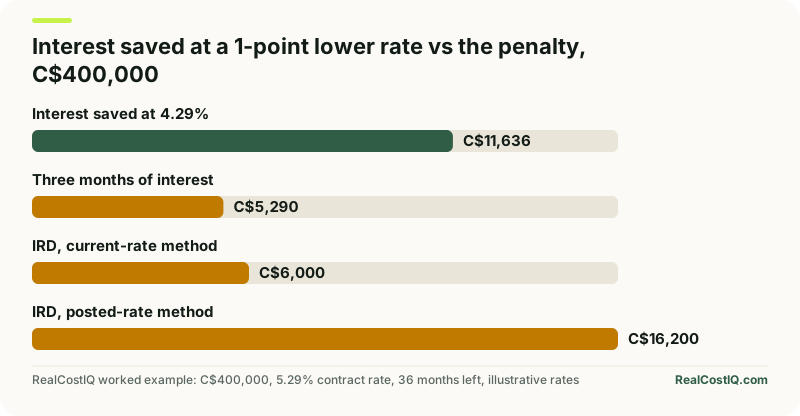
Now find the break-even. With the current-rate method, the penalty is C$6,000. Each point of gap saves about C$11,636. So you need about 0.5 points: C$6,000 / C$11,636 is 0.52. With the posted-rate method, the penalty is C$16,200, so you need about 1.4 points: C$16,200 / C$11,636 is 1.39. Those are rules of thumb for this example. Your balance, your months left and your penalty will move them.
There is a hidden catch in the first table
Look at the current-rate column. The penalty is C$6,000 on every row. That is because the IRD depends on your lender's rate, not the rate you pick up elsewhere. The part of the savings above C$6,000 is what you earn by finding a rate below your lender's own. If another lender is only as cheap as yours, the penalty eats the gain. That is why shopping for the lowest rate matters more than the size of the market drop.
Time works for you: the penalty shrinks as the term runs down
An IRD gets smaller each month. It is multiplied by the months left. Three months of interest does not shrink in the same way, so it acts as a floor. Here is the current-rate IRD for the same one-point gap at four points in the term.
| Months left | IRD (C$400,000 x 1.00% x months / 12) | Three-month interest | Penalty you pay |
|---|---|---|---|
| 36 | C$12,000 | C$5,290 | C$12,000 |
| 24 | C$8,000 | C$5,290 | C$8,000 |
| 12 | C$4,000 | C$5,290 | C$5,290 |
| 6 | C$2,000 | C$5,290 | C$5,290 |
With 12 months or fewer left, the three-month figure is the larger one. First National also notes that a per-day charge applies if fewer than three months remain.
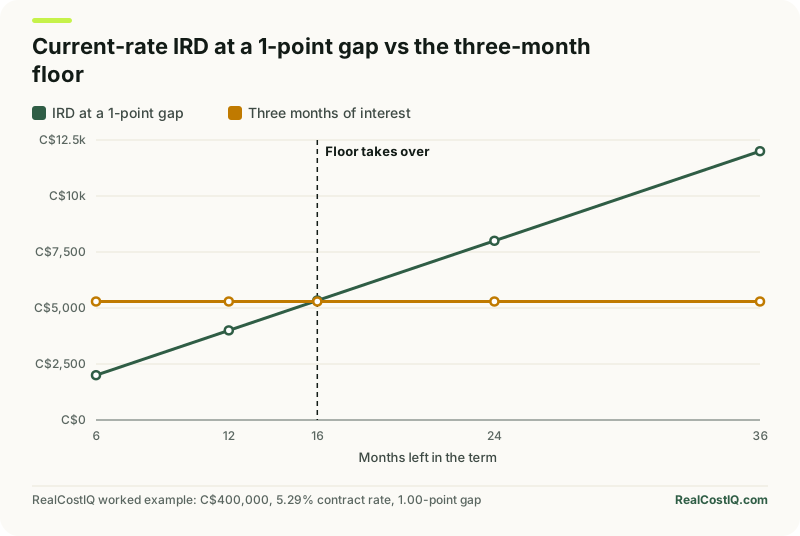
The IRD and the three-month figure cross when C$400,000 x 1.00% x months / 12 equals C$5,290. That is at about 16 months, where the IRD is about C$5,333. So late in the term the penalty stops falling. But your savings keep falling too, because fewer months remain to enjoy the lower rate. Both sides of the break-even shrink together. This is why the smartest time to act on a big rate drop is early, and the second-best choice is often to wait for the end.
A cheaper road to a lower rate: blend-and-extend
A blend-and-extend does not break your mortgage. Your lender takes your old rate and today's rate for a new, longer term. It averages them. It then gives you one new rate for the new term. The FCAC says you may be able to extend before your term ends with no prepayment penalty, though administrative fees may apply. It also says the lender must explain how it worked out the new rate.
The FCAC gives a formula. The old rate counts for the months left in the old term. The new rate counts for the rest of the new term. Its example is C$200,000 with 24 months left at 5.5%, moving to a new five-year term at 4%. That blends to 4.6%. Here is our mortgage in the same method. You have 36 months left at 5.29%. You choose a new five-year term at an illustrative 4.29%. The blend is (5.29% x 36 + 4.29% x 24) / 60, which is 4.89%.
At 4.89% the payment drops from C$2,393 to C$2,301, about C$90 a month. Over the 36 months that you had left, you would pay about C$4,658 less interest. There is no penalty. That is less than the C$11,636 you would save by breaking at 4.29%. But at a posted-rate bank, breaking at 4.29% leaves you C$4,564 worse off, so the blend comes out ahead there.
| Route | New rate | Penalty | Interest saved over the old 36 months | What you give up |
|---|---|---|---|---|
| Stay put | 5.29% | none | none | Nothing, but you pay the old rate |
| Break, current-rate IRD | 4.29% | C$6,000 | C$11,636 | Legal and other fees; the term restarts |
| Break, posted-rate IRD | 4.29% | C$16,200 | C$11,636 | A loss of C$4,564 after the penalty |
| Blend-and-extend | 4.89% blended | none | C$4,658 | Two more years locked at the blended rate |
The blend uses the FCAC's weighting. Lenders can use other formulas. A CP24 column from 2026-05-25 says there is no standard formula, and that some lenders use a simple average.
A blend has real catches. First, the new rate is higher than the market rate, because it is partly your old rate. Second, you lock in for a longer term. If rates fall again, you are stuck. Third, nesto notes that a longer term can raise your penalty if you leave early. Fourth, some banks may charge a fee. CP24 adds a simple test: a blend makes little sense if your contract rate is already lower than what is offered today.
Another no-penalty road: the early renewal
Some lenders let you renew before the term ends and pay no penalty. TD says you can renew a closed TD mortgage 120 days before its maturity date with no prepayment charge or extra fees, in an article dated 2024-04-12. RBC says it has a 120-day early renewal option and adds that some restrictions apply. Check your own lender's rule. The window changes from lender to lender, and our search results showed other numbers on third-party pages.
What does an early renewal save? Say your term ends in 100 days. Your rate is 5.29%. Your lender will renew you today at 4.29%. You skip 100 days at the old rate. At a one-point gap on C$400,000, that is C$400,000 x 1.00% x 100 / 365, or about C$1,096. You also lock the new rate today. If rates drop in the next 100 days, you would have done better by waiting. If they rise, you would have done better by moving. Nobody knows which. The Bank of Canada holds its policy rate at 2.25% and will announce its next decision on 2026-10-28. That is not a forecast. It just shows that things can change before your date.
An early renewal has a limit too. It only helps if the new rate is lower than your old one. It does not help if you are more than 120 days from maturity. Ask your lender whether any income check applies to the renewal. The FCAC says your lender must send a renewal statement at least 21 days before the term ends. Start asking for offers a few months before that, as the FCAC advises. Use offers from other lenders to bargain with your own.
Will the new lender stress-test you?
The stress test is the rule that you must show you could still pay at a higher rate. For uninsured mortgages the Office of the Superintendent of Financial Institutions (OSFI) sets the minimum qualifying rate at the greater of your contract rate plus 2 points, or 5.25%. On a new 4.29% loan that would be 6.29%. OSFI's page, last modified on 2026-01-29, says it does not expect lenders to apply the test when a borrower moves an uninsured mortgage to another federally regulated lender with no rise in the amortization or the loan amount. The Department of Finance made a matching change for low-ratio insured mortgages (loans up to 80% of the home's value) on 2024-12-16. It says the balance can rise by up to C$3,000 to cover costs such as penalties or fees, and that you cannot take out equity.
Both rules talk about moves at renewal. A break in the middle of a term is not a renewal. We did not find a page that says a mid-term break to a new lender gets the same exemption. Do not assume it. Ask the new lender. If you also want to stretch your amortization, the exemption does not apply. Our post on extending your amortization at renewal covers that.
Ways to cut the penalty before you break
The FCAC lists several steps. Each one can shave the bill.
- Use your prepayment privileges every year. A lower balance means a lower future penalty. Most lenders do not let you carry unused room into the next year.
- Make a lump-sum prepayment before you break. Some lenders limit this close to the break date.
- Wait for the end of the term if the penalty would be large. You can prepay a lump sum then with no penalty.
- Port the mortgage if you are buying a new home. You keep the rate and terms and avoid breaking the contract.
- Ask a new lender to cover costs. The FCAC says lenders may pay some or all of the fees when you switch.
One more rule applies only to long terms. If your mortgage is not payable until more than five years after its date, such as a 7-year or 10-year term, a federal rule limits what you can be charged after year five. First National says its charge after the fifth anniversary uses the three-month figure. Our post on the Interest Act five-year rule explains it.
A short checklist
- Find your rate, your balance and your months left. Find your contract's penalty clause.
- Ask your lender for a written payout statement. Ask which method it uses for the IRD.
- Get a firm rate quote from at least two other lenders, including one that is not a big bank.
- Work out interest saved over the months left, as in the first table. Subtract the penalty and fees.
- Price a blend-and-extend and an early renewal. Check how many days before maturity your lender allows.
- Compare the net result. Choose the route that leaves the most money in your pocket and a term you can live with.
For your own numbers, use the mortgage penalty calculator for the penalty and the mortgage renewal calculator to compare the new payment with staying. Then treat your lender's written figure as the final word.
What this post did not read
- We did not find a current posted rate or discount for any named bank. Every posted rate in the example is illustrative.
- We did not open a penalty page for a monoline lender other than First National and Tangerine, so other monolines may differ.
- We did not read a recent forum thread. RedFlagDeals now routes automated readers to a paid gateway, so we could not open the threads.
- Blend formulas vary by lender. We show the FCAC's weighting only.