Most Canadians treat the income line of a mortgage application as a fact: it is what the pay stub says. Lenders treat it as an estimate. They must prove it, and then adjust it. Overtime is discounted and a bonus is averaged. A sole proprietor (someone who runs a business in their own name) has net income read from a tax return, not a bank balance. Only part of a tenant's rent is allowed to count. The adjusted figure, not your gross pay, goes into the debt-service ratios. Those ratios compare your housing costs and debts to your income. They set how much you can borrow.
This guide covers the income side only. It shows what each type of income is worth to a lender. It shows which rules are written down by OSFI, CMHC, Sagen and Canada Guaranty, and which are left to the lender's own policy. OSFI is the Office of the Superintendent of Financial Institutions, the federal bank regulator. CMHC is the Canada Mortgage and Housing Corporation. Sagen and Canada Guaranty are private mortgage insurers. The stress test explainer covers how the qualifying rate and the debt-service limits then use that income. We do not repeat it here. Every rule below was read on the insurer's or regulator's own page on 2026-10-07. All dollar figures are Canadian dollars (CAD).
Who writes the income rules
Three layers decide how your income is counted. Applicants often blame the wrong one. The first is the regulator. OSFI's Guideline B-20 applies to federally regulated lenders. It sets principles, not formulas. Principle 3 says lenders should verify income with a source that is independent and difficult to falsify. They should substantiate employment status and income history. They should also treat temporarily high income by normalizing or discounting it. OSFI names overtime wages, irregular commissions and bonuses as examples. For the self-employed, it asks for proof such as a Notice of Assessment and T1 General plus business documentation. (The Notice of Assessment is the Canada Revenue Agency's summary of your tax return.) The page was last updated on 2023-03-30.
The second layer is the mortgage insurer. If you put down less than 20%, the loan must be insured by CMHC, Sagen or Canada Guaranty. Your lender follows the insurer's underwriting guide line by line. The insurers publish far more specific rules than OSFI does. They cover percentages, years of history and documents. The third layer is the lender's own credit policy. It can be stricter than the insurer, but not looser on an insured file.
| Income type | Typical treatment | Where the rule is written |
|---|---|---|
| Salary, hourly with guaranteed hours | Counted in full; verified with a letter of employment plus a pay stub or direct-deposit history | Sagen (fixed income); lender policy on probation |
| Overtime, bonus, commission, tips | Needs 2 years of history; lesser of last year or the 2-year average (Sagen) | OSFI B-20 (normalize or discount); Sagen; Canada Guaranty |
| Self-employed (sole proprietor or partner) | Net income from the tax return, grossed up 15% or increased by eligible add-backs | CMHC, Sagen, Canada Guaranty |
| Rent from the home you live in | 100% of gross rent for the second unit of a duplex; 50% for a 3-4 unit building | CMHC, Sagen |
| Rent from other properties | Owner-occupied: up to 50% of gross rent or net rental income. Not owner-occupied: net rental income only under CMHC; Sagen allows 50% of gross or net by lender policy | CMHC, Sagen |
| Pension, support, parental leave | Counted when documented and continuing; parental leave at return-to-work pay | Sagen |
Insurers update these pages. Treat the table as the position on 2026-10-07 and confirm with your lender before relying on a figure.
Salary and hourly pay
Salary is the simplest case, and it is counted at the contract amount. The lender checks that the income is real and likely to continue. Sagen classes salary and hourly pay with guaranteed hours as fixed income. It asks for a primary source. That is a letter of employment, a recent pay stub, or two months of direct deposits. It also asks for a secondary source, such as last year's year-end stub, a T4 (the yearly pay slip from your employer) or a Notice of Assessment. A letter combined with a pay stub can stand on its own. So can a letter combined with a direct-deposit history.
Two details catch applicants out. The first is probation. Sagen's rule is that applicants are qualified under the lender's own probation policy. A new hire on a three-month probation may be approved at one bank and asked to wait at another. The second is hours. Hourly pay is fixed income only when the hours are guaranteed. Part-time pay is treated as fixed or variable depending on its terms. A part-time job with no guaranteed hours falls into the variable category that the next section describes.
Changing jobs is not a barrier in itself. Sagen's page leaves probation to the lender: applicants are qualified under the lender's own probation policy. So how a recent move is read depends on the lender. The insurer pages read for this guide set no separate rule for a change of employer.
Bonus, commission and overtime
Variable income is where applicants lose the most ground, because lenders discount it by design. Sagen lists overtime, bonus, commission and tips as examples. It also puts contract work and non-guaranteed part-time hours in the same group. Its rule has two parts. The income must have been received for at least two years. For qualification, the lender uses the lesser of the previous year's income or the two-year average. There is one exception. The most recent year can be used if the income has risen year over year for at least four years.
Sagen's own page, read 2026-10-21, states two things. One is the lesser-of rule above. The other is that the two-year average may be used when the most recent full year is within 20% of that average. The two statements point different ways when last year is below the average. The lesser-of rule gives last year's lower figure, while the 20% test can allow the higher average. Canada Guaranty's February 2024 lender update uses the same 20% test. Neither rule is a promise. The lender decides which insurer to use and can apply a stricter internal policy. Ask the lender which figure it will use.
| Bonus year | Amount | How the lender reads it |
|---|---|---|
| Two years ago | C$10,000 | Counts toward the history requirement |
| Last year | C$18,000 | Higher than the average, so not used on its own |
| Two-year average | C$14,000 | The lesser figure, which Sagen's rule picks |
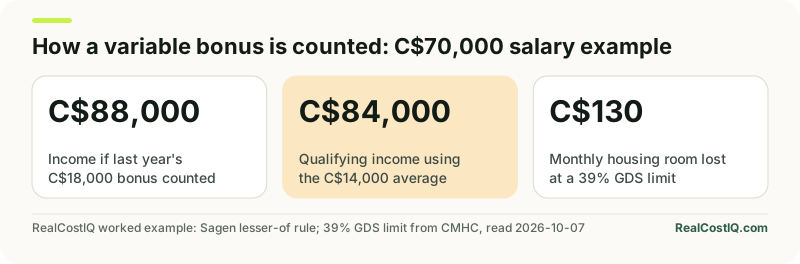
| Qualifying income (Sagen rule) | C$84,000 | C$70,000 salary plus C$14,000 bonus |
| Income if last year's bonus counted | C$88,000 | C$4,000 more than the lender will use |
At a 39% gross debt service limit, C$84,000 supports about C$2,730 a month of housing cost and C$88,000 about C$2,860. The C$130 monthly difference is the practical price of a one-off high year. The 39% figure is CMHC's published GDS limit for insured loans; see the stress-test post for how it is applied.
Commission-only earners face a second hurdle. A commission salesperson with a base salary can have the commission portion averaged like any other variable pay. A borrower whose income is entirely commission and who files as self-employed is a different case. Sagen's Business for Self program and Canada Guaranty's Low Doc Advantage both state that commission-based or commission sales income is not eligible for those programs. Such a borrower is documented under the standard self-employed or variable-income rules instead.
The lesson for planning is simple. A strong bonus year helps only if you can show two years of history. A single exceptional year is discounted to the average. If you expect a large bonus to land next quarter, apply after it appears on a tax return, not before.
Second job, overtime and hourly pay with changing hours
Sagen's Covenant Underwriting page, read 2026-10-21, sorts pay by one test: is it guaranteed and steady? Fixed income is received at regular intervals in an established amount. It includes salary and part-time pay with guaranteed hours. Variable income can change from one pay period to the next. Sagen lists overtime, secondary employment, commission and part-time pay with non-guaranteed hours in that group. The variable rule from the section above then applies. The income must have been received for at least two years.
- Second job. Sagen treats secondary employment as variable income. A second job you started 8 months ago usually does not count at an insured lender. After two years it counts at the lesser of last year or the two-year average.
- Overtime. The same two-year test applies. A guaranteed overtime clause in your contract is a question for the lender's own policy.
- Hourly pay with changing hours. Sagen's page does not name this case. By its own definitions, hours that are not guaranteed are variable. Expect the lender to average them, and ask whether the contract states a minimum number of hours.
- Part-time pay. Guaranteed hours count as fixed income. Non-guaranteed hours count as variable.
- A new job. Sagen sets no minimum job tenure for salaried work. It leaves probation to the lender's policy and asks the lender to verify employment status and tenure. The employment letter states the hire date.
A worked case: you earn C$60,000 in salary plus a second job that paid C$9,000 last year and C$7,000 the year before, both years documented. The two-year average is C$8,000, which is lower than last year's C$9,000, so C$8,000 is the counted amount. Your counted income is C$68,000. Enter C$68,000, not C$69,000, in the mortgage affordability calculator.
Self-employed income
Self-employed borrowers are judged on what they report to the Canada Revenue Agency, not on revenue or bank deposits. CMHC asks for a Notice of Assessment accompanied by the T1 General. It also asks for the statement of business activities, which is the T2125 for sole proprietors. The NOA shows the income the CRA assessed. Insurers care just as much about whether any tax is owing, and the NOA shows that too. The T1 General breaks out the sources when you have more than one.
The size of that income is where a good accountant's tax strategy works against a mortgage application. A sole proprietor who writes off home-office space, vehicle costs and depreciation shows a low net income. The lender starts from that net figure. CMHC lets lenders correct for this in one of two ways. Income of sole proprietors and partners may be grossed up by 15%. Or lenders may use an add-back approach, in which eligible deductions are returned to income. CMHC's page names business-use-of-home, motor-vehicle expenses and capital cost allowance as examples of deductions that can be added back. Sagen's page gives the same 15% gross-up for sole proprietorships and partnerships. It also applies the lesser-of rule, which means the lower of last year's income or the two-year average.
| Step | Amount |
|---|---|
| Net income, two years ago | C$52,000 |
| Net income, last year | C$60,000 |
| Two-year average | C$56,000 |
| Lesser of last year or the average (Sagen rule) | C$56,000 |
| Grossed up 15% | C$64,400 |
| Alternative: add back C$12,000 a year of home-office, vehicle and capital cost allowance | C$68,000 |
Illustrative arithmetic on a hypothetical file. Which method a lender uses, and whether it applies the gross-up to the average, is lender policy. At a 39% GDS limit, C$64,400 supports about C$2,093 a month of housing cost and C$68,000 about C$2,210.
Length of history matters as much as the amount. CMHC recommends at least 24 months operating the business or in the same line of work. It says a borrower with less can still qualify when there are offsetting factors. These are an established business acquired, cash reserves, predictable earnings, relevant training and a history of managing credit well. Sagen's and Canada Guaranty's self-employed programs both require a minimum of two years in business. CMHC also sets a minimum credit score of 600 for at least one borrower or guarantor on a self-employed file. Its documents list includes business credit reports, GST returns, business account statements, a business licence or articles of incorporation, and financial statements with a review engagement report.
The 'stated income' programs, and how they differ
Two insured programs let a self-employed borrower declare an income rather than have it calculated from the T1 General. They are not interchangeable.
- Sagen Business for Self: requires two years of business tenure, no tax arrears (overdue tax owing) and a reasonable income for the industry. The minimum credit score is 600 at loan-to-value above 80%. (Loan-to-value is the loan as a share of the home's value.) A score of 680 is recommended for at least one applicant at 80% or less. The down payment must be at least 5% from the borrower's own savings. The maximum loan-to-value is 90% on a purchase. The premium schedule is higher than a standard insured loan, from 1.50% of the loan at up to 65% loan-to-value to 5.85% at 85.01% to 90%. Amortization over 25 years adds a further 0.20%. (Amortization is the number of years over which the loan is paid off.)
- Canada Guaranty Low Doc Advantage: requires two years self-employed, no income tax arrears and no mortgage defaults in the past five years. Income is stated on a signed application. The insurer judges whether it is reasonable from the nature and tenure of the business, the credit profile, the financial position and the current shelter payment. The minimum down payment is 10%, of which at least 5% must be the borrower's own resources. Borrowed down payments are not permitted.
Both programs keep the 39% and 44% debt-service limits, so a stated income does not escape the arithmetic. What changes is the evidence. To see what the extra premium costs on your own numbers, run the loan through the CMHC insurance calculator and compare it with the stated-income schedule.
Rental income
Rent can turn a borderline application into an approved one, but lenders never count all of it. Rent is revenue, not profit. It has to cover property tax, insurance, maintenance and vacancy before it helps you service the loan. Insurers handle that in two ways. One is a percentage of gross rent. The other is a net rental income figure calculated by the lender. Which one applies depends on whether the property is the one being mortgaged and whether you live in it.
| Property | Rule | Source |
|---|---|---|
| Owner-occupied 2-unit, the property you are buying | Up to 100% of gross rent of the second unit | CMHC rental income page (published 2024-05-22); Sagen |
| Owner-occupied 3 to 4 units, the property you are buying | Up to 50% of gross rent, or a net rental approach | CMHC; Sagen |
| Non-owner-occupied 2 to 4 unit rental being financed | Up to 50% of gross rent for the subject property, with taxes and heat that may be excluded from the ratios; 20% minimum down payment | CMHC income property page |
| Other properties you already own | CMHC: up to 50% of gross rent or net rental income if you live there, net rental income only if you do not. Sagen: 50% of gross or net, by lender policy | CMHC; Sagen |
CMHC's income-property page also sets a maximum purchase price below C$1,000,000, a maximum 80% loan-to-value and a credit score of at least 600 for one borrower. Canada Guaranty's Rental Advantage product page allows 50% of gross annual rental income and accepts T1 Generals, lease agreements, fair market rent from an approved appraiser, or bank statements showing 12 months of rent received.
Two features of the rules are easy to miss. First, when rent is added to income, the property tax and heat on that property can be excluded from the debt ratios, as CMHC states. That is a separate benefit from the rent itself. It is why a rental property can improve the ratio more than the rent percentage suggests. Second, the lender must be satisfied that the rent is real. Sagen asks for signed leases or an appraisal's fair market rent. Canada Guaranty adds that income from an unauthorized suite may be considered case by case. A basement apartment that is not legal is therefore not automatically ignored. But it is not automatically counted either.
| Property type | Share counted | Annual gross rent | Added to income |
|---|---|---|---|
| Owner-occupied duplex, second unit | 100% | C$21,600 | C$21,600 |
| Owner-occupied 3-4 unit building, one unit | 50% | C$21,600 | C$10,800 |
The same C$21,600 of rent adds twice as much on a duplex as on a larger building. At a 39% GDS limit the extra C$10,800 of counted income is worth about C$351 a month of housing cost.
The treatment of rental income for the lender's own capital rules changed in late 2025. It is worth separating from the underwriting rule. (Capital rules set how much money a lender must hold in reserve.) On 2025-11-14, OSFI clarified that institutions can continue to use rental income to underwrite mortgage applications, including for investors with several properties. It explained that the capital guideline requires loans that rely heavily on property income to be classified as income-producing residential real estate for capital purposes. Guideline B-20, which governs how a borrower qualifies, was not altered. For an applicant, the practical point is that the rental-income rules above still apply. For the cash-flow side of owning a rental, which is a different question from qualifying, use a rental property calculator.
Pension, support and parental leave
Income that is not wages is counted when it is documented and expected to continue. Sagen's guide sets out the verification for each type. Employer pension income needs two sources from a list. The list includes the Notice of Assessment, three months of statements, a pension stub, a T4A and an employer letter. Pension income from a public source needs one source. Public sources mean CPP or OAS (the Canada Pension Plan and Old Age Security). Support income must be continuous under a court order or separation agreement. It is documented with that order or agreement plus a Notice of Assessment or account statements. A file where support exceeds 50% of the total qualifying income goes to an underwriter for referral.
Parental leave has the friendliest rule. Sagen allows 100% of the return-to-work income to be used to qualify, regardless of the return date. The employer must confirm the return date and salary. A borrower on leave can therefore qualify on the full salary they will return to, not the reduced income received during the leave. Sagen's page also gives a gross-up for non-taxable income. It is 25% where the amount is under C$30,000 and 35% above that. That wording can be read in more than one way. So read the exact line on the page before assuming how the threshold applies.
One applicant, three lenders
The same household can produce different qualifying incomes depending on who counts it. The following table applies the published rules to a hypothetical couple. One partner earns a C$70,000 salary plus a bonus of C$18,000 last year and C$10,000 the year before. The other is a sole proprietor with net income of C$52,000 two years ago and C$60,000 last year.
| Reading | Partner 1 (salary and bonus) | Partner 2 (self-employed) | Household income | GDS room per month at 39% |
|---|---|---|---|---|
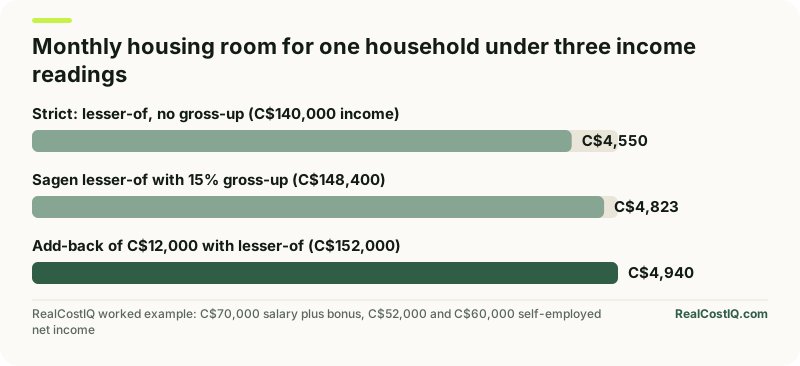
| Strict: lesser-of, no gross-up | C$84,000 | C$56,000 | C$140,000 | C$4,550 |
| Sagen lesser-of with 15% gross-up | C$84,000 | C$64,400 | C$148,400 | C$4,823 |
| Add-back (C$12,000) with lesser-of | C$84,000 | C$68,000 | C$152,000 | C$4,940 |
Hypothetical figures. GDS room is gross income times 39% divided by 12 and is the total housing cost the ratio allows before the stress test and debts are applied. The spread between the strict and add-back readings is C$390 a month, purely from how one partner's income was counted.
That spread is the reason for asking each lender how it counts. A mortgage broker's value in this part of the process is knowing which lender uses which method. It is also the reason to bring the evidence in a form that makes the favourable reading easy. That means two years of T1 Generals with the business statement attached, a schedule of the add-backs, and the bonus history shown by year.
What to prepare before you apply
- Pull your Notices of Assessment and T1 Generals for the last two years. Insurers read them for income and for tax owing. Any balance owing to the CRA can stop a self-employed or stated-income file entirely.
- Get a letter of employment that states the pay and the hours. If part of your pay is variable, ask for the amount paid in each of the last two years to be shown separately.
- List every deduction on the T2125 and mark the ones that are add-backs. Business-use-of-home, motor vehicle and capital cost allowance are the ones CMHC names.
- Collect leases or an appraisal's fair market rent for any unit you want counted, and confirm whether a secondary suite is legal where you live.
- Ask which insurer will back the file and which averaging method the lender applies. The answer is different for CMHC, Sagen and Canada Guaranty. A lender may prefer one for variable-income files.
- Run your own numbers first. Enter the adjusted income, not the gross figure, into the mortgage affordability calculator so that what you see is closer to what the lender will see.
New to Canada: proving income you earned abroad
Newcomers search for this more than almost any other income question. Both insurers have a newcomer program, and neither one asks for years of Canadian pay history. We read both pages on 2026-10-21.
- Status. CMHC accepts permanent residents and non-permanent residents who are legally authorized to work in Canada. It states no minimum period of residency. Sagen asks for a valid work permit or permanent residency.
- Down payment and credit. CMHC's minimum starts at 5% (5% of the first C$500,000 of lending value and 10% of the rest), and at least one borrower needs a credit score of 600. Without Canadian credit, CMHC may consider an international credit report or a reference letter from your bank.
- Sagen's paperwork. For every file: proof of status, income confirmation, down payment proof and the purchase agreement. Up to 90% loan-to-value, add six months of statements from your main account. Up to 95%, add an international credit report, 12 months of rent or bill payments and a reference letter from a financial institution.
- Foreign income. Sagen counts debts held outside Canada in your debt ratios. It excludes rental income earned outside Canada. The income you rely on needs to be documented in the usual way: a letter of employment, pay stubs and tax documents.
Lenders still set their own rules above these floors, so ask each one for its newcomer checklist. The full walk-through, including the cash you need on top of the down payment, is in our guide to buying a first home as a newcomer.
When the lender counts less than you earn
If the adjusted income is lower than you expected, there are legitimate ways to narrow the gap. They work by changing the evidence, not the rules. Waiting one tax year can turn a rising income into a higher two-year average. Filing a return that does not minimize income to the last dollar is a trade-off between tax and borrowing power. Only an accountant can size it. Adding a co-borrower adds their documented income to the file, along with their debts. Choosing a property with a legal second unit can add rent at 100% rather than 50%. A different lender or insurer may also count the same income more generously. That is a reason to compare more than one before accepting a decline.
What does not work is overstating income. B-20 is explicit that income should be verified by a source that does not contradict the rest of the file. Misrepresentation on an application is a legal problem as well as a credit problem. If the honest number is too low for the home you want, the options are a larger down payment, a smaller purchase or time.