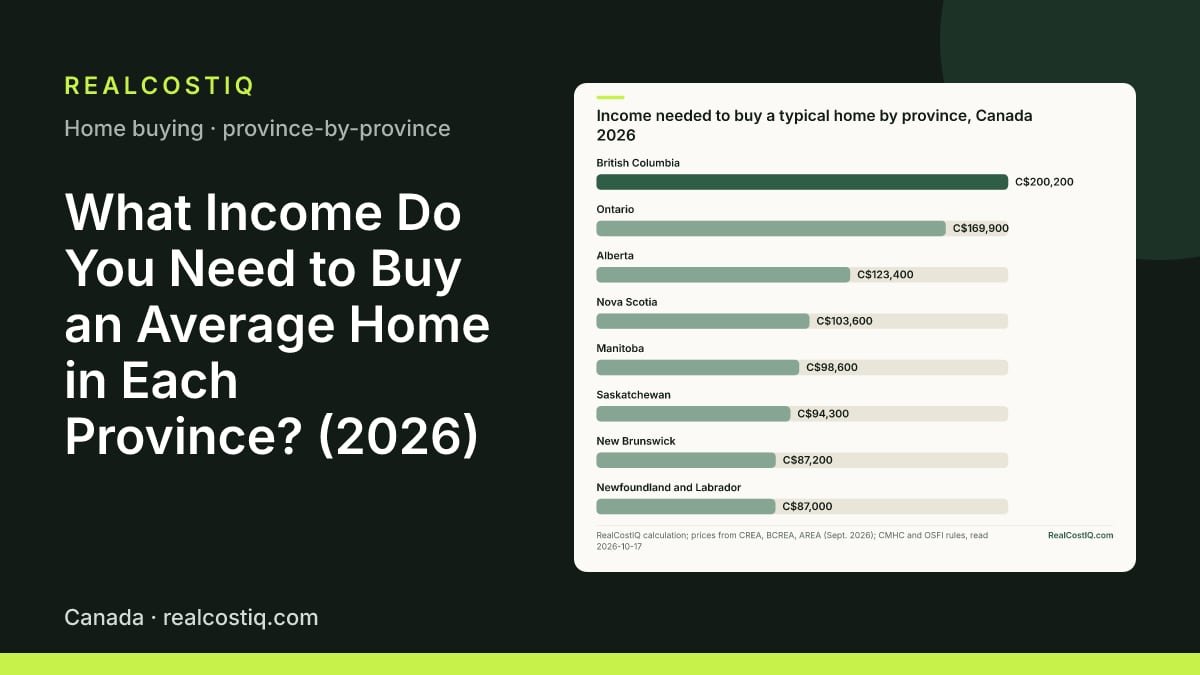
Home prices are easy to find. The income a lender wants to see is harder to find, and it is the number that decides whether you can buy. Lenders do not ask what the home costs. They ask whether your income can carry the payment, the property tax and the heat, at a rate higher than the one you will actually pay. This post turns the latest price in each province into that income figure, using the same rules everywhere so the provinces can be compared.
All amounts are in Canadian dollars (CAD). Every price comes from a Canadian real estate body, and every rule comes from CMHC or OSFI. The mortgage rate is an example, not a quote. Property tax is the part that varies most, and it is set by each city, not each province. So for every province we picked one named city and used that city's own 2026 rate, read on the city's website. Where we could not read a city's rate, we say so and show no income. The post is not advice. Check your own case with the mortgage affordability calculator.
The rules that turn a price into an income
Four rules do most of the work. They are the same in every province.
- The housing limit (GDS). GDS means gross debt service. It is the share of your gross household income that goes to housing: mortgage payment, property tax and heat, plus half of any condo fees. CMHC says it should not be more than 39% (CMHC, Calculating GDS / TDS, read 2026-10-17).
- The total debt limit (TDS). TDS means total debt service. It is the same list plus your other debts, such as a car loan or a credit card minimum. CMHC puts the limit at 44% (same page).
- The qualifying rate. The lender tests your payment at the greater of your contract rate plus 2 percentage points, or 5.25%. CMHC states this for insured mortgages. OSFI states the same formula for uninsured mortgages at federally regulated lenders (OSFI, Minimum qualifying rate for uninsured mortgages, page updated 2026-01-29, read 2026-10-17). The stress test explainer covers it in full.
- The minimum down payment. CMHC says it is 5% of the first C$500,000 and 10% of the rest, and that an insured home must cost less than C$1.5 million (CMHC, General requirements for homeowner mortgage loan insurance, read 2026-10-17). With less than 20% down, the mortgage must be insured, and the one-time premium is usually added to the loan.
One more word. Amortization is the number of years your payments are spread over to repay the whole loan. The usual maximum on an insured mortgage is 25 years. Your term, often five years, is the length of one contract and rate. They are not the same thing. This post uses 25 years of amortization throughout. A longer amortization lowers the payment, and our post on 30-year amortization for first-time buyers covers who may use it.
Property tax: one city per province
A mortgage payment depends on the loan. Property tax depends on where the home is. It is set by the city, and in most provinces the bill also carries a school or education part set by the province. A single rate for all of Canada would hide that. So we used the 2026 rate of one named city in each province, taken from that city's own website. Each rate is shown as a share of the home's assessed value, which is the value the city taxes. The table also says what is inside the rate.
| Province | City used | Rate (share of assessed value) | What the rate includes |
|---|---|---|---|
| British Columbia | Burnaby (not Vancouver) | 0.328373% (C$3.28373 per C$1,000) | City 0.172223%, provincial school tax 0.111020%, TransLink 0.035860%, Metro Vancouver 0.005440%, BC Assessment 0.003810% and Municipal Finance Authority 0.000020%. Not the Sewer Parcel Tax, a flat charge, or the extra school tax on homes over C$3 million. |
| Alberta | Calgary | 0.66499% | City 0.38906% plus provincial education 0.27593% |
| Saskatchewan | Saskatoon | 1.0467% of full value | City 0.80291, library 0.07844 and education 0.42700 (per C$100 of taxable value, total 1.30835), times the 80% share of value that Saskatoon says is taxable for homes |
| Manitoba | Winnipeg (Winnipeg School Division) | 1.3215% of full value | Municipal 13.372 mills plus school division 15.994 mills, which is 29.366 mills, times the 45% share of value that is taxed |
| Ontario | Toronto | 0.767311% | City 0.605295%, provincial education 0.153000% and City Building Fund 0.009016% |
| Québec | Montréal | Not read today | The City's 2026 rate table opens only in a script-driven viewer that we could not read. We show no income for Québec. |
| New Brunswick | Fredericton (inside rate) | 1.3086% (C$1.3086 per C$100) | The City's inside rate for 2026. The City's notice does not mention a provincial charge on the inside rate. |
| Nova Scotia | Halifax (urban area) | 1.002% (C$1.002 per C$100) | Urban general rate 0.687, provincial property valuation 0.010, provincial education 0.290, supplementary education 0.015. Not the climate action rate or local area rates. |
| Prince Edward Island | Charlottetown | Not read today | The Province's property-tax pages block automated reading and the City page states no rate. We show no income for Prince Edward Island. |
| Newfoundland and Labrador | St. John's | 0.91% (9.1 mills) | The residential rate for homes with water and sewer. The separate C$700 water tax per unit is a flat charge and is not in the rate. |
Sources are listed at the end: City of Toronto (page modified 2026-05-11), City of Calgary, City of Saskatoon, City of Winnipeg Assessment and Taxation (combined 2026 mill rates; the sheet's footer reads 'Last updated: April 7, 2025'), City of Fredericton (notice of 2025-11-25), Halifax Regional Municipality (2026/27 rates), City of St. John's, and City of Burnaby (2026 residential tax rates). We could not use Vancouver, whose website blocked automated reading today, so Burnaby stands in for British Columbia. Rates differ by city and by area within a city. Flat charges, utility fees and credits such as the BC home owner grant are not in any rate.
Look at the spread. Burnaby's rate is about one quarter of Winnipeg's. On a C$500,000 home, the tax is about C$1,642 a year at Burnaby's rate and about C$6,608 at Winnipeg's rate. That is a gap of roughly C$5,000 a year, which is worth about C$12,700 of required income. This is why the old shortcut of one flat rate for every province misleads. It also means a province's ranking depends on which city you use. We used one large city per province, so treat each row as an example and not as the province's average.
Two cautions. First, the tax bill is the rate times the assessed value, and the assessed value can differ from what you pay. Assessments lag the market in some places and are capped in others. We apply each rate to the price we use, as if the home were assessed at that price. Second, the price comes from a province-wide source, while the rate comes from one city. In a province where the main city costs far more than the province as a whole, the real tax would be higher than our figure.
One worked example: a typical Ontario home
Start with one province and follow every step. The Ontario Real Estate Association reports an MLS Home Price Index composite benchmark price of C$736,300 for September 2026 (CREA Statistics, Ontario Real Estate Association page, read 2026-10-17). A benchmark price is the price of a typical home, built from sales trends. A few very high or very low sales do not move it much. We use that as the home price, and Toronto's 2026 rate for the tax.
- Find the minimum down payment. 5% of the first C$500,000 is C$25,000. 10% of the remaining C$236,300 is C$23,630. The total is C$48,630. That is 6.6% of the price.
- Find the loan before insurance. C$736,300 minus C$48,630 is C$687,670. The loan is 93.4% of the price, so insurance is required.
- Add the CMHC premium. For a loan between 90.01% and 95% of the price, CMHC's table shows 4.00% (CMHC, Premium information for homeowner and small rental loans, read 2026-10-17). 4.00% of C$687,670 is C$27,507. We add it to the loan, which makes C$715,177. Ontario also charges provincial sales tax on the premium, about C$2,201. CMHC says that tax cannot be added to the loan, so it is cash you pay at closing.
- Pick a contract rate. We use 4.75% as an example. It is not a quote. At 4.75% and 25 years, with the semi-annual compounding that Canadian fixed-rate mortgages use, the payment is about C$4,058 a month.
- Find the qualifying rate. 4.75% plus 2 points is 6.75%, which is above the 5.25% floor. At 6.75% the same loan has a test payment of about C$4,899.
- Add property tax and heat. Toronto's 2026 rate is 0.767311%. On C$736,300 that is about C$5,650 a year, or C$471 a month. We assume heat of C$150 a month. That heat figure is an assumption, not a measured cost.
- Total the housing costs. C$4,899 plus C$471 plus C$150 is about C$5,520 a month, or C$66,242 a year.
- Work back to income. The total may be at most 39% of gross income. C$66,242 divided by 0.39 is about C$169,900.
So a household that wants a typical Ontario home with the minimum down payment needs roughly C$169,900 a year before tax. If you also carry other debts, the 44% total debt limit can become the tighter rule. In this example it takes over once your other debt payments pass about C$708 a month. Below that, the 39% housing limit decides.
The payment you actually make is lower than the test payment. You would pay about C$4,058 a month at the 4.75% example rate, not C$4,899. The higher rate is only a test. Lenders use the gap as a safety margin in case your rate is higher when your term ends and you renew.
The same test in each province
Now apply those steps to the latest price in each province. The table uses the same rules, the same 4.75% example rate, 25 years, the minimum down payment and C$150 a month for heat. The price and the city's property tax change. Read the notes under the table about which price measure each row uses, because the sources do not all publish the same one.
| Province | Price used (measure) | Minimum down | CMHC premium (added to loan) | Payment at 4.75% | Test payment at 6.75% | Property tax a month (city rate) | Income needed (GDS 39%) |
|---|---|---|---|---|---|---|---|
| British Columbia | C$924,279 (average, BCREA) | C$67,428 | C$34,274 | C$5,057 | C$6,105 | C$253 (Burnaby) | C$200,200 |
| Alberta | C$528,556 (average, AREA) | C$27,856 | C$20,028 | C$2,955 | C$3,567 | C$293 (Calgary) | C$123,400 |
| Saskatchewan | C$381,600 (benchmark, August 2026, SRA) | C$19,080 | C$14,501 (plus C$870 tax at closing) | C$2,139 | C$2,583 | C$333 (Saskatoon) | C$94,300 |
| Manitoba | C$388,200 (benchmark, MREA) | C$19,410 | C$14,752 | C$2,176 | C$2,627 | C$427 (Winnipeg) | C$98,600 |
| Ontario | C$736,300 (benchmark, OREA) | C$48,630 | C$27,507 (plus C$2,201 tax at closing) | C$4,058 | C$4,899 | C$471 (Toronto) | C$169,900 |
| Québec | C$556,157 (average of all residential sales, QPAREB) | C$30,616 | C$21,022 (plus C$1,892 tax at closing) | C$3,102 | C$3,744 | Not read today | Not shown |
| New Brunswick | C$341,700 (benchmark, NBREB) | C$17,085 | C$12,985 | C$1,916 | C$2,313 | C$373 (Fredericton) | C$87,200 |
| Nova Scotia | C$423,200 (benchmark, NSAR) | C$21,160 | C$16,082 | C$2,373 | C$2,864 | C$353 (Halifax) | C$103,600 |
| Prince Edward Island | C$377,900 (benchmark, PEI association) | C$18,895 | C$14,360 | C$2,119 | C$2,558 | Not read today | Not shown |
| Newfoundland and Labrador | C$355,600 (benchmark, NLAR) | C$17,780 | C$13,513 | C$1,994 | C$2,407 | C$270 (St. John's) | C$87,000 |
Calculated with the site's Canadian mortgage and CMHC premium engines (semi-annual compounding). Incomes are rounded to the nearest C$100. Property tax is the city's 2026 rate times the price. Sources: CREA Statistics provincial association pages for ON, MB, NS, PE, NL, NB and SK; BCREA release of 2026-10-14; Alberta Real Estate Association September 2026 report; QPAREB Centris report for September 2026 (sales volume divided by sales). Premium tax rates for ON, QC and SK come from the site's CMHC calculator.
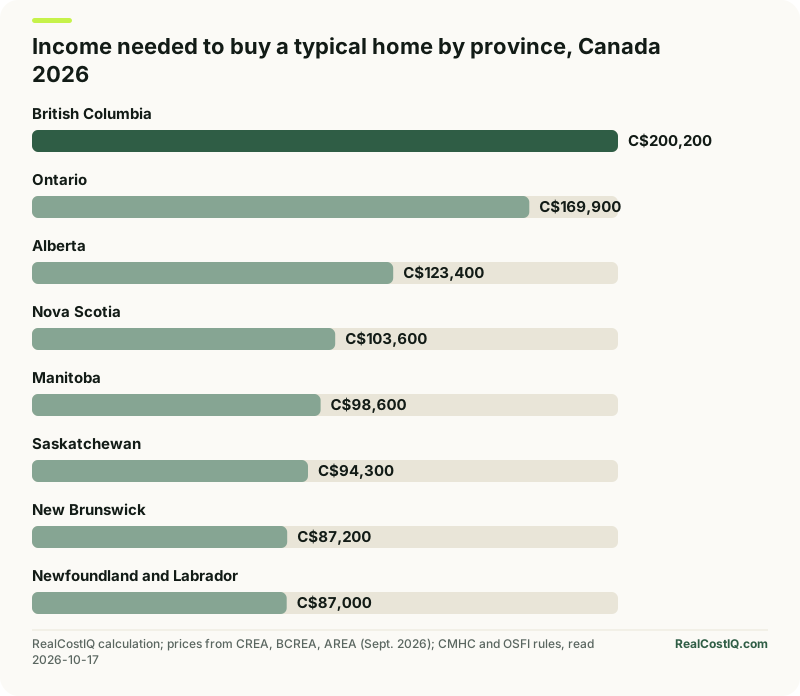
Where the sources agree on the measure, the benchmark is the better guide. Six of the eight priced rows use the MLS Home Price Index benchmark. Two rows, British Columbia and Alberta, do not, because those sources publish an average price instead. An average is the total dollars of homes sold divided by the number sold. It can be pushed up by a few expensive sales. Look at the five provinces where we could read both numbers for September 2026. The average ran above the benchmark by about 5% in Newfoundland and Labrador and 7% in Manitoba and Ontario. It ran about 8% higher in Prince Edward Island and almost 10% higher in Nova Scotia. So the British Columbia and Alberta rows are likely a little high next to the others. Treat them as the top of a range, not a point.
A note on Québec. QPAREB, the Québec brokers' association, publishes sales and dollar volume for the whole province. We divided volume of C$3,918,161,072 by 7,045 sales to get C$556,157. That figure includes plexes, which are buildings of two to five units. QPAREB's median price for a single-family home in September 2026 was C$498,500, and for a condominium C$400,000. We kept the Québec row so you can see the down payment, the CMHC premium and the payments, but we did not compute an income because the Montréal tax rate could not be read. The same goes for Prince Edward Island.
What the table shows
The first thing to see is the spread. A typical home needs about C$87,000 of income in Newfoundland and Labrador and New Brunswick and C$200,200 in British Columbia. That is a gap of more than two times. The second thing is that the income needed rises with the price, but not in a straight line. Divide the price by the income and you get a number between 3.9 and 4.6. British Columbia is at the top of that range because Burnaby's tax rate is low. Manitoba and New Brunswick are at the bottom because Winnipeg's and Fredericton's rates are high. That ratio differs by about 18% from one end to the other, and property tax is the main reason.
That means the real question is not how many dollars of income a province needs. It is how that income compares with what households in that province earn. Statistics Canada reports the median after-tax income of families and unattached individuals for 2024 (Canadian Income Survey 2024, released 2026-04-29, read 2026-10-17). Median means the middle household, with half above and half below. The figures are after tax, while the lender's income is before tax, so the two are not on the same basis. They still show which provinces ask for more.
| Province | Income needed (before tax) | Median after-tax income, 2024 | Needed income as a multiple of the median |
|---|---|---|---|
| British Columbia | C$200,200 | C$75,800 | 2.6 |
| Ontario | C$169,900 | C$79,500 | 2.1 |
| Nova Scotia | C$103,600 | C$64,200 | 1.6 |
| Alberta | C$123,400 | C$85,300 | 1.4 |
| Manitoba | C$98,600 | C$72,000 | 1.4 |
| New Brunswick | C$87,200 | C$65,100 | 1.3 |
| Newfoundland and Labrador | C$87,000 | C$68,000 | 1.3 |
| Saskatchewan | C$94,300 | C$75,500 | 1.2 |
Median figures are in 2024 constant dollars from Statistics Canada, Table 11-10-0190-01. The group includes unattached individuals, who often buy on one income, as well as couples and families. The multiple is a rough strain gauge, not a measure of who can or cannot buy. Québec and Prince Edward Island are left out because no income was computed.
By this gauge, British Columbia is the hardest market by a wide margin. A typical home asks for about 2.6 times the median household's after-tax income. Ontario comes next at 2.1. Nova Scotia is third at 1.6, even though its price is only a little above the middle of the pack. Its median income is the lowest in the table. Alberta is the opposite case. It has the highest median in the table, so its gap is smaller than its price suggests. The order is the same whether we assume C$0, C$150 or C$300 a month for heat, so that assumption does not change the ranking. It does move each income, by about C$4,600 for every C$150.
Keep the limits of this in mind. A household can earn more than the median, and many buyers do, because they own a home already, have savings or help from family, or earn two incomes. First-time buyers also tend to earn less than owners. The table does not say who buys. It says what a lender needs to see.
What moves the number
The mortgage rate
The rate changes the answer more than anything else you can choose. We tested the Ontario example at four contract rates. Below a 3.25% contract rate, the 5.25% floor takes over, so the test payment stops falling. Above it, each extra percentage point raises the test rate by a point, too.
| Contract rate | Qualifying rate | Actual payment | Test payment | Income needed |
|---|---|---|---|---|
| 3.25% | 5.25% (the floor) | C$3,477 | C$4,262 | C$150,200 |
| 3.75% | 5.75% | C$3,666 | C$4,470 | C$156,600 |
| 4.75% | 6.75% | C$4,058 | C$4,899 | C$169,900 |
| 5.75% | 7.75% | C$4,470 | C$5,345 | C$183,600 |
Same loan, premium, property tax and heat assumptions as the worked example. Rates are examples, not quotes.
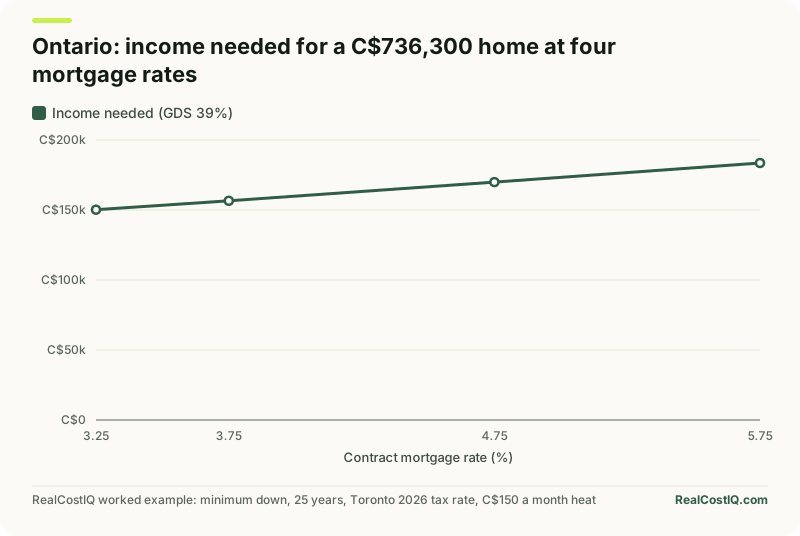
Going from a 3.75% rate to a 5.75% rate adds about C$27,000 to the income needed in this example. The Bank of Canada's overnight rate is not your mortgage rate, but it moves the market. The Bank held it at 2.25% at its latest decision, and its next announcement is on October 28, 2026 (Bank of Canada, Policy interest rate, read 2026-10-17). CREA's chair said in the October 16 release that fixed mortgage rates took an even larger jump at the start of the fall market than they did in the spring. So the contract rate you are offered when you shop may differ from the example.
Property tax and heat
Each extra C$100 a month in property tax or heat adds about C$3,100 to the income needed, because C$100 times 12 months, divided by 0.39, is C$3,077. That is why the city matters so much. CMHC says lenders should use your actual heat bills if you have them, or a reasonable estimate if you do not. For a condominium, CMHC says 50% of the condo fee counts in both ratios. So a C$400 monthly fee adds C$200 to the housing total, which raises the income needed by about C$6,200.
Your other debts
A car loan, a student loan or a credit card minimum counts in the TDS but not in the GDS. In the Ontario example, other debts of up to about C$708 a month fit inside the 44% limit without raising the income needed. Above that, every extra C$100 of monthly debt raises the income needed by about C$2,700. The how lenders count your income post explains which of your income counts and in what amount, which matters just as much as the limits do.
The down payment
A bigger down payment does less for the income test than most buyers expect. The loan gets smaller and the premium rate falls, but the tests still use the same rules. At 20% down, the premium disappears, yet in our check the income needed for the Ontario home was about C$143,300, only about 16% below the minimum-down figure. The reason is that the extra C$98,600 or so of cash you need to reach 20% down is far larger than the income it saves. Cash and income are two different limits. The CMHC insurance calculator shows the premium at each down payment level.
Cash you need beyond the down payment
The income test is only one hurdle. You also need cash for closing. Ontario, Québec and Saskatchewan charge provincial sales tax on the CMHC premium, as the table shows. Land transfer tax is another cost. It is set by each province, and Toronto and Montréal add their own on top. It is not in the income figures above, and it is not in the down payment. Look up your own province's schedule before you plan. The numbers above are the least you could put down. Many buyers choose more.
Where these figures are weak
- Prices are not for your street. A provincial price covers every city and town in the province. A home in Toronto or Vancouver costs far more than the provincial figure, and a home in a small town costs less.
- One city stands in for each province. The tax rate is the rate of one named city. Other cities in the same province charge different rates. Pick your own city's rate when you plan.
- Two provinces are missing. We could not read the Montréal 2026 rate table or any Charlottetown rate on the official sites today, so Québec and Prince Edward Island show no income. We did not fill the gap with a guess.
- The two average-price rows run high. British Columbia and Alberta use averages. The benchmark would likely be lower, as the gaps in the other provinces suggest.
- Saskatchewan is one month older. The Saskatchewan REALTORS Association had its August 2026 benchmark posted on CREA Statistics when we read it. The other provinces show September 2026.
- Assessed value is not price. Property tax is charged on the assessed value. We applied each rate to the price.
- Lenders may differ. CMHC's limits are for insured mortgages. For an uninsured mortgage, each lender sets its own limits and most use something close. The stress test floor is the same.
- The rate and the heat cost are examples. Change them and the answer changes. The table is for comparing provinces, not for predicting your own approval.
- Income counts only when it can be proven. The amount a lender counts may be lower than your gross pay, for example for bonuses or self-employment.
How to use this for your own plan
Start from the other end. Take your own gross household income and multiply by four. That gives a rough price ceiling for a minimum-down purchase under these rules, a little lower where property tax is high and a little higher where it is low. A household earning C$120,000 lands near C$480,000 on this logic. It is only a first look. Then put your real figures into the mortgage affordability calculator: your income, your debts, the actual property tax for the home you want, and a rate from a lender. A pre-approval from a lender will give the final answer for your file.
If the number is out of reach, there are only a few levers. You can look at lower prices, add a co-borrower with income, pay down other debts, or wait while you save a bigger down payment. A longer amortization is a fifth lever for some buyers. It lowers the payment, and with it the income needed, but it adds interest. Who may use it is covered in our 30-year amortization post. None of these is advice. They are the parts of the formula you can move.