You signed the agreement to buy a new condo years ago. The price was fixed then. The building is now finished, and your lender sends an appraiser to value the unit before final closing. The appraiser looks at what similar condos sell for today, not at the number in your contract. If today's number is lower, you have a gap. The lender will not fill it. You will.
This post shows how big that gap can get and what each choice costs. It uses one example unit in Ontario, priced at C$720,000, with a C$144,000 deposit already paid. All dollar figures are Canadian dollars (CAD). The appraisal levels are our own examples, not a forecast. The rules come from CMHC, OSFI, Statistics Canada and Tarion pages read on 2026-10-25. This is general information, not legal or mortgage advice. If you are in this spot, call your real estate lawyer and your mortgage broker or lender this week.
Two things are not repeated here. How deposits are paid, and what the interim occupancy fee is, are already worked out in the pre-construction deposit calculator. That is the money you pay before the final closing day. This post starts on closing day, when the lender's number shows up.
Why the bank lends on the lower number
A mortgage is a loan secured by the home. If you stop paying, the lender sells the home to get its money back. So the lender cares about what the home would sell for, not what you promised the builder. That is why every mortgage is sized as a share of value, called the loan-to-value ratio, or LTV. A loan of C$400,000 on a home worth C$500,000 is an LTV of 80%.
CMHC, the federal housing agency that insures many Canadian mortgages, states the rule plainly. Down payment requirements are based on the lending value, and CMHC defines that as the lower of the market value or the purchase price (or cost of construction). The sentence sits in CMHC's programs fact sheet. The minimum equity is then set on the lending value: 5% of the first C$500,000 and 10% of the rest. The CMHC Purchase fact sheet, which carries a 2024 date code, repeats those tiers and says the lending value must be below C$1,500,000.
The bank rules sit behind this. OSFI is the federal regulator of banks. Its Guideline B-20 says lenders should rely on realistic, supportable valuations. It also says the person who values the property should be independent of the people who sell or approve the loan, and that lenders should not lean on a single valuation method. The same guideline says a mortgage above 80% LTV must be insured. So a lender cannot simply agree to ignore a low appraisal because you signed a contract.
In short, your price sets what you owe the builder. The appraisal sets what the bank will lend. The two numbers were not tied together when you signed. They meet on closing day.
The gap in dollars: a C$720,000 example
Take a one-bedroom-plus-den condo in the Greater Toronto Area. The contract price is C$720,000. Over the build you paid deposits of C$144,000, which is 20% of the price. Your mortgage plan assumed an 80% loan on the price. That is a loan of C$576,000. The rest of the price was already paid in deposits, so you planned to bring no more cash, apart from closing costs.
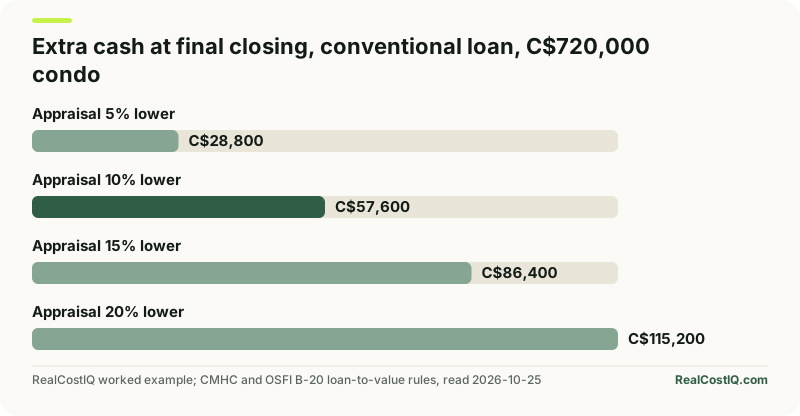
Now the appraiser comes in lower. The first route is a regular, uninsured loan, called a conventional mortgage. A conventional loan can be at most 80% of the lending value. If the appraisal is C$648,000, which is 10% below your price, the most the lender will lend is 80% of C$648,000. That is C$518,400. You planned C$576,000. The difference is C$57,600.
| Appraisal vs price | Appraised value | Largest conventional loan (80%) | Planned loan | Extra cash at closing |
|---|---|---|---|---|
| 5% lower | C$684,000 | C$547,200 | C$576,000 | C$28,800 |
| 10% lower | C$648,000 | C$518,400 | C$576,000 | C$57,600 |
| 15% lower | C$612,000 | C$489,600 | C$576,000 | C$86,400 |
| 20% lower | C$576,000 | C$460,800 | C$576,000 | C$115,200 |
Our arithmetic on a hypothetical unit. Extra cash is the planned loan of C$576,000 minus 80% of the appraised value. It sits on top of closing costs. Ontario land transfer tax is normally based on the amount paid, so it does not fall when the appraisal does.
There is a simple shortcut. Under a conventional loan, the extra cash is 80% of the gap between price and appraisal. A C$72,000 gap becomes C$57,600 of cash. A C$144,000 gap becomes C$115,200. The lender takes the other 20% as your equity, which you already paid in deposits.
These figures are for illustration. How big is the real-world gap? We could not find an official Canadian count of low appraisals on new condos. A trade article in Canadian Mortgage Professional, dated 11 February 2025, said many Toronto buyers who bought pre-construction years ago now face appraisals 10% to 30% below their contract price. The article did not name a dataset for that range, so treat it as a claim from the press, not a measured fact. It also gave one buyer's story. He signed for a C$2,195,000 unit and paid a 20% deposit of C$439,000. A fall 2024 appraisal came in at C$1,600,000, which is 27% below the price. He reported a C$595,000 shortfall. He chose to give up the deposit.
Note how that C$595,000 compares with our rule. C$2,195,000 minus C$1,600,000 is C$595,000, the whole gap between price and appraisal. A conventional loan at 80% of the lower value would leave a smaller cash gap of C$476,000, by our arithmetic. We do not know how the article counted. The point holds either way. On a high-priced unit, the gap can be bigger than the deposit itself.
What the market data can and cannot tell you
Statistics Canada publishes the New Condominium Apartment Price Index. It tracks what developers charge for new apartment-style condos, quality-adjusted, with 2017 set to 100. For the second quarter of 2026, released 31 July 2026, Toronto stood at 128.6, unchanged from the first quarter. In the first quarter, released 6 May 2026, Toronto was also 128.6, after falling 1.5% from the quarter before. The national index was 121.5 in the second quarter, down 0.7%. Vancouver fell the most of the nine cities, at 2.6%.
Read that carefully. The index measures developers' selling prices on units sold now. It does not measure what your unit would fetch as a resale, and it does not measure appraisals. A flat Toronto number does not say your unit will appraise at your price. Your contract was signed at an earlier price level. Your appraiser will compare your unit to recent sales of similar units in or near your building. Those can be lower than both the builder's price list and your contract.
What the index does tell you is direction. Developer prices in Toronto were flat to down through the first half of 2026, and the national index fell in both quarters. If you signed in a stronger year, a gap is plausible. If you signed in a weaker year, the gap may be small or zero. The only way to know is the lender's appraisal. Ask for a copy, and ask which comparable sales it used.
Route one: use CMHC insurance to shrink the gap
If you have less than 20% equity in the lending value, the loan can be insured. Insurance lets the lender lend up to 95% of the first C$500,000 of lending value and up to 90% of the rest, on a home under C$1,500,000. Above C$500,000 the overall limit is below 95%. You pay a one-time premium. CMHC sets it by LTV. At 80.01% to 85% LTV the premium is 2.80% of the loan. At 85.01% to 90% it is 3.10%. At 90.01% to 95% it is 4.00%. In Ontario, Quebec and Saskatchewan the provincial sales tax applies to the premium, and CMHC says that tax cannot be added to the loan. In Ontario that tax is 8% of the premium, per the Ontario Ministry of Finance retail sales tax page on insurance, and it is payable in cash at closing. The premium itself can be blended into the loan.
Here is the same C$720,000 unit on the insured route. The lender sizes the loan on the lending value, which is the appraisal. The least equity CMHC allows on a one- or two-unit home is 5% of the first C$500,000 plus 10% of the rest. Your equity is your C$144,000 of deposits against the price you owe. Work through each case below. We ask for the planned C$576,000 loan, or the most the rules allow if that is less.
| Appraisal vs price | Lending value | Least equity allowed | Largest insured loan | Loan used | LTV | Premium rate | Premium (added to loan) | Ontario 8% tax on premium (cash) | Extra cash vs plan |
|---|---|---|---|---|---|---|---|---|---|
| 5% lower | C$684,000 | C$43,400 | C$640,600 | C$576,000 | 84.2% | 2.80% | C$16,128 | C$1,290 | C$1,290 |
| 10% lower | C$648,000 | C$39,800 | C$608,200 | C$576,000 | 88.9% | 3.10% | C$17,856 | C$1,428 | C$1,428 |
| 15% lower | C$612,000 | C$36,200 | C$575,800 | C$575,800 | 94.1% | 4.00% | C$23,032 | C$1,843 | C$2,043 |
| 20% lower | C$576,000 | C$32,600 | C$543,400 | C$543,400 | 94.3% | 4.00% | C$21,736 | C$1,739 | C$34,339 |
Our arithmetic, premium rates from CMHC read 2026-10-25. Largest insured loan is lending value minus least equity (5% of the first C$500,000 plus 10% of the rest). Extra cash adds any loan shortfall to the sales tax on the premium. It ignores the 0.20% premium surcharge CMHC adds for 26- to 30-year amortizations, and it assumes you pass the lender's stress test and the lender submits the file to CMHC.
Look at the 10% row. The conventional route asked for C$57,600 of cash. The insured route asks for about C$1,428, the sales tax on the premium. The C$17,856 premium is added to the mortgage, so you pay it back with interest over the amortization. That is a real cost. It is also far smaller than a lump sum of C$57,600 that many buyers do not have.
The 15% row shows how thin the edge is. At a C$612,000 lending value, the largest insured loan is C$575,800. That is C$200 under the C$576,000 plan. At 20% lower the insured loan stops at C$543,400, and you need C$32,600 of cash on top of the premium tax. Insurance helps a lot at small and medium gaps. It runs out at large ones.
Close or walk away: compare the paper loss to the deposit
Some buyers decide not to close. Before you do, compare two numbers. If you close, you own a unit worth less than you paid. The gap between the price and the value is a paper loss. If you walk away, you may lose your deposit. The builder may also claim more, and a lawyer must tell you where you stand. The Canadian Mortgage Professional article notes that buyers who fail to close can lose their deposit and may face legal action from developers.
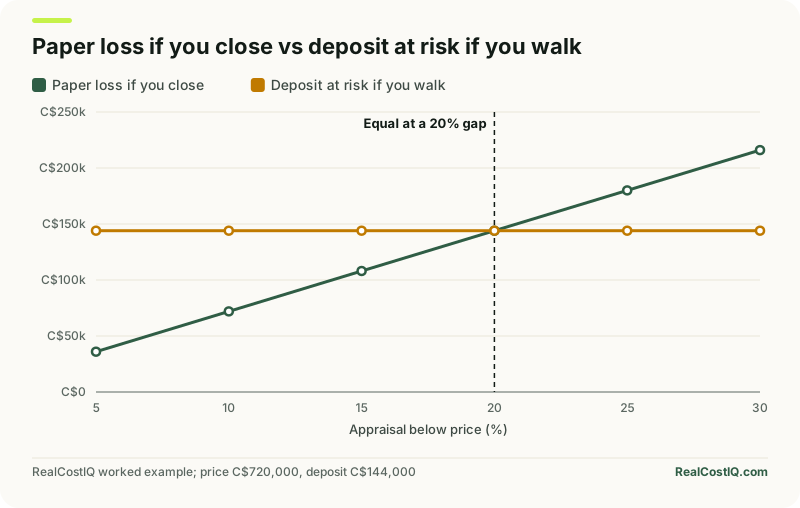
On our example the deposit is C$144,000, or 20% of the price. The paper loss if you close is the price minus the appraisal. That is C$36,000 at a 5% gap, C$72,000 at 10%, C$108,000 at 15% and C$144,000 at 20%. At a 20% gap the two numbers are equal. Past 20%, walking away loses less on paper than closing does. Before 20%, closing loses less.
| Appraisal vs price | Paper loss if you close | Deposit at risk if you walk | Smaller loss on paper |
|---|---|---|---|
| 5% lower | C$36,000 | C$144,000 | Close |
| 10% lower | C$72,000 | C$144,000 | Close |
| 15% lower | C$108,000 | C$144,000 | Close |
| 20% lower | C$144,000 | C$144,000 | Equal |
| 25% lower | C$180,000 | C$144,000 | Walk |
| 30% lower | C$216,000 | C$144,000 | Walk |
Paper loss is the price minus the appraised value. It ignores interest, carrying costs, any claim the builder may make beyond the deposit, and the chance the unit's value later rises or falls. It is a way to size the choice, not advice.
Two cautions. First, a smaller paper loss does not mean you can afford to close. If you cannot find the cash, the choice is made for you. Second, an appraisal is one opinion on one day. A lender may value the unit differently from a second lender. Some buyers get a second opinion from another lender or a broker before they decide. The mortgage terms you sign for must still pass the lender's own test.
Other options to ask about
Ask the builder for help
A builder has no duty to cut your price. Your agreement is a signed contract. Still, builders want closings. The trade article described one builder that worked with a bank on a blanket appraisal. In that program the bank valued every unit in the building and lent on the original purchase prices. The bank said it can reassess such programs when conditions change. That is one example, not a right. Ask your builder's sales office whether any lender has a program for your building. Do it early, before the final closing date is set.
Find the missing cash
Common sources are savings, a gift from family, selling another asset, or borrowing against another property you own. The CMHC fact sheet allows a non-repayable gift from a relative as a traditional down payment. Borrowed money is treated differently. CMHC's non-traditional category covers unsecured loans and lines of credit and carries a higher premium of 4.50% at 90.01% to 95% LTV. Borrowing for the gap also raises your debt ratios, so the lender must still approve you. Any new loan for the gap, such as a home equity line of credit on another property, counts as debt when the lender checks whether you can carry the mortgage.
Sell the contract instead
Some buyers assign the agreement to someone else before closing. The builder must agree, and the sale can carry GST/HST. If the market value is below your price, a buyer will want a discount, so you may take a loss. The tax details, with the federal sources, are in our assignment sale post. It does not replace a talk with your lawyer.
Ask for more time, and know the clock
On a condo, the builder sets a firm occupancy date, within the Tarion addendum. If the builder misses it, it owes you delayed occupancy compensation. Tarion's condo page says up to C$7,500, with living expenses set at C$150 a day, plus documented moving and storage costs. That money is for builder delays. It does not cover your own delay, and the page does not say what happens if a buyer fails to close or cannot get financing. Do not assume a late closing is free for you. Our Tarion post covers the builder-side rules.
A checklist for the months before final closing
- Ask your lender, in writing, what appraisal and what loan amount they will use, and when they will order it.
- Ask whether your approval allows an insured loan if the appraisal is low, and what the premium tax will be.
- Work out the cash gap at appraisals 5%, 10% and 15% below your price. Use the tables in this post.
- Add the cash to the other closing costs. Ontario land transfer tax is normally based on the amount paid for the land, so it does not shrink with the appraisal.
- Ask your lawyer what your agreement says about failing to close, and what the builder can claim beyond your deposit.
- Ask the builder whether any lender has a blanket appraisal program for the building.
- Decide your walk-away line before you see the number, so you are not deciding under pressure.
Keep one more point in mind. Ontario says land transfer tax is normally based on the amount paid for the land, which here is your price. A low appraisal does not lower it. Only the loan moves. That is why the shortfall is cash on top of everything else you planned.
A final note on method. We built the tables from rules, not from a lender's file. Real lenders have their own policies on top of CMHC and OSFI rules. A lender can refuse to insure a unit, set a lower loan limit for condos in a certain building, or order a second appraisal. Treat the tables as a way to see the size of the problem early. They are not a quote.