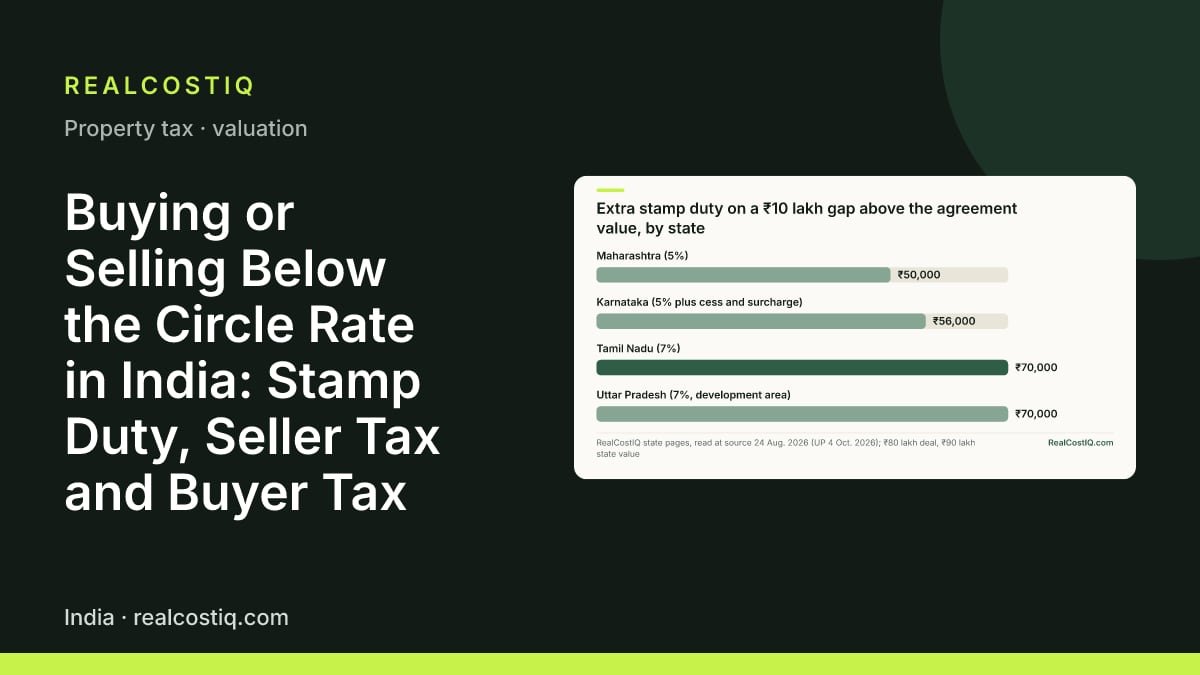
Take a flat registered at ₹80 lakh, where the state's official value is ₹90 lakh. This does not produce one problem. It produces three, each under a different law and each with a different trigger. The state charges stamp duty on the higher figure. The seller is taxed on a capital gain worked out as if the flat sold for the higher figure. The buyer can be taxed as though the ₹10 lakh gap were income. All three use the same number, which the tax law calls the stamp duty value. None of the three is waived because the parties genuinely agreed a lower price. This post sets out how each works and what the 10% tolerance actually protects. It also shows which section numbers apply now that the Income-tax Act, 2025 has replaced the 1961 Act on 1 April 2026.
A note on what we read and what we did not. The statutory text below comes from the Income-tax Act, 2025 as published in the Gazette of India (Extraordinary, 21 August 2025). We read it on 7 October 2026. We did not find a consolidated version showing the changes made by the Finance Act, 2026. So if you rely on a figure here for a transaction, read the current section at the Income Tax Department's site as well. The state registration portals (Maharashtra, Karnataka, Tamil Nadu and Delhi) refused our connection on 7 October 2026. The Uttar Pradesh portal returned an empty page. So the state rates quoted below are those on our own state pages, with the date each was last read at source. They are not a fresh reading. This is general information, not tax or legal advice.
One number, three bills
Every state publishes a minimum valuation for land and buildings. Each state uses a different name for it. It is circle rate in Delhi, Uttar Pradesh, Rajasthan and Haryana. It is ready reckoner rate in Maharashtra, guidance value in Karnataka and guideline value in Tamil Nadu. The Income-tax Act, 2025 does not use any of these names. Section 2(105) defines the stamp duty value as the value adopted or assessed or assessable by any authority of the Central Government or a State Government for the payment of stamp duty on an immovable property. The word assessable matters. It means the value the authority would have adopted had the instrument been presented for stamping. So a property whose deed has not been registered yet still has a stamp duty value.
| Who | What the law does | Figure that changes |
|---|---|---|
| State (stamp duty and registration) | Charges duty on the higher of agreement value and state value | Duty base is ₹90,00,000, not ₹80,00,000 |
| Seller (capital gains) | Section 78 substitutes the stamp duty value for the price when it exceeds 110% of the price | Full value of consideration is ₹90,00,000 |
| Buyer (income from other sources) | Section 92(2)(m) taxes the excess when it is more than the higher of ₹50,000 or 10% of the price | ₹10,00,000 is added to the buyer's income |
| Buyer (TDS at payment) | Section 393(1) deducts 1% on the higher of consideration and stamp duty value | TDS is ₹90,000, not ₹80,000 |
The seller's and buyer's tests are different. The seller is caught if the stamp duty value is more than 110% of the price; the buyer is caught if the shortfall is more than the higher of ₹50,000 or 10% of the price. On ₹80 lakh both work out to a gap of more than ₹8 lakh, but on a cheap plot the buyer's ₹50,000 floor is the binding test.
Stamp duty: the higher value wins, state by state
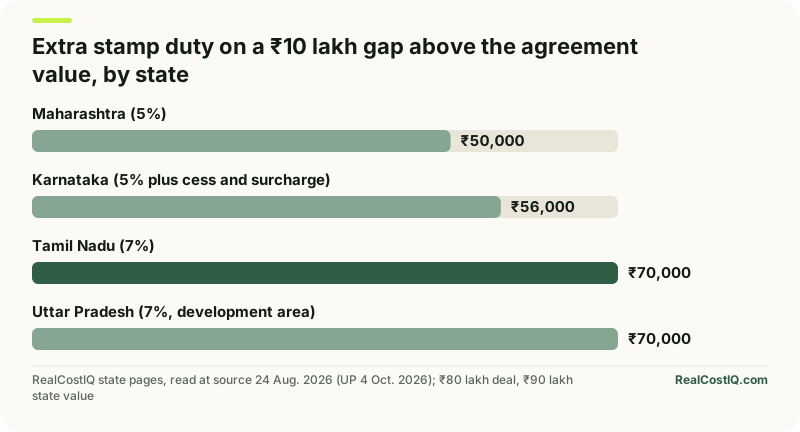
Stamp duty is a state subject. So the first question is always which state's stamp act governs the deed. Every state we cover charges on the higher of two figures: the consideration stated in the deed, and the state's own valuation. None lets you register at a lower figure just because the sale price was lower. What differs is the name of the valuation, the rate, any concession for a woman buyer, the cess on top, and whether the registration fee is capped. The table shows the five states in the plan for this post. Rates are from our own state calculators, with the date each was last read at the state's source. We did not re-read them today because the portals were unreachable.
| State | Valuation used | Rate on our page (resale, general buyer) | Last read at source | Extra duty on the ₹10 lakh gap |
|---|---|---|---|---|
| Maharashtra | Ready Reckoner Rate (IGR Maharashtra) | 5% (4% for a sole woman buyer), plus 1% metro cess in Mumbai or LBT in Pune; registration 1%, capped at ₹30,000 | 24 August 2026 | ₹50,000 at 5%; registration fee unchanged because it is already at the ₹30,000 cap |
| Karnataka | Guidance value (Kaveri) | 5% under Article 20(1), plus cess of 10% of the duty and surcharge of 2% (urban) or 3% (panchayat) of the duty; registration 2% | 24 August 2026 | ₹50,000 duty + ₹5,000 cess + ₹1,000 surcharge = ₹56,000 (before registration fee) |
| Tamil Nadu | Guideline value (TNREGINET) | 7% stamp duty, 4% registration | 24 August 2026 | ₹70,000 at 7%; the registration fee is also on the registered value, so confirm the base with the sub-registrar |
| Uttar Pradesh | Circle rate (IGRSUP) | 7% inside a development area, 5% outside; 1 percentage point less for a woman buyer up to ₹1 crore; registration 1% | 4 October 2026 | ₹70,000 at 7% (₹50,000 at 5%) |
| Delhi | Circle rate (Revenue Department) | Our Delhi page states the rule that duty is on the higher of circle rate and transaction value; rate not re-read at source, so not quoted here | Not read at source for this post | Depends on the rate: 1% of the gap is ₹10,000 |
Arithmetic: extra duty equals rate multiplied by ₹10,00,000. Karnataka's cess and surcharge are percentages of the duty, not of the property value. Check the current rate and the valuation for your own street or sector on the state portal before you budget; these are not a substitute for the sub-registrar's computation.
Three details move the answer. First, the date. In Tamil Nadu and Uttar Pradesh, the valuation is set street by street or sector by sector. It is revised at intervals. So the figure that applies is the one in force when the deed is presented, not when you signed the agreement to sell. Whether a stamped agreement to sell can lock in an earlier valuation is a question for each state's stamp act. We did not read that today. Ask the sub-registrar, and keep it separate from the income-tax rule on agreement dates described later. Second, the buyer's identity. Maharashtra's 4% rate for a sole woman buyer, Uttar Pradesh's 1 percentage point concession up to ₹1 crore and Delhi's lower rate for women all apply to the higher value. So a woman buyer saves a percentage of ₹90 lakh, not ₹80 lakh. Third, what the concession does not cover. Karnataka has no gender concession at all on our reading of its schedule.
Suppose the state value looks too high for your property. The remedy is with the stamp authority, not the income-tax department. Each state's stamp act has a route to contest an undervaluation or an overvaluation by the registering officer. It has its own forms, deposit and time limit, and these differ by state. Whatever the stamp authority concludes does not bind the income-tax authority. The valuation officer route described below does not reduce stamp duty already paid. Treat them as two independent processes. The circle rate calculator shows how the Rajasthan DLC schedule works. It also shows where the higher-of rule is stated for the states it covers.
The seller: section 78 of the Income-tax Act, 2025
Capital gains on land or a building are worked out from the full value of the consideration, less cost and expenses. Section 78 overrides the price in the deed when the price is low. As published in the Gazette, section 78(1) says this. Suppose the consideration received or accruing from the transfer of a capital asset, being land or building or both, is less than the stamp duty value. Then for the purposes of section 72, the stamp duty value shall be deemed to be the full value of the consideration. Section 72 is the capital-gains computation section. The old home of this rule is section 50C of the Income-tax Act, 1961. The commentary we read on 7 October 2026 pairs 50C with 78 in its section-number mapping.
The tolerance is in section 78(1)(b). If the stamp duty value does not exceed 110% of the consideration received or accruing, the consideration is deemed to be the full value. That is a cliff, not a slope. Take a seller who bought for ₹50 lakh and sells for ₹80 lakh.
- State value ₹88,00,000: this is exactly 110% of ₹80,00,000, so it does not exceed 110%. Full value of consideration stays ₹80,00,000. The gain is ₹30,00,000, before indexation or other adjustments allowed for the asset.
- State value ₹88,10,000: this exceeds 110% by ₹10,000. The full value becomes ₹88,10,000 and the gain is ₹38,10,000. A ₹10,000 difference in the state value has moved ₹8,10,000 into the gain.
- State value ₹90,00,000: full value ₹90,00,000 and gain ₹40,00,000. That is ₹10 lakh more than the seller actually received.
So the seller pays capital-gains tax on ₹10 lakh they never received. The rate is the long-term or short-term rate that applies to the asset. The property capital gains tax calculator works it out from the sale price you give it. That calculator does not apply the stamp-duty-value substitution. It takes the price as given. So for a below-circle-rate sale, enter the stamp duty value as the sale price if it exceeds 110% of the price you agreed.
The agreement-date relief and the valuation officer
Two provisions soften the rule. The first is section 78(1)(a). Suppose the agreement fixing the consideration and the registration of the transfer happen on different dates. Then the stamp duty value on the date of the agreement may be taken as the full value. This holds if part or full consideration was received on or before the date of the agreement in a specified banking or online mode, as defined in section 66(32). A builder who signs an allotment letter in March and registers in September, after the state revises its rates, is the typical case. A cash advance does not qualify. Only a banking or online mode does.
The second is section 78(2). The Assessing Officer may refer the valuation to a Valuation Officer where two things are true. The assessee must claim that the stamp duty value exceeds the fair market value on the date of transfer. And the stamp duty value must not have been disputed in any appeal or revision or before another authority, court or the High Court. Section 78(3) closes the loop with a ratchet. If the value determined by the Valuation Officer exceeds the stamp duty value, the stamp duty value is taken as the full value of consideration. So the reference can lower the figure to the Valuation Officer's number if that is lower. It can never push the seller above the stamp duty value. The same reference mechanism applies to the buyer under section 92(4)(b), which pulls in section 78(2).
The substitution applies to land or a building held as a capital asset. A builder or dealer holds property as stock-in-trade instead. For business income, section 53 of the 2025 Act does the same job. If consideration is less than the stamp duty value, the stamp duty value is deemed the full value. The 110% test in section 53(2) switches it off. The agreement-date rule in sections 53(3) and (4) applies. Section 53(5) imports the valuation officer provisions of section 78(2) and (3).
The buyer: section 92(2)(m) and the ₹50,000 or 10% test
The buyer's exposure is the one most people miss. The buyer's own agreement is signed at the lower price, and the cheque matches it. Section 92 of the 2025 Act is the charging section for income from other sources. Clause (m) of sub-section (2) deals with property received without consideration or for inadequate consideration. For immovable property received for a consideration, the Gazette text taxes the stamp duty value of such property that exceeds such consideration. This applies if the excess amount is more than the higher of two amounts: ₹50,000, or 10% of the consideration. This clause replaces section 56(2)(x)(b) of the 1961 Act, according to the commentary we read on 7 October 2026.
Note exactly what is taxed. It is the excess, which is the stamp duty value minus the price. It is not the whole stamp duty value. It is taxed only if the excess clears the threshold. If the excess does not clear the threshold, nothing is taxed. If it does, the full excess is taxed, not just the part above the threshold. With ₹80 lakh as the price, 10% is ₹8 lakh. That is higher than ₹50,000, so the threshold is ₹8 lakh.
| State value | Excess over price | Threshold (higher of ₹50,000 or 10% of price) | Buyer's income added |
|---|---|---|---|
| ₹86,00,000 | ₹6,00,000 | ₹8,00,000 | Nil |
| ₹88,00,000 | ₹8,00,000 | ₹8,00,000 | Nil (the excess is not more than the threshold) |
| ₹88,10,000 | ₹8,10,000 | ₹8,00,000 | ₹8,10,000 |
| ₹90,00,000 | ₹10,00,000 | ₹8,00,000 | ₹10,00,000 |
Taxed at the buyer's slab rate under the head income from other sources, so at a 30% slab ₹10 lakh of extra income is about ₹3,00,000 of tax before surcharge and the 4% health and education cess. The buyer is not the only taxpayer in the deal: the seller has a separate liability under section 78 on the same gap.
The buyer's threshold is the higher of two numbers. On small deals, the fixed ₹50,000 does the work. On a ₹3 lakh plot, 10% is only ₹30,000, so the threshold is ₹50,000. A state value of ₹3,60,000 gives an excess of ₹60,000. That is above ₹50,000, so ₹60,000 is taxable to the buyer. The seller's 110% test on the same plot catches any state value above ₹3,30,000. So at the low end of the market, the seller is caught before the buyer is.
Who is outside the buyer's net
Section 92(3) switches clause (m) off in several cases. These are property received from a relative, on the occasion of the individual's marriage, under a will or by inheritance, and in contemplation of death. They also include property received from a local authority, from or by a registered non-profit organisation in the cases stated, and on a few transfers that are not regarded as transfers under section 70. This is why the relative exclusion matters for a family transfer at a nominal price. Take a flat sold by a father to a daughter below the stamp duty value. It does not trigger the buyer's tax if the daughter is within the Act's definition of relative. But the seller's section 78 and the state's stamp duty still apply to the higher value. Gifts, and the choice between gift deed, will and release deed, are in our gift deed vs will comparison. This post is about a sale.
Section 92(4)(a) carries the same agreement-date rule as section 78. Suppose the date of the agreement fixing the consideration and the date of registration differ. Then the stamp duty value on the agreement date applies. This needs the consideration to have been paid, in whole or part, in a specified banking or online mode on or before the agreement date. The practical lesson is the same on both sides. Put the agreement on stamp paper. Pay the first instalment by bank transfer or cheque on or before that date. Keep the proof.
TDS at the time of payment: 1% of the higher figure
The buyer's withholding obligation also uses the higher figure. TDS means tax deducted at source: the buyer holds back part of the payment and deposits it with the tax department. Section 393(1) of the 2025 Act, Table serial number 3(i), covers any consideration for transfer of immovable property other than agricultural land. The rate is 1% of the consideration or the stamp duty value of the property, whichever is higher, with a threshold limit of ₹50 lakh. That is the old section 194-IA, which our TDS calculator still names alongside the new number. On a ₹80 lakh price and ₹90 lakh state value, TDS is ₹90,000 rather than ₹80,000. The buyer deducts it and deposits it, and the seller claims credit. This 1% is for a resident seller. If the seller is a non-resident, the rate is 13.00% to 14.95% under section 393(2); see buying a flat from an NRI seller.
A caution on the printed text. The Gazette table prints Note 3 against serial 3(iii), the compulsory-acquisition entry. The table row for 3(i) refers to the same Note 3 for its threshold. Read the threshold for ordinary purchases as ₹50 lakh. Confirm the current Form 26QB instructions on the Income Tax Department site before depositing. The TDS on property calculator covers the mechanics, the 26QB filing and the interest for late deduction.
Old and new section numbers
A transaction completed up to 31 March 2026 falls in a tax year governed by the 1961 Act. One from 1 April 2026 falls under the 2025 Act. The Taxguru analysis we read on 7 October 2026 explains the year labels. The tax year 2026-27 under the new Act corresponds to what used to be called assessment year 2027-28. Assessment year 2026-27 (for income of the 2025-26 year) is still dealt with under the 1961 Act. So a registered sale dated 15 March 2026 uses 50C and 56(2)(x). One dated 15 April 2026 uses 78 and 92.
| Question | Income-tax Act, 1961 | Income-tax Act, 2025 (read in the Gazette) |
|---|---|---|
| Seller of a capital asset, price below stamp duty value | Section 50C | Section 78, using section 72 for the computation |
| Seller holding property as stock-in-trade | Section 43CA | Section 53 |
| Buyer, inadequate consideration for immovable property | Section 56(2)(x)(b) | Section 92(2)(m)(ii)(B), with sub-sections (3) and (4) |
| Buyer's TDS on purchase of immovable property | Section 194-IA | Section 393(1), Table serial number 3(i) |
| Definition of stamp duty value | Explanations to the sections above | Section 2(105) |
The 2025 section numbers and text were read in the Gazette of India copy of the Act on 7 October 2026. The 1961 numbers are from the commentary and cross-reference tables cited in the sources and on our TDS page, not from a fresh reading of the repealed Act.
The thresholds did not change in the move. The 110% test, the ₹50,000 floor and the 10% buyer threshold are the same figures the old sections used. The commentary we read confirms the ₹50,000 and 10% figures carried over. What the new Act does is reorganise the text. The agreement-date relief now sits inside section 78(1)(a) and section 92(4)(a). The valuation-officer mechanism sits in section 78(2) and (3), with the buyer's side pointing to it. The definition of the stamp duty value, including the word assessable, is in one place, section 2(105).
What you can actually do about a gap
The cleanest outcome is to avoid the gap. Suppose the state value is above the market price. The honest course is to register at the higher of the two and pay the duty on the state value. Or you can stay within the 110% band (seller) and the 10% band (buyer). Registering at a price you did not pay is a different matter. It is a false statement in a registered document. The tax and stamp consequences described above are the minimum exposure, not the ceiling. This post does not recommend splitting payments or recording a lower figure to save duty.
There are genuine reasons for a price below the state value. Examples are a distress sale, a defect in title, a tenanted property, a plot with no road access, or a state value that is simply stale. In those cases the sensible steps are the following.
- Check the state value for your exact street, survey number or sector on the state portal. Print it with the date.
- If the gap is within 10% of the price, you are inside the seller's 110% safe zone and the buyer's 10% threshold. Write the reason for the price in the agreement anyway.
- If the gap is larger, decide before registration whether to contest the valuation with the stamp authority. Keep evidence. Useful items are comparable registered sales nearby, a registered valuer's report, photographs, and encumbrance and access details.
- Stamp the agreement. Pay the first instalment by bank transfer or cheque on or before the agreement date. Then you can argue the agreement-date value under section 78(1)(a) and section 92(4)(a) if the state revises its rates before registration.
- Suppose you are the seller and believe the stamp duty value exceeds the fair market value. Tell the Assessing Officer in writing and ask for a reference to the Valuation Officer under section 78(2). That is available only where the value is not already under dispute elsewhere. The outcome is capped by section 78(3).
- Work out three sums before you sign: duty on the higher value, the seller's gain on the substituted value, and the buyer's excess and TDS.
A separate warning about case law. Tribunals and High Courts have heard arguments on two questions. Can the buyer's clause be applied where the seller's clause already operates? Can the seller's rule create income that is otherwise not charged? The Taxguru article of 9 July 2026 that we read argues that the capital-gains substitution cannot be used to create income under the residuary head. Treat that as an argument to put to your tax adviser, not as settled law. Do not rely on it when budgeting.
A full worked example, start to finish
A resale flat in Pune is agreed at ₹80,00,000. The Ready Reckoner Rate puts its stamp duty value at ₹90,00,000. The seller bought it for ₹50,00,000. The buyer is a man. We show only the 5% duty. The Mumbai metro cess and the Pune Local Body Tax are left out because we did not re-read them today.
| Line | On the agreement value (₹80,00,000) | On the stamp duty value (₹90,00,000) | Difference |
|---|---|---|---|
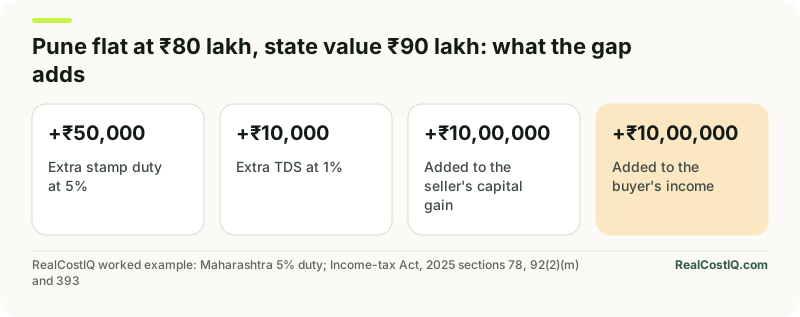
| Stamp duty at 5% (Maharashtra, general buyer) | ₹4,00,000 | ₹4,50,000 | ₹50,000 |
| Registration fee (1%, capped at ₹30,000) | ₹30,000 | ₹30,000 | Nil |
| TDS at 1% | ₹80,000 | ₹90,000 | ₹10,000 |
| Seller's gain before indexation or other adjustments (cost ₹50,00,000) | ₹30,00,000 | ₹40,00,000 | ₹10,00,000 |
| Buyer's income from other sources | Nil | ₹10,00,000 (excess is above the ₹8,00,000 threshold) | ₹10,00,000 |
Duty and fee from our Maharashtra page as read at source on 24 August 2026; income-tax lines from sections 78, 92(2)(m) and 393 of the Income-tax Act, 2025 read in the Gazette on 7 October 2026. The seller's gain is shown before any adjustments the law allows for the asset. The totals are illustrative, not a computation of anyone's actual tax.
Suppose the agreed price had been ₹86,00,000 instead. The state value of ₹90,00,000 is only about 104.7% of the price. That is inside the seller's 110% limit, so the seller's gain stays on ₹86,00,000. The gap is ₹4,00,000, below the buyer's threshold of ₹8,60,000, so the buyer's tax is nil. Stamp duty would still be charged on ₹90,00,000, because the stamp authority has no tolerance band. That is the central asymmetry of the whole subject. The income-tax law forgives a gap of up to roughly a tenth. The stamp law forgives none.
Why the gap exists, and how to read a state value
State valuations are set in advance by a government schedule, usually by area and property type. They are revised at intervals that range from annually to every few years. They measure what the government thinks the land is worth per square metre or square foot. Many states add a construction rate and a depreciation allowance for the building. They often lag actual prices in fast-moving areas. That is why buyers in a hot micro-market see prices above the schedule. They overshoot in areas where prices have stalled. That is why a distressed seller sees a schedule above what a buyer will pay.
Before you rely on a figure, check three things on the state portal. They are the valuation basis (carpet, built-up or super built-up area, or land only), the locality code, and the effective date. Carpet area is the usable floor area inside the walls. Built-up area adds the walls, and super built-up adds a share of common areas. A flat sold on carpet area but valued by the state on built-up area can produce a state value far from your own expectation. So can a plot valued on a street that has been recoded. Our circle rate calculator shows the structure for Rajasthan. There the District Level Committee schedule is read at source and the higher-of rule is stated.
For a new flat from a builder, the state value is often not the base at all. Stamp duty is on the agreement value if it is higher, and the builder's price list normally exceeds the schedule. The gap problem is mostly a resale and plot problem. It is sharpest in the months after a state raises its rates, when the schedule jumps ahead of the market. That is exactly when the agreement-date rule is worth more than any other planning point in this post.
What this post does not cover
- Agricultural land. It is outside the TDS rule and has its own capital-gains treatment.
- Joint development agreements and redevelopment. The Act's specified-agreement rules apply to them. The stamp duty value on the date of the completion certificate enters the computation, as the Gazette text shows.
- GST on under-construction property. This is covered in the GST on property calculator. It is an indirect-tax matter and has no stamp duty value test.
- Income-tax slabs, surcharge and set-off. These depend on the individual's income and are outside the scope of this site.
- The state-specific procedure to challenge an undervaluation or an overvaluation. It differs in every state, and we have not read it at source for this post.