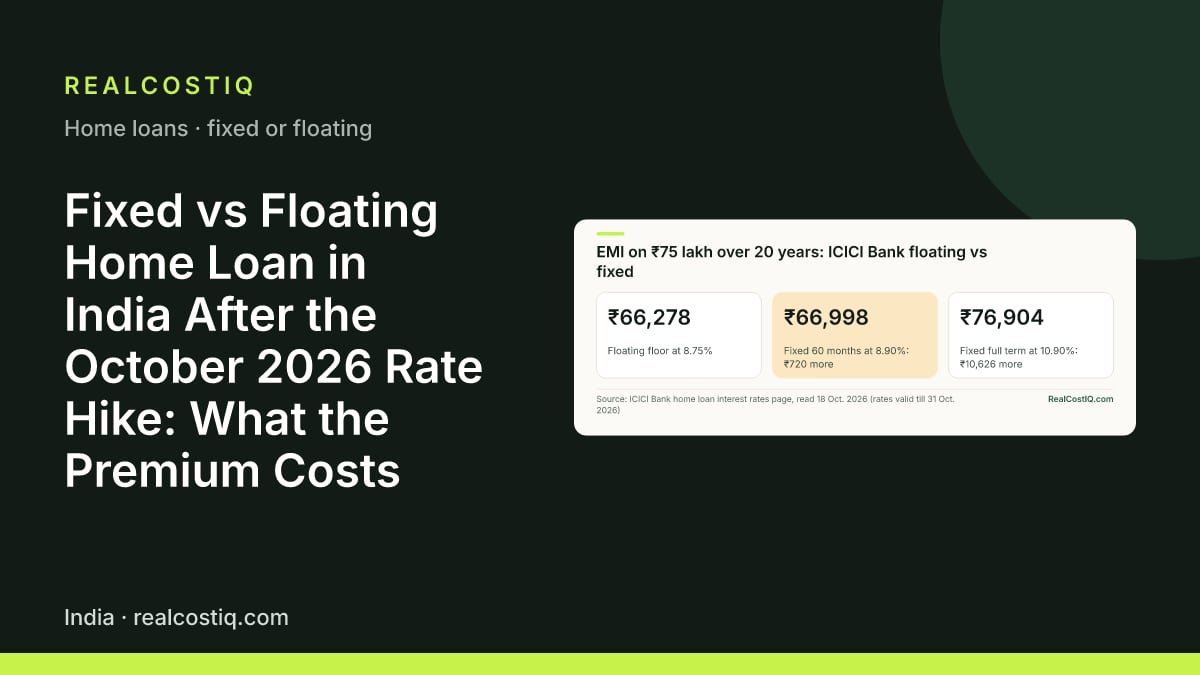
On 7 October 2026 the RBI raised its repo rate by 25 basis points to 5.50%. A basis point is one hundredth of a percentage point. It also changed its stance to calibrated tightening, and its statement says rate cuts are off the table in the near term. For a borrower on a floating rate, that is a reason to ask whether a fixed rate would be safer. This post does not answer that for you. It gives you the arithmetic, so that you can see what the safety costs.
We read every source named here on 18 October 2026. Two earlier posts cover nearby ground, and we do not repeat them. Our post on what RBI rules let you do when your rate resets covers your choices after a rise on a floating loan. Our post on home loan interest rates for October 2026 lists each bank's floating rates and says it does not tabulate the fixed ones. This post does that, and puts rupee costs on them.
A worked example first: ₹75 lakh over 20 years
Take a ₹75 lakh loan for 20 years. The EMI is the fixed monthly payment on the loan. We use ICICI Bank's published rates, because its page lists both floating and fixed rates on the same screen. The lowest floating rate in its table is 8.75%. Its fixed rates run from 8.90% to 11.20%, by how long the rate is fixed. ICICI Bank says rates vary with bureau score and customer profile, so the lowest rate in each row is a best case.
| Rate | Where it comes from | EMI | More than the floating floor |
|---|---|---|---|
| 8.75% | ICICI Bank floating, lowest rate in its table | ₹66,278 | — |
| 8.90% | ICICI Bank fixed for 37 or 60 months, lowest | ₹66,998 | ₹720 a month |
| 9.15% | ICICI Bank fixed for 37 or 60 months, highest | ₹68,205 | ₹1,927 a month |
| 10.75% | ICICI Bank fixed for 120 months, lowest | ₹76,142 | ₹9,864 a month |
| 10.90% | ICICI Bank fixed for the full term, lowest | ₹76,904 | ₹10,626 a month |
| 11.20% | ICICI Bank fixed for the full term, highest | ₹78,438 | ₹12,160 a month |
EMI is the standard reducing-balance formula, the same one as our home loan EMI calculator, at ₹75,00,000 for 240 months. Rates are from ICICI Bank's home loan interest rate page, read 18 October 2026. The page says the fixed rates are valid till 31 October 2026. The floating rows are a floor, not a rate every borrower gets.
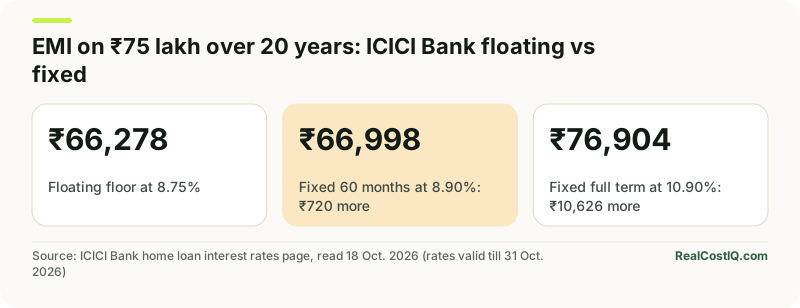
The gap is small for a short fix and large for a long one. A fix of three to five years costs between ₹720 and ₹1,927 a month more than the floating floor. A fix for ten years or the full term costs between ₹9,864 and ₹12,160 a month more. That is a different kind of decision. The first is a small premium. The second is about 16% more on every EMI for 20 years.
What “fixed” means on the bank pages
The RBI has a plain definition. Its Interest Rates on Advances Directions, 2025 say, in paragraph 5(5), that a “fixed rate loan means a loan on which the interest rate is fixed for the entire tenor of the loan”. Paragraph 5(6) says a floating rate loan is one “on which interest rate does not remain fixed during the tenor of the loan”. Paragraph 6(3) adds that a bank has “the freedom to offer all categories of advances on fixed or floating interest rates”.
Now look at what banks sell. ICICI Bank's table lists fixed periods of 24, 37, 60 and 120 months, and a full term. HDFC Bank's page describes a product it calls trufixed, in which the rate “remains fixed for a specific tenure (say first two years of the entire loan tenure) after which it converts into an adjustable-rate loan”. By the RBI's definition, a loan that is fixed for two or five years and then floats is not a fixed rate loan. The Directions also use the word hybrid, for loans “where the interest rates are partly fixed and partly floating” (paragraph 45(4)(v)). That is the best word for these products.
There is one more thing to watch on ICICI Bank's page. The line above the table says you can lock in your rate for the entire loan tenure. The table below it lists fixed periods of 24 months to the full term. The page does not say, for the shorter periods, what rate applies once the fixed period ends. We do not guess. Before you sign, ask the bank in writing what the rate will be on the first day after the fixed period, and how it is set.
The premium by fixed period
| Fixed for | Rate on the page | Points above 8.75% | EMI on ₹75 lakh, lowest rate |
|---|---|---|---|
| 24 months | 9.10% to 9.15% | 0.35 to 0.40 | ₹67,963 |
| 37 months | 8.90% to 9.15% | 0.15 to 0.40 | ₹66,998 |
| 60 months | 8.90% to 9.15% | 0.15 to 0.40 | ₹66,998 |
| 120 months | 10.75% to 10.85% | 2.00 to 2.10 | ₹76,142 |
| Full term | 10.90% to 11.20% | 2.15 to 2.45 | ₹76,904 |
Source: ICICI Bank home loan interest rates page, read 18 October 2026; rates valid till 31 October 2026 per the page. The comparison point is the lowest floating rate in the table. The page also lists floating rates up to 10.05%, which depend on loan size, job type and profile. The 24-month rate is higher than the 37-month and 60-month rates on the same page. We report it as shown and do not explain it.
The table shows a jump. A fix up to 60 months costs a few tenths of a point. A fix for 120 months or longer costs about two points more. The bank prices the longer promise very differently. Pricing like this tells you that a bank sees a long fixed period as costly to offer.
HDFC Bank's page shows its floating rates, which start at 8.00% for all loans and sit at 8.50% on its example card for a credit score of 800 and above. It describes the trufixed product, but the page we read gives no rate for it. So we have a fixed-rate table for one lender only. Treat it as one lender's price, not as the market's. Compare any offer you get with its own floating rate, on the same day.
A five-year fix against a floating rate that rises
Now the question that decides it. How much would the floating rate have to rise for a five-year fix to win? We compare ICICI Bank's 8.90% five-year rate against a floating loan that starts at 8.75%. We count the interest you pay over the first five years. We assume the floating loan keeps its 20-year term, so its EMI is reset each year to fit the new rate. The fixed loan is then floating after year five, so we stop the comparison there.
| Floating path, year by year | Interest on the floating loan | Interest on the 8.90% fixed loan | Fixed is better or worse by |
|---|---|---|---|
| Falls 0.25 point a year (8.75, 8.50, 8.25, 8.00, 7.75) | ₹29,29,525 | ₹31,64,331 | Worse by ₹2.35 lakh |
| Stays at 8.75% | ₹31,08,185 | ₹31,64,331 | Worse by ₹0.56 lakh |
| One 0.25 rise at the start of year 3 (8.75, 8.75, 9.00, 9.00, 9.00) | ₹31,61,977 | ₹31,64,331 | Better by ₹0.02 lakh, about equal |
| One 0.25 rise at the start of year 2 (8.75, 9.00 for four years) | ₹31,81,532 | ₹31,64,331 | Better by ₹0.17 lakh |
| Rises 0.25 point a year (8.75, 9.00, 9.25, 9.50, 9.75) | ₹32,87,691 | ₹31,64,331 | Better by ₹1.23 lakh |
| Rises 0.50 point a year (8.75, 9.25, 9.75, 10.25, 10.75) | ₹34,67,974 | ₹31,64,331 | Better by ₹3.04 lakh |
Our sums on ₹75,00,000 over 20 years, monthly reducing balance, with the EMI reset at each yearly step to keep the 20-year term. The paths are tests, not forecasts. The floating start of 8.75% is ICICI Bank's lowest floating rate; the fixed 8.90% is the lowest rate on its 60-month row.
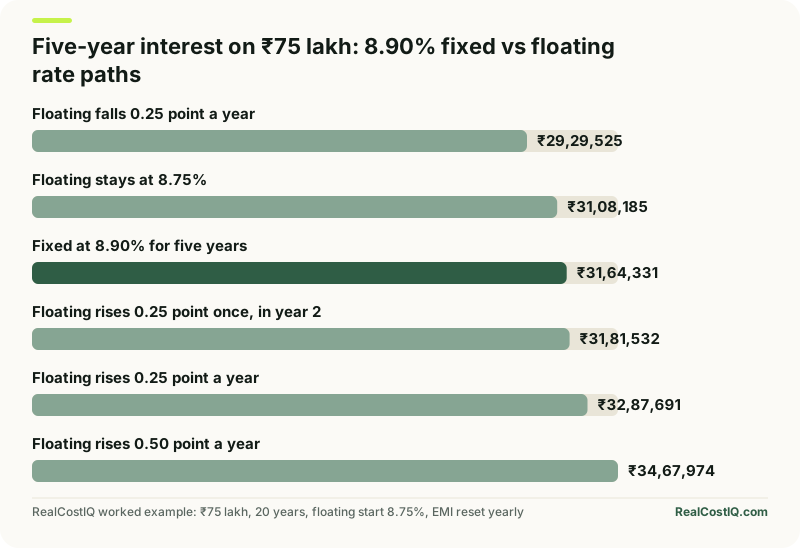
Read it from the middle. If floating stays flat, the fix costs about ₹56,000 more over five years. That is the price of insurance when nothing happens. A single 0.25 point rise in the second year is enough for the fix to come out ahead. A rise of 0.25 point in year three makes it about equal. In short, the fix breaks even if the floating rate rises by about 0.08 point a year on average, reaching about 9.06% by year five.
That is a low bar compared with the current mood. The RBI has just raised the repo rate and said its stance is calibrated tightening. But a rate rise does not reach every floating borrower the same way. Whether a repo rise reaches your loan depends on your lender's benchmark and spread, and on how often your loan resets. Our rate reset post covers the reset rules. The downside is real, too. If rates fall 0.25 point a year, the fix costs ₹2.35 lakh more than floating over five years.
A full-term fix: floating would have to average near 10.9%
A full-term fix is a bigger bet. At 10.90%, the lowest full-term rate on ICICI Bank's page, a ₹75 lakh loan over 20 years costs ₹1,09,57,047 in interest. To find out what floating rate would match that, we ran the loan at several constant floating rates. A constant rate is a simple test. It is not a forecast.
| Floating rate held for 20 years | EMI | Total interest | Full-term fix at 10.90% costs more by |
|---|---|---|---|
| 8.75% | ₹66,278 | ₹84,06,793 | ₹25.50 lakh |
| 9.75% | ₹71,139 | ₹95,73,303 | ₹13.84 lakh |
| 10.75% | ₹76,142 | ₹1,07,74,121 | ₹1.83 lakh |
| 10.90% (the fix) | ₹76,904 | ₹1,09,57,047 | — |
| 11.90% | ₹82,059 | ₹1,21,94,204 | Floating costs ₹12.37 lakh more |
Our sums with the standard EMI formula on ₹75,00,000 for 240 months. A constant rate is a simplification. A real floating rate moves, and what matters is the balance-weighted average rate over the loan.
For the full-term fix to win, floating must average close to 10.9% over 20 years. That is 2.15 points above the starting 8.75%. In steps of 0.25 point, it is about nine rises in a row with no cut. Even then, the borrower with a fix would also have paid ₹10,626 a month more from day one. We do not say it cannot happen. We say that is what the full-term price assumes. A buyer with a fixed income that cannot stretch may value the certainty more than the cost. That is a personal choice and our sums only price it.
You also keep one option with a floating loan. If rates fall, you gain at once. If they rise a lot, you can look at moving the loan to another lender, which our reset post covers. That is why a floating loan with a good cash buffer can be a manageable risk. A fixed loan gives that option up for a price.
Leaving a fixed loan early
The exit rules differ for fixed and floating loans. Paragraph 353 of the RBI's Commercial Banks (Responsible Business Conduct) Directions, 2025, in its version updated on 1 October 2026, says a bank “shall not levy pre-payment charges” on floating rate loans to individuals for purposes other than business. Paragraph 353(4) says that for dual or special rate loans, a combination of fixed and floating, the bar “will depend on whether the loan is on floating rate at the time of pre-payment”. Paragraph 353(5) says that in other cases, any pre-payment charge is as per the bank's approved policy, and on a term loan it must be based on the amount prepaid.
Put plainly: if you prepay a hybrid loan while its rate is still fixed, the bank's own policy may allow a charge. If you prepay after it has turned floating, the bar applies. We read the text for commercial banks only. We did not read the matching text for housing finance companies. The reset post has the full set of conditions, and paragraph 353(8) says any charge must be disclosed in the sanction letter and the Key Facts Statement. Ask the bank what it charges if you leave inside the fixed period. Our home loan comparison calculator can show the cost of moving to a lower-rate loan.
Can you switch later?
At a reset, the RBI's paragraph 349(2) says a bank “may, at its option, provide a choice to the borrowers to switch over to a fixed rate as per its Board approved policy”. The word is may. So a switch from floating to fixed after you take the loan is the bank's offer, not your right. Banks that do offer it may charge a fee and may set a different rate. Our post on the reset rules gives the details. For planning, treat a later switch as uncertain. If you want a fix, the safest time to ask is before you sign.
How to compare the two on your own loan
- Get both offers on the same day. Ask the bank for the floating rate and the fixed rate, with the date on each. Rates change often. ICICI Bank's fixed rates are valid till 31 October 2026.
- Ask what “fixed” covers. For how many months is the rate fixed? What rate applies the day after? Ask for the spread in writing.
- Work out the monthly premium. Use the EMI calculator at both rates. Multiply the difference by the months the rate is fixed. That is the most the fix can cost you in cash.
- Find your break-even. Our five-year table shows the idea. A fix wins if the floating rate rises faster than the premium, by about 0.08 point a year for a gap of 0.15 point. For a gap of two points, the rise must be large and last.
- Check the exit. Ask what the bank charges if you prepay inside the fixed period. Paragraph 353(5) leaves it to the bank's policy.
- Look at the Key Facts Statement. It should show the rate type and the APR. Compare the APR, not the headline rate.
- Test your cash. If the EMI rose by ₹10,000 a month, could you pay it? If yes, floating may be a risk you can carry. If no, the premium buys something real.
Run both rates through the home loan EMI calculator with your own loan amount and tenure. Steps three and four take a few minutes there.
What this post cannot tell you
- What rates will do. We do not forecast the repo rate or any bank's rate. The paths in our tables are tests. The RBI's statement says rate cuts are off the table in the near term, and that is not a promise about the next hike.
- What other lenders charge. We have fixed rates for one lender, ICICI Bank. HDFC Bank describes a trufixed product, but the page we read gives no rate for it. SBI's page we read lists only floating rates. Other banks and housing finance companies will price differently.
- What follows a fixed period. ICICI Bank's page does not say. We do not guess the rate or spread that applies after it.
- Your own rate. Rates depend on your score, profile and loan size. ICICI Bank says so on its page. The rows we use are the lowest in each band.
- Rules for housing finance companies. We read the commercial banks' Directions. We did not read the housing finance texts.
- Tax, fees and processing charges. Our sums leave them out. A balance transfer or a switch can carry fees that change the answer.
- Advice. This post prices the choice. It does not tell you which to take.