Search for a home loan rate and you will find dozens of tables. Many have no date. Some copy a bank's lowest rate from months ago. A few mix up the rate a bank advertises with the rate a typical borrower gets. This post does something narrower. We opened each bank's own rate page on 16 October 2026, wrote down what it says, and noted what it leaves out.
Two terms come up all through the post, so here they are once. EMI means equated monthly instalment, the fixed amount you pay each month. Tenure means the length of the loan, in years. We define the other terms the first time they appear.
What an EMI costs at each rate: a ₹50 lakh example first
Start with the rupees. Take a loan of ₹50,00,000 (₹50 lakh) for 20 years. We ran the same loan at every rate we found on the banks' pages. The only thing that changes is the rate. The EMI comes from the same method as our home loan EMI calculator.
| Annual rate | Where it appears | Monthly EMI | Total interest over 20 years |
|---|---|---|---|
| 7.50% | SBI card, lowest rate | ₹40,280 | ₹46.67 lakh |
| 8.00% | HDFC Bank, lowest rate in its table | ₹41,822 | ₹50.37 lakh |
| 8.50% | HDFC Bank example card, credit score 800 and above | ₹43,391 | ₹54.14 lakh |
| 8.75% | ICICI Bank, lowest rate in its table | ₹44,186 | ₹56.05 lakh |
| 8.80% | SBI card, highest rate for a home loan | ₹44,345 | ₹56.43 lakh |
| 9.90% | ICICI Bank, top of the range for salaried borrowers above ₹75 lakh | ₹47,920 | ₹65.01 lakh |
| 13.45% | HDFC Bank, highest rate in its table | ₹60,189 | ₹94.45 lakh |
Loan ₹50,00,000, 20 years, monthly repayment. EMI and total interest come from the site's EMI engine at these inputs. They are illustrations, not offers. Each rate is the figure shown on the named bank's page on 16 October 2026.
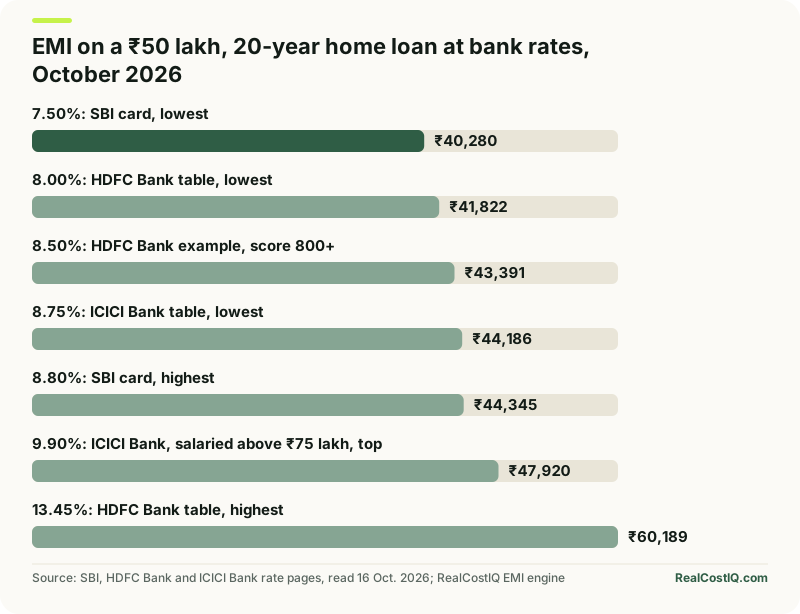
Read the table from top to bottom. Between 7.50% and 8.80% the EMI moves by about ₹4,065 a month, and the total interest moves by about ₹9.8 lakh. From the lowest SBI rate to the top of HDFC Bank's table, the EMI is ₹19,909 a month higher. A small gap in rate is a large gap in rupees because you pay it every month for 20 years.
The method behind the EMI is the standard one. Take the monthly rate, which is the annual rate divided by 12 and by 100. Call it r. Take the number of months, n, which is the years times 12. Then EMI = loan × r × (1 + r)^n ÷ ((1 + r)^n − 1). For ₹50 lakh at 8.50% for 20 years, r is 0.007083 and n is 240. That gives ₹43,391. You do not need to do this by hand. The calculator does it.
How we checked these rates
We opened each lender's own page on 16 October 2026. We did not use any rate site or news summary. Here is what loaded and what did not.
- SBI: the home loan rate card, the benchmark page, the current home loan rate page and the rate-change notice all loaded. The rate card is an image on SBI's home loan site, and we read it directly.
- HDFC Bank: the home loan interest rate page loaded. It shows a range, example rates and a repo-linked table. It shows no effective date for the table.
- ICICI Bank: the home loan interest rate page loaded. It shows rate tables by loan size and job type, and says the rates are valid till 31 October 2026.
- LIC Housing Finance (LIC HFL): the home loan page loaded, but its rate sections for salaried and self-employed borrowers show no figures. We could read only a PDF of its contracted-loan rate range for April to June 2026. That is a record of past loans, not a current offer. So LIC HFL is in this post as context, not in the table of current rates, and not in the title.
- RBI: the October 2026 Monetary Policy Committee resolution loaded.
We found some oddities on the banks' own pages. We note each one where it appears. The rule we follow is simple. If a bank's page says two different things, we show both and say so.
The base for everything: the RBI repo rate
The repo rate is the rate at which the RBI lends money to banks for the short term. Banks link their home loan rates to it. When it goes up, floating home loan rates go up. A floating rate is a rate that the bank can reset when its benchmark changes. A fixed rate stays put for a set period.
On 7 October 2026 the RBI's Monetary Policy Committee raised the policy repo rate by 25 basis points to 5.50%. A basis point is one-hundredth of a percentage point, so 25 basis points is 0.25 percentage points. The same resolution put the standing deposit facility rate at 5.25% and the marginal standing facility rate at 5.75%. It also changed the policy stance to calibrated tightening. (Source: RBI Monetary Policy Statement, 2026-27, resolution of 5 to 7 October 2026, read 16 October 2026.)
What does a 0.25-point rise do to your EMI? On our ₹50 lakh, 20-year loan, moving from 8.50% to 8.75% lifts the EMI from ₹43,391 to ₹44,186. That is ₹795 a month more. We work out how a rise like this flows through loans of different sizes in our post on what a 0.25 point repo hike does to EMIs by loan size. We do not repeat that table here.
SBI: what the rate card says
SBI's home loan rate card is dated "w.e.f. 15.10.2026", which means with effect from 15 October 2026. It says all home loans are linked to the External Benchmark Lending Rate, or EBLR, and that the prevailing EBLR is 8.15%. The EBLR is the benchmark rate a bank sets from an outside reference, in SBI's case tied to the repo rate. It is the starting point for your rate. The bank then adds its own premium.
| Product | Rate shown |
|---|---|
| Home Loan (term loan) | 7.50% to 8.80% |
| Home Loan Maxgain (overdraft) | 8.00% to 9.30% |
| Top Up Loan | 8.00% to 10.75% |
| Top Up (overdraft) Loan | 8.50% to 11.25% |
| Loan Against Property | 9.20% to 10.75% |
| Reverse Mortgage Loan | 10.55% |
| YONO Insta Home Top up Loan | 8.35% |
Source: SBI home loan rate card (homeloans.sbi.bank.in), read 16 October 2026. The card says the rates are based on CIBIL score and carry terms and conditions.
Three details matter. First, the card says rates are based on CIBIL score. This is a three-digit score from 300 to 900 that credit bureaus give you based on how you have repaid past loans. Second, the card says there is an extra premium of 10 basis points for non-salaried customers with a CIBIL score below 825 on home loans and top-up loans. Third, the card does not list a rate for each score band. It gives a range. So you cannot work out your own rate from this card alone.
SBI's benchmark page shows the EBLR moved from 7.90% to 8.15% effective 15 October 2026. It shows that the base is "EBLR plus CRP plus BSP". CRP is the credit risk premium, and BSP is the business strategy premium. The page does not give the size of either. It also lists a second benchmark, the RLLR, moving from 7.50% to 7.75%. The page was last updated on 14 October 2026.
A simple sum shows the link to the repo rate. The EBLR of 8.15% minus the repo rate of 5.50% is 2.65 percentage points. That gap is our arithmetic, not a figure SBI states on the page we read. The card's range of 7.50% to 8.80% sits on both sides of the 8.15% benchmark. This tells you the final rate is not just "benchmark plus a fixed add-on". SBI does not explain the difference on the card.
SBI's current rate page also shows a headline of 7.50% onwards, effective 15 October 2026, with a note that terms and conditions apply. SBI's "Important Notification" says that when the repo rate changes, the home loan rate changes with it. It lists four ways to handle a rise: pay a lump sum and keep the same EMI and tenure, lengthen the tenure, raise the EMI, or mix these. We cover those choices, and the RBI rules behind them, in our post on what to do when your home loan rate resets.
SBI's home loan site also lists an interest concession for women borrowers as a feature. It gives no amount. We could not read how large the concession is. If you are a woman borrower or a co-borrower, ask the branch for the figure in writing.
HDFC Bank: a range, a repo link, and a headline that does not match
HDFC Bank's page links its rates to the policy repo rate and lists that rate as 5.50%. The repo-linked table runs from 8.00% to 13.45% a year for all loans. The spread over the repo rate runs from repo plus 2.50 percentage points at the low end to repo plus 7.95 at the high end. A spread is the amount a bank adds to its benchmark. You can check the sums: 5.50 plus 2.50 is 8.00, and 5.50 plus 7.95 is 13.45.
The page also shows loan cards at 8.50% a year for 15-year, 20-year and 30-year tenures. It says these are "as on today" and tie them to a credit score of 800 or above. It says a higher score generally gets a better rate. It does not list bands for lower scores. It has a heading about special rates for salaried and self-employed borrowers, but it lists no separate figures under it. It does not state a concession for women borrowers.
ICICI Bank: tables by loan size and job type
ICICI Bank's page says its rates are linked to the repo rate, which it gives as 5.50% effective 8 October 2026. It says the rates are valid till 31 October 2026. That end date is useful. It tells you the table is a short-lived snapshot, not a standing price list. The page does not name its benchmark as an EBLR, and it does not state the spread.
| Loan amount | Salaried | Self-employed |
|---|---|---|
| Up to ₹35 lakh | 8.75% to 9.65% | 8.75% to 9.80% |
| ₹35 lakh to ₹75 lakh | 8.75% to 9.80% | 8.75% to 9.95% |
| Above ₹75 lakh | 8.75% to 9.90% | 8.75% to 10.05% |
Source: ICICI Bank home loan interest rates page, read 16 October 2026. The page also lists special rates by credit score: 8.75% for salaried and self-employed borrowers at a score of 800, and 8.75% (salaried) or 8.85% (self-employed) at 750 to 800. It gives no bands below 750.
Read the table in two steps. The low end is the same, 8.75%, for every size and both job types. The high end rises with the loan size and is higher for self-employed borrowers. So the loan size and the job type decide where in the range you land, along with your score. The page shows a processing fee of 0.5% of the loan amount plus taxes. On a ₹50 lakh loan, that is ₹25,000 before taxes.
The page also lists fixed rates by tenure. They run from 8.90% to 11.20%, depending on the period. A fixed period is the stretch of years the bank holds your rate. ICICI Bank's page also offers a full-term fixed rate of 10.90% to 11.20%. Fixed rates are higher than the floating floor. We do not tabulate them here.
LIC Housing Finance: last quarter's range, not today's rate
LIC Housing Finance, or LIC HFL, links its home loan rates to its own prime lending rate. It calls this the LHPLR. The company's page for the LHPLR on retail loans shows two figures, 16.90% and 17.00%, with no label and no date. We cannot tell which is current. The rate section on its home loan page is empty for both salaried and self-employed borrowers. So we cannot give you an offer rate from LIC HFL today.
What the company does publish is a PDF of the range of rates on loans it signed in the April to June 2026 quarter (Q1 of its financial year 2026-27). We read it on 16 October 2026.
| Scheme | Lowest rate | Highest rate | Average rate |
|---|---|---|---|
| Griha Prakash | 7.15% | 10.25% | 7.46% |
| Griha Bhoomi | 7.25% | 9.15% | 7.65% |
| Griha Suvidha | 7.40% | 9.80% | 7.76% |
| Griha Sobha (for NRIs) | 7.15% | 9.65% | 7.56% |
Source: LIC Housing Finance, interest rate range of contracted loans for the past quarter (Q1 FY2026-27), read 16 October 2026. These are rates on loans already signed, before the 7 October 2026 repo rise. They are not the rates on offer today. The PDF lists eight individual housing schemes; we show four. The others ran up to 11.00% (Griha Sugam).
Treat this table as a record, not a quote. A loan signed in May at 7.15% does not tell you what the same borrower would get now. The repo rate has since risen by 0.25 points. It is still a useful signal. It shows the spread between the lowest and highest rate on loans actually signed, which is wide: 3.10 percentage points for Griha Prakash. That spread is the same story as the other banks. Your rate depends on who you are, not only on the bank.
The four lenders side by side
| Lender | Rate range shown | Benchmark | Effective date or validity | What is missing |
|---|---|---|---|---|
| SBI | 7.50% to 8.80% (home loan, term) | EBLR 8.15% | w.e.f. 15 October 2026 | Rate by CIBIL band; women's concession amount |
| HDFC Bank | 8.00% to 13.45% | Repo rate 5.50%; spread 2.50 to 7.95 points | No date shown on the table | Score bands below 800; separate salaried and self-employed rates |
| ICICI Bank | 8.75% to 10.05% | Repo rate 5.50% (from 8 October 2026) | Valid till 31 October 2026 | Spread; bands below a score of 750; women's concession |
| LIC HFL | 7.15% to 11.00% across its individual housing loan schemes (loans signed April to June 2026) | LHPLR (two unlabelled figures) | Past quarter only | Any current offer rate |
Each cell comes from the lender's own page or PDF, read on 16 October 2026. SBI's and HDFC Bank's ranges are for a home loan; ICICI Bank's range covers its standard table for loans of all sizes and both job types.
A table like this makes the ranges look comparable. They are not quite. SBI's range starts lower, but its card also applies an extra 10 basis points to some non-salaried customers. HDFC Bank's range is the widest because it covers all loans. ICICI Bank's range depends on loan size and job type. Neither the width of a range nor its lowest figure tells you what you will pay. Only a sanction letter does.
What moves your rate inside the range
Every page we read says the rate depends on the borrower. Here are the factors the pages name.
- Credit score. SBI's card says its rates are based on CIBIL score. HDFC Bank ties its 8.50% example to a score of 800 or above and says a higher score generally earns a better rate. ICICI Bank lists special rates at 800 and at 750 to 800.
- Salaried or self-employed. ICICI Bank's table gives self-employed borrowers a higher top rate at every loan size, by 0.15 points. SBI adds 10 basis points for non-salaried customers with a score below 825.
- Loan size. ICICI Bank's top rate rises as the loan grows: 9.65% up to ₹35 lakh, 9.80% up to ₹75 lakh and 9.90% above that, for salaried borrowers.
- Product type. SBI's card shows that a regular term loan costs less than an overdraft loan, a top-up loan or a loan against property.
- Who is on the loan. SBI's home loan site lists a concession for women borrowers. We could not read the amount. HDFC Bank's and ICICI Bank's pages do not state one.
Notice what the pages do not give. None of the three banks publishes a full grid that says, "score 780, salaried, ₹50 lakh: this rate." To get that, you have to apply or ask. This is why a rate table, including this one, can only frame the range. It cannot quote your rate.
Why a headline "from" rate is not your rate
Two of the three banks we read show a headline rate that sits below the lowest rate in their own tables. HDFC Bank shows 7.20% against a table floor of 8.00%. ICICI Bank shows 7.55% against a table floor of 8.75%. SBI's 7.50% "onwards" does match the bottom of its own card, which is the cleaner case.
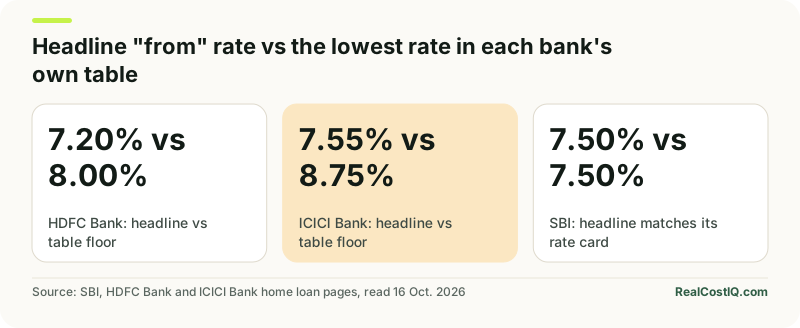
Why does this matter? A headline "from" rate is the best case, shown to attract clicks. It may apply to a narrow group, such as pre-approved customers, a special scheme, or an old campaign. The footnote usually says terms and conditions apply. If you plan a budget on a headline rate, your EMI may be higher than you expect. On a ₹50 lakh loan over 20 years, the gap between ICICI Bank's 7.55% headline and its 8.75% table floor is about ₹3,750 a month.
A safer way to plan: take the middle of a bank's range, not the bottom. Then run your numbers at that rate and at a rate 1 percentage point higher. Our home loan comparison calculator lets you put two loan offers side by side with the same loan amount and tenure. It also shows why banks' floating rates tend to move together when the repo rate moves.
Questions to put to any lender before you sign
These are not recommendations of a bank. They are things the pages above leave open, and you can ask any lender in writing.
- What exact rate will my loan carry on the sanction date, and which benchmark is it tied to?
- What is the spread over that benchmark, and can the bank change the spread during the loan?
- How soon after a repo rate change does my rate reset? Is the reset quarterly or sooner?
- On a rate reset, can I choose between a higher EMI and a longer tenure? (RBI rules say the bank must offer the choice. We set out the rules in the rate reset post.)
- What is the processing fee, and is it a percentage of the loan? ICICI Bank's page shows 0.5% plus taxes.
- Is there any concession for a woman borrower or co-borrower, and what is its size in percentage points?
- What happens to my rate if my credit score changes after sanction?
What this post cannot tell you
We are plain about the limits. First, a rate page is a snapshot. ICICI Bank's page runs only till 31 October 2026, and SBI's card is dated from 15 October 2026. Check the date on any rate before you rely on it. Second, we read the pages as a visitor does. A bank may quote different rates to customers through its branches or its relationship managers. Third, we could not read a current offer rate for LIC HFL, so any claim about how it compares to the other three would be a guess. We make none.
Fourth, we do not tell you which lender to choose. The right choice depends on your score, your income type, your loan size and what the bank will sanction. If you want to turn any rate in this post into a monthly cost, use the home loan EMI calculator with your own loan amount and tenure. To see whether your income supports a loan at all, read our post on home loan eligibility on a ₹50,000 salary.
Quick reference: the figures in this post
- RBI policy repo rate: 5.50%, raised by 25 basis points on 7 October 2026 (RBI resolution, read 16 October 2026).
- SBI: home loan 7.50% to 8.80%; prevailing EBLR 8.15%; effective 15 October 2026 (SBI rate card and benchmark page, read 16 October 2026).
- HDFC Bank: 8.00% to 13.45%, repo plus 2.50 to 7.95 points; 8.50% example at a score of 800 or above; no effective date shown (HDFC Bank page, read 16 October 2026).
- ICICI Bank: 8.75% to 10.05% across its standard table; valid till 31 October 2026; processing fee 0.5% plus taxes (ICICI Bank page, read 16 October 2026).
- LIC HFL: 7.15% to 11.00% across its individual housing loan schemes on loans signed April to June 2026; no current offer rate readable (LIC HFL PDF, read 16 October 2026).
- EMI on ₹50 lakh over 20 years: ₹40,280 at 7.50%, ₹41,822 at 8.00%, ₹43,391 at 8.50%, ₹44,186 at 8.75%, ₹47,920 at 9.90%.