Most Indian stamp duty content is written for a flat. A plot or a piece of farmland is a different purchase. The sub-registrar (the official who records property deeds) will ask for a fee. But three other questions come first. They decide whether the deal is lawful and what the land can be used for. One: are you allowed to own that land at all? Two: is it classed as agricultural, so that it must be converted before you build? Three: is the seller's name in the land record, so that a registered deed will really move the title to you? A flat buyer almost never meets these questions. A plot buyer meets all three. Each is answered by a state law, not a central one.
This post reads those state laws where we could read them on 8 October 2026. It says plainly where we could not. We read the Karnataka Land Reforms Act, 1961 and Land Revenue Act, 1964 as consolidated on India Code, the Government of India's statute database. That includes the 2020 Land Reforms amendment (Karnataka Act 56 of 2020) and the 2025 Land Revenue amendment (Karnataka Act 56 of 2025). For Maharashtra, we read the Land Revenue Code amendment bill as passed by both Houses in December 2025. For Uttar Pradesh, we read the Revenue Code with the amending Acts of 2019, 2020 and 2026. These are appended to the PRS Legislative Research copy of the gazette. For Telangana, we read the Bhu Bharati Act, 2025, also through a PRS copy of the gazette. The state websites that carry the official text refused our connections. The registration-fee sums do not come from a portal. We ran them through our own state calculators at named values. Each calculator's rate was last read at the state source on the date we give, not today. This is general information, not legal advice. Before you pay an advance, check the amended text with a local advocate.
Three questions a plot buyer has to answer before the registration fee
- May you buy it? Several states limit who can buy farmland. They also limit how much one person or family can hold. Some bar the sale of land held by particular groups. Karnataka rewrote its rules in 2020. Uttar Pradesh has a holding cap and a permission rule for certain sellers.
- Can you build on it? Farmland must be converted before you build. In some states it counts as converted when the local plan already allows the use. The cost and the time taken differ sharply between Karnataka and Maharashtra.
- What will registration cost? Stamp duty, cess and surcharge, and the registration fee are charged on the value of the land. A plot normally pays the general rate. It does not get the lower rate that some states give on a first sale of a flat.
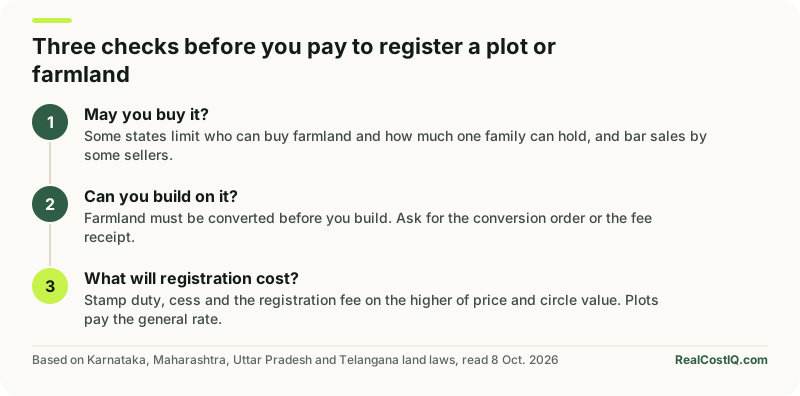
The first two questions are about whether the deed is worth registering. The third is the figure everyone searches for, and it is the smallest of the three risks. The costly mistake is a plot with a correct fee sum but no conversion order.
May you buy it? What four state laws say
Karnataka: the buyer-eligibility sections were omitted in 2020
The Karnataka Land Reforms (Amendment) Act, 2020 (Karnataka Act 56 of 2020) was first published as an ordinance in the Karnataka Gazette Extraordinary on 13 July 2020. It omitted sections 79A, 79B and 79C of the Karnataka Land Reforms Act, 1961, with effect from 1 March 1974. We take this from the footnotes in the India Code text. The old section 79A is reproduced there. A person, family or joint family could not acquire farmland if it had an assured annual income of not less than ₹25 lakh from sources other than agricultural land. This was an average over five consecutive years. An acquisition in breach was void. That income bar is gone. India Code's consolidated Act, read today, lists sections 79A, 79B and 79C as “Omitted”. So the 2020 omissions have not been reversed in that copy. Cases already disposed of before publication are not reopened. Cases pending under the three sections abated, which means they ended.
The Act did not remove all control. Section 80 was headed “Transfer to non-agriculturists barred” until July 2020. It is now headed “Restrictions on transfer of certain lands”. As consolidated on India Code, no sale, gift, exchange or lease of land is lawful in favour of a person in two cases. The first case is A-class irrigated land, where the buyer does not use it for agriculture. The second case is a person who holds, as owner or tenant, land above the limits in section 63 or 64. The earlier tests of being an agriculturist or an agricultural labourer are omitted. So is the clause barring a buyer disentitled under 79A or 79B, and the old clause (b) on mortgages with possession. Section 81 is now headed “Restriction on Sale or Mortgage of Agriculture Land”. It has a new sub-section (2-A). This bars any mortgage of farmland in favour of a person other than the institutions named in the section. A new section 80-A says that no condition in the Act is relaxed for land granted to Scheduled Castes or Scheduled Tribes during the period of prohibition under the 1978 Karnataka Act. The holding ceiling in section 63 is a puzzle. The July 2020 ordinance text raised it to 20 units. But the India Code text we read still shows ten units, rising to twenty for larger families, with no 2020 footnote. So we state no current ceiling. A unit is a legal measure, not an acre.
Two cautions apply. First, India Code's footnotes, not the Act itself, are our source for the effective dates. A consolidated copy can lag behind the gazette. Second, the 2020 omission removes only the buyer-income bar. The sale of A-class irrigated land to a non-farmer is still barred. The section 63 and 64 limits still bind. Before buying farmland, ask the sub-registrar or a Karnataka advocate for the current sections 63, 80 and 81.
Uttar Pradesh: a 5.04 hectare cap, a citizenship rule and a Collector's permission
The Uttar Pradesh Revenue Code, 2006 (U.P. Act 8 of 2012) is more specific about the buyer. Under section 89(2), you may not buy or receive as a gift any holding, or part of one, from a bhumidhar with transferable rights if you would then hold more than 5.04 hectares in Uttar Pradesh with your family. A bhumidhar is a landholder who can sell the land. Act 28 of 2020 added an explanation that “person” here means a natural or a legal person.
Section 89(3) was substituted by Act 7 of 2019 (deemed in force from 10 March 2019). It lets the State Government or an authorised officer approve an acquisition above that limit. This covers a registered firm, company, partnership firm, LLP, trust, society or educational or charitable institution. The acquisition must be in the public interest. It must also be likely to generate economic activity other than agriculture and provide jobs.
Under section 89(4), the Collector can grant that permission up to 20.2344 hectares. The Commissioner can grant it above that and up to 40.4688 hectares. The State Government decides above that. The permission lapses if the project is not set up in five years, with an extension of up to three years. If an institution bought without prior approval, the approval can be regularised afterwards on a fine. Act 7 of 2019 set the fine at 5%. Act 28 of 2020 raised it to 50% of the cost of the land in excess of the limit at the circle rate. The circle rate is the state's minimum land value.
Section 90 says that no person other than an Indian citizen may acquire land by sale or gift without the State Government's prior written permission. A company or association counts as Indian if Indian citizens wholly or substantially own or control it.
Section 98 protects land held by Scheduled Caste bhumidhars. Outside the limits of a development authority, such a bhumidhar may not sell, gift, mortgage or lease land to a person who is not a Scheduled Caste member without the Collector's written permission. The Collector may not grant it if the seller would be left with less than 1.265 hectares in the State. Section 99 has a parallel restriction for Scheduled Tribe bhumidhars. So before you pay for a plot cut out of a village holding in Uttar Pradesh, find out two things. What is the seller's category? How much land is left after the sale? The khasra number (the plot's number in the village record) is not enough. We found no change to sections 90, 98 or 99 in the Acts of 2019, 2020 and 2026 appended to the PRS copy. That copy also lists Acts 4 of 2016 and 4 of 2021. We could not find their text in the file, so check the current wording.
Telangana: the registrar checks the record before it registers
The Telangana Bhu Bharati (Record of Rights in Land) Act, 2025 (Act 1 of 2025) was assented to on 3 January 2025 and published in the Telangana Gazette on 4 January 2025. In the sections we read, it sets no buyer-eligibility test of its own. It works through the registration gate. Section 5(4) tells the Registrar to register a document on farmland when three conditions hold. The pattadar (the landholder named in the record) and the property details must match the Record of Rights. The transfer must not be prohibited under the Telangana Scheduled Areas Land Transfer Regulation, 1959, the Telangana Assigned Lands (Prohibition of Transfers) Act, 1977 or any other State or Central law. And stamp duty, the registration fee and the prescribed mutation charges must have been paid. The section gives no route for a document that fails these tests. So a seller who is not the person in the record puts the deed outside it. So does assigned land (land the government gave to a person with a bar on sale). The Act comes into force in such areas and on such dates as the Government notifies. We did not read the notification. A Suryapet district notice does list two Government Orders of 14 April 2025 as the Bhu Bharati guidelines.
Maharashtra: the agriculturist requirement was not read at the source
Maharashtra restricts the transfer of farmland to people who are not agriculturists under its tenancy law. Anyone buying farmland there will be asked for proof of that status. We could not read the statute at a state or India Code source today. We reached only commentary and a court summary, and none of those is a source for this post. So we state no rule for Maharashtra buyer eligibility. If you are buying farmland there, ask the seller's advocate which section of the tenancy law applies. Ask the Tahsildar (the local revenue officer) for the status certificate in writing.
Can you build on it? Conversion, state by state
Farmland that you plan to build on has to leave the agricultural category. How it does so is the biggest difference between the four states we read.
Karnataka: application, deemed approval and a fee
Section 95 of the Karnataka Land Revenue Act, 1964 governs diversion, which is the change of land use. Its current form is the result of three substitutions: Act 2 of 2023 and Act 25 of 2023 (for sub-section (2)), then Act 56 of 2025. India Code prints those footnotes with the “w.e.f.” date left blank for the two 2023 Acts. So we cannot tell you from which date the new time limits bind the Deputy Commissioner.
Under sub-section (2), an occupant who wants to divert farmland must file an affidavit with the application. Suppose the use sought matches the land use in the published Master Plan under the Karnataka Town and Country Planning Act, 1961. Then the Deputy Commissioner's permission is no longer required. Instead, the prescribed fee under sub-section (7) is paid to the Town Planning Authority when the requisite permissions are obtained. A self-declaration, as prescribed, goes with it.
Now suppose the land lies outside the local planning area, or there is no published Master Plan. Then the concerned authorities must give their opinion within 15 days, and silence counts as no objection. The Deputy Commissioner then issues the approval, subject to the fee. If he has not decided within 30 days, the approval is deemed granted.
The same section adds protections that matter to a buyer. A diversion obtained on a false affidavit becomes null and void. The conversion fee is forfeited, and the Deputy Commissioner may order forfeiture of the land itself. If only part of a survey number is converted, a pre-conversion sketch must be filed with the application. The Survey Settlement and Land Records Department must approve it. If that department does not act within 15 days, it is deemed approved. Sometimes the applicant declares the land to be granted land. Then the Deputy Commissioner must reject the application if the diversion breaches the Scheduled Castes and Scheduled Tribes (Prohibition of Transfer of Certain Lands) Act, 1978 or the Land Grants Rules, 1969. A diversion order does not by itself raise the guidance value unless the land is put to actual non-agricultural use. Sections 96(1) and 96(2) set penalties for using farmland without permission. They now read up to ₹1 lakh, with a further penalty of up to ₹2,500 a day. They once read ₹1,000 and ₹25. The fee itself is not in the Act. Sub-section (7) says it is “as notified from time to time”. We did not find the notified amount today.
Two other changes matter. First, no diversion is required where up to 2.00 acres of farmland are used to set up a new industry. This comes from Act 6 of 2025, in force from 10 January 2025, and a similar proviso added to sub-section (2)(ii) by Act 56 of 2025. Second, sub-section (10), as substituted by Act 56 of 2025, exempts land for renewable energy projects from conversion on payment of the prescribed fees. Neither helps a residential plot buyer. What does matter is section 192-A, entry 5.
Karnataka Act 56 of 2025 is the Karnataka Land Reforms and Certain Other Law (Amendment) Act, 2025. It was L.A. Bill 51 of 2025, published in the Gazette Extraordinary on 10 September 2025. It substituted that entry. India Code now prints the punishment for a person who sells farmland for non-farm purposes without getting it converted, or without the competent authority's prior approval. The punishment is “the penalty of rupees one lakh”. There is an exception for cases the Government regularises under a special scheme. The earlier punishment of three years' imprisonment and a ₹10,000 fine no longer stands in that text.
Maharashtra: no Collector permission where the plan already permits the use
The Maharashtra Land Revenue Code (Second Amendment) Act, 2025 substitutes a new section 42. We read it as L.A. Bill No. XCVII of 2025. The Legislative Assembly passed it on 10 December 2025 and the Legislative Council on 11 December 2025. Under the new section, no permission of the Collector is required to change land from agricultural to non-agricultural use. This holds if the use is allowed under the draft or final Development Plan or Regional Plan under the Maharashtra Regional and Town Planning Act, 1966, or the Development Control Regulations. The Planning Authority gives development permission or building plan approval. It must also change the revenue records to match. The occupancy status of land other than Class-I occupancy land is not altered merely because a planning approval is given. Sections 42A to 42D, 44, 44A, 45 and 46 are deleted. We read the bill as passed, not the gazetted Act. The Maharashtra Act number was not available to us. Secondary reports say it was notified on 31 December 2025, but we have not relied on them.
In place of the annual non-agricultural assessment, the new section 47 charges a one-time premium. The premium is worked out on the current market value of the land as shown in the Annual Statement of Rates, also called the ready reckoner. The rate is 0.1 per cent for an area up to 1,000 square metres. It is 0.25 per cent for an area above 1,000 and up to 4,000 square metres. It is 0.5 per cent above 4,000 square metres. The Planning Authority collects it before it gives development permission or approves the building plan. Some land was converted to non-agricultural use on or before 31 December 2001, or between 1 January 2002 and the commencement date. For that land, a one-time premium replaces the old annual assessment. It is worked out on the market value in the Annual Statement of Rates of 2001 or of the year of conversion respectively. The State may exempt a project by gazette notification.
Uttar Pradesh: a declaration by the Sub-Divisional Officer
In Uttar Pradesh the route runs through section 80 of the Revenue Code. Act 7 of 2019 (deemed in force from 10 March 2019) replaced that section. Suppose a bhumidhar with transferable rights uses his holding, or part of it, for industrial, commercial or residential purposes. Then the Sub-Divisional Officer may make a declaration that the land is used for a purpose not connected with agriculture. He may do so on his own motion or on application. Or he may reject the application. He must decide within 45 working days, and a rejection must give written reasons.
Act 28 of 2020 added a deemed-approval rule. It applies if the application comes with the prescribed fee, and with the no-objection of co-holders where the holding is joint. If the Sub-Divisional Officer has not decided within the 45 days, the declaration is deemed made. The Tahsildar records it, subject to his order.
Sub-section (2) lets a bhumidhar who plans to use the land in future obtain a declaration. This works only where a boundary wall surrounds the land. It lapses if the activity does not start within five years. A sub-section (2) declaration does not change the land use. The land stays agricultural, though the holder can get loans and clearances on it. After construction, the holder can apply within the five years to convert it into a sub-section (1) declaration. That is decided in 15 days, and the holder pays only the balance of the fee at the prevailing circle rate.
No declaration is made if the use is likely to cause a public nuisance, or affect public order, health, safety or convenience, or if it is against the Master Plan. Where the land is in the notified area of an urban or industrial development authority, that authority's prior permission is mandatory. The State fixes the scale of fees. There is none where the holder uses the land for his own residence. We did not find the fee scale.
Two later changes sit on top of this. First, Act 7 of 2019 also amended section 81. The consequences it lists now follow a declaration under sub-section (1) of section 80, not a sub-section (2) declaration. Those consequences are that the Chapter's transfer restrictions cease, and the land is exempt from land revenue from the next agricultural year. So they do not follow from a sub-section (2) declaration on its own.
Second, Act 19 of 2026 is deemed in force from 8 April 2026. It covers land in the notified area of a Development Authority, an Industrial Development Authority, a regulated area, a Special Area Development Authority or the Uttar Pradesh Housing and Development Board. In such an area, a building permission, development permission or layout plan approval may have been granted under the named urban planning, industrial area, building operations, special area or housing board Acts. The new rule says that grant is deemed to be a declaration under section 80(2). The revenue record entry must then be made within fifteen days, and no fee is charged at that declaration. So for a plot in an approved layout, the layout approval is the conversion step in Uttar Pradesh. We did not read the rules on the inquiry.
Telangana: the NALA process through MeeSeva
Conversion in Telangana runs under its Non-Agricultural Lands Assessment (NALA) law. The Hyderabad district page, published by the district administration, calls it the Act that regulates converting farmland to non-farm land. It tells applicants to apply through MeeSeva, the state's online service portal. That page gives no rate. We tried to read the conversion tax from the Act but could not read it reliably, because the only copy we reached was a poor scan. So we state no Telangana conversion rate. If you read a percentage of basic value elsewhere, check it against the Telangana Revenue Department's current notification before you rely on it.
| State | Who decides | Route | Cost | What we could not read |
|---|---|---|---|---|
| Karnataka | Deputy Commissioner for land outside a planning area; Town Planning Authority where the Master Plan permits the use | Affidavit plus application; Master Plan use: fee paid to the Town Planning Authority with a self-declaration; no Master Plan or outside planning area: authorities opine in 15 days, deemed approval at 30 days | Fee “as notified”; not found | Commencement dates of the two 2023 Acts; the notified fee |
| Maharashtra | Planning Authority (no Collector permission where the plan permits the use) | Development permission or building plan approval; one-time premium first | 0.1% / 0.25% / 0.5% of Annual Statement of Rates value by area band | Gazetted Act number; how bands apply to the whole plot |
| Uttar Pradesh | Sub-Divisional Officer (development authority where it holds the layout) | Declaration under section 80: decision in 45 working days, deemed made if the fee is paid and the SDO is silent; layout approval by a development authority is deemed a section 80(2) declaration (Act 19 of 2026) | State-fixed scale (none for own residence; none on a layout-approval declaration); scale not found | The fee scale; rules; Acts 4 of 2016 and 4 of 2021 |
| Telangana | Competent authority under the NALA law | Application through MeeSeva | Not read | Rate and rules |
Layout approval by the development authority (BDA, BMRDA, DTCP and equivalents) is a separate step that we did not read today for any state.
What registration costs: a ₹50 lakh plot, state by state
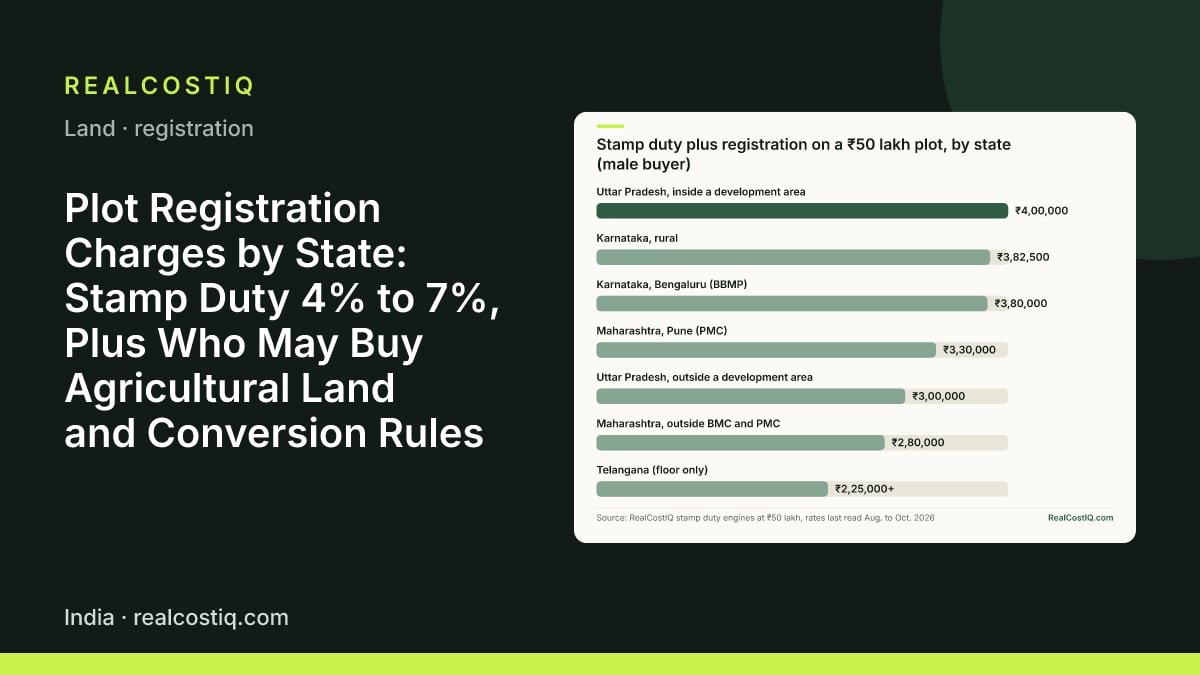
A registered deed for a plot normally pays the state's general conveyance rate. This is charged on the higher of the price and the circle or guidance value. The numbers below come from the state engines behind our stamp duty calculators. We ran them at one named value: a ₹50,00,000 (₹50 lakh) plot, male buyer, no concession. We did not take a rate from any portal today. kaveri.karnataka.gov.in, igrmaharashtra.gov.in and the Telangana registration host refused our connections on 8 October 2026. igrsup.gov.in answered, but we did not read a rate from it. So each rate is the one our own state page last read at the state source, on the date shown. The engine cites the department that publishes it. If you need a figure for a deal, confirm it at the sub-registrar's office first.
| State and body | Stamp duty | Cess, surcharge or local tax | Registration fee | Total | As % of value | Rate last read at source |
|---|---|---|---|---|---|---|
| Karnataka, Bengaluru (BBMP) | ₹2,50,000 (5%) | ₹30,000 (cess 10% and surcharge 2%, both of the duty) | ₹1,00,000 (2%) | ₹3,80,000 | 7.6% | 2026-08-24 |
| Karnataka, other urban body | ₹2,50,000 (5%) | ₹30,000 | ₹1,00,000 (2%) | ₹3,80,000 | 7.6% | 2026-08-24 |
| Karnataka, rural | ₹2,50,000 (5%) | ₹32,500 (cess 10% and surcharge 3%, both of the duty) | ₹1,00,000 (2%) | ₹3,82,500 | 7.65% | 2026-08-24 |
| Maharashtra, Pune (PMC) | ₹2,50,000 (5%) | ₹50,000 (Local Body Tax, 1%) | ₹30,000 (1%, capped) | ₹3,30,000 | 6.6% | 2026-09-10 (duty); 2026-08-21 (LBT); 2026-08-24 (fee) |
| Maharashtra, outside BMC and PMC | ₹2,50,000 (5%) | Nil | ₹30,000 (1%, capped) | ₹2,80,000 | 5.6% | 2026-09-10 (duty); 2026-08-24 (fee) |
| Uttar Pradesh, inside a development area | ₹3,50,000 (7%) | Nil | ₹50,000 (1%) | ₹4,00,000 | 8.0% | 2026-09-30 (rate); 2026-10-04 (development-area split) |
| Uttar Pradesh, outside a development area | ₹2,50,000 (5%) | Nil | ₹50,000 (1%) | ₹3,00,000 | 6.0% | 2026-09-30 (rate); 2026-10-04 (development-area split) |
| Telangana (floor only) | ₹2,00,000 (4%) | Transfer duty not modelled | ₹25,000 (0.5%) | ₹2,25,000 or more | 4.5% or more | 2026-08-21 |
Engine runs at ₹50,00,000, male buyer. These are residential-site figures: the Karnataka engine excludes the state's separate agricultural-land schedule, so do not read them as farmland costs. Maharashtra: the one-point women's concession (4%) applies in our engine's source only to residential units where women are the only purchasers, and we have not read it as covering a bare plot, so the standard 5% is shown. Uttar Pradesh: the 7% applies inside a notified development area and 5% outside, and our UP page notes that the department tags each village or mohalla, so check yours; the registration cost calculator always applies the inside-area 7%, so the outside-area row cannot be reproduced there. Telangana is a floor because the state also levies a transfer duty that our page could not source; do not read 4.5% as the all-in cost. Karnataka's registration fee was doubled to 2% from 31 August 2025 by a Stamps and Registration Department notification.
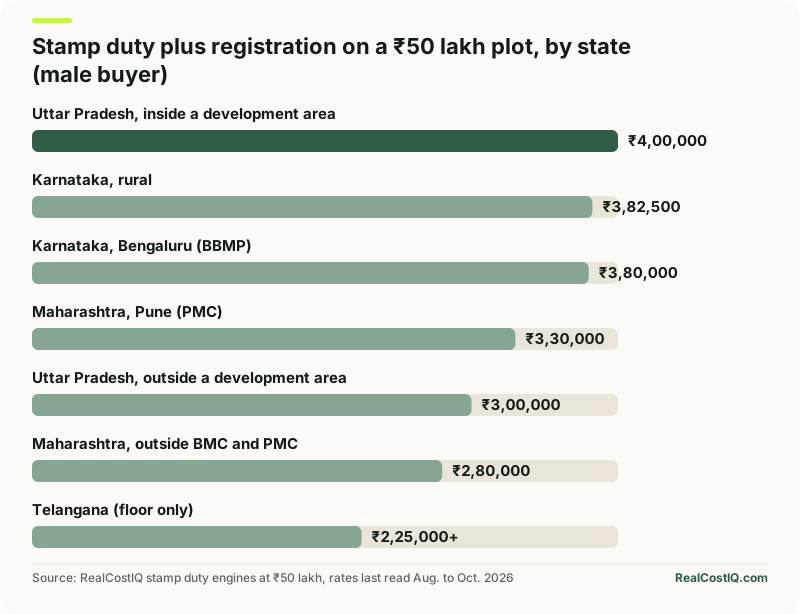
Two points in that table matter more than the ranking. First, Karnataka's reduced duty bands for a first sale of a flat do not apply to a plot. A ₹30 lakh plot in Bengaluru pays the general 5% duty and totals ₹2,28,000 (7.6%). The same ₹30 lakh as the first registration of a flat totals ₹1,60,800 (5.36%). A buyer who assumes the flat rate understates the plot's cost by ₹67,200. Our Karnataka stamp duty calculator has a first-sale toggle for exactly this reason. Second, Maharashtra's registration fee stops growing at ₹30,000. So on a larger plot there, the cost is nearly all stamp duty.
The percentage is applied to the higher of the price and the state's minimum value. So the category your survey number sits in matters. Karnataka's section 95(2)(vi) says a diversion order does not by itself raise the guidance value until the land is put to actual non-agricultural use. That is a rule about exactly this point. Our circle rate guide explains how Rajasthan values farmland near a city as residential and applies plot-size slabs. That is a worked example, not a rule for other states. Our flat-buying post sets out the order of payments for other costs of a purchase, such as GST, TDS and brokerage, though it is written for a flat. None of the figures above includes the cost of legal checks, a survey sketch, conversion fees, layout development charges or the broker.
Once the deed is registered, the record has to be updated. This step is called mutation. In Telangana, the Tahsildar amends the Record of Rights straight after registration of farmland. In Karnataka, the mutation fee is collected at registration. Our post on mutation after you buy property covers both, so we do not repeat them here.
If you plan to build on the plot, see our worked comparison of a plot plus construction loan with a ready flat. It shows how stamp duty on the land only, the loan interest during the build and the construction bill add up for a Bengaluru buyer.
Red flags that are specific to plots
- No conversion order for a plot being sold as residential. In Karnataka, selling farmland for non-farm purposes without conversion or the competent authority's prior approval is an offence under section 192-A(5). Since 10 September 2025 it carries a penalty of ₹1 lakh. Ask for the diversion order. Where the Master Plan permits the use, ask for the fee receipt and self-declaration instead. For part of a survey number, ask for the approved pre-conversion sketch.
- A conversion order on a false affidavit. Under section 95(2)(iii) of the Karnataka Act, a diversion obtained on a false declaration is void. The fee is forfeited and the land can be forfeited. The order's date and the affidavit's accuracy are part of your due diligence.
- Seller not in the record. Telangana's registration route is built on the pattadar matching the Record of Rights, and on the land not being assigned land. Elsewhere, a registered deed from someone who is not the recorded holder still leaves you without the title you paid for.
- A holding above the cap. In Uttar Pradesh, an acquisition that takes the buyer and family above 5.04 hectares needs approval under section 89(3). The Collector, Commissioner or State decides, depending on the area involved. Institutions that bought without approval can regularise on a fine of 50% of the cost of the excess land. Check this if a family that already holds land wants a farm plot.
- Seller from a protected category. UP's sections 98 and 99 and Karnataka's section 80-A show how transfers of land from Scheduled Caste and Scheduled Tribe holders are restricted. Ask for the permission in writing before the deed.
- A premium that nobody has priced. In Maharashtra, the Planning Authority collects the one-time premium before the building plan is approved. Add it to your build budget.
What this post did not read
We set one rule for this post. We had to read at least three states' rules at primary level on the day. We did that for Karnataka, Maharashtra, Uttar Pradesh and Telangana. We read Karnataka and the national statute database through India Code. We read Maharashtra through the Legislature's own bill PDF. We read Uttar Pradesh and Telangana through PRS copies of the gazette.
We did not read the following today. We name them so you do not assume them.
Maharashtra's buyer-eligibility section. The commencement dates of Karnataka's 2023 conversion Acts, and the notified conversion fee. The Karnataka section 63 ceiling after 2020. The Uttar Pradesh fee scale for a section 80 declaration, its rules, and Acts 4 of 2016 and 4 of 2021. The Telangana conversion rate. Layout approval by BDA, BMRDA, DTCP or any other authority. Tamil Nadu, Kerala, Gujarat, Rajasthan, Andhra Pradesh and every state not listed. The NRI position, which is a separate question under foreign exchange rules and is covered in one row of our NRI buying guide.
We also did not read any portal fee table today. Treat the registration table as a dated read of our own calculators. Treat the statutory sections as what the cited texts said on 8 October 2026.