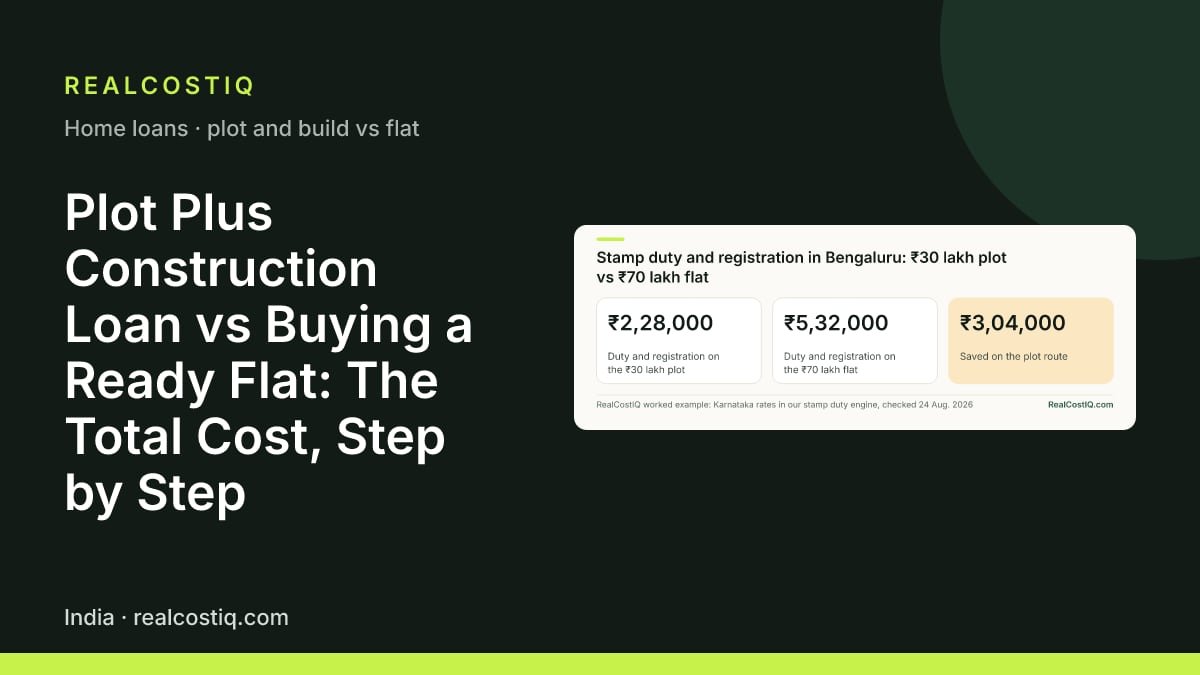
The question, and the one example we use all the way through
Many buyers ask the same thing. A plot looks cheaper than a flat. A ready flat looks simpler than a build. Which one costs less in the end? The honest answer depends on a few lines that are easy to miss. This post adds them up one at a time, with round numbers, in one city.
Here is the example. You live in Bengaluru, in Karnataka. You are a man buying alone. You have a budget of ₹70,00,000 (₹70 lakh). Route A is a plot for ₹30 lakh and a house built on it for ₹40 lakh. Route B is a ready flat for ₹70 lakh. By ready we mean finished, with a completion certificate (CC). That is a paper from the local authority that says the building was built as per the approved plan.
You borrow 80 per cent of the ₹70 lakh, which is ₹56 lakh, for 20 years. The yearly interest rate is 8.50 per cent for both routes. The 8.50 per cent is our illustration, not a quote. HDFC Bank's plot loan page, which we opened on 14 October 2026, shows rates as the RBI repo rate plus a spread, and lists a range of 8% to 13.45% a year with the repo rate at 5.50%. So 8.50 per cent sits near the low end of that range.
| Item | Route A: plot plus build | Route B: ready flat |
|---|---|---|
| What you buy | ₹30,00,000 plot, then a ₹40,00,000 house built on it | ₹70,00,000 finished flat with a completion certificate |
| City and body | Bengaluru, inside the BBMP (Bruhat Bengaluru Mahanagara Palike, the city corporation) area | Bengaluru, inside the BBMP area |
| Loan (80% of ₹70 lakh) | ₹56,00,000, 20 years, 8.50% | ₹56,00,000, 20 years, 8.50% |
| Your own money for the price | ₹14,00,000 | ₹14,00,000 |
| When you can move in | About 12 months after buying the plot (our assumption) | On day one |
Illustrative inputs chosen for round numbers. Interest rate and construction time are assumptions, not lender or builder quotes.
The loan cap of 80 per cent is not random. RBI's Credit Facilities Directions, which we read in the version updated on 15 July 2026, set the loan-to-value ratio, or LTV. LTV is the share of the property's value that a bank may lend. For an individual housing loan above ₹30 lakh and up to ₹75 lakh, the ratio may be up to 80 per cent. Above ₹75 lakh it is up to 75 per cent.
Step 1: stamp duty and registration, the saving on the plot route
Stamp duty is a tax the state charges when ownership of property is transferred on paper. Registration is the fee for recording that transfer in the state's records. In Karnataka both are charged on the property's value. The state also keeps a minimum value for each area, called the guidance value. In many states this is known as the circle rate. Duty is charged on the higher of your price and that minimum.
Here is the key point. On Route A you pay duty on the land only. When you build on land you already own, you sign no sale deed for the house. So the ₹40 lakh you spend on construction carries no stamp duty. On Route B you pay duty on the whole ₹70 lakh.
| Line | Plot, ₹30,00,000 | Ready flat, ₹70,00,000 |
|---|---|---|
| Stamp duty at 5% | ₹1,50,000 | ₹3,50,000 |
| Cess, 10% of the duty | ₹15,000 | ₹35,000 |
| Surcharge, 2% of the duty | ₹3,000 | ₹7,000 |
| Registration fee at 2% of the value | ₹60,000 | ₹1,40,000 |
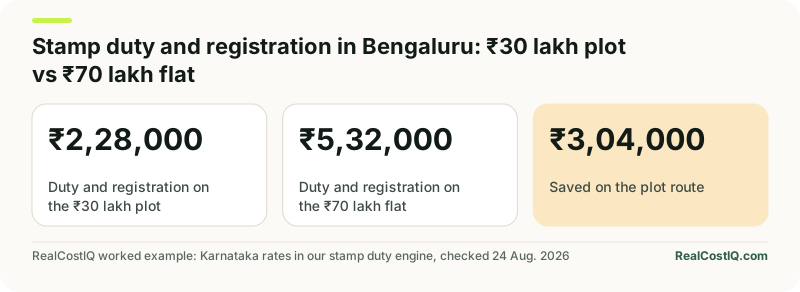
| Total | ₹2,28,000 (7.6%) | ₹5,32,000 (7.6%) |
| On the ₹40,00,000 build | Nil | Not applicable |
From the Karnataka rates in our stamp duty engine, run at these two values. The engine's Karnataka rates were last checked by us on 24 August 2026. A flat's reduced first-sale bands in Karnataka stop at ₹45 lakh, so the ₹70 lakh flat pays the general 5%. Cess and surcharge are charged on the duty itself. Karnataka's own registration portal did not open from our network today, so we did not re-read the state's schedule on 14 October.
Both routes come to 7.6 per cent of the value they are charged on. The saving comes from the base. ₹2,28,000 on the plot against ₹5,32,000 on the flat is a gap of ₹3,04,000. That is 7.6 per cent of the ₹40 lakh that is never stamped.
Two cautions. First, the rate for a plot is the general rate. Karnataka's reduced duty for the first sale of a flat does not apply to a plot, as we show in our post on plot registration costs by state. Second, rates differ in other states. Maharashtra, Telangana and Uttar Pradesh charge differently, and some add city levies. Do not use Karnataka numbers for another state. Our post on the true cost of buying a flat in India sets stamp duty and registration beside GST, brokerage and the other buyer-side costs of the flat route.
Step 2: GST, which only an unfinished flat carries
GST, short for goods and services tax, is a central and state tax on goods and services. It matters here because of one date. A flat that is still being built is treated as a service from the builder. A finished flat is not.
The Central Board of Indirect Taxes and Customs (CBIC) puts it in the law itself. Under Schedule II of the CGST Act, constructing a building meant for sale is a supply of service, except where the whole price is received after the completion certificate is issued or after first occupation, whichever is earlier. Schedule III says the sale of land and, subject to that exception, the sale of a building is neither a supply of goods nor of services. In plain words, a ready flat sold after its completion certificate carries no GST.
For flats that are still being built, CBIC's "GST – An Update" (as on 1 May 2019) states an effective rate of 5 per cent on homes outside the affordable segment and 1 per cent on affordable homes. Affordable means a carpet area up to 60 square metres in metro cities such as Bengaluru, with a value up to ₹45 lakh. Our ₹70 lakh flat is above ₹45 lakh, so 5 per cent would apply if it were still under construction. That document says it is for education and holds no legal validity, so check the current rate for your project. The 5 per cent comes with no input tax credit, which means the builder cannot pass back tax paid on his own costs.
| Flat stage when you pay | GST | On ₹70,00,000 |
|---|---|---|
| Ready, completion certificate in hand | Nil | ₹0 |
| Under construction, not affordable | 5% effective | ₹3,50,000 |
| Plot, then self-build | Not on the land | Not priced here (see below) |
Rates read in CBIC documents on 14 October 2026. The 1 May 2019 update is a summary, not the notification. Our GST on property calculator applies the same 5% and 0%.
On Route A, the sale of the plot is outside GST, as Schedule III says. But you will pay for the construction. A contractor's bill and the materials may carry GST. We have not read a current rate for those, so we have not priced it. Ask every quote for the tax shown on a separate line.
Step 3: what ₹40 lakh builds, and why this is the shaky number
Every other number in this post comes from a rule or a rate card. The construction cost does not. No Indian state sets a rate per square foot for building. The figure is a market estimate, and different surveys give different answers.
We read two published city tables today. HouseYog gives Bengaluru at ₹2,100 to ₹3,600 per square foot of built-up area. JK Cement gives Bengaluru at ₹1,800 to ₹2,800. Built-up area is the total floor area you build, on every floor, including the walls. The two surveys disagree, and we show both rather than average them. Our house construction cost calculator uses the HouseYog band for Bengaluru and splits it into three finish levels.
| Built-up area | HouseYog band (₹2,100 to ₹3,600 per sq ft) | JK Cement band (₹1,800 to ₹2,800 per sq ft) |
|---|---|---|
| 1,200 sq ft | ₹25,20,000 to ₹43,20,000 | ₹21,60,000 to ₹33,60,000 |
| 1,500 sq ft | ₹31,50,000 to ₹54,00,000 | ₹27,00,000 to ₹42,00,000 |
| 1,800 sq ft | ₹37,80,000 to ₹64,80,000 | ₹32,40,000 to ₹50,40,000 |
Area multiplied by each survey's published range. Both are market surveys, not government rates. Our construction engine's data was last verified on 28 August 2026, and we read both source pages again on 14 October 2026.
Our ₹40 lakh budget buys about 1,500 square feet at ₹2,667 per square foot. That sits in the lower half of HouseYog's band and near the top of JK Cement's. It is plausible. It is not safe. At 1,500 square feet, the HouseYog band runs from ₹31.5 lakh to ₹54 lakh. A basic finish could land at the low end. A better finish, a basement or a second floor could push it past ₹46 lakh.
A flat has no such range. The price on the agreement is the price. That fixed number is a large part of what you are paying for.
Step 4: what RBI says about the loan
RBI's Credit Facilities Directions for commercial banks set a few rules that shape both routes. We read them in the version updated on 15 July 2026. Housing finance companies follow their own regulator, so confirm with yours.
- Plot loans need a declaration. Paragraph 90 says a bank may finance a plot only if you declare that you intend to build a house on it, with the bank's help or otherwise, within a period the bank sets.
- The plan must be sanctioned first. Paragraph 92 says that if you own a plot and want a loan to build, the bank must get a copy of the building plan sanctioned by the competent authority before it sanctions the loan.
- You promise to build as per the plan. The same paragraph requires an affidavit that you will follow the sanctioned plan and obtain the completion certificate within three months of finishing. If you do not, the bank may recall the whole loan with interest and costs.
- The bank checks the build. An architect appointed or empanelled by the bank certifies at stages of construction that the work matches the plan.
- Stamp duty is outside the LTV. Paragraph 113 says the bank shall not count stamp duty, registration and other documentation charges in the cost it finances. There is an exception for homes costing up to ₹10 lakh. So the 80 per cent applies to the price, and you pay the ₹2.28 lakh or ₹5.32 lakh from your own pocket.
- Money is released in stages. Paragraph 116 says disbursal of housing loans to individuals shall be closely linked to the stages of construction, with no upfront release for incomplete or under-construction projects. Disbursal is the bank releasing the loan money to you or to the seller.
For how the plot-loan declaration, the prepayment rule and repo-rate tracking work in detail, see our plot loan eligibility calculator. We do not repeat them here. One related point is worth stating. RBI's Pre-payment Charges on Loans Directions, 2025 say a lender shall not levy pre-payment charges on floating-rate loans to individuals for purposes other than business. They apply to loans sanctioned or renewed on or after 1 January 2026, and the page above explains how they apply to a floating-rate plot loan.
Step 5: one composite loan, or a plot loan and then a home loan
A composite loan is one loan that covers both the plot and the construction. You sign once, and the bank sanctions the full amount up front. It then releases the money in parts. The other way is two separate loans. First a plot loan, then, once the plot is yours and the plan is sanctioned, a home loan for the build. A separate plot loan is repaid by EMI from the first month. EMI, short for equated monthly instalment, is the fixed monthly payment that covers interest and part of the loan.
State Bank of India's home loan portal lists a Combo Home Loan for plot purchase plus construction. It describes a single composite loan with an upfront sanction, repayment up to 30 years, interest on a daily reducing balance, and no pre-payment penalty. We read that page on 14 October 2026. It gives you the comfort of knowing the construction money is already approved.
HDFC Bank's plot loan page, read the same day, shows a plot loan as a separate product. It lists a tenure of up to 15 years and funding of 80 per cent of the plot cost for loans up to ₹75 lakh, and 75 per cent above that. It says funding may be restricted to 70 per cent if the plot is outside city limits, and that the limits apply to direct allotment cases. For a salaried borrower the page lists a processing fee of up to 0.50 per cent of the loan or ₹4,000, whichever is higher, plus taxes. On a ₹24 lakh plot loan that is up to ₹12,000 before taxes. A later home loan for the build may bring a second fee, so ask for both schedules.
| Item in the first 12 months | One composite loan | Plot loan, then a separate home loan |
|---|---|---|
| Plot money borrowed on day one | ₹24,00,000 | ₹24,00,000 over up to 15 years |
| Payments on the plot part | Interest only: ₹2,04,000 | 12 EMIs of ₹23,634: ₹2,83,605, of which ₹2,00,824 is interest |
| Interest on the build part, ₹8 lakh released each quarter | ₹1,02,000 | ₹1,02,000 |
| Interest paid in the year | ₹3,06,000 | ₹3,02,824 |
| Cash paid out in the year | ₹3,06,000 | ₹3,85,605 |
| Loan owed at the end of the year | ₹56,00,000 | About ₹55,17,219 |
| Is the build money already approved? | Yes, sanctioned up front | No, you apply again |
Computed with the standard reducing-balance method and checked against the site's EMI engine for the ₹56 lakh loan. We assume ₹8 lakh of the build part is released at the end of months 3, 6, 9 and 12. The second loan is assumed to be sanctioned on the same schedule.
The interest is almost the same. The difference is in the cash. With a plot loan you start repaying principal at once, so you pay about ₹80,000 more out of pocket in the year, and you must get a second loan approved. A composite loan keeps year-one payments lower and removes the approval risk. The price is that you are tied to one lender from the start.
Step 6: the interest you pay before you can move in
A loan on a finished flat is simple. All ₹56 lakh is paid out on day one, and your EMI starts at once. A construction loan is different. Money is released in stages as the work is done. You pay interest only on the amount released so far. This is often called pre-EMI interest, and we explain it in our post on pre-EMI versus full EMI.
Here is our build year. The plot part, ₹24 lakh, is out on day one. After that, ₹8 lakh is released at the end of each quarter as the walls, roof, finishing and fittings are completed.
| Months | Loan paid out | Interest in the quarter |
|---|---|---|
| 1 to 3 | ₹24,00,000 | ₹51,000 |
| 4 to 6 | ₹32,00,000 | ₹68,000 |
| 7 to 9 | ₹40,00,000 | ₹85,000 |
| 10 to 12 | ₹48,00,000 | ₹1,02,000 |
| Total for the year | ₹56,00,000 by month 12 | ₹3,06,000 |
Each quarter's interest is the balance multiplied by 8.50% divided by four. In month 13 the full EMI on ₹56,00,000 starts: ₹48,598 a month for 20 years, which is ₹60,63,544 of interest in all.
Now compare this with Route B. On the ready flat, you start paying EMI on day one, and you live in the flat while you do. We do not count that first-year interest as a cost of getting the home, because you are already in it. On Route A the ₹3,06,000 is a cost you pay before you can move in. That is why we count it.
Step 7: adding it all up
Now we put the lines together. For each route we add what you pay on top of the price: duty and registration, GST, and the interest you pay before you move in. We then try the plot route at three build costs, taken from the HouseYog and JK Cement ranges above.
| Route | Price and build | Duty and registration | GST | Interest before move-in | All-in cost |
|---|---|---|---|---|---|
| B: ready flat, with certificate | ₹70,00,000 | ₹5,32,000 | Nil | None | ₹75,32,000 |
| B: same flat, still under construction | ₹70,00,000 | ₹5,32,000 | ₹3,50,000 | Depends on the builder's stages, not priced | ₹78,82,000 plus pre-EMI |
| A: plot plus build at ₹40,00,000 | ₹70,00,000 | ₹2,28,000 | Contractor's tax not priced | ₹3,06,000 | ₹75,34,000 |
| A: build comes in at ₹31,50,000 | ₹61,50,000 | ₹2,28,000 | Not priced | ₹3,06,000 | ₹66,84,000 |
| A: build comes in at ₹46,50,000 | ₹76,50,000 | ₹2,28,000 | Not priced | ₹3,06,000 | ₹81,84,000 |
Interest is held at ₹3,06,000 in all three plot rows for simplicity. It would move a little with the build cost. Own money, rent paid during the build and the contractor's GST are not in these totals. The flat rows are for a flat in the same area.
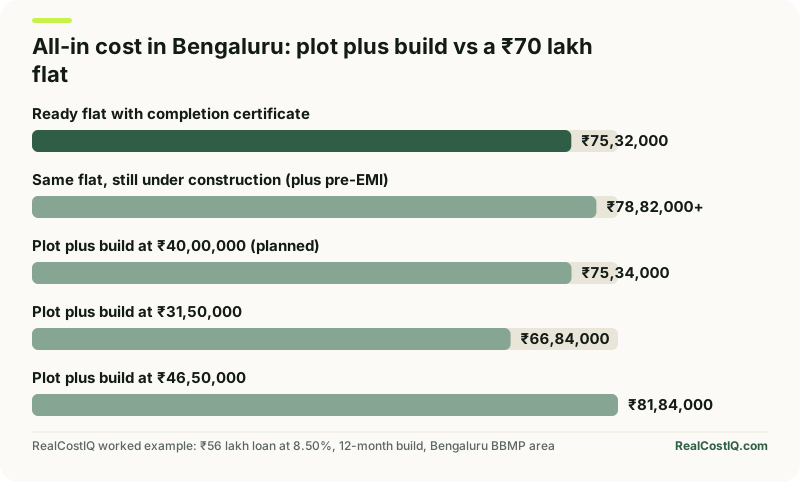
At the planned numbers, the two routes cost nearly the same: ₹75,34,000 against ₹75,32,000. That is a coincidence of these inputs, not a rule. Change the interest rate, the build time or the loan amount and the order can flip.
What does not change is the shape. The flat's cost is fixed once you sign. The plot route's cost is spread across a range of about ₹15 lakh, from ₹66.84 lakh to ₹81.84 lakh, depending only on the construction bill. The plot route can be the cheaper one by ₹8 lakh or more. It can also be the dearer one by ₹6 lakh. You choose how much of that uncertainty you can carry.
A still-unfinished flat is the worst of the three on these lines. GST of ₹3.5 lakh adds to duty, and the builder's stage schedule adds pre-EMI. This is the strongest case for waiting until the completion certificate is out, if you can.
What this comparison leaves out
A cost table can only hold what can be priced from a source. Several things that matter are not in it. We name them but do not price them.
- Time. A flat is yours now. A house takes the time we assumed, plus approvals before it. During the build you may pay rent. Add your own monthly rent times your own number of months.
- Approvals. The sanctioned building plan must be in your name before the bank sanctions the build loan, as paragraph 92 says. Plan fees, khata work, and water and power connections are not in our table. For what the khata type does to a Bengaluru loan, see our post on A-khata, B-khata and e-khata for a Bengaluru flat.
- Builder and contractor risk. A flat buyer takes the risk that the project is late or stuck. A self-builder takes the risk that a contractor overruns the budget or the schedule. Neither risk has a price we can source.
- Not the same home. ₹70 lakh buys a different place on each route. A flat may be in a centre with a lift and a clubhouse. A plot may be farther out. The comparison fixes the budget. It does not fix the quality, the size or the location.
- Other costs of a flat. Maintenance, a parking charge and club fees come with a flat. Our post on the true cost of buying a flat covers them.
How to run your own numbers
- Write down your state, city and the local body for the plot. Use that state's stamp duty calculator, not Karnataka's. Our Karnataka stamp duty calculator covers Karnataka.
- Find the guidance value, or circle rate, for the plot. Duty is charged on the higher of the price and that value.
- Ask a local engineer or two contractors for a written quote for the house, with the finish named and GST shown. Compare it with the ranges in the house construction cost calculator.
- Ask your bank for a composite loan quote and a plot-plus-home-loan quote. Ask for the sanction letter's fee schedule and the date the build money is released.
- Use the staged-interest table above and your own timeline to work out the interest before move-in.
- For the flat, ask whether the completion certificate is in hand. If not, add 5 per cent GST for a flat above ₹45 lakh. Our GST on property calculator works the amount for your price.
What this post did not verify
- We did not re-read Karnataka's stamp duty and registration schedule at the state's own portal on 14 October 2026. It did not open from our network. The rates used are from our Karnataka stamp duty engine, last checked on 24 August 2026.
- We did not read a current bank rate card. The 8.50 per cent is an illustration.
- We did not price GST on a contractor's bill or on building materials, the cost of a sanctioned plan, utility connections, or rent during the build.
- The CBIC GST rates for flats come from a 2019 summary and from the CGST Act schedules. Check the notification in force for your project.
- Construction costs are market surveys, not official rates. HouseYog and JK Cement disagree, and we show both.
- We did not model a delayed project, a stuck project or a builder insolvency. For the last, see our post on a homebuyer's rights when a builder goes insolvent.