A 30-year amortization is the easiest way to lower a mortgage payment in Canada. It is also one of the easiest ways to pay more for the loan. For years most buyers with a small down payment were held to 25 years. Federal rules changed that for two groups of buyers. This post checks who is covered today, what the extra five years cost, and what they do to the income you need to qualify.
All amounts are in Canadian dollars (CAD). The rule text was read on the Department of Finance Canada, Justice Laws and CMHC pages on 2026-10-17. The rate is an example, not a quote, and the price is a round number, not a market figure. The post is not advice. The CMHC insurance calculator and the Canadian amortization calculator let you run your own case.
Who can use a 30-year amortization today
The rule sits in the federal regulations for mortgage insurance. Subsection 5(1.1) of the Insurable Housing Loan Regulations says an insured loan may be scheduled to amortize over more than 25 years, up to 30, if any of the borrowers is a first-time home buyer or if the property is newly built (Justice Laws, Insurable Housing Loan Regulations, regulations current to 2026-09-30, last amended 2025-02-27, read 2026-10-17). The Eligible Mortgage Loan Regulations carry the same wording.
That is a rule for insured mortgages. The Department of Finance says the 30-year measure applies where the loan is more than 80% of the home's value, which is called a high-ratio mortgage (Finance Canada, Delivering the Boldest Mortgage Reforms in Decades, backgrounder of September 24, 2024, read 2026-10-17). In other words, it applies when you put down less than 20%. The same package raised the price cap for insured mortgages from C$1 million to C$1.5 million.
| Buyer and home | Longest insured amortization | Why |
|---|---|---|
| First-time buyer, resale home | 30 years | Any borrower is a first-time buyer |
| First-time buyer, new build | 30 years | Either test is enough |
| Repeat buyer, new build | 30 years | The home is newly built |
| Repeat buyer, resale home | 25 years | Neither test is met |
Rule: Insurable Housing Loan Regulations, s. 5(1.1), as amended by SOR/2025-55. The test is met if any one borrower qualifies.
What counts as a first-time buyer
The regulation gives three ways to qualify. You have never bought an eligible home in Canada before. Or you have not lived in a home owned by you or your current spouse or common-law partner in the current calendar year or the four years before it. Or you are separated from a spouse or partner after a relationship breakdown. For that last one, the separation must have lasted at least 90 days and begun in the current year or the four before it. The Department of Finance notes that this follows the approach of the Home Buyers' Plan. Only one borrower needs to qualify. So a repeat buyer who adds a first-time buyer as a co-borrower can meet the test.
What counts as a new build
A home is newly built if it has never been occupied for residential purposes. For a condominium, a short period when the buyer moved in early, before the condo was registered, does not disqualify it. This matters for pre-construction condos, where early occupancy is common. It means a home that someone has already lived in does not count, even if it is nearly new. Lenders check this, so ask yours how they document it.
When the rule started and whether it is still in force
The first version began on August 1, 2024, and covered first-time buyers of new builds. The wider version began on December 15, 2024. The regulation that wrote both into law, SOR/2025-55, was registered on February 27, 2025, and deems the wider text to have been in force from December 15, 2024 (Canada Gazette, Part II, Volume 159, Number 6, read 2026-10-17). The consolidated regulations on Justice Laws are current to September 30, 2026, and still show the 30-year text with no later change. So the rule is in force as we write this. Rules can change with a federal announcement, so check with a lender or the Department of Finance before you rely on it.
What if you put down 20% or more? Then the mortgage is not insured, and this insurance rule does not apply. The lender sets the longest amortization it will offer, so ask. The stress test explainer covers the qualifying rate, which applies either way.
One worked example: a C$575,000 first home
Take a first-time buyer who wants a home priced at C$575,000. The price is a round example, chosen to be different from the C$600,000 case in our mortgage payment on a C$600,000 home post. The buyer puts down the minimum and gets an insured mortgage. The question is what changes between 25 and 30 years.
- Find the minimum down payment. The rule is 5% of the first C$500,000 plus 10% of the rest (CMHC, general requirements, read 2026-10-17). That is C$25,000 plus C$7,500, which is C$32,500, or 5.65% of the price.
- Find the loan before insurance. C$575,000 minus C$32,500 is C$542,500. That is 94.35% of the price.
- Find the CMHC premium at 25 years. For a loan between 90.01% and 95% of the price, CMHC's table shows 4.00% (CMHC, premium information, read 2026-10-17). 4.00% of C$542,500 is C$21,700. Added to the loan, the total is C$564,200.
- Find the premium at 30 years. CMHC's premium page says an amortization beyond 25 years is subject to a 0.20% surcharge. The premium becomes 4.20%, which is C$22,785. The total is C$565,285. The surcharge costs C$1,085.
- Pick the rate. We use 4.75% as an example for both. It is not a quote.
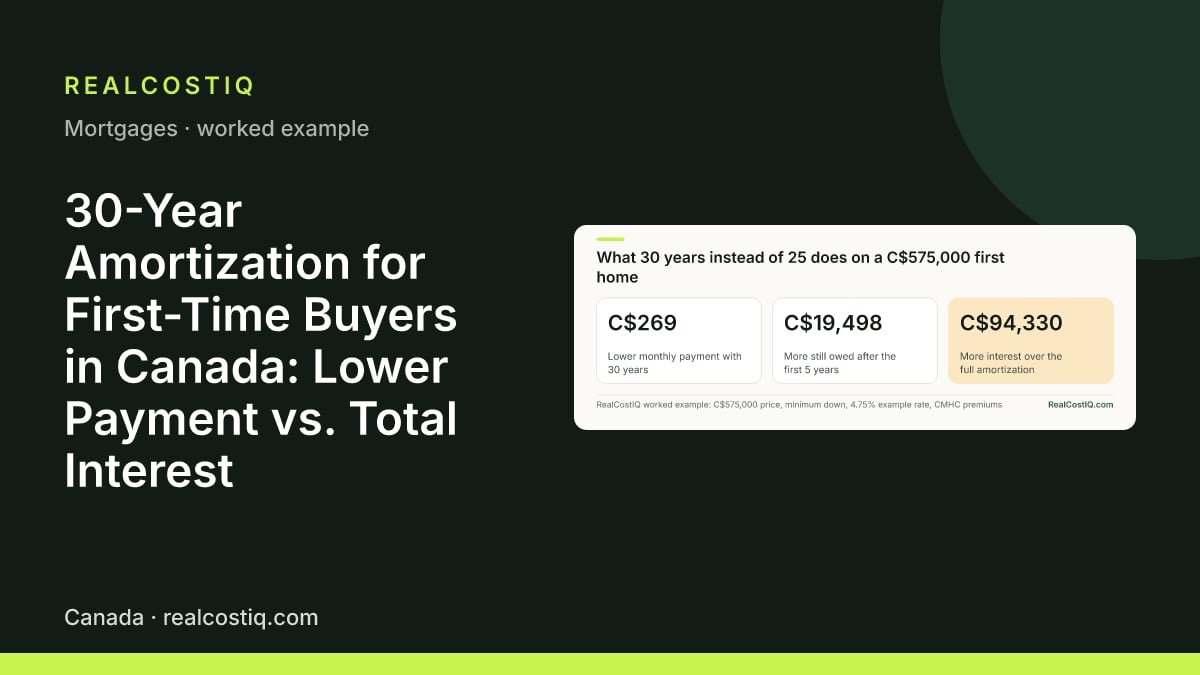
- Work out the payments. Canadian fixed-rate mortgages compound twice a year, not monthly. With that rule, the payment on C$564,200 over 25 years is about C$3,202 a month. The payment on C$565,285 over 30 years is about C$2,933 a month. The difference is about C$269 a month, or C$3,223 a year.
A note on the surcharge. CMHC's premium page prints the 0.20% line under its refinance table, and its 2024 notice about the 30-year option describes a premium surcharge of 20 basis points (CMHC notice, June 5, 2024). A basis point is one hundredth of one percent. We apply it to the purchase loan, as the CMHC calculator on this site does. The two private insurers, Sagen and Canada Guaranty, publish their own premium tables. Get the exact figure in writing from your lender.
What the lower payment costs
A smaller payment is a real benefit. But the loan runs five years longer, and interest is charged on the balance for all of that time. If the rate stayed at 4.75% for all 30 years, the interest over the life of the loan would be about C$396,275 for 25 years and about C$490,605 for 30 years. That is about C$94,330 more. It is a rough guide only. A mortgage term is usually five years, and the rate resets each time you renew, so the real figure will differ.
| Item | 25 years | 30 years | Difference |
|---|---|---|---|
| Premium rate | 4.00% | 4.20% | +0.20 point |
| Premium | C$21,700 | C$22,785 | +C$1,085 |
| Total mortgage | C$564,200 | C$565,285 | +C$1,085 |
| Monthly payment | C$3,202 | C$2,933 | -C$269 |
| Interest in the first 5-year term | C$125,270 | C$127,570 | +C$2,300 |
| Balance owed after 5 years | C$497,375 | C$516,873 | +C$19,498 |
| Interest over the full amortization (if the rate never changed) | C$396,275 | C$490,605 | +C$94,330 |
Computed with the site's Canadian mortgage engine (semi-annual compounding). Rate is an example. Alberta is used for the CMHC calculation because it charges no provincial sales tax on the premium.
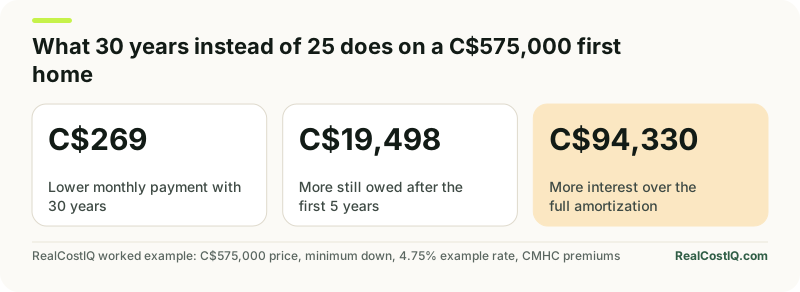
Look at the middle of the table. During the first five years, the extra interest is small, about C$2,300. The real difference shows up in what you still owe at the end of the term. The 30-year buyer owes about C$19,500 more. Put another way, in five years the 25-year buyer repays about C$66,800 of the loan and the 30-year buyer repays about C$48,400. That is equity, the part of the home you own outright. A slower start means less equity early on, and less cushion if prices fall or you need to sell.
The pattern repeats at higher down payments. At 10% down on the same home, the premium is 3.10% for 25 years and 3.30% for 30, and the payment falls from about C$3,028 to about C$2,774, a saving of about C$254. At 15% down, the premium is 2.80% and 3.00%, and the payment falls from about C$2,851 to about C$2,612, a saving of about C$239. The extra lifetime interest in those cases is about C$89,200 and C$84,000. A bigger down payment shrinks the cost of the longer period, but only a little. The CMHC insurance calculator shows the premium for each level.
What it does to the income you need
Lenders do not test your payment at 4.75%. They test it at the qualifying rate, which is the greater of your contract rate plus 2 points or 5.25% (CMHC, Calculating GDS / TDS, read 2026-10-17). Here that is 6.75%. They then check that your housing costs are no more than 39% of your gross income. Housing costs are the payment, property tax and heat. That ratio is called GDS, for gross debt service.
At 6.75%, the test payment is about C$3,865 for the 25-year loan and about C$3,632 for the 30-year loan. We add C$4,000 a year for property tax and C$120 a month for heat. These are placeholders, not averages. Then the income needed is about C$132,900 for 25 years and about C$125,700 for 30 years. The longer amortization lowers the income needed by about C$7,200, or 5.4%. That gap comes only from the two test payments, so it stays the same whatever property tax and heat you plug in; only the two income totals move.
Turn that around and you see the risk. A buyer earning C$132,900 who takes the 30-year option can qualify for a mortgage about C$37,400 larger than the 25-year buyer, because each dollar borrowed costs less per month. The 30-year amortization is a tool that lets you borrow more. If a buyer uses all of that room, the extra interest grows, and so does the risk at renewal. The stress test explainer covers why the test exists. It is there because your term ends long before your amortization does.
A 30-year amortization is not a 30-year rate
Many first-time buyers mix up two numbers. The amortization is the whole period for repaying the loan. The term is how long your contract and rate last. Most Canadian mortgages have a term of five years or less. At the end of the term you renew at the rates of that day. So when someone says they have a 30-year mortgage, they mean a loan scheduled over 30 years with a rate fixed for a shorter term.
This matters here. The C$269 saving in the table holds only while your rate stays at 4.75%. If your rate is higher at renewal, the payment on the remaining balance rises, and the 30-year buyer has a higher balance to carry. The Bank of Canada held its policy rate at 2.25% at its latest decision and will announce the next one on October 28, 2026 (Bank of Canada, policy interest rate, read 2026-10-17). The policy rate is not the mortgage rate, but it is one input.
Can you get the benefit and still pay it off sooner?
Some buyers take the 30-year schedule to qualify, then pay more than the minimum when they can. Suppose the buyer in our example takes 30 years but pays the 25-year payment of about C$3,202 from the start. The balance still falls in under 26 years. It takes about 302 months, roughly two months longer than the 25-year loan, because of the higher premium. So the extra years are an option, not a commitment.
Whether you can do this depends on the lender. Many mortgages let you raise the payment or make lump-sum prepayments each year up to a limit, but the limits differ. Ask these questions before you sign: Can I raise my regular payment, and by how much? What share of the original amount can I prepay each year without a penalty? What is the penalty if I repay in full before the term ends? Our Canadian amortization calculator can show what an extra payment does to the schedule. The accelerated bi-weekly mortgage calculator shows what paying every two weeks does to the payoff date.
How to think about the choice
This is not a recommendation. These are the trade-offs a buyer weighs.
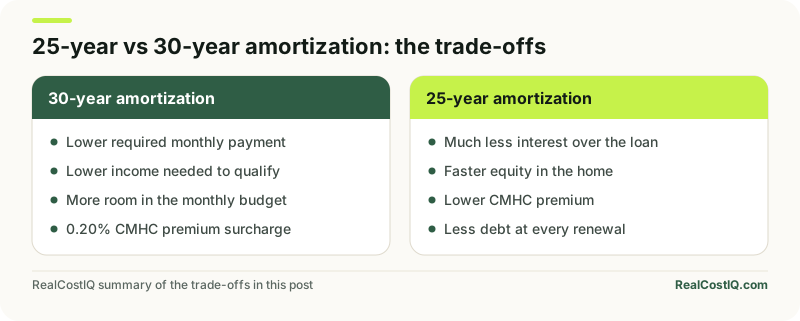
- For 30 years: a lower required payment, more room in the monthly budget, a lower income needed to qualify, and the option to pay extra when money is available.
- For 25 years: much less interest over the life of the loan, faster equity, a lower premium, and less debt at every renewal.
- The middle path: many buyers qualify on 30 years and then pay at a 25-year level. This keeps the safety margin while still repaying fast, if the lender allows it.
- The risk: using the lower payment to buy a more expensive home, so the saving disappears and a larger balance remains.
If you are buying a new build, the choice also applies to you even if you have owned before. If you are a repeat buyer of a resale home with less than 20% down, 25 years is the longest insured amortization, and this post does not change that.
Limits of this analysis
- One rate for all years. Real mortgages renew. The 30-year interest total is an illustration, not a forecast.
- One price. The numbers scale with the price and the premium tier. The pattern holds, but your own figures will differ.
- The surcharge wording. CMHC's page prints the 0.20% line in its refinance section. Check the exact premium for a purchase with your lender, and note that private insurers set their own.
- Placeholders. Property tax of C$4,000 a year and heat of C$120 a month are not averages. Your costs will differ.
- Provincial taxes. Ontario, Québec and Saskatchewan charge sales tax on the premium, which cannot be added to the loan. The surcharge adds to that tax.
- Rules can change. We confirmed the rule in force on 2026-10-17. Check again before you apply.