Many Canadian buyers search for one thing. How much will the monthly payment be on a C$600,000 home? The answer depends on three choices: how much you put down, your interest rate, and how long you take to repay. This post works through all three in Canadian dollars (CAD), step by step, with round numbers.
In plain English
- A mortgage is a loan to buy a home. The monthly payment pays back the loan plus interest.
- In Canada, you must put down at least 5% of the first C$500,000 and 10% of the rest. On a C$600,000 home, that is C$35,000.
- If you put down less than 20%, the mortgage must be insured. The insurance protects the lender, not you. You pay a one-time premium to the Canada Mortgage and Housing Corporation (CMHC) or another insurer. It is usually added to your loan.
- At an example rate of 4.50% and 25 years to repay, the payment on a C$600,000 home is about C$3,252 with the minimum down, C$3,081 with 10% down, and C$2,657 with 20% down.
- Property tax, heat and home insurance are extra. They are not part of the mortgage payment, but you need to budget for them.
One worked example: C$600,000 with the minimum down
Start with the simplest case. You buy a C$600,000 home. You put down the least the law allows. Here is each step.
- Find the minimum down payment. The Financial Consumer Agency of Canada (FCAC) says homes between C$500,000 and C$1.5 million need 5% of the first C$500,000 plus 10% of the rest. That is C$25,000 plus C$10,000, or C$35,000. This is 5.83% of the price.
- Find the loan before insurance. C$600,000 minus C$35,000 is C$565,000.
- Add the CMHC premium. With less than 10% down, the CMHC premium table says 4.00% of the loan. 4.00% of C$565,000 is C$22,600. FCAC says you can add the premium to your mortgage or pay it as a lump sum. Here it is added, so you do not pay it up front.
- Find the total mortgage. C$565,000 plus C$22,600 is C$587,600.
- Pick an interest rate. We use 4.50% as an example. It is not a quote. Your rate depends on your lender, your term and your credit.
- Pick the amortization. We use 25 years. Amortization is the total time you take to repay the whole loan. It is not the same as the term. The term is the length of one contract, often five years.
- Work out the payment. The result is about C$3,252.21 a month.
That payment is for principal and interest only. Principal is the money you borrowed. Of the first month's payment, about C$2,183 is interest and about C$1,069 reduces the loan.
Next, add the costs that come with owning the home. We use placeholder numbers: C$500 a month for property tax (C$6,000 a year) and C$150 a month for heat. These are not averages. Your own numbers will differ, and property tax varies a lot by city. With those placeholders, the total monthly cost is about C$3,902. The site's property tax calculator, linked at the end, is a better guide for your own city.
| Item | Amount (CAD) |
|---|---|
| Mortgage principal and interest | C$3,252.21 |
| Property tax (placeholder) | C$500.00 |
| Heat (placeholder) | C$150.00 |
| Total per month | C$3,902.21 |
Hypothetical. Mortgage payment worked out with semi-annual compounding on C$587,600. Property tax and heat are placeholders, not averages. Home insurance, utilities other than heat, condo fees and maintenance are not included.
The same home with 10% and 20% down
Now compare three down payments on the same C$600,000 home. The rate and the 25 years stay the same.
| Minimum down | 10% down | 20% down | |
|---|---|---|---|
| Down payment | C$35,000 (5.83%) | C$60,000 | C$120,000 |
| Loan before insurance | C$565,000 | C$540,000 | C$480,000 |
| CMHC premium rate | 4.00% | 3.10% | None |
| CMHC premium added to loan | C$22,600 | C$16,740 | C$0 |
| Total mortgage | C$587,600 | C$556,740 | C$480,000 |
| Monthly payment | C$3,252.21 | C$3,081.41 | C$2,656.67 |
| Difference from minimum down | - | C$170.80 less | C$595.54 less |
Hypothetical. Premium rates are the base rates in CMHC's premium table (read 2026-10-14); the site's CMHC calculator adds 0.20 points for a 30-year amortization. Payments use semi-annual compounding. Provincial sales tax on the premium (see below) is paid in cash and is not in these numbers.
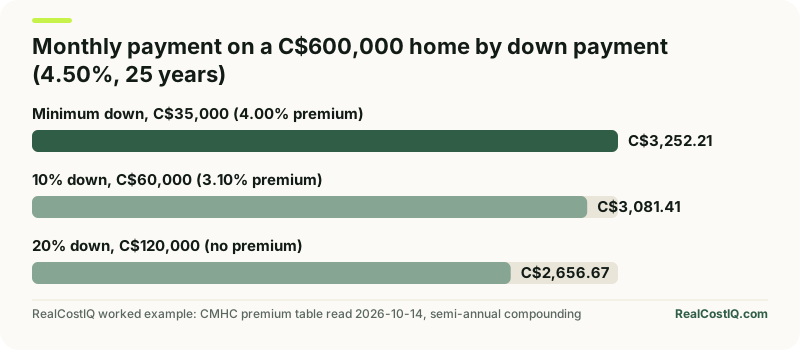
Look at the difference between the first and second columns. Putting down C$25,000 more cuts the payment by about C$171 a month. Part of that is a smaller loan. Part of it is a lower premium rate: 3.10% instead of 4.00%.
The jump to 20% down is bigger. You borrow C$480,000. You pay no premium at all, because with 20% or more down the mortgage does not have to be insured. The payment falls to about C$2,657. That is about C$596 a month less than the minimum-down case.
After the first five-year term, the loan balance is also different. At the same 4.50% rate, you would still owe about C$515,892 with the minimum down, about C$488,798 with 10% down, and about C$421,423 with 20% down. That assumes the rate does not change, which a real five-year renewal will not do. Still, it shows that a bigger down payment is felt for years.
How the CMHC premium works
CMHC is a federal Crown corporation. It insures mortgages for lenders. If you put down less than 20%, FCAC says you will typically need mortgage loan insurance. You, the borrower, pay the premium. The insurer protects the lender if you stop paying.
CMHC's own premium table sets the rate by the loan-to-value ratio. That is the loan divided by the price of the home. Here are the parts of the table that matter for a C$600,000 home.
| Loan-to-value | Premium on the total loan |
|---|---|
| Up to and including 65% | 0.60% |
| 65.01% to 75% | 1.70% |
| 75.01% to 80% | 2.40% |
| 80.01% to 85% | 2.80% |
| 85.01% to 90% | 3.10% |
| 90.01% to 95% | 4.00% |
Source: CMHC, premium table for mortgage loan insurance, read 2026-10-14. CMHC also lists a higher rate (4.50%) for a non-traditional down payment, for example borrowed funds. Other insurers have their own tables. For the full tiers, the 30-year amortization surcharge and a calculator, use the site's CMHC insurance calculator.
Our three cases line up with the table. The minimum down is 94.17% loan-to-value, so it falls in the 4.00% band. 10% down is 90% loan-to-value, which is in the 3.10% band. 20% down is 80%. With 20% or more down, insurance is not required, so we treat it as no premium.
Why the 5% down payment does not apply to a C$600,000 home
You may have heard that you can buy a home with 5% down. That is true only up to the first C$500,000. On a C$600,000 home, 5% would be C$30,000. That is below the legal minimum of C$35,000. So the first column in our tables uses C$35,000, not C$30,000.
The same rule gives different minimums at nearby prices. For a C$500,000 home, the minimum is C$25,000 (5%). For a C$700,000 home, it is C$45,000 (6.43%). Above C$1.5 million, FCAC says the minimum is 20% of the price.
C$500,000, C$600,000 and C$700,000 side by side
Here is the same method at three prices. Each row uses the minimum down payment, 10% down and 20% down. Rate: 4.50%. Amortization: 25 years.
| Home price | Minimum down | 10% down | 20% down |
|---|---|---|---|
| C$500,000 | C$25,000 down: C$2,734.16 | C$50,000 down: C$2,567.84 | C$100,000 down: C$2,213.89 |
| C$600,000 | C$35,000 down: C$3,252.21 | C$60,000 down: C$3,081.41 | C$120,000 down: C$2,656.67 |
| C$700,000 | C$45,000 down: C$3,770.26 | C$70,000 down: C$3,594.97 | C$140,000 down: C$3,099.45 |
Hypothetical. Insured cases include the CMHC premium added to the loan (4.00% at the minimum down, 3.10% at 10% down). Premiums: C$19,000 / C$22,600 / C$26,200 at the minimum down and C$13,950 / C$16,740 / C$19,530 at 10% down. Semi-annual compounding. No provincial sales tax on the premium, no property tax or other costs.
Each C$100,000 of price adds about C$518 a month at the minimum down. That is the cost of borrowing C$100,000 more at this rate and term, plus a higher premium. At 20% down, each C$100,000 of price adds about C$443 a month.
What a different rate does
We used 4.50% as an example. Your rate may be higher or lower. For context, Royal Bank of Canada's mortgage page, read on October 14, 2026, listed a variable-rate special of 4.150% for 25 years or less. The Bank of Canada's weekly table showed the posted 5-year conventional mortgage rate at 6.19% on October 7, 2026. A posted rate is a bank's list price. Most borrowers negotiate a lower rate. Neither number is a quote for you.
| Rate | 10% down (loan C$556,740) | 20% down (loan C$480,000) |
|---|---|---|
| 3.50% | C$2,779.64 | C$2,396.50 |
| 4.00% | C$2,928.56 | C$2,524.90 |
| 4.50% | C$3,081.41 | C$2,656.67 |
| 5.00% | C$3,238.03 | C$2,791.70 |
| 5.50% | C$3,398.29 | C$2,929.88 |
Hypothetical. Semi-annual compounding. The 10% down loan includes a CMHC premium of C$16,740.
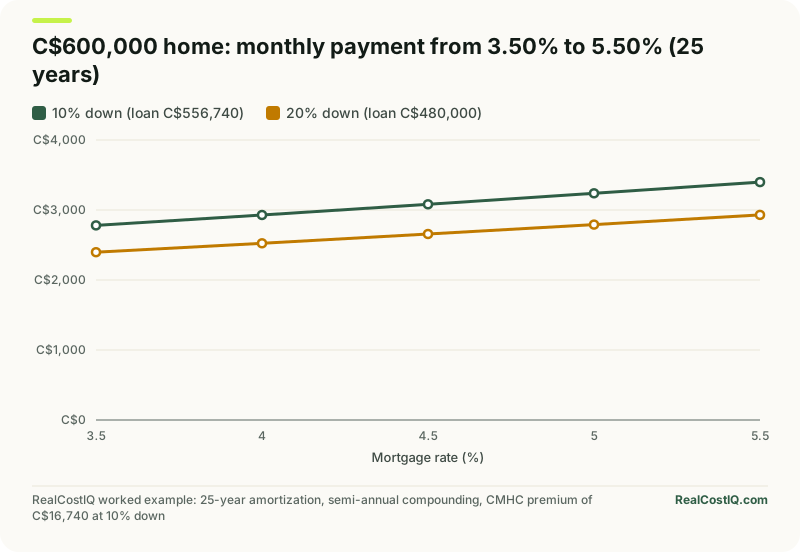
A full point on the rate is worth about C$317 a month with 10% down and about C$273 a month with 20% down. Rate matters, but so does the size of the loan.
Canadian rates use half-yearly compounding. Compounding means interest is added on top of earlier interest. The Interest Act, section 6, says that for many mortgages the rate must be stated as a yearly or half-yearly rate, not in advance. The site's mortgage calculator turns the stated rate into a monthly rate the Canadian way. A US-style calculator, which divides the rate by 12, gives a slightly different payment. Do not use it for a Canadian mortgage.
Term versus amortization
Two words cause most of the confusion. The first is amortization. The second is term. FCAC defines the term as the time your mortgage contract is in effect. It can run from a few months to five years or more. The amortization period is the total time it takes to repay the mortgage. It is estimated using the rate of your current term.
Here is what that means for you. The numbers in this post assume 25 years of amortization. In real life you sign a contract for a term, often five years. At the end of the term, you renew at the rate then on offer. Your payment can then go up or down. The 25-year clock keeps running.
FCAC says the maximum amortization is 25 years when the down payment is under 20%, with 30 years allowed for first-time buyers and new builds. With 20% or more down, the lender sets the maximum. A longer amortization lowers the payment, but you pay more interest in total. For example, 20% down on C$600,000 at 4.50% over 30 years gives about C$2,420 a month instead of C$2,657. That is about C$236 less a month, in exchange for five more years of interest. For a first-time buyer's insured case, with the premium surcharge and the interest cost worked on a different home, see 30-year amortization for first-time buyers. To see how accelerated bi-weekly payments would shorten the 25 years, use the bi-weekly mortgage calculator.
What the payment does not include
The mortgage payment is only part of the cost of owning a C$600,000 home. These costs are separate, and some are large.
- Land transfer tax. Several provinces and some cities charge a tax when you buy. The amount depends on the province and sometimes the city. Use the land transfer tax calculator for your location. Some provinces have rebates for first-time buyers. Do not assume a national figure.
- Provincial sales tax on the CMHC premium. Only Ontario, Quebec and Saskatchewan charge it. It is paid in cash at closing.
- Legal fees, title insurance and other closing costs. These vary by province.
- Property tax. It is set by the municipality and differs a great deal from one city to the next.
- Home insurance, utilities, maintenance and condo fees. All are extra.
Can you qualify for this payment?
A lender will not only look at the payment. It will also test whether you could still afford the loan if rates were higher. That test is called the stress test. For uninsured mortgages (20% or more down), the Office of the Superintendent of Financial Institutions (OSFI) says the minimum qualifying rate is the greater of your contract rate plus 2 percentage points or 5.25%. OSFI's page shows a date modified of January 29, 2026.
Apply that to our 20% down case. At a contract rate of 4.50%, the qualifying rate is 6.50%. On C$480,000 over 25 years, the payment at 6.50% is about C$3,215 a month. You would still pay the C$2,657. But the lender checks that your income can carry the higher figure. How much income that takes is a separate question, covered in the post on the mortgage stress test in Canada, which has a worked income table.
How this compares with Canada's average price
A C$600,000 home is a little under the national average. The Canadian Real Estate Association (CREA) reported a national average home price of C$668,219 for August 2026. That was up 0.6% from August 2025. Its National Composite MLS Home Price Index was down 3% from a year earlier, and was unchanged from July. CREA released the numbers on September 15, 2026.
Two cautions. First, an average mixes very expensive and very cheap markets, so it says little about your city. Second, it is the average of homes that sold, not the price of the home you will buy. The same method in this post works at any price. Change the price, and the minimum down payment and the premium change with it.
How to use this for your own numbers
- Write down the home price you are looking at.
- Work out the minimum down payment with the FCAC rule, or choose your own amount.
- If the down payment is less than 20%, look up the CMHC premium for your loan-to-value, and add it to the loan.
- Enter the loan, a realistic rate and 25 years in the site's mortgage calculator. Try rates one point above and one point below.
- Add property tax, heat and insurance for your own city.
- Check whether you pass the stress test with your income and debts.
- Compare the total monthly cost with renting a similar home. For a Toronto worked example, see Rent or Buy in Toronto in 2026? Condo vs House, Worked Out.