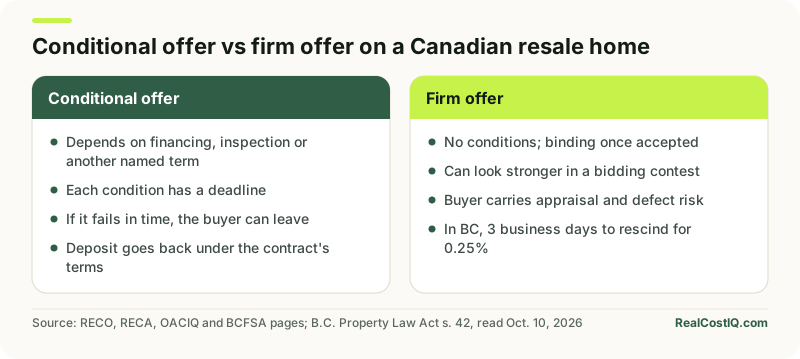
A condition in an offer is a stated way out. The buyer writes into the contract that the purchase depends on something, usually a mortgage approval or a home inspection. The buyer also sets a deadline. If the condition is met or waived by the deadline, the contract is firm. Waived means the buyer gives up the condition. If the condition is not met, the contract ends and the deposit goes back. The deposit is the money the buyer puts down when the offer is accepted. So dropping a condition to make an offer more attractive means giving up the way out to be more competitive. The price of that trade depends on what the condition protected you from, and on where in Canada you are buying.
This post explains how the contract works. It draws on statutes, regulations and regulator pages read on 2026-10-10. It does not teach the stress test or how lenders count income. Our mortgage stress test post and lender income posts already cover those. It also does not re-explain condo document review, which the status certificate post owns. (A status certificate is a condo corporation's summary of its finances and rules.) We read four provinces at primary level: British Columbia, Ontario, Alberta and Quebec. Anything about another province was not read and is not stated. Dollar figures are Canadian dollars (CAD). The worked examples are our own arithmetic on hypothetical inputs. This is information, not legal advice. Whether to waive a condition is a decision to make with a real estate lawyer (or a notary in Quebec) who reads your actual contract.
The four provinces side by side
| Province | Statutory right to back out after acceptance? | How a condition works | Where the deposit sits | What was read |
|---|---|---|---|---|
| British Columbia | Yes, for most residential purchases: rescind by written notice within 3 business days; pay the seller 0.25% of the purchase price from the deposit; cannot be waived (Property Law Act s. 42; B.C. Reg. 175/2022) | Conditions are separate contract terms. The rescission clock starts the day after acceptance (BCFSA FAQ) | If rescinded, the brokerage pays the 0.25% to the seller and returns the rest to the buyer; no signed release needed (BCFSA FAQ) | Property Law Act (current to 6 October 2026); B.C. Reg. 175/2022 (current to 6 October 2026); BCFSA pages |
| Ontario | Not addressed on the RECO pages read | RECO warns buyers against removing protective conditions in competing offers and says pre-qualifying does not eliminate the need for a financing condition | A brokerage holds disputed deposits in a real estate statutory trust account and releases them only on a mutual release signed by both sides or a court order | RECO competing offers page; RECO consumer deposit insurance page (neither shows an update date) |
| Alberta | Not addressed on the RECA page read | RECA says a pre-approval is only an initial assessment; financing can still fail, and an appraisal below the price can leave the buyer to cover the gap | Not addressed on the page read | RECA Licensee Hub article dated 1 March 2026 |
| Quebec | For resale, none in the OACIQ form read. The form states it is not the preliminary contract the Civil Code (arts. 1785 and following) requires when a builder or promoter sells a new home to an occupier; that regime was not read here | The recommended promise to purchase has an inspection clause: notify the seller with the report within the set time or the condition is deemed waived | The deposit is optional; it may be paid with the promise or within 72 hours after the conditions are fulfilled, and goes into the broker's trust account | OACIQ recommended Promise to Purchase, form version v12 06/2024 |
"Not addressed on the page read" is a statement about the page, not about the law. It does not mean the province has no such rule; ask your lawyer.
What each condition protects you from
The financing condition
A financing condition makes the purchase depend on the buyer getting a mortgage on stated terms by a stated date. It protects against the gap between a pre-approval and a final approval. A pre-approval is a lender's early estimate of what you can borrow. The Real Estate Council of Alberta (RECA) wrote an article for Alberta licensees in March 2026. It describes a pre-approval as only an initial assessment of a borrower's financial situation. Final approval comes later. It depends on both the buyer's qualifications and the property, and financing can still fall through. The article names two ways that happens. First, the lender's appraisal can come in below the price. An appraisal is the lender's estimate of what the home is worth. If it is low, the buyer may need additional funds to cover the difference. Second, the buyer's circumstances can change between pre-approval and closing. Employment, income, credit score or new debt can all change. The Real Estate Council of Ontario (RECO) makes the same point on its competing-offers page for Ontario. It says pre-qualifying for a mortgage does not safely eliminate the need for a financing condition in an offer.
An appraisal gap is the cleanest case to put numbers on. Take a hypothetical C$800,000 price with a lender appraisal at C$760,000. The C$40,000 difference between the two is money the buyer may need to bring from somewhere else, in the terms RECA uses. Suppose the contract has a financing condition. Then a shortfall like that can be a reason to renegotiate or end the contract by the deadline. Suppose the condition was waived. Then the buyer must fund the shortfall or default on the contract. The figure illustrates the mechanism at stated inputs. It is not an estimate of how often this happens or of any lender's policy. Lenders differ on how they treat the lower of price and value. The first-time buyer total cost calculator can show what extra cash at closing does to the rest of the plan.
The inspection condition
An inspection condition gives the buyer the right to have the property inspected and to leave if the report shows a problem. The federal government's newcomer guide to buying a home says an offer should be made with the condition that the home passes a professional inspection. That way the buyer can cancel or change the offer if the inspector finds serious problems. RECO says that foregoing a home inspection is a significant risk a buyer needs to consider carefully. In Quebec the risk is built into the form itself. The recommended promise to purchase from OACIQ, Quebec's real estate regulator, carries a warning. A promise without an inspection clause is appropriate only in special circumstances, for example when the building is to be replaced or substantially renovated. A buyer who waives the inspection initials a box. The box says the broker informed them of the risks of not having an inspection done.
The Quebec form also shows how strict a condition clock can be. Suppose the inspection reveals a factor that would significantly reduce the property's value or income, or raise its costs. Then the buyer must notify the seller in writing and hand over a copy of the inspection report. This must happen no later than the fourth day after the inspection period ends, before 8:00 pm. The promise becomes null on the seller's receipt of that notice and report. A buyer who misses the notice is deemed to have waived the condition. So a condition that exists but is not used in time acts as a waiver. That is the point of the next section.
The clock: removing, waiving and missing a condition
Three outcomes are possible when a deadline arrives. In the first, the buyer satisfies the condition and removes it, and the contract is firm. In the second, the buyer waives it, which also makes the contract firm. In the third, neither happens, and the contract and the province set the consequences. The regulator pages read agree on what a firm contract means for the buyer. RECO's consumer pages say a buyer who waives protective conditions in a competing-offer situation gives up protection. The Quebec form treats a missed notice as a deemed waiver. None of the pages read gives one national rule for what happens to the deposit when a buyer fails to act. That is why the deposit section below sticks to the pages that were read.
Some practical points follow from the mechanics. Count the days the way the contract counts them, not the way a calendar does. The Quebec form measures from acceptance and sets a notice cut-off at 8:00 pm. The BC rescission period excludes weekends and holidays. Put the deadline for every condition in your calendar on the day you sign. Add the lender's and inspector's own lead times next to it. Suppose a condition cannot realistically be met by its deadline. Then ask for a longer period in the offer. Do not remove the condition later under pressure.
British Columbia's home buyer rescission period
For resale homes, British Columbia is the one province read here that gives the buyer a legal right to back out after the contract is accepted, regardless of conditions. New homes bought from a developer can carry separate legal rescission rights. Examples are Ontario's Condominium Act and BC's Real Estate Development Marketing Act. This post does not cover those. Section 42(1) of the Property Law Act lets a purchaser of residential real property rescind the contract. To rescind means to cancel it. The purchaser serves written notice on the seller within the prescribed number of days after the acceptance of the offer was signed. The Home Buyer Rescission Period Regulation, B.C. Reg. 175/2022, prescribes three business days. It defines a business day as a day other than a Saturday or a holiday. We read the Act and regulation as current to 6 October 2026. The BC Financial Services Authority (BCFSA) has a public page that states the rule for consumers. A buyer has the right to rescind within three business days after the offer is accepted, whether or not a real estate agent (licensee) is involved. No reason needs to be given.
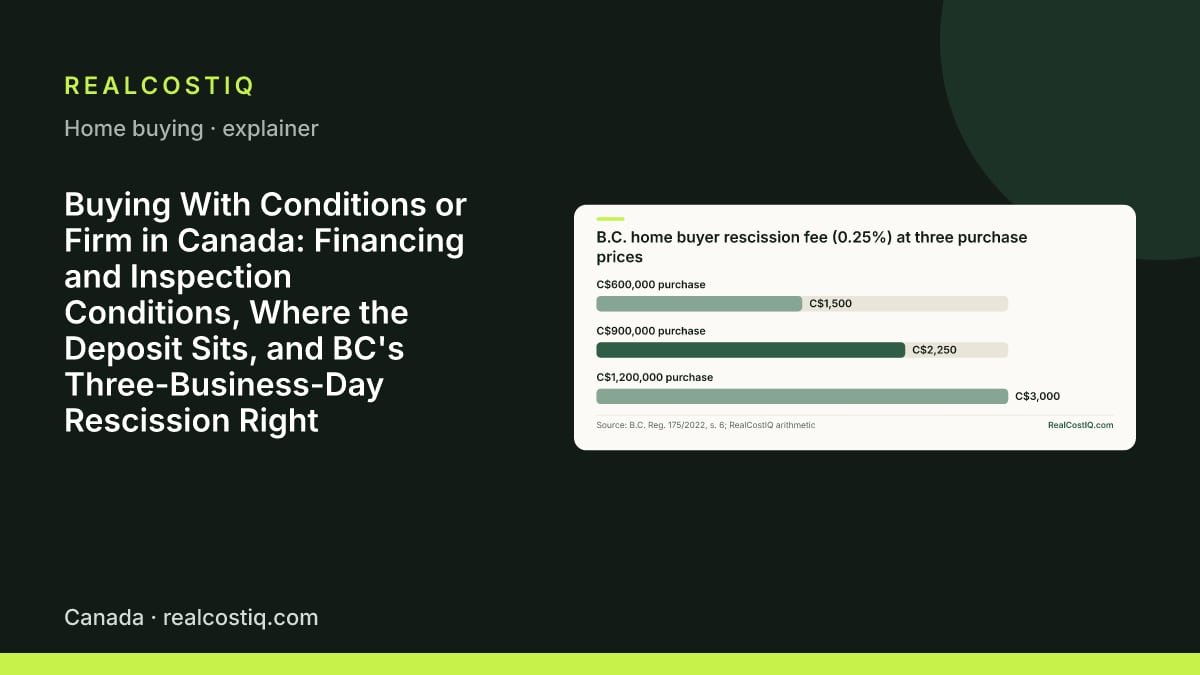
The price of using the right is set by section 6 of the regulation. The buyer must promptly pay the seller 0.25% of the purchase price. If a deposit was received by or for the seller, that amount is paid from the deposit. The remainder goes promptly to the buyer. BCFSA's FAQ adds that a brokerage holding the deposit pays the fee to the seller without needing a signed release. It returns the rest to the buyer. Section 7 says the right cannot be waived. BCFSA repeats this for both buyers and sellers, so a clause in the contract cannot remove it. Section 3 lists the exceptions. They are residential property on leased land, a leasehold interest, property sold at auction and property sold under a court order. The Act separately excludes contracts to which section 21 of the Real Estate Development Marketing Act applies. The right also does not apply once title (legal ownership) has transferred.
| Purchase price (CAD) | 5% deposit | Fee at 0.25% | Deposit returned to the buyer |
|---|---|---|---|
| C$600,000 | C$30,000 | C$1,500 | C$28,500 |
| C$900,000 | C$45,000 | C$2,250 | C$42,750 |
| C$1,200,000 | C$60,000 | C$3,000 | C$57,000 |
The 5% deposit is an assumed input, not a rule. The fee is 0.25% of the purchase price in section 6 of B.C. Reg. 175/2022 and does not vary with the deposit size.
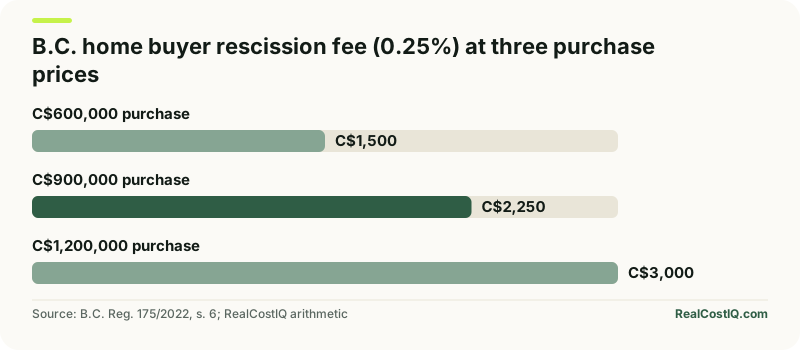
For a buyer, the fee is a known, small, one-time cost for an option that lasts three business days. Whether that option is worth using depends on what you learn in those days. It does not give you free access to the property. BCFSA's FAQ says the buyer has no automatic right of access during the rescission period. The contract's inspection term or other terms must provide it. Counting is also precise. The period starts the day after acceptance. So an offer accepted on a Monday ends at 11:59:59 pm on Thursday if no holiday falls in between. The holidays excluded from the count are those in the Interpretation Act. BCFSA notes this is a different list from the statutory holidays used for employment. Rescinding requires written notice. The notice must include the property address or parcel identifier, the buyer's name and signature, the name of each seller and the date the right is exercised.
Where the deposit sits, and when it is at risk
On the RECO, BCFSA and OACIQ pages read, a deposit is held by someone other than the seller, usually the brokerage, in a trust account. The RECA page read does not address deposits. What differs is what each regulator tells a consumer about releasing it. RECO has a consumer deposit insurance page for Ontario. It says a disputed deposit is held in a real estate statutory trust account. A brokerage can release it only under a mutual consent and release form signed by both buyer and seller, or under a court order. The page also states a limit on the insurance behind the trust account. The coverage responds to events such as theft, fraud, insolvency (the brokerage going broke) or misappropriation (misusing the money) by the brokerage. The limit is up to C$200,000 per claim and C$4 million for all claims arising from one event. It does not respond when the buyer and seller simply disagree about who is entitled to the money.
That makes the difference between a lost deposit and a stuck deposit worth drawing. The insurance protects the money if the brokerage fails. It does not decide the dispute between you and the seller. Suppose a buyer removes conditions and then cannot close. That buyer is in a dispute about who is entitled to the money. The statutory trust account holds it until the two sides agree in writing or a court orders otherwise. So the deposit is at risk in two ways. It can be lost on the merits, and it can be frozen while the dispute is settled. A deposit of C$40,000, which is 5% of the hypothetical C$800,000 price above, stays out of reach for as long as that takes.
Quebec handles timing differently in the form read. The deposit is a choice rather than a requirement. The buyer may pay it with the promise to purchase, or within 72 hours following the fulfilment of the conditions in the promise. Once received, it is deposited without delay in the trust account of the broker or agency. If the promise becomes null and void, the broker must immediately refund the deposit without interest, on a written request. Suppose the deposit is due within the 72 hours and the buyer does not pay it. Then the seller must notify the buyer in writing within five days, or the seller is deemed to have waived that condition. The OACIQ's form is a recommended form, so the contract in your hands governs. Alberta's deposit rules were not available on the RECA page read, and no statement about them is made here.
What waiving a condition can cost: a worked scenario
Take a hypothetical Ontario offer at C$800,000 with a C$40,000 deposit and a financing condition. A competing bidder offers the same price with no conditions. The buyer who waives financing is now betting on three things the pre-approval did not promise. The first is that the appraisal will support the price. The second is that nothing about income, credit or debt changes before the lender funds the loan. The third is that the lender will approve the specific property. RECA lists the first two as the risks. Suppose any of them fails after the waiver. Then the buyer is in default of a firm contract, which means the buyer has broken it. The C$40,000 deposit sits in a trust account. In Ontario, RECO says it is released only on a mutual written release or a court order.
| Condition | If kept and it fails in time | If waived and the risk happens |
|---|---|---|
| Financing (appraisal at C$760,000) | The buyer can renegotiate or leave and recover the deposit under the contract's terms | Buyer funds the C$40,000 difference from other money or faces a failed closing with the deposit in dispute |
| Inspection (serious defect found) | The buyer can leave or renegotiate by the deadline | The buyer owns the defect and its repair cost; in Quebec the form deems the condition waived if the notice is missed |
| BC rescission (use the right) | Pay 0.25% of C$800,000, which is C$2,000, within three business days | After the period, the contract is firm and the right is gone |
All three scenarios are hypothetical and illustrate mechanisms the regulator pages describe. They are not estimates of how often a condition fails or of any lender's practice.
The numbers show why a waiver is rarely a free upgrade. The appraisal gap alone can be a five-figure cash call. Before you decide, test the plan without the missing cash. The mortgage affordability calculator shows what a smaller mortgage does to the monthly budget. The closing cost lines in our closing costs calculator show what else has to be funded on closing day. Suppose those numbers do not work with an extra C$40,000. That is a strong reason to keep the condition and to discuss it with your lawyer before waiving it.
Ways to stay competitive without waiving everything
- Shorten the condition period rather than removing the condition. A short, credible financing period with an approved lender can look close to a firm offer in the seller's eyes. It also keeps your exit.
- Do the inspection before the offer where the seller allows it, and keep a shorter condition or none on that point. RECO's page treats skipping an inspection as a significant risk. A pre-offer inspection gives you the same information without giving up the protection.
- Get a lender's written confirmation of the property-specific approval before the deadline. RECA says pre-approval is only an initial assessment. So the useful document is the final approval, not the pre-approval. Our post on what a mortgage pre-approval and rate hold cover shows what a lender checks again after pre-approval.
- Document the conversation. RECA notes that many licensees find it helpful to write down discussions about pre-approvals and financing risks when a client is considering removing a financing condition. Ask for that record.
- In BC, know that the rescission right is there regardless. But it is not a substitute for conditions. It costs 0.25% of the price and lasts three business days.
What was not read
Several things a buyer might expect on this page are not here, because we did not read the primary source on 2026-10-10. We read no statute or regulation for Ontario, Alberta or Quebec, only regulator and form pages. So the legal treatment of conditions in those provinces is not stated. The RECA page read is an article for licensees dated 1 March 2026. It deals with pre-approvals and unconditional offers. We did not retrieve RECA's consumer deposit guidance, so the Alberta deposit rules are not covered. We did not read other provinces and territories. The contract in your hands may also differ from the standard forms discussed here. A real estate lawyer, or a notary in Quebec, reads the contract. This page cannot.