Many buyers hear the word pre-approved and relax. They should not. A pre-approval is useful, but it is a promise about one thing: the interest rate. It is not a promise that the lender will lend. This post shows what the rate hold is worth in dollars, what it does not cover, and what a lender looks at again before the money moves. All amounts are in Canadian dollars (CAD).
In plain English
- A pre-approval is a lender's early check of what you could borrow. It usually comes with a rate hold, which locks the interest rate for a set number of days.
- RBC and TD each hold the rate for up to 120 days. The Financial Consumer Agency of Canada (FCAC) says holds run from 60 to 130 days, depending on the lender.
- A hold protects you if rates rise. On a C$600,000 purchase, a rise from 4.50% to 4.75% adds about C$82 a month, or about C$4,930 over a five-year term.
- The hold does not protect your approval. The lender checks your income, debts, credit and the home again. A new job, a new loan or a low valuation can change the outcome.
- A pre-approval is not the same as a financing condition in your offer. Do not treat it as one.
Three words that get mixed up
Lenders use different names for different steps, and they do not all use them the same way. FCAC says that pre-approval may also be called pre-qualification or pre-authorization, and that lenders define and set the criteria for each step differently. So read what your lender actually checks. Do not rely on the label.
| Step | What it usually is | What it gives you |
|---|---|---|
| Pre-qualification | A general estimate, often from the numbers you type in. TD describes it as a general idea of how much mortgage you could afford. | A rough budget. Usually no rate hold. |
| Pre-approval | The lender reviews your finances and asks for documents. FCAC says it will likely run a credit check. | A maximum amount, a rate and a rate hold. FCAC says it does not guarantee approval. |
| Final approval | The lender approves you and the specific home. RBC says it refreshes your documents and re-verifies income, credit and debts at this stage. | A mortgage offer. This is the step that can actually fund the purchase. |
Sources: Financial Consumer Agency of Canada, Getting preapproved for a mortgage (page dated 2025-10-15); TD, 'The difference between mortgage pre-qualifications and pre-approvals'; RBC, Getting a mortgage pre-approval. All read 2026-10-15.
The pre-approved amount is a ceiling, not a target. FCAC says the final amount depends on the value of the property and your down payment. It also suggests that you look at homes below your maximum, so you do not stretch your budget to the limit.
Worked example: what a rate hold is worth on a C$600,000 home
Start with round numbers. You plan to buy a C$600,000 home with the minimum down payment. FCAC says homes between C$500,000 and C$1.5 million need 5% of the first C$500,000 plus 10% of the rest. That is C$25,000 plus C$10,000, or C$35,000. Here is the loan.
- Loan before insurance: C$600,000 minus C$35,000 is C$565,000. That is 94.2% of the price.
- CMHC premium: The Canada Mortgage and Housing Corporation (CMHC) is a federal Crown corporation that insures mortgages. For a loan of 90.01% to 95% of the price, its table says the premium is 4.00% of the loan. That is C$22,600. We add it to the loan.
- Total mortgage: C$565,000 plus C$22,600 is C$587,600.
- Amortization: 25 years. Amortization is the total time to repay the loan. The term is the length of one contract, often five years. The rate hold covers the rate on the term you choose.
- Two rates: Your pre-approval holds 4.50%. Suppose that by the time you buy, the same lender's rate has risen to 4.75%.
Canadian fixed rates compound twice a year. This is semi-annual compounding. It gives a slightly different payment from the US method of dividing the rate by 12. We use the site's Canadian mortgage engine, which uses the Canadian method. Here is what the 0.25 point rise costs.
| Held rate: 4.50% | Market rate: 4.75% | Difference | |
|---|---|---|---|
| Total mortgage | C$587,600 | C$587,600 | - |
| Monthly payment | C$3,252.21 | C$3,334.37 | C$82.16 a month |
| Over a 60-month term | C$195,133 | C$200,062 | C$4,930 |
Hypothetical. Rates are examples, not quotes. Payments use semi-annual compounding. The 60-month figure is 60 payments only. It ignores the small difference in balance at the end of the term. The CMHC premium rate is from CMHC's table, read 2026-10-15. Ontario, Quebec and Saskatchewan charge provincial sales tax on the premium, paid in cash at closing.
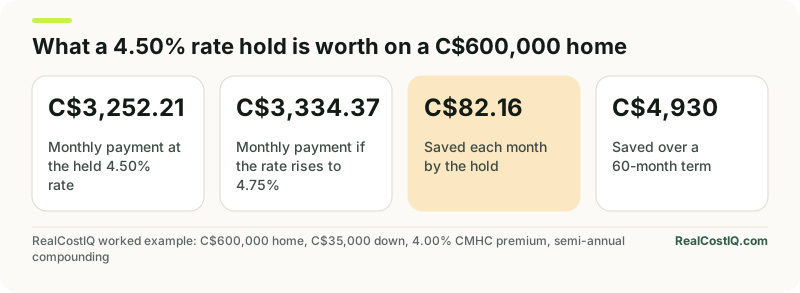
So the hold was worth about C$82 a month in this case. That is real money, but it is not huge. The hold matters more if rates jump by a full point, or if your budget is tight. Use the mortgage calculator to see the effect of a rate change on your own purchase.
The Bank of Canada gives a sense of the scale. It held its target for the overnight rate at 2.25% at its September 2, 2026 decision, and its next announcement is October 28, 2026. The five-year posted mortgage rate it publishes for the big banks was 6.19% on October 14, 2026. Posted rates are list prices, and most buyers negotiate below them, which is why our example uses 4.50%. Your own offer is what matters.
How long the hold lasts, at two named lenders
The hold is a fixed number of days. FCAC says pre-approval may let you lock in a rate for 60 to 130 days, depending on the lender. Two big banks say the following on their own pages.
| Lender | Length of hold | If rates rise | If rates fall | When it ends |
|---|---|---|---|---|
| RBC | Up to 120 days from the application date | Your rate is guaranteed for the mortgage type and term you selected | Page does not say | The guarantee expires if the mortgage is not funded in the period. You must reapply, which may involve a new credit check. |
| TD | 120 days, subject to all conditions | TD honours the rate on your pre-approval if you still meet the conditions | You can ask TD to lower your rate to the current rate. A 2019 TD article adds that this restarts the 120 days. | A 2019 TD article says you can reapply for a new 120-day pre-approval if your search runs long. |
Sources: RBC, Getting a mortgage pre-approval; TD, Mortgage pre-approval; TD Stories article dated April 25, 2019 for the restart and reapply lines. All read 2026-10-15. Terms change, and your own pre-approval letter governs. This post does not favour either lender.
Two details matter. First, the clock may start on the application date, not the day the lender approves you. A hold that is called 120 days can leave you less time than you think if you applied weeks before you started house hunting. Second, RBC says the hold is tied to the mortgage type and term you select. If you chose a five-year fixed and later want a three-year or a variable, the hold may not carry over. Ask.
FCAC lists three questions to ask your lender or broker. How long is the preapproved rate guaranteed? Will you automatically get a lower rate if rates fall while you are preapproved? Can the preapproval be extended? Write down the answers. They differ between lenders, and the second one is where the offers differ most.
What the hold does not cover
The hold is about one number. It does not cover your income, your credit, your other debts, the home you pick or the lender's view of that home. TD says the pre-approval is conditional and you must meet all the conditions to keep the hold. RBC says significant changes to your finances, such as a new job or more debt, could affect approval even within the hold period.
Here is what lenders look at again. FCAC says lenders and brokers review your pre-tax income, your monthly expenses, the loan you ask for, your existing debts, your credit report and score, and the amortization.
| What is checked | What can go wrong | Source |
|---|---|---|
| Income and job | Your pay stubs, employment letter or tax records no longer match, or you change jobs. RBC re-verifies income at full application. | RBC; TD (documents list) |
| Debts | A new car loan, credit card balance or line of credit raises your debt ratios. | FCAC; RBC |
| Credit | A late payment, a high balance or a new credit check lowers your score. FCAC says a weak score can lead to a refused application or a request for a co-signer. | FCAC; Equifax Canada |
| The property | The lender's valuation or its standards for the home do not support the price. FCAC says a lender can refuse you after pre-approval if the property does not meet its standards. | FCAC |
| Down payment | The money is not in your account, or it comes from a source the lender or insurer does not accept. CMHC lists savings, sale proceeds and gifts from relatives as traditional sources. | CMHC |
| Rules | The qualifying rate or the insurance rules change. OSFI reviews its floor and buffer at least once a year. | OSFI |
Sources read 2026-10-15: FCAC, Getting preapproved for a mortgage and Preparing for a mortgage; RBC, Getting a mortgage pre-approval; TD, Mortgage pre-approval; CMHC, General requirements for homeowner mortgage loan insurance; OSFI, Minimum qualifying rate for uninsured mortgages; Equifax Canada, Hard inquiries.
Worked example: a new loan after pre-approval
Debts are the most common surprise, so work one through. First, two terms. GDS is the gross debt service ratio. It is your housing costs divided by your gross (before-tax) income. TDS is the total debt service ratio. It is your housing costs plus all other debt payments, divided by gross income. FCAC says housing costs should stay at or below 39% of gross income and total debt at or below 44%. For a longer look at how lenders count income and run these ratios, see our post on the mortgage stress test.
The stress test adds a twist. A lender must check that you could pay at a higher rate than the one you will really pay. FCAC says banks use the higher of 5.25% or your negotiated rate plus 2 points, for insured and uninsured mortgages. At a 4.50% rate, the qualifying rate is 6.50%.
- Payment at the qualifying rate. On the C$587,600 mortgage over 25 years at 6.50%, the payment is about C$3,936 a month. You will really pay C$3,252 at 4.50%, but the lender tests the larger number.
- Add other housing costs. We use placeholders: C$500 a month for property tax and C$150 for heat. These are not averages. Housing costs for the test are C$4,586 a month.
- Income needed for the 39% housing limit. C$4,586 divided by 0.39 is about C$11,759 a month. That is about C$141,100 a year before tax.
- You have no other debts. You pass the 44% total debt limit too, because it is the same number. You are pre-approved.
- Then you buy a car. You sign a C$900 a month car loan before closing. Total debt is now C$4,586 plus C$900, or C$5,486 a month.
- Check the new ratio. C$5,486 divided by C$11,759 is 46.7%. That is above 44%. To pass, you would need about C$149,600 of income, or a smaller mortgage.
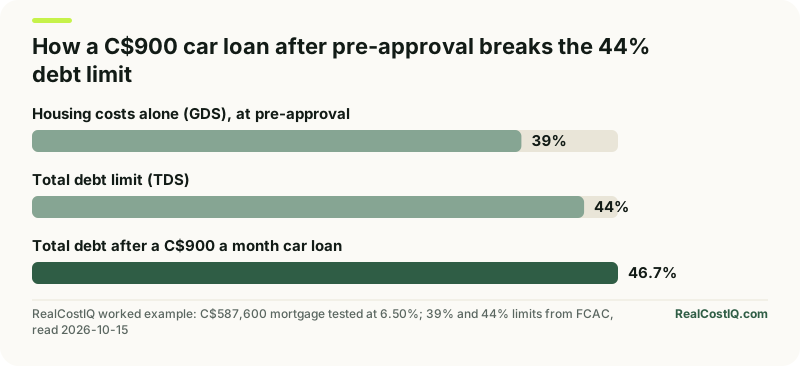
Nothing about the rate hold changed. The rate is still held at 4.50%. But the lender re-checks your debts before it funds the loan, and the car loan broke the ratio. This is a hypothetical, and a real lender may use a different method or limit. The lesson is simple: do not take on new debt between pre-approval and closing. Use the mortgage affordability calculator to test how a new payment changes the price you can afford.
Credit checks and shopping around
A pre-approval often involves a credit check. A hard inquiry is a lender's request to review your credit as part of a loan application. Equifax Canada says hard inquiries may stay on your report for up to 36 months and usually affect your credit scores. A soft inquiry, such as checking your own report, does not.
Lenders differ on timing. RBC says its online pre-approval uses a soft check, and that the credit report is pulled later at the full application. TD says applying online has no effect on your credit score. If you go through an advisor, RBC says your report and documents are verified at the pre-approval stage, so expect a credit check there.
Does shopping at several lenders hurt your score? Equifax says multiple mortgage inquiries within a set window are generally counted as one. It gives that window as 14 to 45 days, depending on the scoring model. All the inquiries still show on your report, but usually only one affects your score. It also says this does not apply to credit cards. So keep your mortgage applications close together in time, and avoid other credit applications while you shop.
Getting the most from a rate hold
A pre-approval is often free. A 2019 TD article says TD's is free and you are not obliged to borrow the full amount. That is a good reason to get one before you view homes, so you know your range. It is also a reason to compare. We do not tell you which lender to choose. When you compare, look beyond the rate at the term, the prepayment rules and the hold itself.
- Time it. Start the clock when you are ready to make offers. If you apply too early, the hold may run out before you find a home.
- Ask about the falling-rate rule. TD says you can ask for a lower rate if rates fall. RBC's page does not say. Ask any lender in writing.
- Ask what the hold is tied to. RBC ties it to the mortgage type and term you chose.
- Keep every document current. Pay stubs, bank statements and tax records age quickly. Keep copies of the newest ones.
- Freeze your finances. Do not change jobs, open credit or make large unexplained deposits if you can avoid it. RBC names a new job and more debt as risks.
- Keep your down payment where the lender can see it. A large deposit from an unclear source can slow the file.
A pre-approval is not a financing condition
A financing condition is a clause in your offer that lets you walk away if you cannot get the mortgage by a deadline. A pre-approval is a lender's early opinion. They are different things. A pre-approval does not protect your deposit. The condition does. If you are thinking of waiving the financing condition because you are pre-approved, read our post on conditional versus firm offers first. It sets out what the regulators in Ontario, Alberta, British Columbia and Quebec say about the risk.
Your checklist from pre-approval to closing
- Get your credit report and check it for errors before you apply.
- Apply to one or two lenders in the same short window. Ask the three FCAC questions about the hold.
- Write down the amount, the rate, the term, the expiry date and the conditions.
- Shop below the maximum. The pre-approved amount is a ceiling.
- Keep your income, debts and credit steady until the mortgage funds.
- When you make an offer, decide whether you need a financing condition. Do not assume the pre-approval replaces it.
- When you have a firm deal, expect the lender to refresh your documents and check the property.
- If the hold will expire before closing, ask for an extension before it does.
This post is information, not financial advice. Every figure above reflects pages read on October 15, 2026. Terms change, and your lender's letter is the only document that binds the lender.