Most Canadians who want a basement suite or a laneway home first meet a financing problem. The work costs six figures, and the equity is in the house. Equity is the part of the home's value you own outright. An ordinary insured mortgage cannot be re-borrowed once it has been placed. Since January 15, 2025 there is a purpose-built route. An owner can take insured financing against the value the home will have after the suite is built. The amortization can be longer than the usual 25 years. Amortization is the number of years a loan would take to pay off. The money pays for the construction. The route comes with conditions that are easy to miss on a lender's one-page summary. A federal loan that was announced alongside it never opened.
This post sets out the rule as the federal government and CMHC publish it. It shows where the money can and cannot go. It explains how the 90% limit and the lending-value test work together. It shows how a suite's rent is counted when you qualify. It also covers what happened to the C$80,000 Canada Secondary Suite Loan Program. Every rule below was read on 2026-10-13 from the Department of Finance Canada, CMHC or the Budget 2025 documents, and the dates are given. Two things are deliberately not here. The cost of building the suite is one. The fire-separation and code requirements that make it legal are the other. Both belong to the basement renovation cost calculator. Tax treatment of the work or of the rent is a question for the Canada Revenue Agency and an accountant, not for this site.
What changed on January 15, 2025
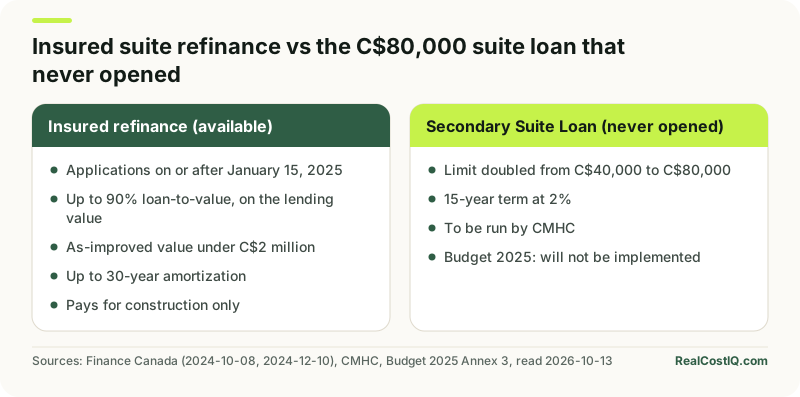
The Department of Finance Canada announced the change on 2024-10-08 in a backgrounder titled Mortgage Insurance Rule Changes to Enable Homeowners to Add Secondary Suites. A backgrounder is a short briefing document. It says the rules apply to insurance applications that lenders submit to mortgage insurers on or after January 15, 2025. It also sets out the headline terms. These are up to 90% of the property value, including the value added by the secondary suite or suites; an as-improved value of less than C$2 million; and a maximum amortization of 30 years.
The December 2024 Fall Economic Statement release, dated 2024-12-10, repeats the same three numbers. It does so when it describes homeowners refinancing with insured mortgages to help fund a suite, and it ties them to the January 15, 2025 start. That matters because the federal messages of the period mixed two separate programs in one sentence. One was a rule change for insured mortgages, which took effect. The other was a loan, which did not. The sections on the C$80,000 loan below keep them apart.
The word to hold on to is insured. In Canada a lender must have mortgage default insurance on a loan where the borrower puts down less than 20% of the property's value. The 20% threshold is explained in the CMHC insurance calculator. This rule lets a lender ask a mortgage insurer to insure financing of up to 90%. The 90% is measured against the lending value, which is the lesser of the as-improved value (the value once the suite exists) and the as-is value plus the cost of the work. It is not a US-style PMI arrangement and it is not an FHA program. PMI is private mortgage insurance, and FHA is a US federal loan program. The insurer in this post is CMHC, and the product is called CMHC Refinance. The premium is a one-time charge that can be added to the loan.
Who qualifies: the owner, the occupant and the suite
CMHC's CMHC Refinance page sets out the eligibility, and it is narrower than the headline. The borrower must already own the home. The borrower, or a close relative, must live in the home. At least one unit must be occupied rent-free by the borrower or by a relative by marriage, common-law partnership or legal parent-child relationship. So this is a product for owner-occupiers and families. An investor who owns a rental house and wants to add a unit is outside it.
Individuals must be Canadian citizens, permanent residents, or non-permanent residents authorized to work in Canada. At least one borrower or guarantor must have a credit score of at least 600. The property must be in Canada. It must be suitable and available for full-time, year-round occupancy, with year-round access. On an island, that means a vehicular bridge or ferry. The product is not available for loans under CMHC's chattel loan insurance product. In plain terms, a home on leased land financed as personal property cannot use it.
What counts as a suite
The Finance Canada backgrounder describes the added units as fully self-contained. Its examples are basement suites that have a separate entrance, and laneway homes. It says they must meet municipal zoning requirements. CMHC's page says the suite must be self-contained and comply with applicable bylaws and regulations. Neither document sets a national building standard, because none exists. Municipalities decide zoning, permits, fire separation and the number of units permitted on a lot, under provincial law. So the rule does not tell you whether your lot may have a suite. Your municipality does.
That is a real constraint, not a formality. CMHC asks for an improvement list with cost estimates or quotes, building plans, and a building permit. It also asks for either an occupancy permit or a third-party report from a qualified professional, such as an inspector, architect or engineer, confirming compliance with bylaws and regulations. A suite built without a permit has no permit to produce. For the permit fee itself, the basement page publishes the City of Toronto's 2026 fee schedule as a worked example. That is the only municipal number this post points to. No provincial page on the number of units permitted as of right, which means without special approval, could be read today. So no provincial or municipal permission rule is stated here.
How many units, and the short-term rental ban
Both sources cap the property at four dwelling units, including the existing one. The ban on short-term rental is the condition most likely to catch an owner who was counting on vacation rental income. Finance Canada states that the added units cannot be used for short-term rentals. CMHC defines it: the suite cannot be rented for any period of less than 90 consecutive days. A furnished suite on a monthly vacation rental would not satisfy that. A twelve-month lease would.
The 90% limit, the C$2 million cap and the lending-value test
Three numbers work together here, and owners often get the arithmetic wrong. First, CMHC sets the maximum loan-to-value at 90% for owner-occupied homeowner loans of up to four units. Loan-to-value is the loan as a share of the home's lending value. CMHC says it uses the as-improved value to work out the loan-to-value and the down payment. Second, the maximum lending value or as-improved value must be below C$2,000,000. Third, lending value is the lesser of two figures. One is the as-improved value. The other is the as-is value plus the cost of the improvements. If the improvements are generally accepted to add value, the lender can submit the as-is value plus the improvement cost to CMHC.
Put together, an appraiser's hopeful view of what a finished suite adds does not set your borrowing limit by itself. Suppose the appraisal says the finished home will be worth more than the as-is value plus what you are spending. Then the lower figure, as-is plus cost, is the lending value that the 90% applies to. Suppose the appraisal comes in lower than as-is plus cost. Then the appraisal governs. The lender and CMHC decide which applies. The insured loan amount cannot exceed what is needed to build.
| Input or limit | Amount (CAD) | How it is set |
|---|---|---|
| Home today (as-is value) | C$900,000 | Assumed for illustration |
| Suite construction cost | C$150,000 | Assumed; from quotes and plans |
| As-improved appraisal | C$1,100,000 | Assumed; appraiser's view of the finished home |
| Lending value | C$1,050,000 | Lesser of C$1,100,000 and C$900,000 + C$150,000 |
| 90% of lending value | C$945,000 | CMHC maximum loan-to-value |
| Existing mortgage balance | C$600,000 | Assumed |
| Room under the 90% limit | C$345,000 | C$945,000 minus C$600,000 |
| What can actually be advanced | Up to C$150,000 | Financing is limited to construction and completion costs |
Hypothetical numbers for illustration only, in Canadian dollars. The loan-to-value ceiling leaves C$345,000 of headroom, but the construction cost, not the ceiling, is what limits the loan, because equity take-out is not permitted. Premiums, fees, the stress-test rate and the lender's own policy are not modelled. Confirm the figures with a lender.
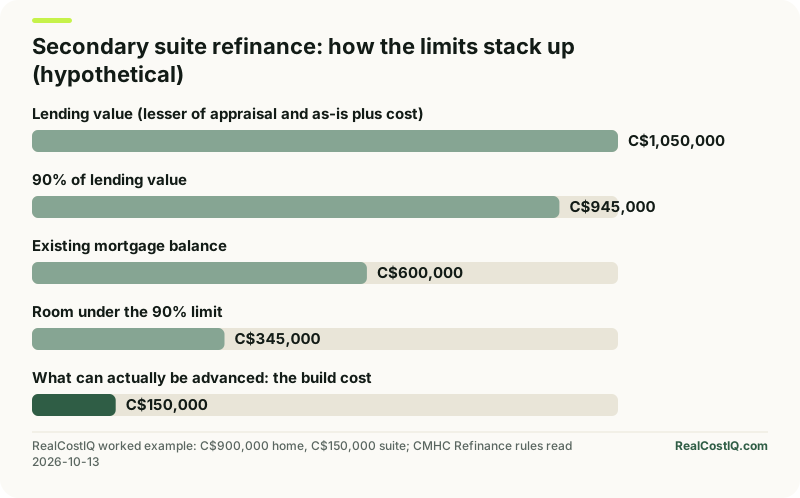
The example shows how most owners with a moderate mortgage will experience the rule. The 90% figure is a ceiling, and it is rarely the limit that binds. The binding limit is the cost of the suite, because the product is not a way to take cash out of the house. The ceiling does bind for an owner who is already close to it. A recent buyer who put 10% down and now wants to add a suite is one case. For that buyer, the 90% of a lending value that includes the added value is what creates room for new borrowing at all.
The C$2 million cap is a hard ceiling on the as-improved value, not on the loan. A home that would be worth C$2,000,000 or more after the suite is built is outside the product, however small the loan. In Toronto, Vancouver and parts of the surrounding regions, that rules out some homes that a suite might otherwise suit.
To test your own numbers, enter the lending value (the lesser of the as-improved value, or the as-is value plus the cost of the work) in the mortgage calculator. It compounds a Canadian fixed-rate mortgage semi-annually, which means twice a year, as lenders do. Use the CMHC insurance calculator for the premium tier at your loan-to-value. This post does not repeat the premium table.
30 years, a term of five, and what happens to an existing insured mortgage
In Canada the amortization and the term are different things. The amortization is the number of years the loan would take to repay at the current payment. The usual insured maximum is 25 years, and 30 is available here. The term is the length of the contract at a fixed rate, most often five years. After the term, the mortgage renews at the rates of the day, and the balance and remaining amortization carry over. A 30-year amortization on a five-year term means five years of the rate you chose and then a renewal. It does not mean 30 years at a fixed rate.
CMHC's page lists a premium surcharge of 0.20% for amortization beyond 25 years. A longer amortization lowers the monthly payment and raises the total interest. You can see both effects in the mortgage calculator when you change the amortization field and nothing else. The suite should bring in rent, so a lower payment is a deliberate part of the design, not a side effect. It makes the loan easier to qualify for and easier to carry through a vacancy.
Some borrowers already have a CMHC-insured mortgage and are adding financing to it. In that case, CMHC's page gives the lender three options for the amortization of the combined loan. It can maintain the existing loan's amortization schedule. It can blend the remaining existing amortization with the new financing's amortization, using a weighted average. Or it can reset the amortization, regardless of how much time has passed since the original closing. In that case the refinance is treated as a prior uninsured loan. A blended amortization carries a surcharge of 0.60%, applied to the increase to the loan amount. The page does not tell you which of the three your lender will offer. That is the lender's choice. Ask about it before you apply, since a reset can lengthen the schedule of the whole balance, not just the new money.
The page also does not say, in the text read today, how the rule applies where the existing mortgage is uninsured. That happens when the owner originally put down 20% or more. The premium table includes a column headed premium on increase to loan, which suggests a refinance of an existing balance is expected. Whether and how an uninsured existing loan is combined with the new insured advance is a question for the lender and CMHC's Homeowner Underwriting Centre. This post cannot answer it.
How the loan is qualified: the stress rate and the suite's rent
CMHC's maximum ratios for this product are a gross debt service ratio of 39% and a total debt service ratio of 44%. The first compares your housing costs to your gross income. The second compares all your debt payments to your gross income. They are calculated at a qualifying rate that is the greater of the contract rate plus 2%, or 5.25%. That is the stress test. A borrower with a contract rate of 4.00% is tested at 6.00%. A borrower at 3.00% is tested at 5.25%, because the floor applies. The stress test is not specific to suites. It is explained in full in the site's post on the mortgage stress test, so it is not repeated here.
Rental income from the suite can help a borrower qualify, and CMHC's page on rental income is specific about how much. Take an owner-occupied property subject to a loan application. CMHC allows up to 100% of gross rental income where the property has two units. It allows up to 50% of gross rental income, or the net rental income approach, where it has three or four. Gross rental income is the rent before costs. Under the gross method, the percentage of rent is added to the borrower's income for the ratios. Under the net method, operating expenses are deducted first. The page notes that the net approach is permitted but is not likely to be used. A property with a main home and one suite has two units. A main home with a basement suite and a laneway home has three.
Two cautions follow. First, these are CMHC's methods for the insured product, and a lender can apply tighter rules of its own. The post on how Canadian lenders count income covers how lenders in general count rental income. It also covers why a prospective rent that has never been collected is treated differently from a lease in place. Second, a suite that does not exist yet has no history. Expect the lender to ask for the appraiser's market rent or a signed lease. Expect it to test the loan on cautious inputs.
The mechanics: approval first, advances in stages
The financing is used only for the construction and completion of the suite. CMHC says it must approve the insured financing before construction starts, or at least at an early stage. So the order of events matters. An owner who finishes the suite and then asks for insured refinancing has done it backwards. The product exists to fund the work, and the lender has to be in the file before the walls are up.
Funds are advanced as the work progresses, not as a lump sum. CMHC offers two service options for progress advances. With Full Service, CMHC validates up to four consecutive advances at no cost. With Basic Service, the lender validates the advances without CMHC pre-approval. For the owner the practical result is the same under both. The contractor is paid as stages are completed and inspected. The owner needs enough cash on hand to carry the gap between invoices and advances. A line of credit can bridge that gap. The HELOC calculator shows what a revolving balance costs while it is outstanding. A HELOC is a home equity line of credit. Whether a lender will allow a second charge on the property for that purpose, alongside the insured refinance, is a lender decision. A second charge is a second claim on the home.
| Item | What CMHC lists |
|---|---|
| Scope of work | Improvement list and cost estimates or quotes |
| Design | Building plans |
| Legal approval | Building permit |
| Completion | Occupancy permit, or a third-party report from an inspector, architect or engineer confirming bylaw compliance |
| Value | As-improved value; lending value is the lesser of as-improved and as-is plus improvements |
| Use of funds | Construction and completion of the suite only; no equity take-out |
Read from CMHC's page on 2026-10-13. CMHC states additional conditions may apply and that the product should be confirmed with CMHC before a loan is processed.
The C$80,000 loan that never opened
The Canada Secondary Suite Loan Program is the other half of the 2024 announcements. Its fate is easy to get wrong, because a great deal of material from late 2024 still describes it as coming. The Fall Economic Statement release of 2024-12-10 doubled the program's loan limit from C$40,000 to C$80,000. It had a 15-year term at 2%, was administered by CMHC, and was given an early-2025 launch. The accompanying remarks, dated the following day, said homeowners could use the loan together with mortgage refinancing.
That combination never became available. Annex 3 of Budget 2025 is the Comprehensive Expenditure Review annex. It states that the Canada Secondary Suite Loan program is not yet operational and will not be implemented. Its stated reason is that the program has a large potential to overlap with the homeowner insured mortgage rule changes announced in January 2025. The annex gives no dollar figure for the program. It also does not say that the program's goals are being carried forward by another measure. This post does not claim that either.
The practical reading for a homeowner today is short. There is no federal C$80,000, 2% loan to apply for. A lender or contractor offering to arrange one is describing something that was never launched. The insured refinance is the federal financing route that exists. It is a mortgage. It carries the premium, the stress test, the amortization surcharge and the interest that any insured mortgage carries. A 2% loan would have had none of those.
Whether the suite is worth building: where this post stops
This post answers a financing question, not an investment one. Whether a suite pays for itself depends on several things. These are its cost, the rent your market will bear, vacancy (months with no tenant), the extra property taxes and insurance, and what the work does to the home's value. None of those can be read from a federal rule. For any other reason to refinance, the usual ceiling is 80%, with a penalty and fees to price first, which we cover in refinancing a mortgage in Canada: the 80% limit, the costs and the break-even. The basement renovation cost calculator models the cost side and prices a legal secondary suite. The carrying side is the payment in the mortgage calculator at the amortization you choose.
A sober comparison runs three numbers. The first is the added monthly payment on the new money, at both the stress-tested rate and the contract rate. The second is the rent a lender will count. The third is the rent you would realistically collect after a vacancy allowance. Suppose the rent you can document covers the added payment at the contract rate with room to spare. Then the financing is doing what the rule intends. Suppose the loan only works at the top of the 90% range with a 30-year amortization and rent that has not yet been proved. Then the margin is thin. A jump in rates at renewal after the five-year term will land on a larger balance than the one you started with.
Some owners build the suite for a parent or adult child rather than a tenant. The occupancy condition is easier to satisfy then, since a close relative's rent-free occupancy counts for the owner-occupancy test. The federal Multigenerational Home Renovation Tax Credit is the tax measure usually discussed alongside it. How that credit works is a question for the Canada Revenue Agency and a tax professional. Our multigenerational renovation tax credit calculator estimates it, but confirm eligibility with the CRA or a tax professional.
Before you call a lender
- Confirm with your municipality that a suite is permitted on your lot, and what permit it needs. The federal rule does not answer this.
- Settle the as-improved appraisal question early. The lending value is the lesser of the as-improved value and the as-is value plus cost.
- Check that the as-improved value is under C$2,000,000. Check that the total number of units will not exceed four.
- If you already have an insured mortgage, ask which of the three amortization options applies. Also ask whether a surcharge applies.
- Plan the suite as a tenancy of 90 consecutive days or more. A short-term rental model is outside the product.
- Obtain quotes, plans and the building permit before the insured approval. Do not start construction until the lender has CMHC's approval, or is at least in the file.
- Run the payment at both the contract rate and the stress rate. Test your rent assumption against the lender's own method.