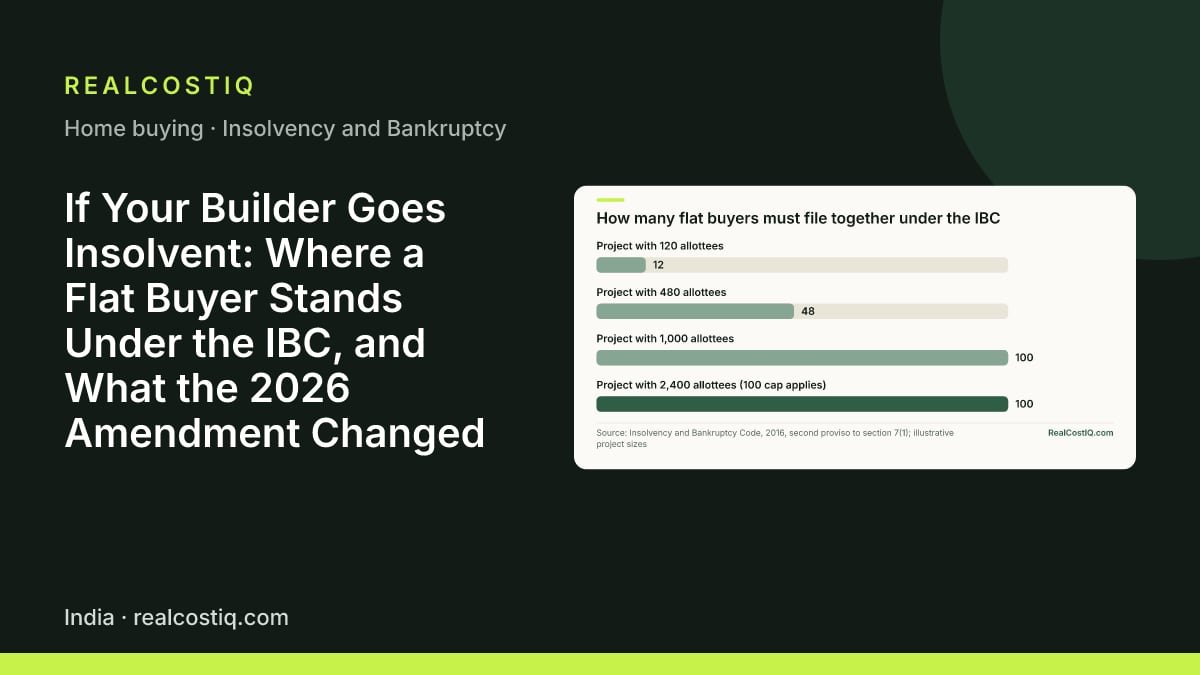
When a builder stops work and the sales team stops answering, most flat buyers in India think first of the state RERA authority. That is usually the right first move. This post is about the other door: the Insolvency and Bankruptcy Code, 2016. A buyer meets it when a builder company, or a creditor of that company, takes the company into the corporate insolvency resolution process. In that process the buyer is not a complainant asking for a refund. The buyer is a creditor in a queue. The buyer has a claim form and a representative who votes for the whole group. The plan is written by other people. The rules for this sit in four places, and none of them is easy to find. The first is the Code. The second is the Insolvency and Bankruptcy Code (Amendment) Act, 2026, which received assent on 6 April 2026. The third is the Ministry of Corporate Affairs notification that switched part of that Act on. The fourth is the regulations and circulars of the Insolvency and Bankruptcy Board of India (IBBI).
How this was checked. We opened and read every document cited below on 12 October 2026 on ibbi.gov.in. They are:
the Insolvency and Bankruptcy Code, 2016 as consolidated on the IBBI site up to 12 August 2021; the Insolvency and Bankruptcy Code (Amendment) Act, 2026 (Act No. 6 of 2026, assented to on 6 April 2026); the Ministry of Corporate Affairs notification S.O. 2625(E) dated 22 May 2026; the IBBI (Insolvency Resolution Process for Corporate Persons) Regulations, 2016 as amended up to 9 June 2026; IBBI Circular No. IBBI/CIRP/94/2026 of 2 June 2026, which prescribes the claim forms; and the IBBI (Liquidation Process) Regulations, 2016 as amended up to 22 September 2026.
We paraphrase, and quote only short phrases. We did not read any court judgment. So nothing here describes how a particular bench has applied these provisions. This is a reading of the texts, not legal advice. A buyer in a live process should take it to an advocate or to the insolvency professional running the case.
Why a buyer is a creditor at all
The Code divides the people owed money by a company into financial creditors and operational creditors. A financial creditor is, broadly, someone owed a financial debt. The Code defines financial debt as money disbursed against the consideration for the time value of money. Clause (f) of that definition catches any amount raised under a transaction that has the commercial effect of a borrowing. The consolidated Code adds an Explanation to that clause with two parts. First, any amount raised from an allottee under a real estate project is deemed to have the commercial effect of a borrowing. Second, the words allottee and real estate project take the meanings given in the Real Estate (Regulation and Development) Act, 2016. The footnote in the consolidated text shows that Explanation as inserted by Act No. 26 of 2018 with effect from 6 June 2018.
The practical result is that the instalments you paid against your agreement for sale are, for the Code's purposes, a loan to the builder. That does not turn you into a bank. It puts you on the financial-creditor side of the line. That decides three things. One is who can start the process. Another is who sits on the committee of creditors. The third is where your money ranks if the company is wound up. You may also have a RERA remedy, but that is a separate question. Our RERA buyer rights guide and the RERA delay compensation calculator cover that side. Nothing in this post restates those remedies.
Starting the process: the 100-allottee or 10 per cent rule
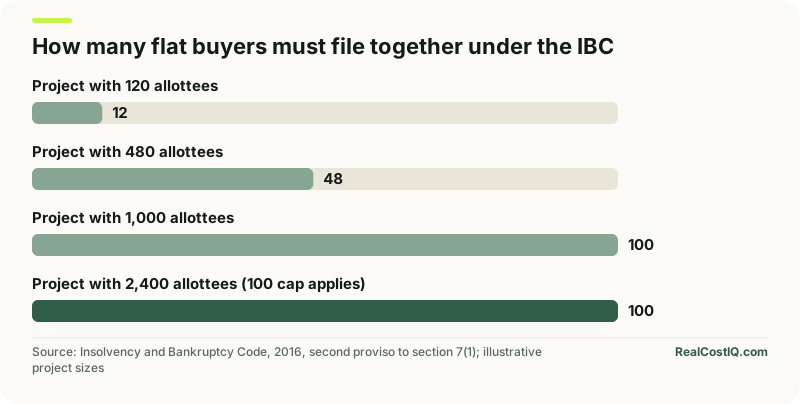
Section 7 lets a financial creditor apply to the National Company Law Tribunal (the Adjudicating Authority). The application starts insolvency resolution against a company that has defaulted. For allottees, the second proviso to section 7(1) adds a filter. Financial creditors who are allottees under a real estate project must file the application jointly. At least one hundred of the allottees under the same project must join. Or at least ten per cent of the total number of allottees under the same project must join, whichever is less. The consolidated text shows that proviso as inserted by Act No. 1 of 2020, with effect from 28 December 2019.
Two things in that rule are easy to miss. First, the count is per project, not per builder. A developer with five projects does not pool buyers across them. Second, the test is whichever is less. So the 100 figure only bites in large projects. The table shows how it works for four illustrative project sizes. The sizes are ours, chosen to show the arithmetic. They are not drawn from any real project.
| Allottees in the project | 10 per cent of them | Minimum joint applicants (the lesser of 100 and 10 per cent) |
|---|---|---|
| 120 | 12 | 12 |
| 480 | 48 | 48 |
| 1,000 | 100 | 100 |
| 2,400 | 240 | 100 |
Illustrative project sizes. The rule is the lesser of one hundred allottees and ten per cent of all allottees of the same real estate project; where 10 per cent is not a whole number the Code does not say how to round, and we did not find a rounding rule in the text we read.
A group filing must also show a default of at least ₹1 crore. Section 4 of the Code applies the insolvency Part where the minimum default is ₹1 lakh. The Central Government raised that minimum to ₹1 crore by notification S.O. 1205(E) of 24 March 2020. The text does not say whether the amount is tested for each applicant or for the group. We read no decision on it. The rule does not stop an individual buyer from being heard once the process is on. It governs who can start it. Suppose a bank, another creditor or the company itself has taken the builder company into insolvency. Then every allottee who files a claim is a financial creditor in the process. It makes no difference whether that buyer was part of a group that applied.
What the 2026 Act changed at the front door
The 2026 Act does not mention allottees or real estate projects anywhere in its text. It does not touch the proviso above. What it changes for a joint application is what happens after filing. Section 4 of the Act substitutes sub-section (5) of section 7. The Adjudicating Authority must now admit the application, or reject it, within fourteen days of receiving it. It admits the application if three things are true. A default has occurred. The application is complete. No disciplinary proceeding is pending against the proposed resolution professional. A new Explanation says that once those requirements are met, no other ground may be considered to reject the application.
Before rejecting an application for a defect, the Tribunal must give the applicant notice to fix it within seven days. If it has not passed an order within fourteen days, it must record the reasons for the delay in writing. For a group of 100 allottees, that is a real change in how carefully they must draft. The Act pushes the Tribunal towards getting a fixable defect corrected instead of rejecting the application. It does not make admission automatic. The Act says the Tribunal must record reasons if it misses fourteen days. It does not say that an application is deemed admitted.
Section 12A covers withdrawing an application after admission. Section 8 of the Act substitutes it. The Tribunal may allow withdrawal only on an application by the resolution professional, with approval of ninety per cent of the committee's voting share. No withdrawal is allowed before the committee of creditors is constituted. None is allowed after the first invitation for a resolution plan has been issued. Allottees are financial creditors, and they vote in the committee through their representative. We cover that in a later section. So a settlement between the builder and a few of the buyers who filed cannot unwind the process on its own.
Once admitted: the moratorium and the clock
On the insolvency commencement date, the Tribunal declares a moratorium under section 14. A moratorium is a freeze on legal action against the company. Sub-section (1) prohibits, among other things, the institution of suits or the continuation of pending suits or proceedings against the corporate debtor. This includes execution of any judgment, decree or order in any court of law, tribunal, arbitration panel or other authority. It also bars any transfer or disposal of the debtor's assets. We have not read any decision on whether a particular RERA proceeding or recovery order falls within those words, and we will not guess. A buyer holding a RERA order against the builder should ask the insolvency professional and an advocate how that order is treated in the process. The buyer should file a claim in any case.
Section 12 sets the clock. The process is to be completed within 180 days of admission. The resolution professional can seek an extension only if the committee approves it with a 66 per cent vote. The Tribunal can extend by no more than 90 days, once. The Code also says the process must be completed within 330 days from the insolvency commencement date. This counts the extension and the time taken in legal proceedings. For a buyer waiting on a stalled tower, 330 days is the outer limit before the Code requires a result. The result is either a resolution plan or liquidation.
Two housekeeping rules in the regulations matter to buyers in particular. Regulation 4D requires the interim or resolution professional to operate a separate bank account for each real estate project of the debtor. So money from one project does not simply disappear into a common pool. Regulation 4E covers handing over homes. The resolution professional may hand over possession of the plot, apartment or building. This is for an allottee who has asked for it and has performed his part of the agreement. The professional may also help with registration. This needs the committee's approval with not less than 66 per cent of votes. That is the route by which a buyer who has paid in full can end up with a flat while the company is still in the process.
Making your claim: Form CA, the evidence and the deadline
Once the process starts, the interim resolution professional publishes a public announcement and collects claims. Allottees of a project are financial creditors in a class once there are enough of them. Their claims go in under regulation 8A of the IBBI CIRP Regulations. The regulation defines a class of creditors as at least ten financial creditors under section 21(6A)(b) of the Code. So a project with ten or more claiming allottees will ordinarily be treated as a class. The claim must be filed with proof, in electronic form, in the form the Board has notified by circular. The circular dated 2 June 2026 prescribes it as Form CA, submission of claim by financial creditors in a class. Until 2 June 2026, the form was a schedule to the regulations. The June amendment replaced the schedule with circular formats.
What the form asks for is a good guide to what to gather before the announcement appears. It asks for your total claim in rupees. It asks for the documents that substantiate the debt, and for details of how and when the debt was incurred. It asks about any mutual dealings that could be set off against the claim, and any security you hold. It asks for the bank account to which a payment under a plan can be made, and a list of the documents attached. It also asks for the name of the insolvency professional you want as your authorised representative. A declaration confirms that the debt was owed to you on the insolvency commencement date. It also says whether you are, or are not, a related party of the builder.
The regulation says you can prove the debt from records held by an information utility, or from other relevant documents. It names the usual ones for a buyer. These are the agreement for sale, the letter of allotment, the receipts for payments made, or any other document showing the debt. A buyer with a bank loan should keep two sets of papers. One is the builder's receipts for what went from your pocket. The other is the bank's disbursement record for what went from the lender. They answer different questions, and the form asks you to explain how the debt arose. Our pre-EMI versus full-EMI post explains why those two streams of money are not the same thing.
On the deadline, regulation 12 says a creditor must submit a claim on or before the last date in the public announcement. A creditor who misses it can still submit to the resolution professional. The cut-off is the date the request for resolution plans is issued, or ninety days from the insolvency commencement date, whichever is later. Beyond ninety days, the creditor has to give reasons for the delay. So the system is not as unforgiving as it once was. Still, the safe course is plain: file inside the announced window. Regulation 12(3), as we read it, speaks of a financial creditor claiming under regulation 8. Allottees in a class claim under regulation 8A. So we do not say from what date an allottee's admitted claim counts. Ask the resolution professional.
A buyer who does not file is not simply forgotten. Regulation 38A was inserted with effect from 25 February 2026. It says that the information memorandum may list allottees who have not submitted claims. In that case, the resolution plan must provide for how they are treated. This protects the buyer who never saw the notice. It is also a reason to check whether your name appears in the list that the builder's own records and the RERA records give. Regulation 36 also requires the information memorandum to carry details of allottees who have not submitted claims. It must show the amounts due and units allotted, as drawn from the debtor's records or from the records of the Real Estate Regulatory Authority.
Voting without a seat: the authorised representative
Allottees do not each get a seat in the committee of creditors. Take a financial debt owed to a class of creditors. Section 21(6A)(b) of the Code then applies. The interim resolution professional must ask the Tribunal to appoint another insolvency professional as the authorised representative of that class. This must happen before the first committee meeting. That person attends meetings and votes for each creditor in the class, to the extent of that creditor's voting share.
The regulations give buyers a say in who it is. The interim professional identifies three insolvency professionals who are not his relatives or related parties, who are eligible, and who are willing to act. The public announcement names them. Each claimant indicates a choice in Form CA. The interim professional then selects the person chosen by the highest number of financial creditors in the class. He applies to the Tribunal for appointment within two days of verifying the claims. Until the Tribunal rules, the selected person acts as an interim representative with the same rights and duties. A choice made on a form received after the time stated in the announcement is not counted.
Voting power follows the amount of your claim, not the number of buyers. Section 25A(2) requires the representative to circulate the agenda and minutes to the creditors he represents. Under section 25A(3A), a representative appointed for a class under section 21(6A) casts the class's whole vote. He follows the decision of more than fifty per cent of the voting share of the class members who have cast their vote. So you influence the class vote by voting, in proportion to your claim. A buyer who does not respond is simply left out of the count. The one exception in that sub-section is a vote on withdrawal of the application under section 12A. There the representative follows each creditor's own instructions. The committee decides plan approval by a voting share of the financial creditors. Since the 2026 Act, it must record reasons for approving a plan. Handing over possession under regulation 4E needs 66 per cent of votes.
The 2026 plan rules that matter to a buyer
Most of what the 2026 Act changes for a buyer is in how a resolution plan is built and what it does to claims. (A resolution plan is the proposal to revive the company or pay its creditors.) Four changes are in the sections notified on 26 May 2026.
- A floor for dissenting financial creditors (section 30(2)(ba), via section 18 of the Act). A plan must now give financial creditors who do not vote for it, in the manner specified, an amount not less than the lower of two figures. The first figure is what they would receive on a liquidation under section 53. The second is what they would have received if the amount distributed under the plan were distributed in the section 53 order of priority. The Act adds that the distribution must be fair and equitable to them. The floor does not apply if one of these happened on or before the commencement date. Either the committee had approved a plan, or a liquidation order or decision had been made.
- Reasons on the record (section 30(4)). The committee approves a plan by the required voting share of financial creditors. It must then record its reasons for the approval.
- A thirty-day target for the Tribunal (section 31(2A)). The Adjudicating Authority is to pass its order on a plan within thirty days of receiving it. If it does not, it must record reasons in writing. Before rejecting a plan, it may also give the committee notice to fix defects.
- Two-stage approval of distribution (proviso to section 31(1)). The Tribunal may act on the resolution professional's application. The application needs approval of 66 per cent of the voting share. It may first approve implementation of the plan. It then approves the manner of distribution within thirty days.
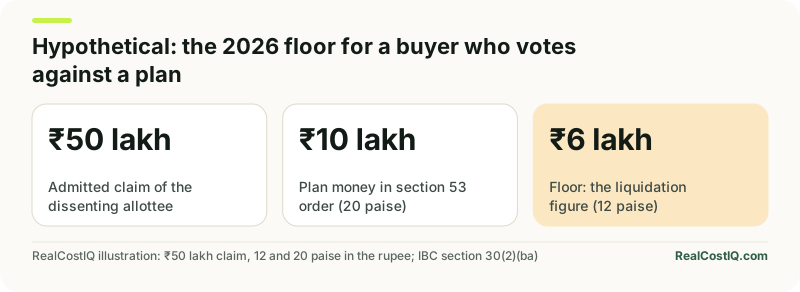
The floor in section 30(2)(ba) is the change a buyer is most likely to feel. Here is an illustration, with numbers that are ours and not from any case. Suppose an allottee's admitted claim is ₹50,00,000 (₹50 lakh), and the allottee votes against a plan. A liquidation might pay unsecured financial creditors 12 paise in the rupee. Then the liquidation figure for that claim is ₹6,00,000 (₹6 lakh). Distributing the plan's money in the section 53 order might pay 20 paise in the rupee. Then the plan figure is ₹10,00,000 (₹10 lakh). The floor is the lower of the two, ₹6 lakh. The rule guarantees a minimum for those who vote no. It does not promise a dissenting buyer the plan's higher figure. It does not promise a refund.
The clean slate: section 31(6) and what a plan can extinguish
The most consequential new text for a buyer may be the new sub-section (6) of section 31. Section 19 of the Act inserted it, and it has been in force from 26 May 2026. Suppose the Tribunal approves a resolution plan. Then, unless the plan provides otherwise, any claim under any other law against the corporate debtor and its assets is extinguished. This covers claims from before the date of approval. That means it ends. No proceedings may be continued or started against the debtor or its assets on the basis of such claims, including proceedings for assessment of the claims. A new Explanation says that nothing in the section affects a claim or proceeding against certain other people. These are a promoter or a person who managed or controlled the debtor. They also include a guarantor of the debtor. The last group is a person with joint liability with it.
For a buyer the reading is straightforward, even if the legal arguments are not. Once a plan is approved, what you receive is what the plan gives you. Take a claim you hold against the builder company under another law. That would include a RERA refund or compensation order against the company. It does not survive alongside the plan unless the plan says it does. The section does not touch any claim against the people behind the company. Whether a particular buyer has a claim against a promoter personally, and on what basis, is a question for an advocate. It is outside what we read. The Act also adds a third Explanation. It says sub-sections (5) and (6) are deemed to apply to a plan approved under section 31(1). They apply from the commencement of the Code, except for matters that have attained finality. That signals that the drafters meant the clean slate to be read back, not just forward.
The practical lesson is to read the plan at the committee stage, not after. The plan is the document that decides whether your flat is built, your money is paid in rupees, or you are offered a mix. Since regulation 38A, it also decides how a non-claiming allottee is treated. Your authorised representative casts the class vote on it according to the majority of the class members who respond. So the way a single buyer reaches the outcome is by answering the vote requests. Organising with other buyers in the project before the vote also helps.
If there is no plan: liquidation and where a buyer ranks
If the committee does not approve a plan, or the Tribunal rejects it, the company goes into liquidation. Liquidation means selling the company's assets to pay its debts. Section 53 sets the order in which sale proceeds are paid. First come the insolvency resolution process costs and liquidation costs, paid in full. Next, ranking equally, are two groups. One is workmen's dues for the twenty-four months before the liquidation commencement date. The other is debts owed to secured creditors who have relinquished their security. Then come wages and unpaid dues of employees other than workmen for twelve months. Then, in clause (d), come financial debts owed to unsecured creditors. After them rank dues to the Central and State Governments for the two years before liquidation, and the unpaid part of secured debts after enforcement. Then come any remaining debts, then preference shareholders and equity shareholders.
An allottee with no security interest in the builder's assets is, in that list, a financial creditor owed an unsecured debt. That is clause (d). The allottee ranks behind costs, workmen, employees and relinquished secured debt, and ahead of government dues. The Act leaves the order as it is. It adds clarifications for secured creditors who relinquish security worth less than their debt, and for government dues. It also adds illustrations to section 53(2) on contracts that try to rearrange the order. A liquidator must disregard such contracts when they disrupt the priority among equally ranking recipients.
One rule in the liquidation regulations is for buyers. Regulation 46A of the IBBI (Liquidation Process) Regulations says this. Suppose the corporate debtor has given possession to an allottee in a real estate project. Then that asset is not part of the liquidation estate. So a buyer who has taken possession of a flat is not competing with the lenders for it. The 2026 Act also gives the committee of creditors a supervisory role over a liquidation under the new section 21(11). It limits the liquidator to completing the liquidation and applying for dissolution within 180 days, extendable by up to 90 days. Both provisions are in the notified sections.
What is not in force, and what this does not cover
The creditor-initiated insolvency resolution process is a new Chapter IV-A, inserted by section 40 of the 2026 Act. It is open only to a financial creditor belonging to a class of financial institutions that the Central Government notifies. It is not a route for allottees, and section 40 is not in the 22 May 2026 notification. We mention it because the Act's headline summaries do. A buyer should not mistake it for a new remedy.
- Court decisions. We read statutes, regulations and circulars. This post does not cover how the Supreme Court, the National Company Law Appellate Tribunal or a particular NCLT bench has applied the allottee provisions. That matters, so ask an advocate.
- Whether the 2026 provisions apply to your pending case. Several provisions carry their own transitional Explanations tied to the commencement of the Act. We have described them without applying them to any facts.
- RERA remedies and state authorities. The site's RERA pages cover rights and orders under the Real Estate (Regulation and Development) Act, 2016. This post does not.
- Your home loan. The bank loan is a contract between you and the lender. The texts we read deal with proceedings against the builder company. We did not read your loan terms or any RBI instruction on a loan for a stalled project. The forum section below says what section 14 does and does not stop. While the project is stuck, your lender may also be charging pre-EMI interest, which our pre-EMI vs full EMI post explains.
- Taxes. GST on an under-construction flat is a separate subject, with its own GST on property calculator. We did not read anything on how an insolvency affects tax already paid.
- A consolidated post-2026 Code. The IBBI page we used carries the Code consolidated up to 12 August 2021, and the 2026 Act separately. We applied the Act's amendments by hand to the sections discussed. Check the section against the Gazette text before relying on it.
RERA, consumer commission or NCLT: which forum, in what order
A stuck project gives a buyer up to three places to go. They are not three steps in a fixed line. The right one depends on one fact: has the Tribunal admitted the builder into insolvency yet?
- Before insolvency starts, you choose between RERA and the consumer commission. In Imperia Structures v. Anil Patni (Supreme Court, 2 November 2020), the Court held that RERA does not bar a buyer's complaint under the Consumer Protection Act. LiveLaw's report of the judgment says the Court read the law as giving the allottee a choice. We read that report, not the full judgment, on 21 October 2026. Pick one forum with an advocate. Do not assume you can run both.
- After insolvency starts, section 14 changes the picture. From the insolvency commencement date, the Tribunal's moratorium bars new suits against the builder. It also bars the continuation of pending suits and proceedings, including execution of any decree or order. A refund order you already hold cannot be enforced against the builder in the usual way while the moratorium lasts. Your route is the claim.
- Then file Form CA for what the builder owes you. The claim is judged against the builder's debt to you, and the creditors vote on a plan. A buyer cannot start the process alone. The 100-allottee or 10 per cent rule decides that, as set out above.
Two practical points follow. First, a pending RERA or consumer case is not lost when insolvency starts. It is paused as against the builder, and the evidence you built for it is the same evidence Form CA asks for. Second, the order matters less than the date. Check the insolvency status of the builder company before you spend money on a new filing. An advocate should confirm how the Tribunal or the appellate tribunal has treated your forum choice, because we read no decision on that.
A checklist of what to do and when
- Before anything is filed, gather your papers. You need your agreement for sale, allotment letter, every payment receipt and demand letter, and any bank statement showing the payments. The regulation names these as proof.
- Count the allottees in your project from the RERA registration page. Compare the count with the 100-or-10-per-cent rule. If you are organising an application, you need that many joint signatories. A defect in the application is now something the Tribunal must give seven days to fix.
- When the public announcement appears, note the last date for claims and the names of the three proposed authorised representatives. File Form CA inside the window, with your choice of representative.
- Once the claim is admitted, ask for it to be shown in the list of creditors, and read the committee notices. Respond to every vote request from your representative. The class vote follows the majority of the voting share of members who respond.
- Read the information memorandum and the resolution plan when they are circulated. Look for how allottees are treated and whether the plan offers possession or money. Also see what it says about claims under other laws, since an approved plan can extinguish them.
- Suppose a plan is approved over your objection. The floor in section 30(2)(ba) then applies to a financial creditor who did not vote in favour. Ask the resolution professional how the floor was worked out for your class.