Buy a flat that is still a set of drawings, and your home loan will not arrive as one cheque. The bank releases it in pieces as the builder reaches stages. What you pay in between depends on a choice that most sanction letters mention only in passing. Do you pay interest alone on whatever has been released so far? That arrangement is called pre-EMI. Or do you start paying a full EMI as soon as the first tranche goes out? The two feel similar in month one. By month thirty-six they diverge sharply. This post explains the one RBI rule that creates the situation. It then works a ₹60 lakh loan through three common ways of carrying it, with the numbers.
How this was checked. We read the RBI and NHB documents cited on 11 October 2026. They are:
the Commercial Banks (Credit Facilities) Directions, 2025 (RBI/DOR/2025-26/154, 28 November 2025, in the HTML version updated 15 July 2026), paragraphs 114 to 120; the circular on housing loans of 5 March 2015; NHB's advisory to housing finance companies of 20 November 2025; the Key Facts Statement circular of 15 April 2024; and the penal-charges circular of 18 August 2023.
We paraphrase and do not reproduce them. The payment figures are our own. The full-EMI amounts come from the engine behind the site's home loan EMI calculator. The pre-EMI amounts are simple interest on the released balance, which that engine does not compute. Every figure is illustrative and rests on stated assumptions, not on what any lender charges. Nothing here is advice about which structure to choose.
Pre-EMI per ₹10 lakh released: a lookup table
Most searches for a pre-EMI calculator want one number: what do I pay each month on the amount the bank has released so far? The sum is simple interest on the released balance. Pre-EMI = amount released × annual rate ÷ 12. Nothing is repaid, so the figure does not fall. It rises only when the next tranche goes out. The table below does the sum for six amounts and four rates. Read down the column for your rate, and across to the amount released. The method is our own plain formula. It is not a lender's quote, and a lender that counts days may differ by a few hundred rupees.
| Amount released | 8.0% | 8.5% | 9.0% | 9.5% |
|---|---|---|---|---|
| ₹10,00,000 (₹10 lakh) | ₹6,667 | ₹7,083 | ₹7,500 | ₹7,917 |
| ₹20,00,000 (₹20 lakh) | ₹13,333 | ₹14,167 | ₹15,000 | ₹15,833 |
| ₹30,00,000 (₹30 lakh) | ₹20,000 | ₹21,250 | ₹22,500 | ₹23,750 |
| ₹40,00,000 (₹40 lakh) | ₹26,667 | ₹28,333 | ₹30,000 | ₹31,667 |
| ₹50,00,000 (₹50 lakh) | ₹33,333 | ₹35,417 | ₹37,500 | ₹39,583 |
| ₹60,00,000 (₹60 lakh) | ₹40,000 | ₹42,500 | ₹45,000 | ₹47,500 |
| For comparison: full EMI per ₹10 lakh, 20 years | ₹8,364 | ₹8,678 | ₹8,997 | ₹9,321 |
Pre-EMI is amount released × yearly rate ÷ 12, rounded to the rupee. The last row is the full EMI on ₹10 lakh over 20 years at the same rates, from the engine behind the site's home loan EMI calculator. The rates are illustrations, not offers. Multiply the ₹10 lakh row for any other amount, for example ₹35 lakh at 8.5% is 3.5 × ₹7,083, which is about ₹24,792.
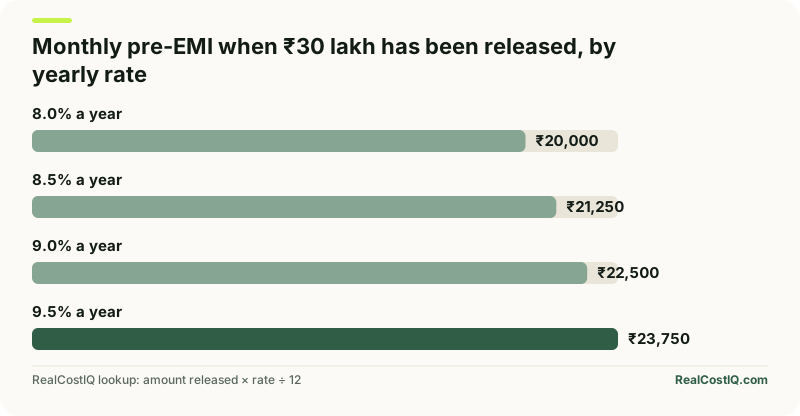
Two readings help. First, per ₹10 lakh the pre-EMI is about four-fifths of the full EMI on a 20-year loan: at 8.5%, ₹7,083 against ₹8,678. The gap is the principal you are not yet repaying. Second, the real bill is the table row for the amount actually released, not for the whole sanction. If your lender has released ₹18 lakh, read between the ₹10 lakh and ₹20 lakh rows, or multiply. The next tranche lifts the figure, which is why the bill grows through the build. We show how it grows over 36 months for a ₹60 lakh loan further down.
The RBI rule behind it: disbursal follows construction
The rule sits in the Reserve Bank of India (Commercial Banks – Credit Facilities) Directions, 2025 (RBI/DOR/2025-26/154, issued 28 November 2025). The heading is Innovative Housing Loan Products – Upfront Disbursal of Housing Loans (paragraphs 114 to 118). The Directions apply to commercial banks. RBI defines these as banking companies other than small finance banks, payments banks and local area banks, plus corresponding new banks and the State Bank of India. They repeal the earlier instructions on credit facilities. These included the Master Circular on Housing Finance of 1 April 2025 (RBI/2025-26/16), whose text they carry forward. The paragraphs begin with the practice RBI wanted to stop. Some banks had tied up with developers to release the sanctioned individual housing loan to the builder upfront, without reference to construction stages. The builder then serviced the borrower's interest or EMI during construction or a set period. These are popularly known as 80:20 and 75:25 schemes. The Directions note they may involve a tripartite agreement between bank, builder and buyer.
RBI's reasoning is the useful part. It says such products expose both the bank and the borrower to extra risks. These are a dispute between buyer and builder, the builder defaulting or paying late on the interest or EMI it promised to cover, and non-completion of the project. It adds that delayed payments by builders on behalf of borrowers may lead to a lower credit rating or score for the borrower. This is because information about the servicing of loans is passed to the credit information companies on a regular basis. Where the whole loan has gone to the builder upfront, the bank carries a disproportionately higher exposure. There is also the risk that the money is diverted.
The rule that follows is short, and in the current text it is mandatory. Paragraph 116 says disbursal of housing loans sanctioned to individuals shall be closely linked to the stages of construction of the housing project. Upfront disbursal shall not be made in cases of incomplete, under-construction or green-field projects. There is one stated exception, in paragraph 117. For projects sponsored by government or statutory authorities, the bank may disburse as per the payment stages the authority prescribes, even where those are not linked to construction stages. This holds provided the authority has no past history of non-completion of projects. The 2015 housing-loans circular records that this exception was added because some banks said they could not lend to allottees of government-built projects whose payment plans were not stage-linked. Paragraph 118 adds a suitability point. A bank introducing any product shall take into account customer suitability and make sure borrowers are fully aware of the risks and liabilities. Paragraph 120 says that a proposal can be sanctioned in the normal course. But the bank shall make disbursements only after the borrower has obtained the requisite clearances from the government authorities for the project.
For housing finance companies, the National Housing Bank issued an advisory on 20 November 2025 saying the same thing. It followed an order of the Karnataka High Court dated 5 August 2025 and advice from the Department of Financial Services about subvention schemes. NHB advised that disbursement must be strictly linked to the stages of construction. It said upfront disbursal shall not be made for incomplete, under-construction or green-field projects. It told HFCs to ensure compliance with paragraphs 87, 88 and 89 of the Housing Finance Company Master Direction of 2021. We did not open that Master Direction's text, so we rely on NHB's description of it.
Why you end up paying pre-EMI
The term pre-EMI is not RBI's. It does not appear in the Credit Facilities Directions, and nothing we read prescribes it. It is what lenders and builders call the interest-only payment that follows from stage-linked disbursal. Say only ₹6 lakh of a ₹60 lakh sanction has been released. Then only ₹6 lakh is outstanding, and the interest accrues on that. A lender can collect that interest as it falls due, which is pre-EMI. It can add the interest to the loan. Or it can start a full EMI on the released amount. All three are product choices. The sanction letter and the key facts statement should spell them out.
The structure that RBI singled out sits beside these, not among them. Under an 80:20 or 75:25 scheme, the builder pays the EMI or interest for you during construction. The Directions say that arrangement creates risk for the borrower. Suppose your builder offers to pay your pre-EMI. Read the tripartite agreement for what happens if the builder stops. The Directions' own warning (paragraph 115) is that a late builder payment may reach your credit record as your late payment. How a builder funds such an offer is outside what we read, so we make no claim about it.
Three ways to carry the same ₹60 lakh loan
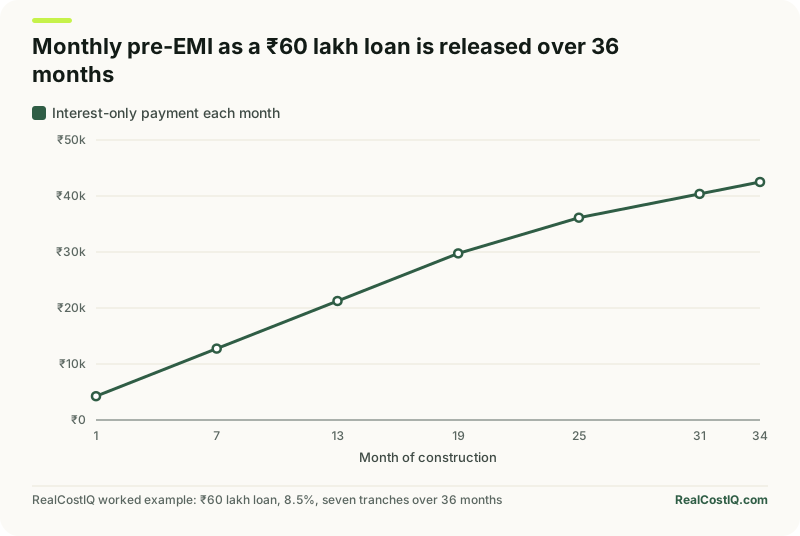
Take a flat priced at ₹80 lakh. You pay ₹20 lakh yourself and borrow ₹60 lakh at 8.5% a year. Construction will take 36 months. These are hypothetical inputs. The builder's stage plan below is also hypothetical. Your agreement for sale sets the real percentages and the real order, and the lender releases only against the builder's demands. Assume the loan is released in seven tranches. (A tranche is one part of the loan paid out at one time.)
| Released at the start of month | Tranche | Total released | Interest-only payment that month (8.5% a year) |
|---|---|---|---|
| 1 | ₹6,00,000 | ₹6,00,000 | ₹4,250 |
| 7 | ₹12,00,000 | ₹18,00,000 | ₹12,750 |
| 13 | ₹12,00,000 | ₹30,00,000 | ₹21,250 |
| 19 | ₹12,00,000 | ₹42,00,000 | ₹29,750 |
| 25 | ₹9,00,000 | ₹51,00,000 | ₹36,125 |
| 31 | ₹6,00,000 | ₹57,00,000 | ₹40,375 |
| 34 | ₹3,00,000 | ₹60,00,000 | ₹42,500 |
Interest each month is the released balance times 8.5% divided by 12. The payment shown holds until the next tranche. Over 36 months the interest-only payments add up to ₹8,73,375.
Now here are the three ways of carrying the loan. Each uses the same total tenure, counted from the first release where noted. That way they can be compared like for like.
- A. Pre-EMI, then full EMI. You pay interest only for 36 months, ₹8,73,375 in all. None of it reduces the ₹60 lakh. From possession, you pay a full EMI on ₹60 lakh over the 204 months left of a 240-month tenure that started at the first release. That EMI is ₹55,698.
- B. Full EMI from the first tranche (tranche EMI). You repay each release over the months remaining in the same 240-month tenure. So the EMI steps up with every tranche, from ₹5,207 after the first to ₹53,505 after the last. The principal falls from the start. You pay ₹10,90,379 in the 36 months, and the balance at possession is ₹57,63,819.
- C. Pre-EMI, then a fresh 20-year loan from possession. You pay interest only for 36 months, ₹8,73,375. Then you pay a full 240-month EMI on ₹60 lakh. The EMI is the lowest of the three, ₹52,069. But the loan runs for 276 months in all.
| A. Pre-EMI, EMI over 204 months | B. Tranche EMI from day one | C. Pre-EMI, then 240-month EMI | |
|---|---|---|---|
| Paid during the 36 months | ₹8,73,375 | ₹10,90,379 | ₹8,73,375 |
| Monthly payment at possession | ₹55,698 | ₹53,505 | ₹52,069 |
| Balance owed at possession | ₹60,00,000 | ₹57,63,819 | ₹60,00,000 |
| Months from first release to last payment | 240 | 240 | 276 |
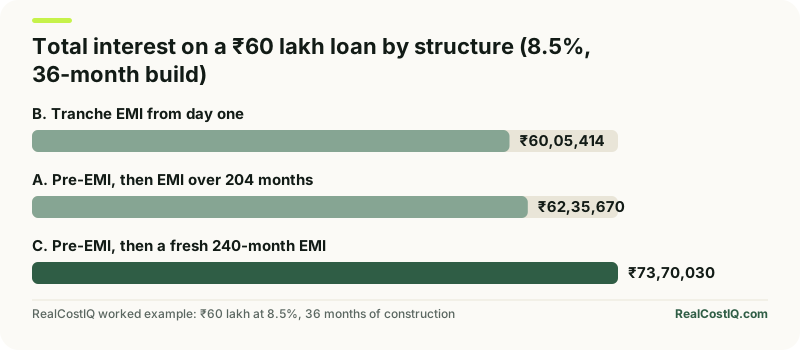
| Total interest over the loan | ₹62,35,670 | ₹60,05,414 | ₹73,70,030 |
| Total repaid, principal plus interest | ₹1,22,35,670 | ₹1,20,05,414 | ₹1,33,70,030 |
Full-EMI amounts from the site's home loan EMI engine and the same formula applied to the remaining balance and months. Pre-EMI is interest on the released balance and is never added to the principal in these three cases. Lenders differ on whether the tenure includes the construction period and on how a tranche EMI is set; these three are common patterns, not the only ones.
What the comparison shows
Three things stand out. First, pre-EMI is not a discount. In structure A, you pay ₹8,73,375 in the 36 months and arrive at possession owing every rupee you borrowed. The money is the price of waiting for the flat.
Second, the structure that costs most per month during construction shows the lowest total interest. B asks for ₹10,90,379 across the 36 months, against A's ₹8,73,375. That is about ₹2,17,000 more. But B ends with total interest ₹2,30,256 lower, because principal starts falling from the first tranche. That is not a saving in the sense of free money. The lower nominal interest comes from repaying principal earlier, and the higher outflow in the early months pays for it. The three structures are equivalent in present value at the loan rate. If you are renting while you wait, B's higher outflow stacks on top of your rent. The rent is not in these numbers. So the decision between A and B is partly a cash-flow question for the next three years. It is partly a cost question for the next twenty.
Third, the tenure convention matters more than the structure. In C, the monthly payment at possession is the lowest, ₹52,069. But total interest is ₹73,70,030, about ₹11.3 lakh more than A, because the loan lasts 36 months longer. When a lender quotes you an EMI, ask whether the tenure is counted from the first release or from possession. The answer can move total interest by ten lakh rupees or more on a loan this size. The home loan EMI calculator works out the post-possession EMI for any tenure you type in. That is a quick way to test the lender's quote.
Pre-EMI interest and income tax
Interest you pay before you get the keys is called pre-construction interest, and the tax law treats it separately. Under section 22(1)(c) of the Income-tax Act, 2025, it can be claimed in five equal yearly parts, starting with the tax year in which the home is bought or its construction is completed. The yearly limit of ₹2 lakh on interest for a self-occupied home now covers current-year interest and these parts together, from 1 April 2026 (Finance Act 2026, section 38). Both points rest on sources we read in our post on home loan tax deductions in 2026-27, which also works a ₹5 lakh pre-construction example. We did not re-read the Act itself on 21 October 2026, because the department's file would not load for us, so check the section text before you file.
A rupee example, using our own arithmetic. Under structure A in this post you pay ₹8,73,375 of pre-EMI interest over 36 months. Claimed in five equal parts, that is ₹1,74,675 a year, for five years from the year the flat is completed. If your interest for the year after possession is already above ₹2 lakh, as it is on a ₹60 lakh loan, the shared cap of ₹2 lakh is full and the slices add nothing extra that year. Under the new regime a self-occupied home gets no interest deduction at all. This post does not say which regime suits you.
What a late flat does to the pre-EMI bill
In structure A, pre-EMI does not stop at the planned possession date. It stops when the loan converts to full EMI. The lender usually ties that to the possession or a fixed date in the sanction. Say the builder is six months late and the full ₹60 lakh is outstanding. Six more months of interest-only payments at ₹42,500 is ₹2,55,000 more. You still owe all ₹60 lakh at the end. In structure B, the delay leaves your monthly payment unchanged, because you are already paying a full EMI.
What you may be owed for a delay is a different question, and a legal one. It turns on your agreement for sale and the real estate law that governs it. We did not read these for this post. The site's RERA delay compensation calculator models the compensation arithmetic. It also discusses pre-EMI paid while a possession dispute runs. We link it rather than restate it.
Pre-EMI is not the only bill while the flat is rising. The builder's demand letters carry GST on each instalment of an under-construction flat. Our GST on property calculator works out the amount for your price. Budget for it alongside the pre-EMI, because the lender does not finance it.
Questions to put to the lender before you sign
The Key Facts Statement circular of April 2024 gives you a standardised document to hold the lender to. The lender must give it before you execute the loan contract. It carries a unique proposal number. It stays valid for at least three working days on a loan of seven days or more. During that time the lender is bound by the terms in it if you agree. It must include a computation sheet of the annual percentage rate and the amortisation schedule over the tenor. The APR includes all charges the lender levies. Charges recovered for third parties, such as insurance or legal fees, are part of the APR. The lender discloses them separately, with receipts. Fees or charges not mentioned in the statement cannot be charged at any stage of the loan without explicit consent. Use it to pin down the points that decide which structure you are in.
- When does the full EMI begin? Is it on the first release, on possession, or on a fixed date? The KFS amortisation schedule should show it.
- Does the tenure count from the first release or from possession? This is the C-versus-A gap above.
- What is the disbursement schedule, and what triggers each release? RBI's rule makes the release follow construction stages. Ask what evidence the lender wants from the builder, and who tells you when a tranche goes out. The texts we read do not say how a lender verifies a stage.
- Is the pre-EMI interest only, or does any of it get added to the loan? The pre-EMI in structure A and C is paid, not capitalised. (Capitalised means added to the loan.) Confirm that is your lender's rule.
- Is there a builder-paid interest or EMI scheme? If so, get the tripartite agreement. Ask what happens if the builder stops paying. RBI's Credit Facilities Directions describe this as a source of risk to the borrower.
- Is the rate fixed or floating, and what resets it? A floating rate changes the pre-EMI each time it resets. Our post on rate resets sets out RBI's rules on how a lender must handle that.
If you miss a pre-EMI, it is an overdue amount like any other. The penal-charges circular of 18 August 2023 says a penalty for non-compliance with a material term is a penal charge. It is not penal interest added to your rate, and it must not be capitalised. The Credit Facilities Directions now route banks to this circular through the Responsible Business Conduct Directions, 2025. We did not read that instrument. Under RBI's asset-classification rules, the clock for flagging an overdue account starts from the due date the lender fixed. We cover the ladder, and what clears it, in our post on a missed EMI and the SMA and NPA rules.
What this post does not settle
Several things sit outside what we read. We did not read the real estate statute that governs your agreement for sale. So we say nothing about the stage percentages a builder may demand or the remedies for delay. We did not read the HFC Master Direction paragraphs that NHB cites. The 1 October 2026 version of the Credit Facilities Directions is PDF-only and we did not open it. So paragraph numbers after July are unchecked. The income-tax treatment of interest paid before possession is summarised from our tax post, not from the Act itself. Where our worked figures help, they are an illustration of arithmetic and not a forecast. The practical takeaway is narrow and checkable. The lender cannot release a home loan for an unfinished flat all at once. So the cost during construction depends on the schedule and the structure. You can read both in the key facts statement before you sign.