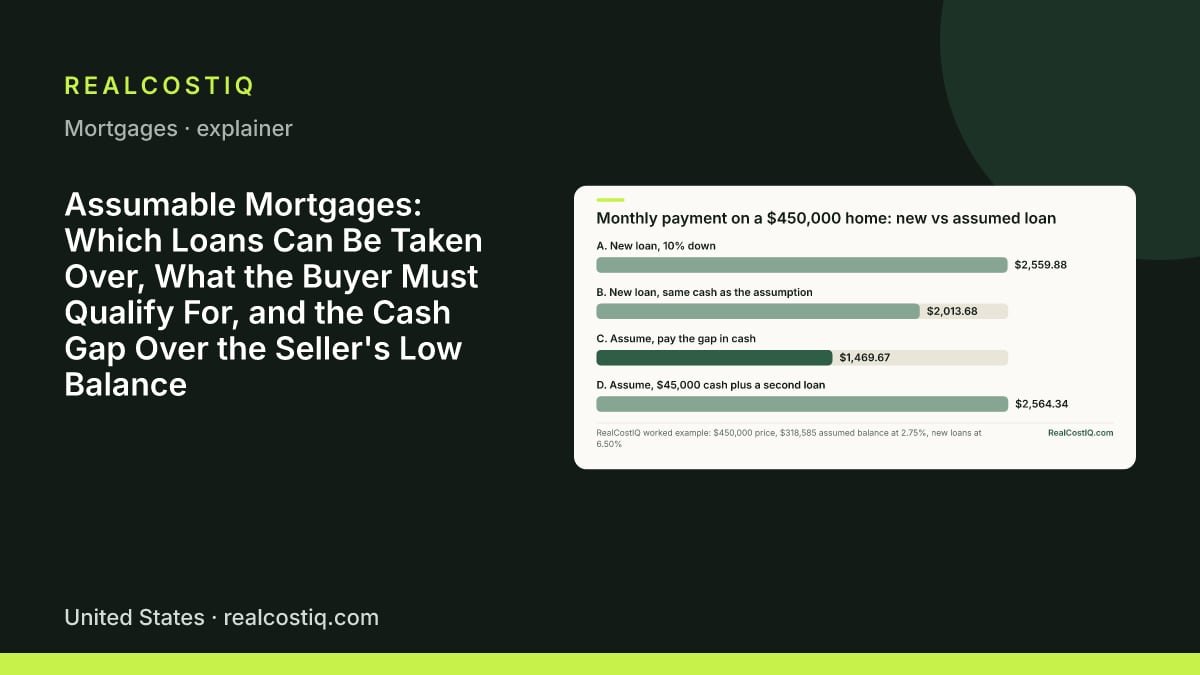
An assumable mortgage is a seller's existing loan that the buyer takes over. The buyer gets the original interest rate, the remaining term and the remaining balance. It matters when the seller's rate is far below today's rates. The buyer then inherits a payment no new loan can match. It is also rarer and more awkward than the headlines suggest. Only some loan types allow it. The servicer, the company that collects the payments, has to approve you. And the seller's equity does not disappear. The buyer must pay it out. This post covers the three questions that decide whether an assumption works. Which loans allow it? What do you have to qualify for? How big is the cash gap? Every program rule below was read in the agency's own document on 2026-10-10. Each figure is labelled with the document's date.
Which loans can be assumed
Whether a loan can be assumed depends on its program and its note, not on how much the buyer wants it. Federal law lets a lender enforce a due-on-sale clause. That is the contract term that makes the whole balance due when the property is transferred. Under 12 U.S.C. 1701j-3(b), the loan contract governs that option. The statute only encourages lenders to permit assumptions. It does not require them. The suggested rate is the existing contract rate, or a rate at or below the midpoint between the contract rate and the market rate. So a lender has no legal duty to let a buyer take over a conventional loan. Each government program writes its own rule instead.
| Loan type | Can a buyer assume it? | Who approves | Source and section |
|---|---|---|---|
| FHA-insured | Yes. "All FHA-insured Mortgages are assumable." The servicer may not enforce restrictions on assumption except as HUD regulations allow. | The servicer, which underwrites the buyer (manually, not with the automated scorecard) | HUD Handbook 4000.1, III.A.3.b (12/30/2025) and II.A.8.n (08/19/2024) |
| VA-guaranteed | Yes, for any qualified buyer, Veteran or not. VA's lender deck says it is not an option to decline to offer assumptions. | The servicer if it has automatic authority, otherwise VA | VA Home Loan Guaranty Buyer's Guide (April 2022); VA Loan Guaranty Conference 2023, Assumptions |
| USDA guaranteed (Section 502) | Yes, with conditions. The transferee must be an eligible applicant, and the interest rate may not exceed the rate on the initial loan. | Rural Development must approve before the lender consents | 7 CFR 3555.256(b) |
| Conventional fixed-rate (Fannie Mae or Freddie Mac) | Generally no for a third-party buyer. The due-on-sale clause is enforced unless an exception applies. | Not applicable | Fannie Mae Servicing Guide D1-4.2-02 (11/08/2017); Freddie Mac My Home, reviewed 11/04/2025 |
| Conventional adjustable-rate | Some can be, but only creditworthy buyers on listed ARM categories, and an ARM reprices anyway. | Servicer, with mortgage insurer approval if there is mortgage insurance | Fannie Mae Servicing Guide D1-4.2-02 |
A loan's own note and any riders control the answer for that specific loan. The only way to know is to ask the servicer in writing.
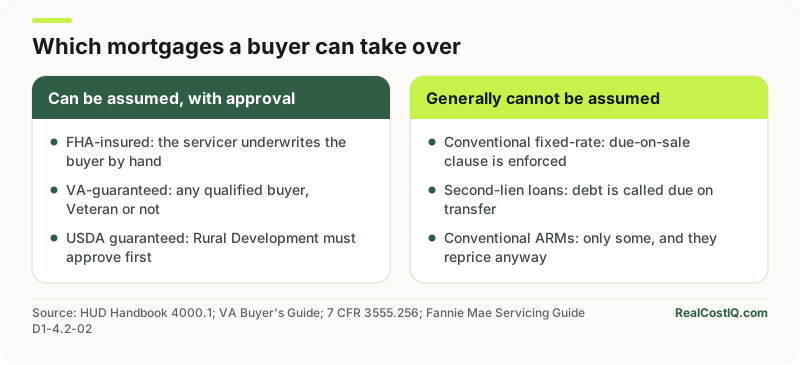
The pattern is clear. The loans with usable assumption rules are the ones backed by a government insurer or guarantor. A seller's FHA or VA loan from 2020 or 2021 is where a low rate usually sits. A conventional loan from the same years almost never works. Fannie Mae's Servicing Guide section D1-4.2-02 lists the narrow cases where a servicer may approve a transfer to a creditworthy buyer. They are most adjustable-rate loans, with named plan exceptions. They also include certain fixed-rate portfolio loans Fannie Mae bought under commitments dated before November 10, 1980. A modern fixed-rate conventional loan is in neither group. The same section says a second-lien loan cannot be assumed on its existing terms. The servicer must tell the parties the debt will be accelerated, which means called due. Freddie Mac says the same thing in plain terms for consumers. Most conventional mortgages, including Freddie Mac's, do not allow third-party assumptions.
The exceptions that are not a purchase
The same federal law lists transfers where a lender may not use the due-on-sale clause. This applies to homes with fewer than five dwelling units. The list includes a transfer by inheritance on a joint tenant's death, a transfer to a relative after the borrower dies, a transfer making the borrower's spouse or children owners, a transfer under a divorce decree or legal separation, and a transfer into a living trust where the borrower remains a beneficiary and occupancy does not change (12 U.S.C. 1701j-3(d)). Freddie Mac says assumptions on conventional loans usually come with life events such as a divorce or inheriting a home. They are not the topic here. If you are a spouse keeping the house in a divorce, or an heir, the rules differ. The lender cannot call the loan just because the title moved. Freddie Mac says the person assuming the loan generally has to qualify with the lender much like applying for a new mortgage.
What the buyer must qualify for
An assumption is not a rubber stamp. The servicer checks the buyer's credit and ability to repay. The program adds its own conditions. They differ more than people expect, so we take each in turn.
FHA: full underwriting, manual, with no minimum cash investment
HUD Handbook 4000.1 says an assuming borrower "must be underwritten in accordance with Origination through Post-closing/Endorsement." It lists exceptions. They are the property-side steps such as ordering an appraisal, the statutory and nationwide mortgage limits, and underwriting with the TOTAL Mortgage Scorecard. The handbook adds that the scorecard "must not be used for assumptions." A Direct Endorsement underwriter must review the assumption by hand. In practice, that means the usual borrower tests. They are credit, income and debts. You can model the debt-to-income ratio in the DTI calculator. Two features are specific to FHA assumptions.
- Occupancy. Say the original mortgage closed on or after December 15, 1989. Then the buyer must plan to live in the home as a principal residence or HUD-approved secondary residence. Only mortgages closed before that date can be assumed as an investment property. Where an investment or secondary-residence assumption is allowed, the handbook caps the loan-to-value at 75 percent for investment property and 85 percent for a secondary residence. It uses either the original appraised value or the new value.
- No required cash investment. The assuming borrower "is not required to make a cash investment in the Property" and may assume 100 percent of the outstanding principal balance. That statement is about the loan, not the price. It does not remove the gap between the price and the balance. The buyer still has to pay the seller that gap.
FHA also has a carve-out for transfers where the due-on-sale clause cannot lawfully be used. Examples are a transfer by devise or descent, or a divorce in which the party left on title keeps occupancy. There, the servicer may process the assumption without a credit review. The assuming borrower must have made the payments for at least six months before applying. A buyer purchasing at arm's length does not qualify for that carve-out.
VA: any qualified buyer, but the entitlement question is separate
VA's lender-training deck is from its 2023 Loan Guaranty Conference. For loans committed on or after March 1, 1988, it defines an assumption as "an approved transfer of ownership with a release of liability." The assumer agrees to become liable for the debt. The assumer must meet VA's credit underwriting standards. The assumer pays the assumption funding fee unless exempt. The original Veteran's entitlement stays tied to the property. Entitlement is the amount of the loan that VA backs. The VA Buyer's Guide adds that anyone, even a non-Veteran, can assume a VA loan if they qualify. It says the servicer's approval is required and, in some cases, VA's. Loans committed before March 1, 1988 are, in the deck's words, freely transferable. They are outside this discussion.
The one extra path is a substitution of entitlement, usually shortened to SOE. It exists only when the buyer is an eligible Veteran. The buyer must also have enough entitlement left to cover what the seller used, and must plan to live in the home. It is done at the same time as the release of liability. It cannot be a standalone step. The deck requires a certificate of eligibility and a signed Form 26-8106, in which the assumer certifies occupancy. Here is the deck's example. A county loan limit of $726,200, times 25 percent, gives maximum entitlement of $181,550. Subtract $36,250 that the assuming Veteran already has in use. That leaves $145,300 available to cover the entitlement the seller used. Those are the 2023 example figures VA used in training, not today's limits. The point is that "enough entitlement" is a computed number. The seller's certificate shows how much is tied up.
USDA: agency approval, an eligible transferee, and a rate ceiling
For USDA's guaranteed single-family loans, 7 CFR 3555.256(b) requires the lender to get Agency approval before agreeing to a transfer with assumption. The agency may approve only if conditions (b)(2)(i) through (x) are met. Among them, the transferee assumes the full outstanding debt. The transferee also acquires all the security property and meets the eligibility rules of the program. The home must meet the program's site and dwelling standards, or be brought up to them before the transfer. The lien priority must be kept or improved. A new guarantee fee based on the remaining principal balance is paid. The lender submits a written request. It supports the applicant's creditworthiness, income eligibility and underwriting analysis. The regulation caps the rate: "the interest rate must not exceed the interest rate on the initial loan." So the buyer has to meet the program's applicant eligibility rules, not just the servicer's credit review.
Conventional ARMs: the narrow route
Fannie Mae's guide does permit a transfer on some eligible loans. In that case, the buyer's credit and finances must meet Fannie Mae's current underwriting guidelines. The mortgage insurer must also approve the transfer if the loan has mortgage insurance. Freddie Mac announced on August 5, 2024 that servicers may use Loan Product Advisor to check creditworthiness for assumptions of Freddie Mac conventional mortgages. This falls under Seller/Servicer Guide section 8406.4(d). The announcement says this is optional and "not an expansion or change" to its transfer and assumption requirements. A buyer should not read it as a new route to assume fixed-rate conventional loans.
Fees, timing and what the servicer must do
The assumption fees are small next to the cash gap. But they are not zero, and programs differ on them.
| Item | FHA | VA | USDA guaranteed |
|---|---|---|---|
| Government or program fee | None listed for the buyer in the handbook sections read | Assumption funding fee of 0.5% (Buyer's Guide fee table and the current VA.gov funding-fee page, updated 10/05/2026), unless the buyer is exempt | A new guarantee fee on the remaining principal balance (7 CFR 3555.256(b)(2)(vi)) |
| Servicer processing fee | Reasonable and customary, not to exceed $1,800 (4000.1, II.A.8.n.vi) | Not read at a dollar figure in the sources above; ask the servicer | Not read at a dollar figure; ask the servicer |
| Third-party costs | Credit reports and verifications of employment at actual cost; up to $45 for a copy of an executed release form on request | Not read | Not read |
| Decision timing | Servicer notifies HUD within 15 days of a change of borrower | Servicer with automatic authority decides within 45 calendar days of a complete package; VA path adds a 35-day submission | Agency approval before the lender consents |
| Refund if it falls through | Half the processing fee is refunded if credit is approved but the assumption does not occur for reasons beyond the assumor's control | Not read | Not read |
A dash in this table means the source read did not state a figure, not that none exists. The FHA $1,800 cap is the figure in Update 18 of the handbook, issued 08/12/2026. Older websites may show a lower cap; the current handbook controls.
The 45-day number is the one that collides with a purchase contract. VA's deck says a servicer with automatic authority has 45 calendar days from a complete application package to decide. If neither the holder nor the servicer has authority, the package goes to VA within 35 days. The deck also says a denial can be appealed to VA within 30 calendar days. VA then decides within 10 business days. Your purchase contract has its own closing date, and the servicer is not working to it. Build the closing date, and any extension rights, around the servicer's timeline, not the other way round. HUD's handbook sets no equivalent decision clock in the sections read. So get the timeline on an FHA assumption from the servicer in writing.
The cash gap, worked through
Most explainers skip this part. A seller who bought with a $360,000 loan five years ago owes only $318,585 today. The buyer does not get the equity for free. The buyer pays the price. The assumed loan covers only the balance. So the buyer has to bring the difference at closing. The seller keeps that difference as their equity.
Hypothetical inputs, not a quote. The seller's VA loan is $360,000 at 2.75 percent on a 30-year fixed term. It began five years ago (60 payments made). The buyer's other choice is a new 30-year fixed loan at 6.50 percent. The sale price is $450,000. All payments are principal and interest only. They use the same amortization formula as the site's mortgage calculator. Taxes, insurance and mortgage insurance are left out, because they follow the home and not the loan.
| Line | Figure |
|---|---|
| Original loan | $360,000 at 2.75%, 30 years |
| Monthly principal and interest | $1,469.67 |
| Balance after 60 payments | $318,585 |
| Months remaining | 300 (25 years) |
| Sale price (hypothetical) | $450,000 |
| Cash gap = price minus balance | $131,415 (29.2% of the price) |
Balance from the year-5 ending balance of the amortization schedule in the site's mortgage engine. Re-amortizing $318,585 at 2.75% over 25 years gives the same $1,469.67, which confirms the payment does not change.
Now compare four ways the buyer could pay for the same $450,000 house. The first is a new loan with 10 percent down. The second is a new loan sized to match the assumed balance, so the cash is the same as the assumption. The third is the assumption with the gap paid fully in cash. The fourth is the assumption with $45,000 cash. The rest of the gap is borrowed on a hypothetical second loan at 9.00 percent over 10 years. Whether a servicer or program allows a second loan alongside an assumption is itself a condition to check. We did not verify it in the sources above.
| Scenario | Cash at closing, before fees | Loan payment(s) | Monthly P&I |
|---|---|---|---|
| A. New loan, 10% down | $45,000 | $405,000 at 6.50%, 30 years | $2,559.88 |
| B. New loan, same cash as the assumption | $131,415 | $318,585 at 6.50%, 30 years | $2,013.68 |
| C. Assume, pay the gap in cash | $131,415 | $318,585 at 2.75%, 25 years left | $1,469.67 |
| D. Assume, $45,000 cash, second loan for the rest | $45,000 | $318,585 at 2.75% plus $86,415 at 9.00%, 10 years | $1,469.67 + $1,094.67 = $2,564.34 |
Computed with the amortization formula in the site's mortgage engine. Scenario D's blended interest rate on the $405,000 of total debt is 4.08% (a weighted average of the two rates, not an APR), but the second loan is repaid over 10 years, so the payment is not lower than Scenario A.
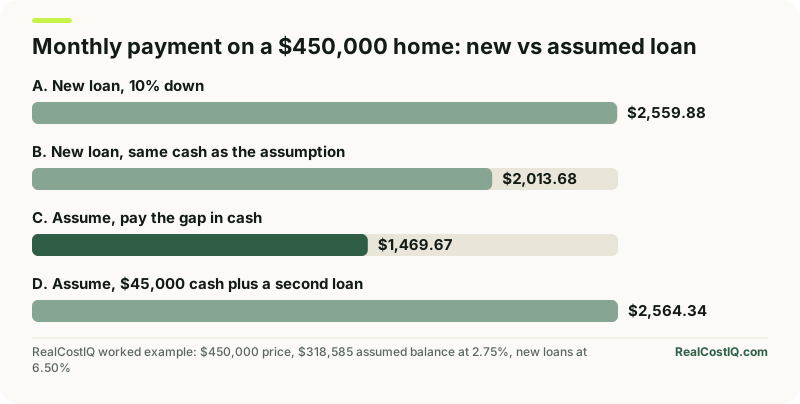
Three results stand out. First, compare C with B, a new loan of the same size. The assumption lowers the payment by $544.01 a month, which is $6,528 a year. That is the real value of the seller's rate. It is the figure to weigh against the fees. Second, compare C with A, a standard 10-percent-down purchase. The assumption saves $1,090.21 a month but needs $86,415 more cash at closing. Divide the annual saving of $13,083 by that extra cash. You get about 15.1 percent a year in the first year. That ratio describes the trade-off. It is not a recommendation. The comparison is not like for like, because the buyer in A borrows $86,415 more and keeps that cash. The saving also shrinks as the new loan is paid down. And the buyer could use that cash in other ways. Third, Scenario D shows how easily the benefit disappears. The gap is borrowed at a market-or-higher rate on a short term. So the total payment ($2,564.34) is no better than the new loan ($2,559.88). That is true even though the blended rate looks like 4.08 percent. A low blended rate on paper is not a low payment if the second loan is expensive or short.
Adding the fees
In Scenario C, the VA assumption funding fee is 0.5 percent. Applied to the $318,585 balance, it would be about $1,593. The Buyer's Guide fee table and the current VA.gov funding-fee page (updated 10/05/2026) both state the 0.5 percent rate. The servicer must confirm what balance the rate is applied to. For an FHA assumption, the processing fee is capped at $1,800 plus third-party costs. Neither changes the picture against a $131,415 gap. But they matter at the margin. A $544 monthly saving repays a $1,800 fee in under four months. Lender, title and recording charges on the transfer are separate. They vary by state and by servicer. We did not read any of those figures in the sources above.
Funding the gap with a second loan: the blended rate
Many buyers do not have the whole gap in cash, so they look at a second loan. The idea is to keep the cheap first loan and borrow only the gap at today's rate. The math can work. The catch is that the second loan is priced at today's rates or higher, and it is often shorter. Here is a case with a 3% loan, an $80,000 gap and the latest Freddie Mac rate.
Inputs (hypothetical). The assumed loan is $300,000 at 3% with 25 years left. The buyer borrows $80,000 more on a second loan at 8.5%, a rate I chose to sit above the first-mortgage average. The comparison is a new $380,000 loan at 7.40% over 30 years. That rate is Freddie Mac's 30-year fixed average in its Primary Mortgage Market Survey (PMMS), released October 15, 2026 and read on 2026-10-21. All payments are principal and interest, computed with the same formula as the site's mortgage calculator.
| Option | Loans | Monthly P&I |
|---|---|---|
| New loan at the PMMS rate | $380,000 at 7.40%, 30 years | $2,631.04 |
| Assume plus a 15-year second | $300,000 at 3.00%, 25 years left + $80,000 at 8.50%, 15 years | $1,422.63 + $787.79 = $2,210.43 |
| Assume plus a 30-year second (if offered) | $300,000 at 3.00%, 25 years left + $80,000 at 8.50%, 30 years | $1,422.63 + $615.13 = $2,037.76 |
Blended rate on the $380,000 of debt: 4.16% (a weighted average of 3.00% and 8.50%, not an APR). Rates for the second loan are assumptions, not quotes. Computed 2026-10-21.
The 15-year second still saves about $420 a month against the new loan. The 30-year second saves about $593. Those savings exist because $300,000 of the debt stays at 3%. They shrink fast if the second loan costs more than 8.5% or the first loan is smaller. Compare this with Scenario D above, where a pricier, shorter second loan erased the benefit. The lesson is the same: price the second loan before you price the house.
Finding assumable homes
Listing sites rarely show whether a loan can be assumed. Three steps help. Ask your agent to request the seller's loan type and rate through the listing agent. Look for FHA and VA homes bought in 2020 to 2022, when rates were lowest. Then ask for the seller's latest mortgage statement, which shows the balance, the rate and the servicer. Call that servicer to confirm it accepts assumptions and what the package needs. Then run the gap math above.
The seller's side: release of liability and entitlement
A buyer who assumes does not automatically free the seller. This is the most common mix-up. It matters, because a seller who cares about the answer will not agree to the deal without it.
- FHA. The servicer "must prepare form HUD-92210.1, Approval of Purchaser and Release of Seller, thereby releasing the original owner." This applies when the sale is by assumption to a borrower who agrees to assume and pay the debt. The servicer must also send a Notice to Homeowner on release of personal liability. That goes to sellers or buyers who ask about the creditworthiness review. Notifying HUD of the change of borrower "does not formally release the original Borrower from personal liability." The release comes from the approved assumption, not from the notice. Say an assumed FHA loan later defaults. The handbook says the servicer must not report the default to consumer reporting agencies for former borrowers. That holds whether or not they remain liable.
- VA. For loans committed on or after March 1, 1988, an approved assumption includes a release of liability. Liability moves to the assumer. The seller's entitlement is a separate question. Without a substitution of entitlement, "the original Veteran's entitlement remains tied to the property." The seller cannot reuse it until the loan is paid off. Say the buyer is a Veteran who has enough entitlement and will live in the home. Then the entitlement can be substituted, and VA can restore the seller's. VA's Buyer's Guide warns that an assumed loan that defaults counts against the original Veteran's entitlement. If VA pays a claim, the amount must be repaid before the entitlement is restored. The seller or the assumer may repay it.
- USDA. Under 7 CFR 3555.256(b)(2)(i), the transferor remains personally liable after a transfer with assumption. The transferor must also pay any interest-subsidy recapture owed at the time. That is the opposite of FHA's release. A USDA seller who is told the buyer "takes over the loan" should know they stay on the debt.
When an assumption goes wrong
Four ways an assumption can fail show up in the rules themselves.
- The buyer cannot fund the gap. The program may not require a cash investment in the loan. But the seller does. A price set around the seller's equity needs money the loan does not provide. This is the usual reason a deal ends.
- The buyer is denied. VA's deck requires a denial letter to state the reasons. For credit reasons, it must also follow the Fair Credit Reporting Act. A VA assumption denied by a servicer with automatic authority can be appealed to VA within 30 calendar days.
- The transfer happens without approval. On FHA, the servicer may ask HUD for approval to accelerate an assumption made without credit approval. It may not accelerate if state law prohibits it, if the seller keeps an ownership interest, or if the transfer is by devise or descent. USDA says the lender must notify the agency. Then it must continue without the guarantee, seek approval, or liquidate. On a conventional loan, Fannie Mae's guide says the servicer must enforce the due-on-sale provision. If the debt is not paid after acceleration, the servicer must start foreclosure. An informal handshake takeover of someone else's loan is not an assumption.
- The timeline outruns the contract. The VA clock, the servicer's backlog and the buyer's documents can all run past a standard closing date. Without a contract timeline that plans for this, the buyer can lose the deposit or the seller can lose the sale.
Questions to put to the servicer before you make an offer
The seller's servicer is the party that approves, so most of the real answers are theirs. This list reflects the rules above. Get the answers in writing.
- Which program is the loan under, and is it assumable on this note? Ask for the payoff and the loan type, not the seller's memory.
- What is the exact principal balance, the interest rate, the remaining term and the escrow balance? The gap is price minus balance. The escrow account is a separate item.
- What assumption fee, processing fee and third-party costs apply? Are they refundable if the assumption is denied?
- How long does the servicer take to decide once the package is complete, and who reviews it? For VA, does the servicer have automatic authority?
- What does the buyer need to submit? Will the servicer review the same income and debt papers as for a new loan? Use a pre-approval versus prequalification check to see how much of that you already have.
- Will the servicer issue a release of liability for the seller? On a VA loan, is a substitution of entitlement being requested? Does the buyer have enough entitlement?
- Is a second loan allowed alongside the assumed loan, and on what terms? This decides whether Scenario D is even possible.
What this post did not verify
We did not confirm some points at a primary source on 2026-10-10. They are left out of the table or flagged. The USDA handbook text on assumptions (HB-1-3555 chapter 17) could not be opened. So the USDA description rests on the regulation, 7 CFR 3555.256. We read it through Cornell's Legal Information Institute copy of the Code of Federal Regulations. The 0.5 percent VA assumption fee appears in both the April 2022 Buyer's Guide and the current VA.gov funding-fee page. VA revises its fee tables from time to time, so confirm the rate with the servicer. VA's conference deck is a training document. It is marked for internal use even though VA hosts it publicly. Its rules fit the Buyer's Guide. But the Lenders Handbook chapter on assumptions is the authority a servicer applies. We read no dollar processing-fee cap for VA or USDA. We read no state transfer-tax or recording figures. Where a source did not state something, the post says so instead of filling it in.
Putting the numbers in order
The decision comes down to three numbers. They are the payment difference against a new loan of the same size, the cash gap, and how you would fund it. In the hypothetical example, the assumption saved $544 a month on a like-for-like loan. But it needed $131,415 at closing. If the gap can only be covered by a second loan at a market-level rate, the saving mostly disappears. Start by finding the loan's program. If it is conventional fixed-rate, assume the answer is no until the servicer says otherwise in writing. If it is FHA, VA or USDA, ask for the balance, the fee schedule and the timeline. Work out the gap before you negotiate the price.