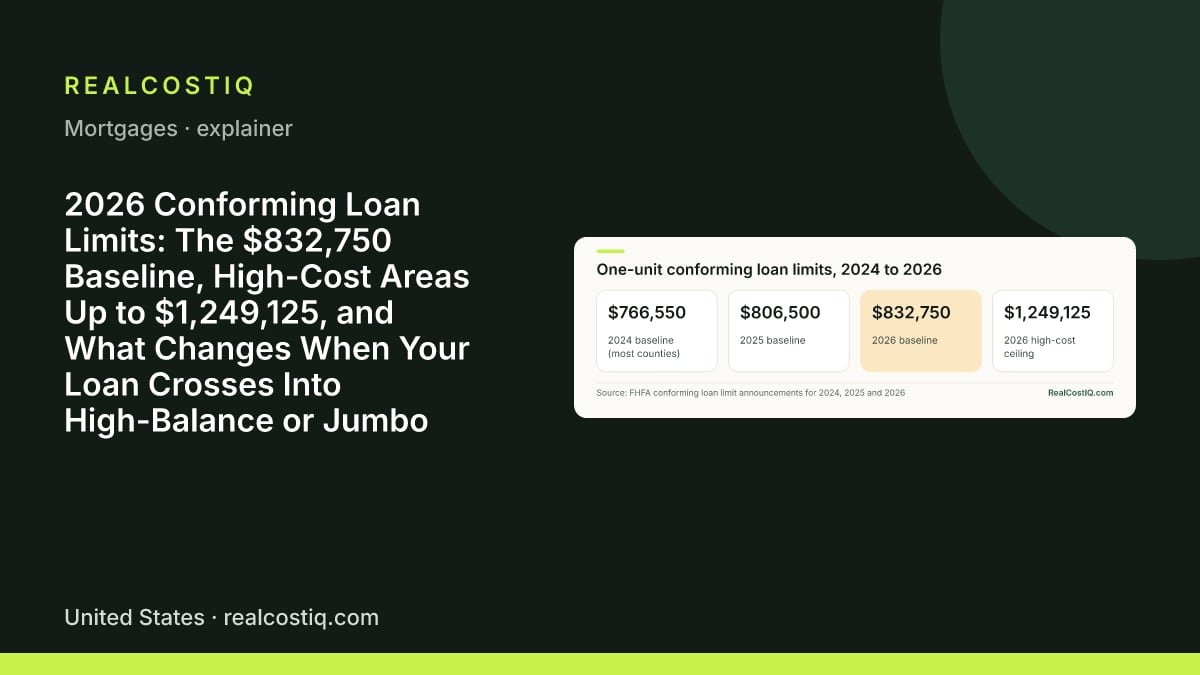
Three words get used loosely in mortgage listings: conforming, high-balance and jumbo. They describe where your loan amount falls against a cap. Fannie Mae and Freddie Mac, the two companies that buy home loans from lenders, cannot buy loans above that cap. The cap is not one figure. It is a county-by-county map. For 2026 it has a floor of $832,750. It has a ceiling of $1,249,125 for a one-unit home in the contiguous states, meaning the mainland states. This post gives the 2026 numbers from FHFA and HUD (each read on 2026-10-11). FHFA is the Federal Housing Finance Agency, and HUD is the Department of Housing and Urban Development. The post explains how the formula produces your county's figure. Then it spells out what actually changes for you at each boundary. It also covers what no agency rule decides at all.
The 2026 numbers
FHFA announced the 2026 values on November 25, 2025. The one-unit baseline rose to $832,750. That is an increase of $26,250 from the 2025 baseline of $806,500. FHFA ties the increase to a 3.26 percent rise in average U.S. home prices over the year to the third quarter of 2025. The same percentage applies to two-, three- and four-unit properties. Here is the full ladder for the contiguous states and the District of Columbia, plus the special areas, as FHFA states it:
| Property | Baseline (most counties) | Ceiling (highest-cost counties) |
|---|---|---|
| One unit | $832,750 | $1,249,125 |
| Two units | $1,066,250 | $1,599,375 |
| Three units | $1,288,800 | $1,933,200 |
| Four units | $1,601,750 | $2,402,625 |
| One unit, Alaska, Hawaii, Guam, U.S. Virgin Islands | $1,249,125 | $1,873,675 |
Baselines and the one-unit ceilings are quoted from FHFA's release and its 2026 addendum. The addendum lists the multi-unit baselines; the multi-unit ceilings are 150 percent of them, which matches the FHA ceilings in HUD Mortgagee Letter 2025-23 ($1,599,375, $1,933,200 and $2,402,625). The addendum's "statutorily defined" areas carry a baseline 50 percent higher than the contiguous states.
A quick check on the arithmetic. 150 percent of $832,750 is $1,249,125, the one-unit ceiling. 150 percent of that again is $1,873,687.50. FHFA's rounding rule is that high-cost values round down to the nearest $25. That turns it into the $1,873,675 shown for the special areas. HUD publishes its own FHA ceiling for those four areas at $1,873,625, which is $50 below FHFA's figure. So the two agencies' published ceilings for those areas differ slightly.
Conforming loan limits by year: 2024, 2025 and 2026
Searches for older years usually want the cap that applied when a loan closed. Here are the one-unit figures for the last three years, each from FHFA's announcement for that year. The ceiling is the most any high-cost county can reach, and it is always 150 percent of the baseline. A loan above these numbers in your county is jumbo, so the same loan can be conforming in one year and jumbo in another.
| Year | Baseline (most counties) | Change from prior year | High-cost ceiling | FHFA announced |
|---|---|---|---|---|
| 2026 | $832,750 | +$26,250 | $1,249,125 | November 25, 2025 |
| 2025 | $806,500 | +$39,950 (5.2 percent) | $1,209,750 | November 26, 2024 |
| 2024 | $766,550 | +$40,350 | $1,149,825 | November 28, 2023 |
Source: FHFA news releases announcing the 2024, 2025 and 2026 conforming loan limit values, read 2026-10-19. Each row's change is the increase FHFA states in that year's release. Alaska, Hawaii, Guam and the U.S. Virgin Islands have higher limits set by statute.
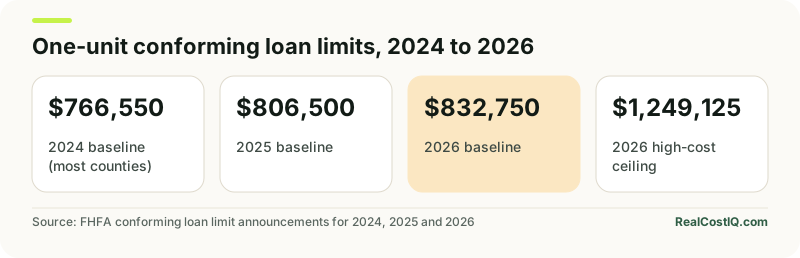
So the answer to "what was the max conventional loan in 2025" is $806,500 in most counties and up to $1,209,750 in high-cost counties. For 2024 it was $766,550 and up to $1,149,825. Each limit applies to loans delivered to Fannie Mae or Freddie Mac in that calendar year.
How FHFA sets the number
The Housing and Economic Recovery Act of 2008 (HERA) requires FHFA to adjust the baseline each year. The change must reflect the change in the national average home price. FHFA's addendum shows the exact calculation for 2026. It compares the nominal (not adjusted for inflation), seasonally adjusted, expanded-data House Price Index for the third quarter of 2025 (419.11864149) with the same quarter a year earlier (405.89713556). The change is 3.25735384 percent, and FHFA applies it to the baseline. Suppose prices fall for a year. Then those declines must be made up before the baseline can rise. The addendum says no such adjustment was needed for 2026.
The high-cost layer works county by county. The median home value is the middle price: half of homes cost more and half cost less. HERA raises the local limit where 115 percent of the local median home value exceeds the baseline. It caps the result at 150 percent of the baseline. FHFA uses median home values that HUD's FHA estimates. It compares the counties within a metropolitan or micropolitan statistical area. It uses the highest value to set the limit for the whole area. FHFA also does not permit declines. The 2026 values reflect the higher of the 2026 formula result and the HERA values for every year from 2009 through 2025.
| Local median home value | 115 percent of median | Resulting 2026 limit |
|---|---|---|
| $600,000 | $690,000 | $832,750 (below baseline, so baseline applies) |
| $900,000 | $1,035,000 | $1,035,000 |
| $1,200,000 | $1,380,000 | $1,249,125 (capped at the ceiling) |
Illustration of the rule in FHFA's addendum. These medians are not real counties, and real limits use HUD's FHA median estimates and area-level comparisons, so look up your county rather than computing it.
For two- to four-unit homes, the same method applies with multipliers. FHFA multiplies 115 percent of the local one-unit median by the two-, three- and four-unit multipliers (1.28021583, 1.54748201 and 1.92314149). Then it compares the result to the ceiling for that unit count. In practice, a duplex's limit in a high-cost area is not simply the one-unit limit times two.
Conforming, high-balance and jumbo: what each label means
Fannie Mae can buy only loans up to a set amount. This is the conforming loan limit. It comes from Fannie Mae's federal charter and changes every year. The limit varies by unit count and property location. Eligibility is judged on the loan's original amount. Fannie Mae's guide says the baseline limits apply to most loans it buys. It says the high-cost area limits apply to properties in designated high-cost areas. It also says high-balance loans are subject to the high-cost area limits. That gives three bands for a one-unit home:
| Band | Loan amount | Who sets the rules |
|---|---|---|
| Conforming (baseline) | Up to $832,750 in any county | Fannie Mae and Freddie Mac guides and the Eligibility Matrix |
| Conforming high-balance | Above $832,750, up to your county's limit (at most $1,249,125) | The same guides, with Fannie Mae's Chapter B5-1 conditions and added pricing |
| Jumbo (non-conforming) | Above your county's limit | The lender or investor; no Fannie Mae or Freddie Mac rule applies |
Fannie Mae's guide describes high-balance loans as those subject to the FHFA high-cost area limits. In a county where the limit is the $832,750 baseline, there is no high-balance band: a larger loan is jumbo.
The key point is that the band depends on the county of the property. It does not depend on where you live, and it does not depend on the price. A $1,000,000 purchase with 20 percent down is an $800,000 loan. That is conforming everywhere. The same price with 10 percent down is a $900,000 loan. That is high-balance in a county whose limit is at or above $900,000. It is jumbo in a county at the baseline. Condos and co-ops follow the same logic, with a co-op wrinkle. For a first lien (the main loan) on a co-op share, Fannie Mae counts the lien plus the prorated share of the co-op's blanket mortgage against the limit.
What high-balance changes
High-balance is not a different product. It is a conforming loan with a short list of added conditions. Here they are, from Fannie Mae's guide sections, as read today:
- Conventional first-lien only, and DU only. B5-1-01 requires a conventional first-lien mortgage underwritten through Desktop Underwriter (DU), which is Fannie Mae's automated approval system. Government loans are covered in separate topics.
- LTV from the Eligibility Matrix. The loan must meet the LTV, CLTV and HCLTV ratios in the Eligibility Matrix. LTV is the loan as a share of the home's value. CLTV and HCLTV also count other loans on the home. The section does not list the ratios itself. The matrix is a separate PDF that Fannie Mae updates. Read the current version for your scenario.
- Not eligible for the 97 percent options. Selling Guide B2-1.3-01 says loans between 95.01 and 97 percent LTV must be fixed-rate. It says high-balance and ARM (adjustable-rate mortgage) loans are not permitted at those ratios.
- Mortgage insurance above 80 percent LTV. B5-1-02 requires mortgage insurance on a high-balance loan with an LTV above 80 percent. Financed borrower-purchased mortgage insurance is allowed. But the maximum gross LTV with the financed premium included is 95 percent.
- Extra pricing. B5-1-02 says specific additional loan-level price adjustments apply to all high-balance loans. They come on top of every other applicable adjustment, and all adjustments are cumulative. The amounts depend on credit score and LTV. They are in Fannie Mae's LLPA Matrix (loan-level price adjustment matrix), which it updates. Check the current version for your scenario.
- Delivery flag. Lenders must report special feature code 808 on delivery. That is lender paperwork, not something a borrower needs to handle. But it is why a high-balance loan is identifiable in the secondary market.
This post describes Fannie Mae's published sections. A lender that sells loans to Freddie Mac may apply that program's own rules, so ask which applies to your loan. The practical result is the same. Crossing the baseline does not make a loan jumbo. But it adds cost and removes the highest-LTV options.
Jumbo is a lender decision, not an agency rule
Once the loan passes the county limit, Fannie Mae and Freddie Mac cannot buy it. So no agency guide sets a minimum credit score, a maximum DTI or a reserve requirement for jumbo loans. DTI is debt-to-income ratio, your monthly debts compared with your income. Reserves are savings kept after closing. Each lender, or the investor that buys the loan, sets its own rules. The Consumer Financial Protection Bureau (CFPB) has a page on finding your county limit. It puts it in two sentences. A loan above the limit is a jumbo loan. And a lender might require a higher down payment or steer you to a jumbo loan instead.
That is why this post gives no jumbo down payment percentage, no jumbo credit score minimum and no jumbo rate premium. Any such figure would be one lender's overlay presented as a rule. Ask for these in writing from at least two lenders, because they vary. Ask for the minimum down payment at your loan size. Ask for the credit score and DTI limits. Ask for the number of months of reserves and what counts toward them. Ask whether the lender requires one appraisal or two. And ask whether the loan is held in the lender's portfolio or sold. A lender that holds the loan sets its own policy on all of them.
How the limit interacts with the down payment
A bigger down payment is the simplest way to stay under a limit. Take a $1,000,000 purchase in a county at the baseline. The minimum down payment to keep the loan at $832,750 is $167,250, or 16.725 percent. Anything less puts the loan above the limit. In a county with a higher limit, the same loan may be high-balance and conforming rather than jumbo.
Worked example: $1,000,000 purchase at three down payments
Hypothetical inputs, not a quote. A $1,000,000 purchase, 30-year fixed at 6.50 percent, principal and interest only. It is computed with the formula in the site's mortgage calculator engine. The rate is the same in every row, so the table isolates the loan size. Real pricing differs by band. High-balance loans carry added adjustments, and jumbo pricing is lender-set.
| Down payment | Loan amount | LTV | Monthly principal and interest | Band in a baseline county |
|---|---|---|---|---|
| $200,000 (20 percent) | $800,000 | 80.00 percent | $5,056.54 | Conforming |
| $167,250 (16.725 percent) | $832,750 | 83.28 percent | $5,263.55 | Conforming, at the limit |
| $100,000 (10 percent) | $900,000 | 90.00 percent | $5,688.61 | Jumbo |
Computed with the site's mortgage engine: payment = P x r(1+r)^n / ((1+r)^n - 1), r = 6.50 / 1200, n = 360. Taxes, insurance and mortgage insurance are excluded.
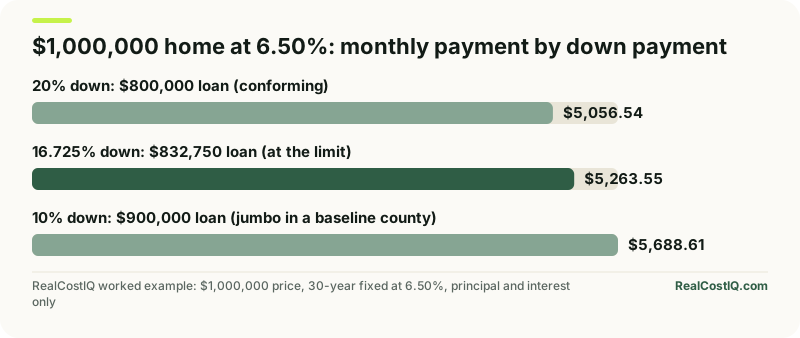
The step from 83.28 percent to 90 percent LTV adds $67,250 to the loan. It adds $425.06 a month in principal and interest ($5,688.61 minus $5,263.55) at the same rate. That is the loan-size effect alone. If the larger loan also carries a higher rate, the gap widens. Here is a sensitivity check, not a prediction. The $900,000 loan costs $5,837.38 a month at 6.75 percent and $5,987.72 at 7.00 percent. So each quarter-point adds roughly $149 to $150 a month at that loan size. Use the mortgage calculator to test your own rate quotes.
FHA and VA use different yardsticks
The conforming limit is a conventional-loan idea. FHA has its own limits, set by HUD in Mortgagee Letter 2025-23 (published December 11, 2025, effective for case numbers assigned on or after January 1, 2026). The low-cost floor is 65 percent of the $832,750 conforming limit. That gives $541,287 for a one-unit home. The high-cost ceiling is 150 percent, or $1,249,125. The ceiling matches the conventional ceiling. The floor does not. In a low-cost county, a loan between $541,287 and $832,750 is above the FHA limit but still conforming for a conventional lender. The FHA limit mechanics are explained in the FHA loan calculator page. County figures are in HUD's lookup tool.
VA follows FHFA. VA is the Department of Veterans Affairs. Its loan-limit page says its limits are the same as the FHFA limits. But a veteran with full entitlement has no loan limit, as long as they can afford the loan and the appraisal supports the price. Entitlement is the amount of the loan VA will guarantee. The county limit matters for veterans with remaining (bonus) entitlement. There, the additional guaranty is 25 percent of the one-unit county limit, less entitlement already used. VA also says to use the one-unit limit for those calculations, even for multi-unit properties. It says most lenders want your entitlement, down payment or a combination to cover at least 25 percent of the loan. The VA mortgage calculator models the funding fee and payment for a VA loan.
How to find your county's limit
- Use the property's county, not yours. The limit depends on where the home is and how many units it has. For a two- to four-unit property, the higher limit applies only if you buy the entire building. For a single condo unit, the regular one-unit limit applies (CFPB).
- Look it up. The CFPB points to HUD's loan limit tool. Select the state and county. Set the limit type to Fannie/Freddie. Then read the One-Family column. FHFA also publishes the full county list for 2026 as XLSX, CSV and PDF files, plus an interactive map. Its conforming loan limit page is linked in the sources below. Start there for any county or state, such as a New York borough county or a South Carolina county.
- Compare your loan, not your price. The test is the original loan amount. If your down payment moves the loan across the line, the band changes.
- Ask whether the lender treats the loan as high-balance or jumbo. Lenders may price the band differently.
- Mind the date. Fannie Mae says lenders must confirm the loan is within the limit for the property's area when it is delivered. Limits change every year. If your rate lock or closing straddles New Year, ask which year's limit the lender will use.
When the 2027 limits arrive
As of October 19, 2026, FHFA has not announced the 2027 limits. FHFA announced the 2024, 2025 and 2026 values on November 28, 2023, November 26, 2024 and November 25, 2025. So the next announcement usually comes in late November. This post will be updated with the official 2027 figures after FHFA publishes them. The baseline moves with the FHFA House Price Index. So the 2027 baseline will reflect the change in average home prices over the year to the third quarter of 2026, based on how FHFA computed 2026. A fall in the index would have to be made up before the baseline could rise. FHFA's stated practice is not to let high-cost area limits fall below their prior values. Treat any 2027 figure published before then as unofficial.
Common mistakes to avoid
- Treating $832,750 as the limit everywhere. It is the baseline. Your county may be higher, up to $1,249,125.
- Treating the price as the test. A $1,000,000 home with a large down payment can be a conforming loan.
- Assuming high-balance means jumbo rules. High-balance stays inside the conforming system, with DU, the Eligibility Matrix and added pricing. Jumbo is lender-set.
- Quoting a jumbo down payment percentage as a rule. There is no agency rule; ask lenders.
- Using an older year's figure. The 2025 baseline was $806,500. CFPB's county-limit page was last reviewed in January 2024 and lists older figures. Use it for the method, not the numbers.
- Forgetting multi-unit rules. Two- to four-unit limits are higher, but only for the whole building. VA entitlement calculations use the one-unit limit.