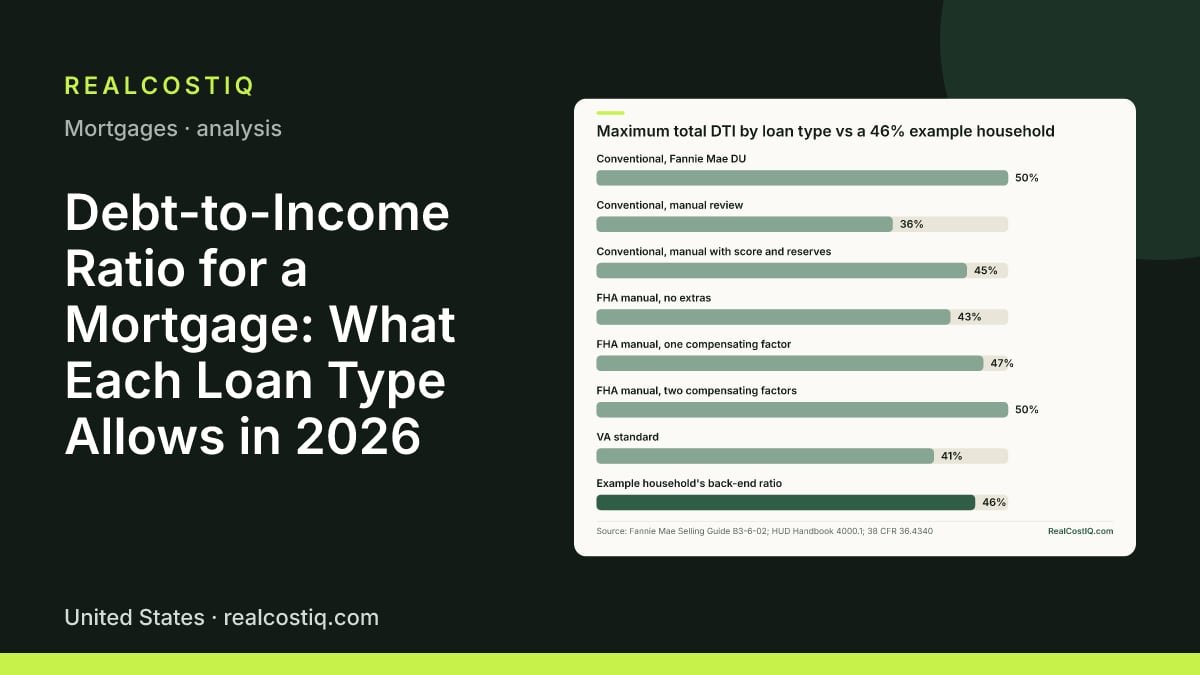
Ask five lenders for the maximum debt-to-income ratio and you may hear five numbers. Each number can be right. The limit depends on the loan type, on how the file is reviewed, and on what else is strong in the file. This post puts one household through each set of rules. Then it shows what changes the answer. It does not say which loan to pick. It shows the rules, so you can ask better questions.
One household, tested four ways
Here is the household. It earns $90,000 a year before taxes. That is $7,500 a month. The planned home has a monthly payment of $2,600. That payment covers principal, interest, property taxes and homeowners insurance. Lenders call that PITI. The household also has three other debts. A car loan costs $450 a month. A student loan costs $300. A credit card has a $100 minimum payment.
There are two ratios. The front-end ratio is the housing payment divided by gross monthly income. The back-end ratio is the housing payment plus all other monthly debts, divided by gross monthly income. The Consumer Financial Protection Bureau (CFPB) describes DTI as all your monthly debt payments divided by your gross monthly income. Gross means before taxes come out.
| Item | Monthly amount | Share of $7,500 |
|---|---|---|
| Housing payment (PITI) | $2,600 | 34.7% (front-end ratio) |
| Car loan | $450 | 6.0% |
| Student loan | $300 | 4.0% |
| Credit card minimum | $100 | 1.3% |
| All debts together | $3,450 | 46.0% (back-end ratio) |
Inputs to the site's DTI calculator code (src/lib/calculators/dti.ts): gross monthly income 7,500; proposed mortgage 2,600; car 450; student loan 300; card minimum 100; other debt 0. Outputs: total monthly debt 3,450; front-end 34.67%; back-end 46.00%. For FHA, the payment would also include its mortgage insurance premium. It is left out here to keep the numbers simple, which makes FHA look better than it may be.
The back-end ratio is 46.0 percent. Hold on to that number. The next four sections show what each program does with it.
Conventional loans: Fannie Mae's three numbers
A conventional loan is one not backed by a government agency. Many follow Fannie Mae's rules. Fannie Mae's Selling Guide, section B3-6-02 (dated April 2, 2025), gives the limit in two parts. For loans run through its automated system, called Desktop Underwriter, or DU, it says the maximum allowable DTI ratio is 50 percent. For manually underwritten loans, it says the maximum total DTI ratio is 36 percent of the borrower's stable monthly income. The maximum can be exceeded, up to 45 percent, if the borrower meets the credit score and reserve requirements.
Manual underwriting means a person checks the file by the book instead of leaning on the automated tool. Reserves are savings you still have after closing. The guide points to its eligibility matrix for the exact score and reserve levels. I did not read that matrix today, so this post gives no score or reserve figure.
The guide counts the whole housing cost for a home you will live in. It says to use the PITIA and the qualifying payment amount. PITIA is PITI plus any association dues. It also counts payments on installment debts and other mortgage debts that run longer than ten months, payments on revolving debts, and payments on lease agreements, whatever the lease end date. The page I read has no separate limit on the housing payment alone. It sets only the total.
Apply that to the household. The 36 percent line is $2,700 a month of debt. The 45 percent line is $3,375. The 50 percent line is $3,750. The household carries $3,450. That is $75 over the manual 45 percent ceiling and $300 under the DU ceiling. Under DU, it fits. If a person must review it by hand, it misses.
Fannie Mae's rules are only the base. A lender may add stricter rules of its own, called overlays. Your lender may stop short of 50 percent even when Fannie Mae allows it. Ask your lender what its own cap is. The housing-payment side of the ratio is the PITI figure used in the example.
FHA loans: two ratios and a ladder of extras
FHA loans are insured by the Federal Housing Administration. Its rules sit in HUD Handbook 4000.1. The copy I read is marked last revised August 12, 2026. FHA does look at two ratios. The handbook says the underwriter must calculate the borrower's Total Mortgage Payment to Effective Income Ratio, or PTI, and the Total Fixed Payment to Effective Income ratio, or DTI. Those are the front-end and back-end ratios.
For manually underwritten loans, the handbook gives a matrix of maximum ratios. The first number is the housing ratio. The second is the total debt ratio. Here is what it lists for a borrower with a credit score of 580 or above.
| Housing / total ratio | What the handbook requires | Example household (34.7 / 46.0) |
|---|---|---|
| 31 / 43 | No compensating factors required | Misses both |
| 37 / 47 | One of: verified and documented cash reserves; minimal increase in housing payment; or residual income | Fits, with one factor |
| 40 / 40 | No discretionary debt | Misses the total |
| 40 / 50 | Two of: reserves; minimal increase in housing payment; significant additional income not reflected in effective income; residual income | Fits, with two factors |
Source: HUD Handbook 4000.1, Approvable Ratio Requirements (Manual), read 2026-10-18. Borrowers with a score from 500 to 579, or no score, may not exceed 31 / 43. Energy-efficient homes can have stretch ratios of 33 / 45.
A compensating factor is a strength in the file that makes up for a high ratio. Residual income is the money left each month after all bills. The example household clears the 37 and 47 line, with $75 of room on the total. To use that line, it must show one factor, such as savings kept after closing. The same household misses the base 31 and 43 line on both counts.
The handbook also has a separate path for loans scored by FHA's automated tool, called TOTAL Mortgage Scorecard. The section I read says a lender may approve a loan if the scorecard rates it Accept and the lender completes its review and documentation steps. It lists no ratio cap in that section. The ratio matrix sits under manual underwriting. So the 31, 37 and 40 lines above apply to files a person reviews. If your file comes back Refer, expect that manual path.
The site's FHA loan calculator prices the monthly payment. Run it first, because the payment is the largest piece of both ratios.
VA loans: a 41 percent standard and a second test
VA loans are guaranteed by the Department of Veterans Affairs. The rule is in federal regulation, 38 CFR 36.4340. I read the current text on the eCFR site today. It says there are two standards: the debt-to-income ratio and a residual income analysis. It adds that, ordinarily, the veteran must meet both. It also says failure to meet one standard will not automatically disqualify a veteran.
The ratio side is simple to state. The regulation says the ratio is the monthly payment on the loan, plus homeowners and other assessments such as special assessments, condominium fees and homeowners association fees, plus long-term obligations, divided by gross income. It says the standard is 41 percent or less. It also says the ratio should be rounded to the nearest two digits. So 40.67 percent rounds to 41.
Now the exceptions. If the ratio is over 41 percent, the loan may be approved with justification by the underwriter's supervisor. If the ratio is over 41 percent and the residual income exceeds the guidelines by at least 20 percent, the second-level review and statement of justification are not required. The regulation also says all members of the household count when residual income is checked, even a spouse who is not on the loan.
The example household sits at 46 percent. That is $375 a month over the 41 percent line, which is $3,075. By the regulation, it cannot be approved on the ratio alone. It needs a supervisor's justification, or it needs residual income at least 20 percent above the guideline. Residual income guidelines come from tables by region and family size. I did not copy them here, because they change by region. The regulation text says the VA's residual income guidelines are in that section, and your lender will pull the right row.
VA has no front-end test in the regulation text I read. Only the total counts. That makes the VA path different from FHA, where both numbers matter. If you want to price a VA loan, use the site's VA mortgage calculator. Lenders can add their own caps on top of the VA standard, so a lender may turn down a file that the VA regulation would allow.
A note on sources. The plan for this post named the VA Lenders Handbook, Pamphlet 26-7, chapter 4. I could not open that chapter's text today. The VA site returned a script page instead of the document. So the VA figures here come from the regulation itself, which is the binding rule. The handbook explains how lenders apply it.
USDA loans: what I could and could not confirm
USDA guaranteed loans are for eligible homes in eligible rural areas. The agency publishes its ratio limits in Chapter 11 of its Technical Handbook, HB-1-3555. Its web server refused every request I made for that chapter today. I will not type in a limit I did not read. So this post gives no USDA ratio figure.
What I did read is the federal rule on automated underwriting, 7 CFR 3555.107. It says approved lenders must process these loans through the agency's automated system. It says the system does not replace the judgment of an experienced underwriter and must not be the only basis for a decision. It also says a loan that gets an Accept recommendation can generally go in with minimal documents. A Refer or Refer with Caution result needs manual underwriting by the lender. That mirrors the FHA split. Ask a USDA-approved lender for the current ratio limits and for any waiver rules before you shop.
The same household, side by side
| Program and review type | Limit the rules set | Result at 46.0% |
|---|---|---|
| Conventional, DU (Fannie Mae) | 50% total | Within the limit, $300 of room |
| Conventional, manual (Fannie Mae) | 36% total, up to 45% with score and reserves | Over the ceiling by $75 a month |
| FHA, manual (HUD 4000.1) | 31 / 43; 37 / 47 with one factor; 40 / 50 with two | Fits the 37 / 47 line with one factor |
| VA (38 CFR 36.4340) | 41% standard; over 41% needs justification or 20% extra residual income | Over the standard; needs a second path |
| USDA (HB-1-3555 ch. 11) | Not read today | Ask a USDA lender |
Dollar gaps use $7,500 gross monthly income and $3,450 of monthly debt. Limits are the agency or investor base rules, read 2026-10-18. A lender may apply a lower cap.
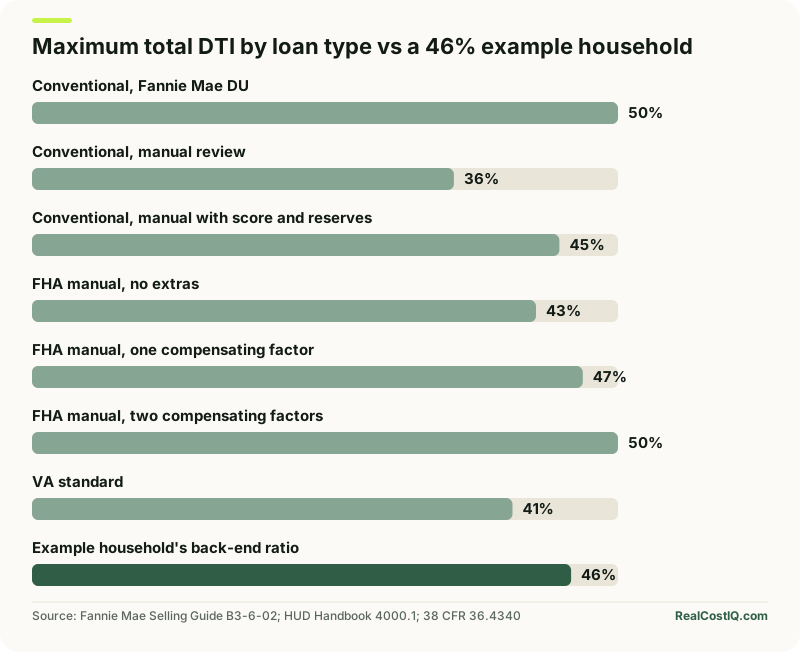
Two things stand out. First, the household is not simply good or bad. It fits under DU and under FHA with one strength. It misses a hand-reviewed conventional loan and the plain VA standard. Second, the review type matters as much as the loan type. A file that the automated tool approves can follow different numbers from the same file reviewed by hand.
Why the lender's answer can differ from the rulebook
The CFPB says it plainly. Different loan products and lenders will have different DTI limits. That sentence explains most of the confusion online. Four things sit between a rulebook and your approval.
- Overlays. A lender can set limits tighter than the agency or Fannie Mae. Many do, especially for borrowers with lower scores.
- Automated versus manual review. Fannie Mae, FHA and USDA each have an automated path and a manual path. The numbers differ between them.
- What counts as debt. Fannie Mae counts installment debts that run longer than ten months and leases of any length. A car loan with six months left may not count. A lease always does.
- What counts as income. Only stable, documented income counts. A raise you have not yet received does not.
Federal rules sit above all of this. The CFPB says a qualified mortgage has a price-based limit on the annual percentage rate. It says the lender must also consider either how much of your income goes toward monthly debt, or your leftover income. So the law asks the lender to look at your debts. It does not hand every borrower one fixed cap. The lender's own rules and the loan type fill in the number.
Four ways to move the ratio, with the numbers
The ratio has two parts. The top is your monthly debt, including the new payment. The bottom is your gross income. You can lower the top, raise the bottom, or both. Here are four changes to the example household. Each one is run through the same engine. None of them is advice. They show how far each move goes.
| Change | Front-end | Back-end | Where it lands |
|---|---|---|---|
| Start: $2,600 payment, three debts | 34.7% | 46.0% | Over VA 41% and the Fannie manual 45% ceiling |
| A. Pay off the $450 car loan | 34.7% | 40.0% | Under VA 41%; inside the Fannie manual 45% ceiling; FHA still needs the 37 / 47 line |
| B. Pick a home with a $2,300 payment and pay off the card | 30.7% | 40.7% | Under VA 41%; passes FHA 31 / 43 with no extras |
| C. Do both A and B | 30.7% | 34.7% | Under every base limit above, including Fannie manual 36% |
| D. Income rises to $8,500 a month | 30.6% | 40.6% | Under VA 41%; passes FHA 31 / 43 with no extras |
All rows use the site's DTI engine at the inputs named in the text. A: car 0, student loan 300, card 100, payment 2,600, income 7,500. B: car 450, student loan 300, card 0, payment 2,300, income 7,500. C: car 0, student loan 300, card 0, payment 2,300, income 7,500. D: car 450, student loan 300, card 100, payment 2,600, income 8,500.
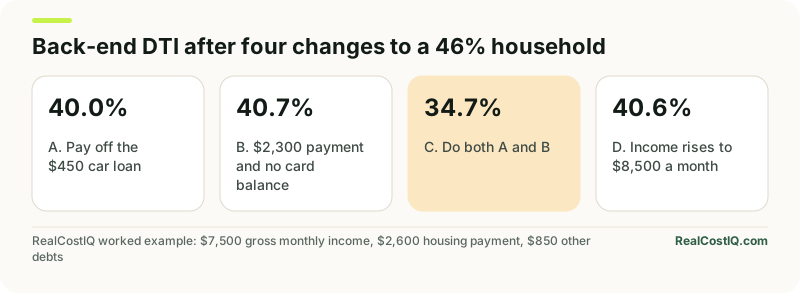
Three plain lessons come out of the table. The first is that paying off one monthly bill is a big lever. The car loan is $450 a month. Clearing it cuts the back-end ratio by six points. A monthly payment counts in full, no matter how much is left to pay. A bill with $3,000 left and a bill with $30,000 left both count the same each month. The exception is the ten-month rule in Fannie Mae's guide for installment debts, so ask your lender how it treats a debt that is almost paid off.
The second lesson is that a cheaper home helps both ratios at once. Lowering the payment by $300 cut the front-end ratio by four points. The third is that income works slowly. A $12,000 raise a year, if it is stable and on paper, moved the total by only five and a half points. Do not count on a future raise. Only documented income counts.
Some moves cost you something else. Paying off debt with your savings leaves less in reserve. For FHA and for Fannie Mae's higher limits, reserves can be the very thing that lets a higher ratio pass. So the best move depends on which line you are trying to clear. Check which factor your target line asks for before you move cash.
A bigger down payment also lowers the loan and the payment. If you want to see how much house your income supports, the site's mortgage affordability calculator works from your income and debts to a price. The debt-to-income calculator works the other way, from a payment to a ratio.
How this differs from the site's DTI calculator
The site's DTI calculator uses one scale for every loan type. It shows a status for each ratio. Its longform page says it does not vary by loan type, and that it has no field for conventional, FHA, VA or USDA. That is deliberate. Program limits change and differ by review type, so the calculator does not guess. This post gives the program lines instead. Use the calculator for your ratio and this post to see which line it must clear.
The calculator's own bands are not the agency limits above. Treat its status label as a general yardstick. Treat the lines in this post as the rules a lender starts from. Then ask your lender for its own number.
Questions to ask a lender before you apply
- Which ratio do you use for my loan type, and do you check the front-end ratio too?
- What is your own maximum total DTI for this loan, and is it lower than the agency limit?
- Will my file go through the automated system, or will a person review it by hand?
- Which of my debts count, and how do you treat a debt that is nearly paid off?
- If my ratio is high, which strengths in the file can offset it? Do you need reserves, a larger down payment or leftover income?
- What income do you count, and what proof do you need?
None of this tells you to buy or not to buy. A passing ratio means a lender may approve the loan. It does not mean the payment fits your life. Run the payment against your own budget, and read each program's rules from the source before you rely on them.