This post covers what FHA mortgage insurance costs and how to end it. It does not say whether an FHA loan is a better choice than a conventional one. That depends on your credit, your savings and your goals. The site's FHA vs conventional calculator puts the two side by side. All rates below come from HUD, the federal housing agency, as read on October 17, 2026.
The example: a $300,000 home with 3.5 percent down
The lowest down payment on an FHA loan is 3.5 percent. On a $300,000 home, that is $10,500. The base loan is $289,500. The base loan is the amount you borrow before the insurance fee is added. Loan-to-value, or LTV, is the loan divided by the home's value. Here it is 96.5 percent.
The upfront premium is 1.75 percent of the base loan. That is $5,066.25. Most borrowers roll it into the loan instead of paying cash. Doing so makes the loan $294,566.25. You then pay interest on the fee too. The rate is 7.40 percent, which is Freddie Mac's average 30-year fixed rate in its survey released October 15, 2026. Your own rate will differ.
The annual premium is 0.55 percent of the base loan for a 30-year loan with LTV over 95 percent. That is $1,592.25 a year, or $132.69 a month. The site's FHA loan calculator uses these same steps. Its results for this loan are below.
| Item | Amount |
|---|---|
| Down payment (3.5%) | $10,500 |
| Base loan | $289,500 |
| Upfront MIP (1.75%, financed) | $5,066.25 |
| Loan after the upfront fee | $294,566.25 |
| Principal and interest per month | $2,039.52 |
| Annual MIP rate (30-year term, LTV over 95%) | 0.55% of the base loan |
| Monthly MIP | $132.69 |
| Principal, interest and MIP per month | $2,172.20 |
| How long MIP lasts | The whole 30-year term |
From the site's FHA loan engine using HUD's rates. Taxes and homeowners insurance are not included. The calculator figures annual MIP on the starting base loan, a simplification. Federal law (12 U.S.C. 1709) bases the annual premium on the remaining insured balance, not counting the financed upfront fee.
The monthly insurance fee is about 6 percent of the total payment. Over 30 years at the flat starting figure, it adds up to roughly $47,800, plus the $5,066 upfront fee. That is the top end. The real total is lower if you leave the loan early or if HUD charges on a shrinking balance. It is also the price of getting in with a small down payment.
The 2026 rate table
HUD last changed its annual premium rates in Mortgagee Letter 2023-05. A mortgagee letter is a notice HUD sends to lenders. This one is dated February 22, 2023. It cut rates for loans with case numbers endorsed on or after March 20, 2023. A case number is the number HUD gives a loan file when the lender starts it. The FHA handbook, Handbook 4000.1, was reissued on August 12, 2026. Its premium appendix still shows the same table, dated March 20, 2023. No later change to these rates was found.
Many web pages call these rates "new for 2026." They are not. They have been in place since March 2023. Here is the table for the usual case: a purchase loan with a term over 15 years.
| Base loan | LTV | Annual MIP | How long you pay |
|---|---|---|---|
| $726,200 or less | 90.00% or less | 0.50% | 11 years |
| $726,200 or less | Over 90.00% to 95.00% | 0.50% | The whole loan term |
| $726,200 or less | Over 95.00% | 0.55% | The whole loan term |
| Over $726,200 | 90.00% or less | 0.70% | 11 years |
| Over $726,200 | Over 90.00% to 95.00% | 0.70% | The whole loan term |
| Over $726,200 | Over 95.00% | 0.75% | The whole loan term |
Upfront MIP is 1.75% of the base loan on all of these. Loans with a term of 15 years or less have lower rates (0.15% to 0.65%) and are not shown. Source: HUD Mortgagee Letter 2023-05 and Handbook 4000.1 (issued August 12, 2026).
The base loan line is $726,200. Most buyers are below it. The high-balance rows apply only to larger loans in costly areas. For the 15-year-or-less rows, the same two sources list 0.15 percent when LTV is 90 percent or less on a base loan up to $726,200, and 0.40 percent above that. The site's FHA loan calculator picks the right row for you.
The law sets the outer limits. Under 12 U.S.C. 1709, HUD can charge up to 3 percent up front and up to 1.5 percent a year. It also says the annual charge can run for the first 11 years if the original LTV is under 90 percent, and for 30 years if it is 90 percent or more. HUD's table sets the exact cutoff. It uses "90.00 percent or less" for the 11-year rows.
How long you pay: the down payment decides
The table shows that the key number is your starting LTV. In plain terms, the question is whether you put down at least 10 percent. Here is the same $300,000 home at three down payments, all with a 30-year loan at 7.40 percent.
| Down payment | Starting LTV | Upfront MIP (financed) | Annual MIP rate | Monthly MIP | How long | Most MIP you could pay |
|---|---|---|---|---|---|---|
| 3.5% ($10,500) | 96.5% | $5,066 | 0.55% | $132.69 | 30 years | $47,768 |
| 5% ($15,000) | 95.0% | $4,988 | 0.50% | $118.75 | 30 years | $42,750 |
| 10% ($30,000) | 90.0% | $4,725 | 0.50% | $112.50 | 11 years | $14,850 |
Computed with the site's FHA loan engine at HUD's rates. "Most MIP you could pay" is monthly MIP times the months it applies, on the starting base loan. It excludes the upfront fee.
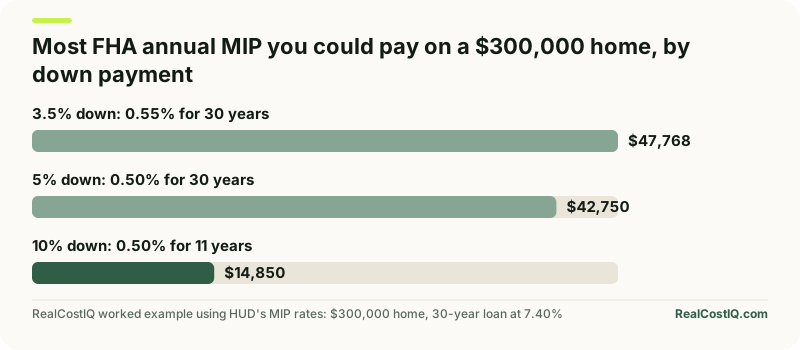
Look at the jump between 5 percent and 10 percent down. The monthly fee barely changes, from $118.75 to $112.50. But the time you pay goes from 30 years to 11. That cuts the most you could pay from $42,750 to $14,850. Moving from 3.5 percent to 10 percent down cuts it by about $32,900 at the top end. That is the biggest lever in the table.
A caution on the 10 percent line. HUD's table says "90.00% or less." A loan at exactly 90 percent LTV gets the 11-year rows. One dollar over, and it is the whole term. If you are near the line, ask your lender to run both versions.
Why you cannot cancel it like PMI
Private mortgage insurance, or PMI, is the version used on conventional loans. It can be dropped when your balance falls to a set share of the home's value. That rule comes from federal law, and the site's post on how PMI is calculated and when it drops off covers it. FHA works differently.
For an FHA loan with a case number assigned on or after June 3, 2013, the handbook says HUD cancels MIP as set out in its premium appendix. That appendix is the table above. There is no step where you ask your servicer to drop it at 80 percent or 78 percent. The only automatic end is the date in the table: 11 years for the low-LTV loans, the end of the loan for the rest. The handbook says the cancellation steps in that part apply only to older loans.
This is the main thing to know. Putting extra money toward your balance does not shorten the MIP term on a newer loan. It does cut your interest. But the monthly fee follows the schedule in the table, not your balance. Check your loan papers for the date of your last MIP payment.
If your loan is older
Loans that closed on or after January 1, 2001 with a case number assigned before June 3, 2013 follow older rules. Under the handbook, HUD cancels the annual premium on a term over 15 years when the loan balance reaches 78 percent of the original value. The borrower must also have paid the annual premium for at least five years. If you paid extra principal and reached 78 percent early, you can ask your servicer to cancel, as long as you are past five years and have not been more than 30 days late in the last 12 months. The servicer, not you, runs the cancellation.
If you bought before mid-2013, ask your servicer whether your MIP is still being charged. A statement or your annual escrow notice will show it. Many loans from that time have already dropped it.
The real ways out
For a loan closed after June 2013, there are three ways to stop paying MIP.
- Reach the end date. If you put down 10 percent or more, MIP stops after 11 years. Nothing else is needed. The date is in your loan documents.
- Pay the loan off. Selling the home, or paying it off in full, ends the loan and so ends the MIP.
- Refinance into a loan without MIP. A refinance replaces your loan with a new one. If the new loan is a conventional loan with 20 percent equity, it carries no mortgage insurance at all.
The third path is the one most FHA borrowers with a small down payment end up studying. Whether it works comes down to simple math. You need enough equity, a rate that does not cost you more than you save, and closing costs you can cover. The site's mortgage refinance calculator runs the cost side for your numbers. This post does not give a break-even table, because it depends on your rate and fees.
How much equity a refinance needs
Here is the equity math for our 3.5 percent down loan. The loan starts at $294,566.25 and the home stays worth $300,000. We use the site's schedule at 7.40 percent.
| Time | Balance | LTV at $300,000 | Home value needed for 80% LTV |
|---|---|---|---|
| Start | $294,566 | 98.2% | $368,208 |
| After 5 years | $278,433 | 92.8% | $348,041 |
| After 7 years | $270,118 | 90.0% | $337,647 |
| After 11 years | $249,312 | 83.1% | $311,640 |
| After 12.5 years (month 150) | $239,785 | 79.9% | $299,731 |
Computed from the site's amortization schedule for $294,566.25 at 7.40% over 30 years. Balances include the financed upfront MIP. Real lenders measure LTV against an appraisal, and FHA's own LTV uses the base loan without the upfront fee. Different lenders ask for different equity levels.
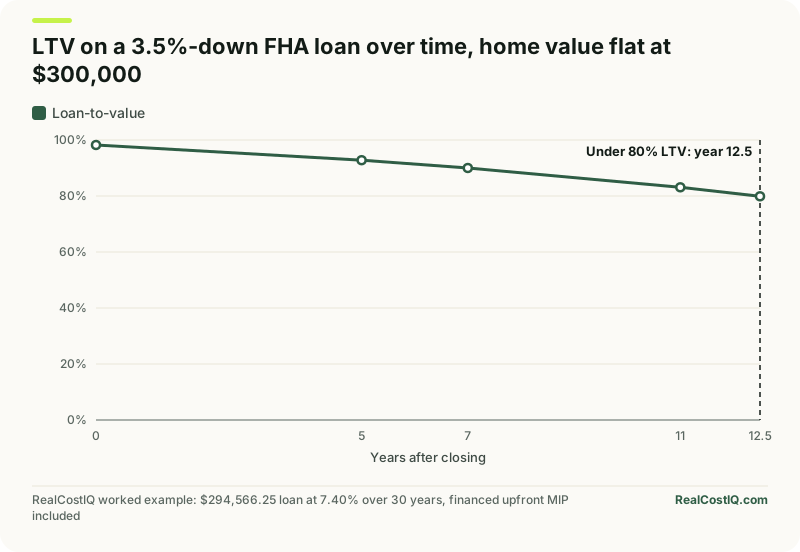
The table shows what it takes to refinance into a conventional loan with no mortgage insurance. Aim for a balance at 80 percent of the home's value. With no price growth, that is about 12.5 years in. If the home gains value, you get there sooner. At five years, the home would need to be worth about $348,000, a 16 percent rise from $300,000. The value that counts is an appraised one, and it can come in lower than hoped.
You also need a rate that works. A refinance at a higher rate than you have now can cost more in interest than the MIP saves. Every refinance also has closing costs. For loans with LTV between 80 and 95 percent, a conventional loan comes with PMI, which has its own cost and its own drop-off rules.
Refinancing from one FHA loan to another
A refinance into a new FHA loan keeps you in the MIP system. The new loan has its own upfront fee and annual rate. But 12 U.S.C. 1709 says that if you pay off an FHA loan early and refinance under the same law, HUD must refund the unearned part of the upfront premium. Ask your lender how that credit works in your case. It is a point to ask about, not a reason on its own to refinance.
What does not end MIP
- Home value growth alone. Unlike PMI, a new appraisal does not end FHA MIP. The handbook says HUD does not use new appraisals when it works out cancellation on older loans.
- Extra principal payments on a newer loan. They save interest, but the MIP end date does not move.
- Waiting for 78 percent LTV. That rule applies to loans with case numbers before June 3, 2013.
- Asking your servicer. On a newer loan, the servicer cannot cancel MIP early. It can only follow the schedule.
MIP and PMI: how they differ
A short side-by-side makes the gap clear. This table only sets out what each charge is. It does not say which loan to pick. For that, the site's FHA vs conventional calculator works through a full comparison.
| Feature | FHA MIP | Conventional PMI |
|---|---|---|
| Who sets the price | HUD, in a public table | Private insurers, based on credit score and down payment |
| Does credit score change it? | No. The CFPB says the FHA premium does not depend on your credit score. | Yes |
| Upfront fee | 1.75% of the base loan, can be financed | Usually none |
| How long you pay | 11 years or the whole loan, set by starting LTV | Until you reach the cancel point |
| Can you ask to cancel? | Not on loans from June 3, 2013 on | Yes, at set equity levels |
FHA details: HUD Handbook 4000.1 and the CFPB's page on mortgage insurance. PMI details: see the site's post on how PMI is calculated.
The CFPB, the federal consumer finance agency, says FHA mortgage insurance is required on all FHA loans, and that the premium does not depend on your credit score but rises slightly for down payments under 5 percent. That matches the table: 0.55 percent above 95 percent LTV, 0.50 percent at or below it.
Tax treatment and special cases
Mortgage insurance premiums are deductible again for tax year 2026, under Public Law 119-21. You must itemize deductions, and the deduction phases out between $100,000 and $109,000 of adjusted gross income. The site's post on whether PMI is tax deductible in 2026 has the full rules and a worked example.
A few special loans are handled differently. HUD's table lists a streamline refinance or simple refinance of a loan endorsed on or before May 31, 2009, which has an upfront fee of just 0.01 percent and an annual rate of 0.55 percent. Hawaiian Home Lands loans have no annual MIP. Indian Lands loans have no upfront fee. Most buyers are not in these groups.
What this post does not cover
- Whether to choose FHA or conventional. That depends on your credit, savings and plans. Use the comparison calculator.
- FHA loan limits and who qualifies. Those rules are separate from the insurance charge.
- VA and USDA fees. They have their own funding and guarantee fees.
- A refinance break-even table. It depends on your rate and fees, so the refinance calculator is the right tool.
- How the HUD formula divides annual MIP across months for a given loan. Your loan documents and servicer show that.
The short version
FHA mortgage insurance has two parts. The upfront part is 1.75 percent of the base loan. The annual part is 0.50 to 0.55 percent on most 30-year purchase loans, paid monthly. HUD's table has not changed since March 2023. Your starting LTV sets how long you pay: 11 years at 90 percent or less, the whole loan above that.
For a $300,000 home with 3.5 percent down, the monthly fee is about $133 and lasts the whole loan. At 10 percent down it is $112.50 and ends after 11 years. For loans from June 3, 2013 on, you cannot cancel it early. You get out by reaching the end date, paying off the loan, or refinancing into a loan without MIP. The refinance route needs enough equity, a workable rate and the cash for closing costs.