This post is about the test only. It does not compare FHA with conventional loans in general, and it does not price FHA mortgage insurance in depth. The FHA loan calculator covers the payment. The house hack calculator shows your monthly cost after rent. I read HUD's Single Family Housing Policy Handbook 4000.1 on October 25, 2026. The copy I read says "Last Revised: 8/12/2026" on each page. Page numbers below are from that copy. Rates come from Freddie Mac's survey: 7.32% for the week of October 22, 2026.
What the handbook actually says
The rule sits in the handbook's section on property types, under three- to four-unit properties, titled "Self-Sufficiency Rental Income Eligibility" (page 171). It has three parts. I am paraphrasing them closely.
- The cap. The payment divided by the net rental income "may not exceed 100 percent for three- to four-unit Properties." The payment here is written as PITI, which stands for principal, interest, taxes and insurance. Principal is the money you borrowed. Interest is the cost of borrowing it.
- The rent. The lender uses the appraiser's estimate of fair market rent "from all units, including the unit the Borrower chooses for occupancy." Fair market rent is what the appraiser thinks each unit would rent for. It is not your lease, and for your own unit it is a rent you will never collect.
- The haircut. From that total, the lender subtracts the greater of two numbers: the appraiser's estimate for vacancies and maintenance, or 25 percent of the fair market rent. What is left is the net self-sufficiency rental income.
Put simply: take the appraiser's rent on all the units. Keep at most 75 percent of it. That number has to be at least as large as the monthly payment. Pass means the ratio is 100 percent or lower. Fail means it is above 100 percent.
75 percent or 85 percent? The handbook says 25 percent off
Many web pages disagree about the number. Some say 75 percent of rent must cover the payment. Some say 85 percent. HUD's handbook text says the haircut is the greater of the appraiser's vacancy and maintenance figure or 25 percent. So 75 percent is the most rent that can count. It can be less if the appraiser's own vacancy and maintenance estimate is above 25 percent. I found no 85 percent figure in the handbook. A lender who quotes 85 percent may be using an older rule or an internal overlay. Overlays are extra rules a lender adds on top of the FHA minimum.
Two common misreadings
- "Only the rent from the units you do not live in counts." A lender in one BiggerPockets thread (July 25, 2023) described the test that way. The handbook says the appraiser's rent from all units counts, "including the unit the Borrower chooses for occupancy." That actually helps you. Your own unit counts at market rent. The problem is the 25 percent haircut and the large payment.
- "The test uses your leases." It uses the appraiser's estimate. A rent roll showing high rents does not change the test. The estimate comes from the appraisal, which in the handbook's rental income section means a Fannie Mae Form 1025 / Freddie Mac Form 72 small residential income property appraisal for two- to four-unit buildings (page 240).
Why a duplex is exempt
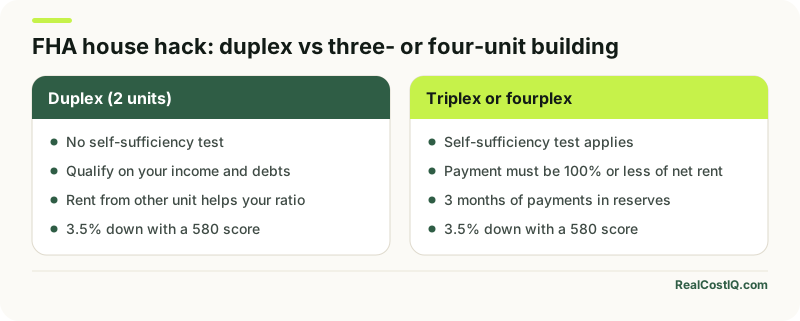
The self-sufficiency standard names only three- to four-unit properties. The handbook's list for a two-unit property says the lender must obtain form HUD-92561 and stops there (page 170). The three- to four-unit entry adds the test. So a duplex is judged on your own credit, income and debts. The rent from the other unit can help you qualify. For a property with no rental history, the handbook has the lender count 75 percent of the lesser of the appraiser's fair market rent or the rent in the lease as income (page 241). That helps your ratio of debts to income, but it is not a pass-or-fail test on the building.
There is one trap. The handbook defines a three- to four-unit property as either a building with three or four dwelling units, or a building with two dwelling units plus one accessory dwelling unit, or three dwelling units plus one (page 170). An accessory dwelling unit is a small separate home on the same lot or inside the building. So a duplex with a backyard cottage counts as a three-unit property. The test applies to it.
A $600,000 fourplex, step by step
Use round numbers. You buy a fourplex for $600,000. You put down 3.5 percent, which is $21,000. The base loan is $579,000. FHA adds an upfront mortgage insurance premium of 1.75 percent, which is $10,132.50. Most buyers roll it into the loan, making it $589,132.50. HUD's Mortgagee Letter 2023-05 sets annual insurance at 0.55 percent of the base loan when you put down less than 5 percent on a 30-year loan up to $726,200. That is $265.38 a month.
The rate is a guess. Freddie Mac's conventional average is 7.32%. FHA rates often run a bit lower. A MortgageDaily article dated August 24, 2026 put FHA at 6.36% against 6.55% for conforming loans on July 20, 2026. I use 7.00%. Property tax is assumed at 1.2 percent of price, or $600 a month. Insurance on a fourplex is assumed at $400 a month. Your numbers will differ.
| Item | Monthly amount |
|---|---|
| Principal and interest on $589,132.50 | $3,919.51 |
| Annual mortgage insurance (0.55% of $579,000) | $265.38 |
| Property tax (assumed 1.2% of price a year) | $600.00 |
| Homeowners insurance (assumed) | $400.00 |
| Total payment (PITI with insurance premium) | $5,184.89 |
Computed 2026-10-25 with the standard payment formula. Annual insurance is figured on the starting base loan, a simplification. The handbook's definition of a borrower's total mortgage payment includes the mortgage insurance premium (page 201), so I count it. The self-sufficiency text itself says only PITI.
Now the test. Say the appraiser says each unit would rent for $1,600 a month. That is $6,400 for all four, your own unit included. Take off 25 percent, which is $1,600. The net self-sufficiency rental income is $4,800. Divide the payment by it: $5,184.89 divided by $4,800 is 108.0 percent. That is above 100, so the loan fails.
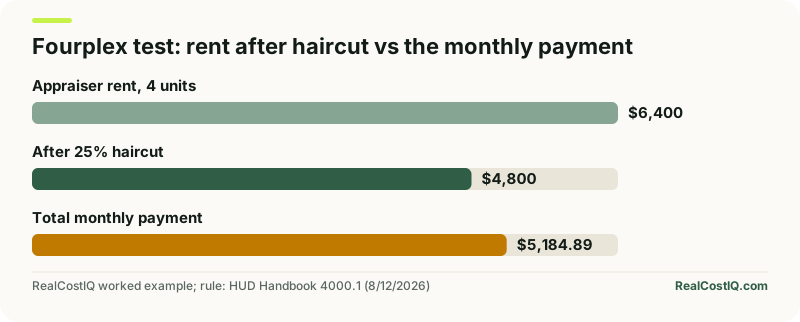
A skeptic might say the insurance premium should not count. Take it out and the payment is $4,919.51. The ratio is 102.5 percent. The loan still fails. The conclusion does not hinge on that choice.
How much rent would pass?
Turn the test around. The payment must be no more than 75 percent of the rent. So the rent must be at least the payment divided by 0.75. That is $5,184.89 divided by 0.75, or $6,913.18 for the building. Spread over four units, it is $1,728.30 each. The appraiser's rent has to be 8 percent above my starting guess. Here is how the ratio moves with the appraiser's number.
| Appraiser rent per unit | All four units | Net after 25% haircut | Payment / net rent | Result |
|---|---|---|---|---|
| $1,600 | $6,400 | $4,800 | 108.0% | Fail |
| $1,700 | $6,800 | $5,100 | 101.7% | Fail |
| $1,750 | $7,000 | $5,250 | 98.8% | Pass |
Computed 2026-10-25. Pass means the ratio is 100% or lower. The line is crossed between $1,700 and $1,750 a unit; the exact crossing is $1,728.30.
A $150 swing in one appraiser's rent estimate flips the result. That is why the test frustrates buyers. You cannot negotiate the number, and the appraiser who sets it is working for the lender, not for you.
What makes a fourplex pass: rate and price
The rent you need depends heavily on the interest rate. I held everything else the same: $600,000, 3.5 percent down, the same tax and insurance. Then I changed only the rate. The required rent per unit falls steadily as rates fall.
| Rate | Total payment | Rent needed per unit | Needed as % of price a month | Ratio at $1,600 a unit |
|---|---|---|---|---|
| 4.00% | $4,077.98 | $1,359.33 | 0.91% | 85.0% (pass) |
| 5.00% | $4,427.97 | $1,475.99 | 0.98% | 92.2% (pass) |
| 6.00% | $4,797.52 | $1,599.17 | 1.07% | 99.9% (pass) |
| 7.00% | $5,184.89 | $1,728.30 | 1.15% | 108.0% (fail) |
| 7.32% | $5,312.31 | $1,770.77 | 1.18% | 110.7% (fail) |
Computed 2026-10-25. Same $600,000 price, 3.5% down, 1.2% tax, $400 insurance, 0.55% annual insurance premium. The percent-of-price column divides the needed total rent by $600,000.
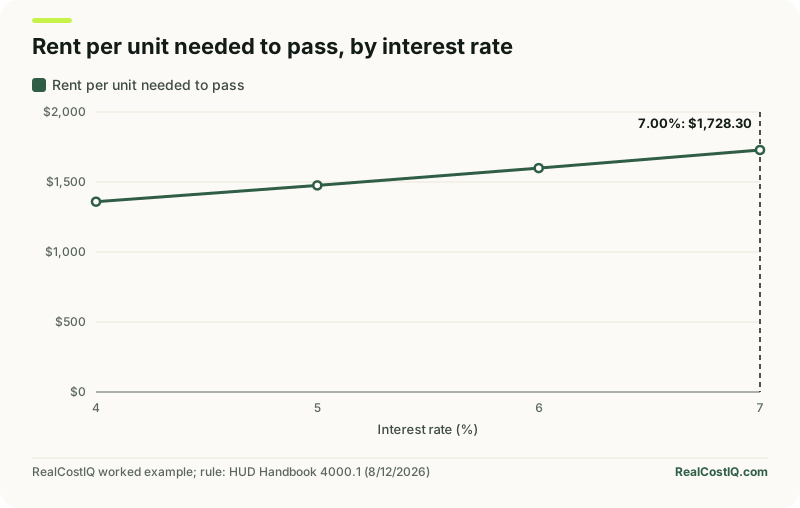
Read the last column. At $1,600 a unit, the same building passes at 6 percent (barely, at 99.9 percent) and fails at 7. Rate is only one lever. One forum poster in 2023 said that his own 3- and 4-unit properties, at 2.75 to 3.625 percent, would not qualify with 3.5 percent down, and that almost none on the market do (BiggerPockets, replies from September 2023). A lender in an October 2026 thread described the test the same way as the handbook: 75 percent of market rent from all units, yours included, must cover the full payment. Prices and tax rates matter as much as the rate does.
A rule of thumb for price
Look at the "as a percent of price" column. At 7 percent, the building's total appraised monthly rent has to be about 1.15 percent of the price. On a $600,000 fourplex that is $6,913. Many investors know the "1 percent rule," where monthly rent is 1 percent of price. This test is stricter than that at 7 percent. It also depends on how heavy your taxes and insurance are. With these assumptions, taxes and insurance add up to 2 percent of price each year. In a high-tax county the bar rises further.
Flip it to see the price. With appraiser rent of $1,600 a unit, the most you can pay is about $550,000. At that price, with the same 1.2 percent tax and the $400 insurance, the payment is about $4,786, which is under the $4,800 net rent. A fourplex priced above that fails on these rents. Prices and rents rarely line up that neatly, which explains the forum complaint that almost no 3- and 4-unit listings pass.
Other rules that hit 3- and 4-unit buyers
- Reserves. For three- to four-unit properties the handbook requires three months of PITI in verified reserves after closing (page 253). Here that is 3 times $5,184.89, or $15,554.66. Reserves do not include borrowed funds or equity in another property.
- Down payment. The minimum required investment is 3.5 percent of the adjusted value (minimum required investment section). On this fourplex that is $21,000. With reserves, the cash you need before closing costs is about $36,555. Credit scores of 580 and above qualify for maximum financing (page 179), while scores from 500 to 579 are limited to 90 percent loan-to-value.
- Occupancy. At least one borrower must move into the property within 60 days of signing and intend to stay at least one year (page 159). FHA also generally insures only one principal residence per borrower at a time, with narrow exceptions such as job relocation. So you cannot keep adding FHA house hacks.
- Loan limits. For 2026, HUD's Mortgagee Letter 2025-23 sets the national low-cost area limit for four units at $1,041,125 and the high-cost ceiling at $2,402,625. Three units are $837,700 and $1,933,200, and two units are $693,050 and $1,599,375. They apply to case numbers assigned on or after January 1, 2026. Your county's number sits between the floor and ceiling. These limits rarely bind first. The rent test usually stops a deal long before the price reaches $1 million.
If your deal fails: five ways out
- Put more down. The test uses the payment, so a bigger loan cut helps. On the example fourplex, 10 percent down ($60,000) gives a base loan of $540,000. At 90 percent loan-to-value or less, annual insurance drops to 0.50 percent and lasts 11 years (Mortgagee Letter 2023-05). The payment falls to $4,880.50, a ratio of 101.7 percent at $1,600 a unit. Still a fail. Down payment alone does not rescue a deal this far off.
- Pay less. Price moves the whole payment. Offering about $550,000 instead of $600,000 gets this building to a pass on $1,600 rents.
- Buy down the rate. A lower rate cuts the payment. The mortgage points break-even calculator shows when paying for points makes sense. Remember that points pay off only if you keep the loan a long time.
- Try a duplex. A duplex skips the test. You give up two units of rent, but you qualify on your own income. Run both in the house hack calculator and compare the monthly cost after rent.
- Look at conventional. Conventional loans do not use this test, but their down payments and reserves for 3- and 4-unit buildings are usually higher. The FHA vs conventional calculator compares the full cost. Ask a lender for current rules; I did not verify them for this post.
What to do before you make an offer
The house hack calculator now runs this test for you. Set "Loan type" to FHA, choose "Separate units", enter three or four units, and add your monthly property tax, insurance and FHA mortgage insurance. It applies the handbook's 75 percent rule and shows pass or fail and the rent you would need. Duplexes are left out, as in the handbook. Doing the test by hand first is still worth it. Estimate the payment: price, rate, taxes, insurance and the insurance premium. Multiply the rent you think each unit could earn by the number of units, then multiply by 0.75. If that number is below the payment, expect to fail. Then ask a lender how the appraiser will set rents. Ask whether the lender can give you a rent estimate before you pay for an appraisal. The appraiser's rent form stays with the property's FHA case number, according to a lender quoted in the BiggerPockets thread above, so a failed estimate can follow a listing from buyer to buyer.
Use your target rate, not today's. If you think rates will fall, a deal that fails now may pass later. But a refinance later does not change the first loan's test. The test is run at purchase.
What this post does not cover
- Your lender's rules. Lenders may add overlays. Ask for the lender's FHA self-sufficiency worksheet.
- Rent estimates. The $1,600 rent is an example, not a market figure. Appraisers differ.
- Forum recency. Two of the BiggerPockets threads I read were posted in 2023. One thread from October 2026 matches the handbook rule. All of them are context only. The handbook text, not the forums, is the source for every rule here.
- The accessory dwelling unit rules for rent. The handbook has separate rules for one-unit properties with an accessory unit. This post does not work them.