The usual advice is not to file a claim you could pay for yourself. It hides two numbers nobody publishes. One is how much your premium rises after a claim. The other is how long that rise lasts. Regulators describe the mechanism and set some limits on it. But none of the primary sources read for this post gives a surcharge percentage. So this post does what a primary-source read can do honestly. First, it shows the break-even arithmetic with the site's own claims multiplier at named inputs, labelled hypothetical. Break-even is the point where filing and not filing cost the same. Second, it reads what the Texas and North Dakota insurance departments, Triple-I (the Insurance Information Institute), LexisNexis, the CFPB (Consumer Financial Protection Bureau) and the Fair Credit Reporting Act say about the report your claim lands in. Third, it tells you how to get your own copy free. Sources were read on 2026-10-13.
What a CLUE report is and what it records
Triple-I describes a loss history report as a record of insurance losses tied to a home or a car. Most homeowners and auto insurers add claims data to the C.L.U.E. database (Comprehensive Loss Underwriting Exchange). LexisNexis makes the database available, and insurers generally use it when underwriting. Underwriting is how an insurer decides whether to cover you and at what price. For a home, the report lists the type of each loss, its date, and the amount and status of the claim. The Texas Department of Insurance adds that the report also shows the policy number, claim number and insurer. It says claims filed on the property appear even if you did not own it at the time. The North Dakota Insurance and Securities Department explains that CLUE lists claims by Social Security number, vehicle identification number or property address. It also notes a second database, A-PLUS. It says the Insurance Services Office manages A-PLUS, and that the database links to Verisk.
The property-address key matters more than most homeowners expect. A claim is attached to the house. So a previous owner's water-damage claim can sit in the file you inherit. Triple-I's advice to buyers follows directly. Ask the current homeowner to request the report. If it shows damage, have a professional inspect the property before committing. That is a purchase-stage use of the report. This post is about the other direction: what your own claim writes into it.
How long claims stay: five years, seven years, ten years, and why they differ
The sources do not agree, and the disagreement is worth stating rather than smoothing over. Triple-I's loss-history page says the C.L.U.E. report covers five years back. The Texas Department of Insurance guide says a report covers claims from the past seven years. The guide was last updated 10/14/2024 on the page read. The site's own calculator describes CLUE as recording claims for seven years, which matches Texas. The two LexisNexis consumer pages read do not state a C.L.U.E. retention period at all. North Dakota's page does not state retention either.
| Source | What it says | What it does not say |
|---|---|---|
| Triple-I, What is a loss history report? | C.L.U.E. report covers five years back. | Does not discuss how insurers weigh older claims. |
| Texas Department of Insurance (updated 10/14/2024) | A report covers claims from the past seven years, including claims before you owned the property. | Does not state a premium effect. |
| LexisNexis consumer and data-access policies | One free report in each 12-month period; freeze available depending on residency. | No C.L.U.E. retention period stated. |
| North Dakota Insurance and Securities Department | Insurers may not use a claim more than 10 years old, and may not use a first wind or hail claim from the past five years, with a maintenance exception. | No database retention period; these are limits on use. |
The first two figures conflict. A reader cannot tell from these sources whether five or seven years is the database's retention; it is possible both describe real practice (a five-year report view and longer retention).
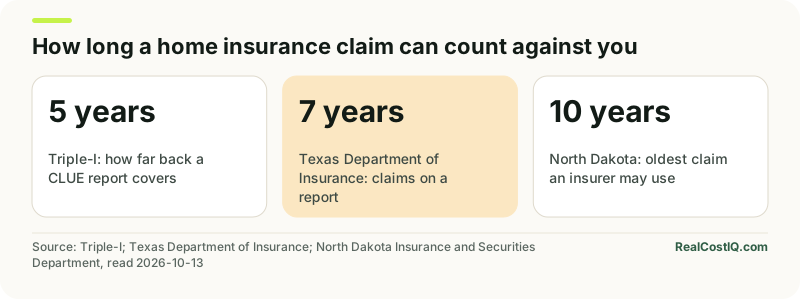
For the decision, use the longer figure as the planning horizon. Suppose the claim stays visible for seven years and you assume five. Then you understate the cost of filing. If it is five, assuming seven overstates it. The break-even table below shows both horizons, so you can see how much the choice matters.
State rules can shorten the useful life of a claim
North Dakota's page shows how much state rules differ from the national picture. It covers private passenger auto, homeowners, motorcycle, mobile homeowner and owner-occupied dwelling fire policies. For these, it says an insurer cannot use an inquiry about coverage where no claim was filed. It also cannot use a claim it did not investigate or pay. It says an insurer cannot use a first wind or hail property claim from the past five years. It can use second and later claims within that window, unless it shows the owner failed to maintain the property and that this contributed to the loss. It says no claim more than 10 years old may be used, with the same maintenance exception. And it says an insurer may not decline a policy based solely on the prior owner's losses, unless it shows the prior owner did not repair the damage. These are one state's rules. Check your own insurance department. The arithmetic in this post assumes no such protection.
Inquiry versus claim: the line regulators draw
Two regulators in the sources draw the same line. North Dakota says insurers cannot use a coverage inquiry where no claim was filed. Texas says questions about your policy or deductible are not supposed to be reported to the database. It says that when a claim is filed, insurers can report the date of loss, the loss type and the amount paid. Texas's practical tip is to be clear with your agent about whether you are filing a claim or just asking a question.
That distinction is a legitimate use of the system. It is also where you must stay honest. Asking what your deductible is, or what your policy would cover, is a question. Reporting a loss is a claim. A policy's notice conditions govern when you must report it. A question does not satisfy a notice requirement. This post does not suggest treating a real loss as a hypothetical. What the regulator language gives you is permission to ask before you decide, in plain words. You can also ask the agent how the conversation will be recorded. Note too that the sources describe what the regulators say should happen. They do not prove that every entry in every file is correct. That is why the free report below is worth pulling.
The break-even arithmetic, with the site's claims multiplier
The comparison is simple to state. Filing is worth it if the payout is more than the extra premium you will pay over the years the claim counts against you. The payout is the repair cost minus your deductible. The deductible is the part of a loss you pay before the insurer pays. The extra premium is the annual increase times the number of years. The only part no regulator supplies is the annual increase. So the example takes it from the engine behind the home insurance cost calculator. That engine applies a claims multiplier to a state base premium. A multiplier is a number the base price is multiplied by. The engine also gives a claims-free discount to homes with no claims.
Hypothetical inputs: Ohio, $300,000 dwelling coverage, home built 16 to 30 years ago, roof 6 to 10 years old, good credit, no bundle or alarm discounts. With a $1,000 deductible, the engine returns $1,923 a year with no claims. With one claim in the history it returns $2,455. That is a difference of $532 a year. The gap contains both the engine's 1.20 claims multiplier and the loss of its 0.94 claims-free discount. With a $2,500 deductible, the figures are $1,711 and $2,185. That is a difference of $474 a year. The engine's claims factors are the site's own modelling assumptions. They are not a published surcharge from a regulator or insurer. Your insurer's actual rise may be higher, lower, or zero.
| Years the claim counts | Extra premium paid | Payout on a $2,000 repair ($1,000 net) | Payout on a $4,000 repair ($3,000 net) | Payout on a $8,000 repair ($7,000 net) |
|---|---|---|---|---|
| 1 | $532 | Ahead $468 | Ahead $2,468 | Ahead $6,468 |
| 3 | $1,596 | Behind $596 | Ahead $1,404 | Ahead $5,404 |
| 5 | $2,660 | Behind $1,660 | Ahead $340 | Ahead $4,340 |
| 7 | $3,724 | Behind $2,724 | Behind $724 | Ahead $3,276 |
Computed with calculateHomeInsurance (Ohio, $300,000 dwelling, home age 16 to 30, roof age 6 to 10, good credit) at $1,000 and $2,500 deductibles; surcharge = premium with one claim minus premium with none, held flat. Real surcharges can fall as the claim ages or rise on renewal; the table holds them flat to show the shape.
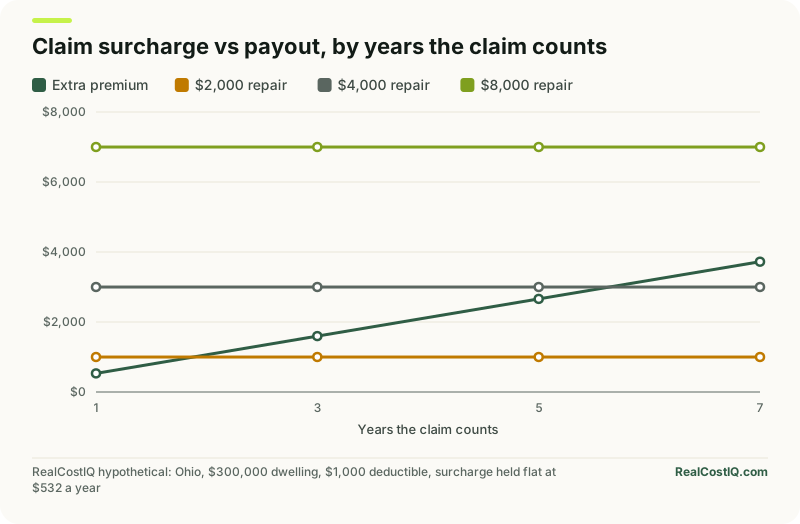
Three readings come out of the table. First, a claim barely above the deductible loses within a year or two, even before any larger effects. A $2,000 repair with a $1,000 deductible is behind after the second year. Second, a mid-size claim is close. A $4,000 repair is ahead at five years by $340 and behind at seven years by $724. So it hinges on the horizon you believe in, which is exactly where the five-versus-seven disagreement bites. Third, a large claim is not close. An $8,000 repair stays ahead at every horizon shown. The break-even payout at a given horizon is just the cumulative surcharge. At five years that is $2,660, so a repair of about $3,660 or more clears it with a $1,000 deductible.
What the table leaves out
- Non-renewal risk. The site's calculator notes that two claims commonly trigger non-renewal. A premium difference does not capture losing the policy and having to buy in a thinner market. No regulator source read puts a number on it.
- Peril and state. North Dakota will not let an insurer count a first wind or hail claim. A peril is a cause of loss, such as wind or fire. In a state with that rule, the first claim of that type costs nothing in surcharge, and the table overstates the cost.
- The deductible you chose. At a $2,500 deductible, the same repair pays $1,500 less. But the surcharge is $58 a year smaller. The higher deductible also cuts the clean premium by $212 a year in this example ($1,923 to $1,711). Whether that trade was wise depends on whether you will in fact pay small losses yourself. That is the point of this post.
- Repair that needs to be done anyway. The damage may be a symptom, such as a leak that will recur. Paying only for the visible fix and skipping the claim can then leave you without coverage when the larger loss lands. That is a risk call the arithmetic does not make.
For roof-related losses, the cost side of the comparison comes from a repair estimate. The roof repair cost calculator gives a range to compare with your deductible before you speak to an agent. Flood is a separate product with its own claim consequences. The flood insurance cost calculator covers that policy. A standard homeowners claim does not touch it.
Testing the "only file above 2x your deductible" rule
A common rule says to file only when the repair costs more than twice your deductible. Test it with the same math. Filing pays when the repair cost minus the deductible beats the extra premium over the years the claim counts. So the repair must exceed the deductible plus the cumulative surcharge. Divide that by the deductible to get the multiple you really need.
| Deductible | Surcharge a year | Years counted | Repair needed to break even | Multiple of deductible |
|---|---|---|---|---|
| $1,000 | $532 | 5 | $3,660 | 3.7x |
| $1,000 | $532 | 7 | $4,724 | 4.7x |
| $2,500 | $474 | 5 | $4,870 | 1.9x |
| $2,500 | $474 | 7 | $5,818 | 2.3x |
Repair needed = deductible + (surcharge x years). Surcharges are the Ohio example above ($532 a year at a $1,000 deductible, $474 at $2,500), held flat. The 2x rule is the one forum posters quote. All figures are the site's model, not a published insurer surcharge.
The rule fails at a low deductible. With $1,000 at stake, a $2,000 repair passes the 2x test. But it pays back only 1.9 years of surcharge ($1,000 divided by $532). You would need 3.7 times the deductible to cover five years. At a $2,500 deductible the rule is close. Its five-year multiple is 1.9, and its seven-year multiple is 2.3. The reason is simple. The surcharge in this model does not grow with your deductible. It is nearly a flat dollar amount. So a fixed multiple of the deductible cannot track it. Use the dollar math with your own quote instead.
Two caveats can change this. The Texas Department of Insurance says insurers there cannot raise rates for claims they denied or for weather and other natural-cause damage. It also says a call to ask a policy or claim-process question cannot raise your rate. In a state with those rules, the surcharge for that type of claim may be zero, and the rule is too strict. Check your state's rules before you apply any multiple.
How to get your own report free, and what to do with errors
The free-report right has a statutory base and two matching practical statements. The Fair Credit Reporting Act, 15 U.S.C. 1681j(a)(1)(A), requires covered consumer reporting agencies to provide a disclosure once during any 12-month period, on request and without charge. The section refers to agencies described in subsection (w), which covers nationwide specialty agencies. The statute also sets a 45-day deadline for reinvestigating a dispute raised after such a free report. LexisNexis states on its consumer and data-access page that consumers can obtain one free report during each 12-month period. The Texas Department of Insurance tells you to use LexisNexis's “Request a Consumer Disclosure Report” option for one free copy each year. Triple-I states the same free-per-year rule.
LexisNexis's consumer disclosure page lists three ways to ask. You can ask online, by mail with a printable request form, or by phone at 1-866-897-8126. Mail goes to P.O. Box 105108, Atlanta, GA 30348-5108. Phone numbers differ across LexisNexis pages, and forms change. So confirm the current details on the consumer site before sending identity documents. The page read does not itself say what each report type contains. It describes the consumer disclosure report generally (real estate transaction and ownership data, liens and judgments, and similar records). So when you request, ask specifically that the report include the C.L.U.E. property loss history.
The CFPB's page on specialty consumer reporting agencies lists homeowners and renters insurance claims among the sources of specialty reports. It also observes that people often do not learn these reports exist until they are denied a job, lease, insurance or a checking account. That is the best argument for pulling yours before a purchase, a re-shop (comparing new quotes) or a claim, rather than after a denial. If something is wrong, Texas says to contact LexisNexis to dispute it or add an explanation. North Dakota's page says to contact the database manager about the disputed entry. It also says to contact the company that made the entry. Then ask the insurer to reconsider your application once it is corrected. A security freeze may be available depending on your state of residence. It may carry a fee in some states.
- Request the report before you shop or before a large decision, not after. One free copy a year is the ceiling, so use it when it matters.
- Check each entry against your records: date of loss, type, amount paid, insurer, and whether an entry is a claim or an inquiry.
- Dispute errors with both parties, the database manager and the insurer that supplied the entry. Do it in writing and keep copies. The statute's 45-day reinvestigation deadline applies to a dispute after a free disclosure.
- Ask the insurer to reconsider once corrected, as North Dakota's page describes, and re-shop the policy with the corrected report in hand.
A decision sequence for a small loss
- Read your policy's notice and deductible provisions first. Know what the policy requires of you after a loss. Know what the deductible is for this peril, since wind, hail and water deductibles can differ.
- Get the repair estimate, and compute payout as repair cost minus deductible.
- Ask your agent a question, in words that make clear it is a question, about how a claim of that type would affect renewal. Texas's guidance on inquiries is the reason to be explicit. Get answers in writing where you can.
- Run the surcharge from your own quote (the calculator's engine if you have no better number). Use a five-year and a seven-year horizon, and compare each to the payout.
- Add what the table leaves out: non-renewal risk, state rules for your peril, and whether the repair is a one-off or a symptom.
- Decide, then pull your report. Then you know what is already in the file before the next renewal. If you are still choosing a deductible or buying a policy, see how much homeowners insurance a lender requires for the lender's coverage floor.
What could not be verified
No regulator or primary source read for this post publishes a percentage by which a premium rises after a claim, so none is quoted. The example uses the site's modelling assumption and says so. Premium-increase figures that circulate in consumer media were not read at their source and are not used. The LexisNexis pages read do not state a retention period for the C.L.U.E. property database. Triple-I and Texas disagree, so both are reported. The statute, the regulators and the LexisNexis pages change. Confirm current terms before relying on them for a transaction.