A parent, grandparent or partner can hand you the down payment. But the lender does not take your word, or theirs. The loan file has to show three things. Who gave the money. That nothing has to be paid back. And that the money actually left the donor's account. Each program words those three tests a little differently. A gift that is fine for one loan can be refused on another. This post puts the four main programs side by side, from their current guides, each read on 2026-10-11. Then it walks the paper trail, the large-deposit rule that catches most first-time buyers, and the gift of equity.
Who can give the money, program by program
| Fannie Mae | Freddie Mac | FHA | VA | |
|---|---|---|---|---|
| Where the rule lives | Selling Guide B3-4.3-04, Personal Gifts (02/04/2026) | Seller/Servicer Guide 5501.4, Other sources of funds (effective 07/01/2026) | Handbook 4000.1, Gifts (Personal and Equity), TOTAL and manual versions (transmittal issued 08/12/2026) | VA Pamphlet 26-7, Chapter 4, Gift Funds |
| Who may give | Relatives by blood, marriage, adoption or guardianship; a domestic partner, a fiance or fiancee, a former relative, or someone with a long-standing family-like or mentorship tie | A "Related Person", a business owned by a Related Person, a trust a Related Person established, or the estate of a Related Person | A family member, the borrower's employer or labor union, a close friend with a clearly defined and documented interest in the borrower, a charitable organization, or a government agency or public entity running a homeownership program for low- or moderate-income or first-time buyers | A donor with no affiliation to the builder, developer, real estate agent or any other interested party |
| Who may not | The builder, developer, real estate agent or any other interested party, or anyone affiliated with them | Not stated in the section read, beyond its donor list; gifts are not eligible on investment properties | Anyone who is the seller or otherwise benefits from the transaction when the money is part of the minimum required investment | Any affiliated or interested party |
| Who signs the letter | The donor | The donor (the trustee for a trust, the authorized representative for an estate, the Related Person for a business) | The donor and the borrower, both signing and dating | Not stated in the section read |
| Where the money must come from | A transfer to be evidenced; see the proof list below | Must come from the donor's account at a financial institution | Cash on hand is not an acceptable source of donor gift funds | Transfer to be evidenced; see the proof list below |
Wording is condensed from each program's own text. FHA's definition of acceptable donors is the widest of the four; Fannie Mae's and Freddie Mac's are anchored to family ties, and Freddie Mac's anchored to the defined term "Related Person" in its Guide glossary.
Two details in that table matter more than they look. First, the ban on interested parties is about incentives, not just blood. Fannie Mae bars a real estate agent as a donor, whether or not they are related to you. FHA lets a family member who is also the agent give the commission as a gift. So the lender will probe the agent's role in the deal. Second, FHA is the only program of the four that lists employers, unions, charities and public homeownership programs as ordinary gift sources. Money from a down payment assistance program, not a family member, follows its own rules. The FHA vs conventional guide covers the FHA minimum investment that a gift can help fund.
What the gift letter must say
The letter is short. But a missing field is the most common reason a gift gets kicked back during underwriting. (Underwriting is the lender's final review of your file.) Every program wants the same core items:
- The donor's name, mailing address and telephone number. Fannie Mae, Freddie Mac, FHA and VA all list these.
- The relationship to the borrower. Fannie Mae, FHA and VA each list the donor's relationship to the borrower. For Freddie Mac the letter must state that the funds come from a Related Person, or the business, trust or estate of one. That is the program's own defined term.
- The dollar amount. Fannie Mae and Freddie Mac accept "the actual or the maximum amount" of the gift. So a letter can say "up to $40,000" if the final figure is not known. FHA asks for the dollar amount of the gift.
- A statement that no repayment is expected. This is the heart of the letter. Fannie Mae asks for the donor's statement that no repayment is expected. Freddie Mac asks that the letter show the funds are a gift that does not have to be repaid. FHA asks for a statement that no repayment is required. VA asks for the donor's statement that no repayment is expected.
- A signature. Fannie Mae, Freddie Mac and FHA require the donor's signature. FHA also requires the borrower's signature and a date. The VA section read lists the letter fields but states no signature requirement.
Three variants change who signs or what is added. First, a trust or an estate. Fannie Mae wants the trust or estate account named. Freddie Mac wants the trustee, or the estate's authorized representative, to sign. Second, a business owned by a Related Person. Freddie Mac wants the Related Person to sign the letter and state their ownership interest. Third, a gift pooled with your own money to reach the minimum cash down payment. Fannie Mae then adds a certification that the donor has lived with you for the last 12 months and will keep doing so. It also wants proof of the shared address, such as a driver's license, a bill or a bank statement.
How lenders trace the funds
The proof has two layers. The money has to leave the donor. And it has to arrive somewhere the lender can see. Fannie Mae accepts any of these as evidence: the donor's check plus your deposit slip; the donor's withdrawal slip plus your deposit slip; evidence of an electronic transfer to your account or to the closing agent; the donor's check to the closing agent; or a settlement statement showing the closing agent received the donor's check. If the funds are not moved before settlement, the lender must document that the donor gave the closing agent an electronic transfer, certified check, cashier's check or other official check.
FHA splits the proof by timing. Say the gift is verified before settlement. Then the lender needs one of four items. The donor's bank statement showing the withdrawal, with evidence of the deposit into your account. The donor's canceled check and evidence of deposit. The donor's withdrawal receipt and evidence of deposit. Or evidence of an electronic transfer from the donor's account to yours. Say it is verified at settlement. Then the lender needs evidence of payment to the settlement agent. That means an electronic transfer, a bank certified check, a cashier's check or another official bank check. FHA adds a catch-all. No matter when the money moves, the lender must be able to decide with reason that it did not come from an unacceptable source.
Freddie Mac is the strictest about the route. Gift funds must move directly from the donor's account at a financial institution to your account or to the settlement agent. A third-party money transfer app is acceptable only when the file shows the app moved the money straight from the donor's bank account. It must go to your bank account or to the settlement agent. The one exception is the earnest money deposit. The donor may give those funds directly to a builder or real estate agent, with evidence of the transfer from the donor's account to the deposit holder. VA asks for evidence of your deposit. It also accepts a copy of the donor's check or electronic transfer to the closing agent, or the closing disclosure showing receipt of the donor's funds.
The large-deposit rule is what catches buyers
A gift that lands in your checking account before closing shows up on your bank statements as a deposit. Fannie Mae defines a large deposit as a single deposit that exceeds 50 percent of the total monthly qualifying income for the loan. On a purchase, if the funds are used for the down payment, closing costs or reserves, the lender must document an acceptable source. Anything the lender cannot source is subtracted from the verified funds. Only the remainder counts. The gift letter, the donor's statement and the transfer record are the documentation. Without them, a gift of $40,000 against $6,000 of monthly income is a large deposit by a wide margin.
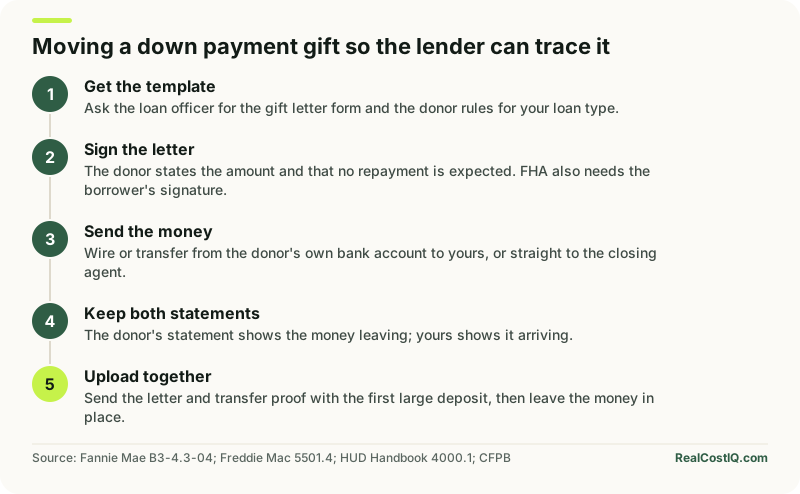
The CFPB's loan application packet checklist asks for account statements showing at least two months of history for the source of your down payment. It also asks for a signed statement from the giver if some of the money was a gift. Its page on answering lender requests says large deposits are common in buyers' bank records. It adds that lenders are generally required to verify the source of your income and down payment funds. The practical rule is simple. Move the gift early. Move it by traceable wire or check from the donor's own account. Keep both statements. Do not have the donor withdraw cash and hand it to you. FHA says plainly that cash on hand is not an acceptable source of donor gift funds. And a cash deposit leaves no trail for any program.
How much of the purchase can be a gift
| Program and situation | Own-funds minimum | Gift can fund |
|---|---|---|
| Fannie Mae, LTV at or under 80 percent, any 1-4 unit principal residence or second home | None | Down payment, closing costs and reserves |
| Fannie Mae, LTV over 80 percent, one-unit principal residence | None | Down payment, closing costs and reserves |
| Fannie Mae, LTV over 80 percent, two- to four-unit principal residence or a second home | 5 percent of your own funds; a gift from a donor who has lived with you for 12 months counts as your own funds only if both of you will use the home as a principal residence, so not on a second home | Anything beyond the 5 percent |
| Freddie Mac, second home with LTV over 80 percent | At least a 5 percent down payment from your personal funds | Anything beyond it. Investment properties: not eligible |
| FHA | None beyond the 3.5 percent minimum required investment, and that can be a gift from an acceptable donor | The minimum required investment, subject to the donor-source rules |
| VA | Not stated in the gift section. With less than full entitlement, most lenders want entitlement plus down payment to cover at least 25 percent of the loan (VA loan limits page) | Down payment and closing costs; see the reserves note below |
Fannie Mae: B3-4.3-04. Freddie Mac: 5501.4. FHA: Handbook 4000.1 on the minimum required investment, which refers to 3.5 percent of the adjusted value. VA: the 25 percent figure is VA's description of what most lenders require, not a rule in the gift section. Lender overlays can be stricter than any of these.
Fannie Mae states no dollar cap on a gift. The binding limits are the occupancy and unit-count conditions in the table. On the conventional side, gifts are fine for a primary home, narrowed for a second home and not allowed on investment properties. Fannie Mae and Freddie Mac both say so. If you plan to buy a rental with family money, a gift is not the tool.
Gifts and reserves
Reserves are the cash left after closing. Programs differ on whether a gift can count toward them. Fannie Mae's section says a gift may fund the down payment, closing costs or reserves once the minimum own-funds rule is met. FHA's manual-underwriting text says surplus gift funds may not be considered cash reserves. VA's chapter says, in its rental-property reserve rules, that gift funds cannot be used to meet reserve requirements. Suppose the loan needs two or three months of payments in reserve, and the gift is your only source. Ask the lender before you commit to the plan.
A gift of equity is a different animal
A gift of equity happens when a family member sells you a home for less than it is worth. The difference is treated as a gift toward your down payment. No cash changes hands for that part, so there is no donor transfer to trace. The paper trail is the settlement statement instead. Freddie Mac defines it as a credit to the borrower from the property seller's equity in the subject property. It requires that receipt of the gift of equity show on the Settlement/Closing Disclosure.
- Donor. FHA allows only family members to provide equity credit on a property sold to other family members. It requires a signed, dated gift letter. Freddie Mac allows a Related Person, a business owned by one, a trust or an estate. Fannie Mae treats the donor as not being an interested party, even though the donor is also the seller.
- Letter. The same core fields as a cash gift letter: donor, address, telephone number, relationship, amount, and a statement that it does not have to be repaid. Freddie Mac adds the settlement-statement requirement.
- Not reserves, not cash back. Fannie Mae says a gift of equity cannot be used for financial reserves. Freddie Mac says it cannot be a source of funds for reserves or cash back to the borrower.
- Occupancy. Freddie Mac allows it on a primary residence or second home. On a second home above 80 percent LTV, the 5 percent own-funds rule applies. It is not an eligible source for an investment property.
- New limit on excess proceeds. This is for Freddie Mac purchase loans with applications received on or after June 3, 2026. Say the gift of equity is more than the amount needed for closing. The extra may only pay off or pay down your debt at closing, when the seller pays the creditor. Or it may be applied as a principal curtailment, an extra payment on the loan balance (Freddie Mac Bulletin 2026-3, March 4, 2026).
A gift of equity also changes the pricing talk in a way a cash gift does not. Before the family agrees on a sale price, ask the lender two things. How is the credit treated in the loan-to-value calculation on your loan program? And what must the appraisal support? The guide sections read for this post describe the documents, but not every pricing case.
A sample gift letter you can fill in
Ask your loan officer for their form first. If they have none, this layout holds the fields the programs above list. Fannie Mae's text requires the donor's name, address, phone and relationship, the actual or maximum amount, and a no-repayment statement (Selling Guide B3-4.3-04, 02/04/2026, read again 2026-10-21).
- Donor: "I, [full name], of [street address, city, state, ZIP], phone [number], am the [relationship, such as mother or grandfather] of [borrower name]."
- Amount: "I am giving [borrower name] the sum of $[amount] (or up to $[maximum]) as a gift toward the purchase of [property address]."
- No repayment: "This is a gift. I do not expect it to be repaid, in money or in any other way, and no lien is placed on the property."
- Source: "The funds come from my [checking or savings] account at [bank name], ending in [last four digits]."
- Signatures and date: the donor signs and dates. On an FHA loan the borrower signs and dates too.
The letter is only half the file. Attach the proof of transfer from the section above. Do not let the donor sign a blank letter or a letter with a different amount from the bank record. The underwriter will compare the two.
FHA gift funds: who can give and what proof the lender needs
FHA has the widest donor list, which is why "FHA gift funds" is a common search. Under Handbook 4000.1, a gift can come from a family member, the borrower's employer or labor union, a close friend with a clearly defined and documented interest in the borrower, a charity, or a public homeownership program. It cannot come from the seller or anyone who benefits from the sale when the money counts toward the minimum required investment. Cash on hand is not an acceptable source of donor gift funds, so a donor must first put the money in a bank. The donor and the borrower both sign the letter. Proof depends on timing. Before closing, the lender wants the donor's withdrawal and your deposit, or an electronic transfer. At closing, it wants a certified, cashier's or other official check, or a wire, paid to the settlement agent. A gift from a charity is still tested against these rules.
Does the person giving the money owe tax?
Usually not, but they may have a form to file. The donor, not the buyer, is generally responsible for any gift tax, per the IRS. For 2026, the annual exclusion is $19,000 per recipient. A gift up to that amount is not a taxable gift. The IRS says each spouse has an exclusion, so a married couple can give up to $38,000 per recipient. The lifetime basic exclusion amount for gifts made in 2026 is $15,000,000. That means a donor pays no gift tax until lifetime gifts above the exclusion pass that mark.
Form 709 is the gift tax return. The IRS instructions (2025 edition) say a donor must generally file when they give more than the annual limit to one person other than a spouse, even if no tax is due. A couple who want to split a gift must file a return to do so, whatever the amount. The return is generally due April 15 of the year after the gift. So a parent who gives $60,000 files Form 709 for the year but typically owes nothing. They use up part of their lifetime exclusion instead. Gifts that stay under the limit need no return.
| Situation | Gift tax owed? | Form 709? |
|---|---|---|
| One parent gives $19,000 or less to one child | No | No |
| One parent gives $60,000 to one child | Normally no; counts against the $15,000,000 lifetime exclusion | Yes, due April 15 of the next year |
| Two parents each give $19,000 to a child and a child's spouse (4 gifts, $76,000 total) | No | No, since each gift is within its own exclusion |
| Spouses split a $60,000 gift | No | Yes, a return is needed to split, whatever the amount |
IRS: Frequently Asked Questions on Gift Taxes (page updated 07/23/2026) and Instructions for Form 709 (2025 edition), both read 2026-10-21. The 2026 form instructions may be worded differently. A tax professional should confirm your case.
Gifts toward closing costs and earnest money
A gift is not limited to the down payment. Fannie Mae allows gifts to fund all or part of the down payment, closing costs or reserves, subject to its minimum own-funds rules. The closing costs calculator estimates how big that second bucket is. This matters because a donor who thought they were covering a down payment may not realize the cash needed at closing is a larger number.
Earnest money is the good-faith deposit you make when you sign the purchase contract. It is the trap in the middle. FHA says that if the source of the earnest money deposit was a gift, the lender must verify the gift follows the gift rules. Freddie Mac lets the donor pay an earnest money deposit directly to the builder or real estate agent, with proof the money came out of the donor's account. Or the gift can go to your account first, and you write the earnest money check yourself. Then the file shows a transfer into your account and then a deposit. That is the simplest trail to document. The mistake to avoid is a donor handing over cash for the deposit.
Worked example: what a $40,000 gift changes
Hypothetical inputs, not a quote. A $400,000 purchase, a 30-year fixed loan at 6.50 percent, principal and interest only. The numbers come from the formula in the site's mortgage engine. A parent offers $40,000. The table shows three ways the buyer might use the money.
| Down payment | Loan amount | LTV | Monthly principal and interest |
|---|---|---|---|
| $12,000 (3 percent, buyer's own savings) | $388,000 | 97.00 percent | $2,452.42 |
| $20,000 (5 percent) | $380,000 | 95.00 percent | $2,401.86 |
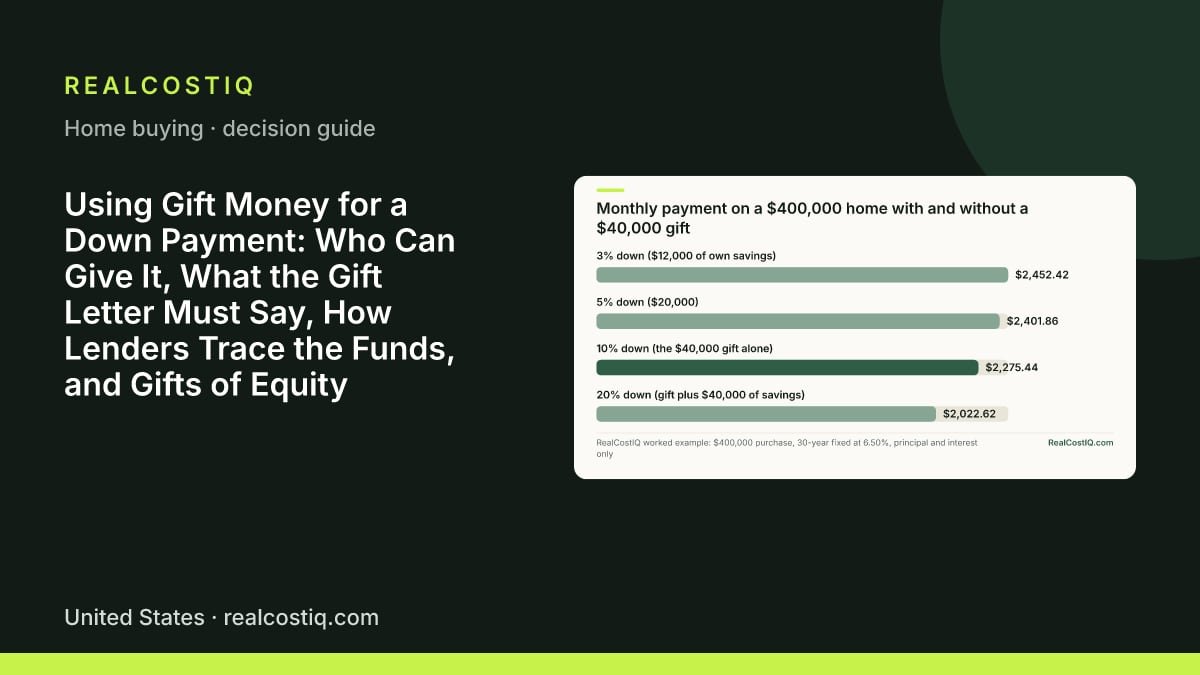
| $40,000 (10 percent, the gift alone) | $360,000 | 90.00 percent | $2,275.44 |
| $80,000 (20 percent, the gift plus $40,000 of savings) | $320,000 | 80.00 percent | $2,022.62 |
Computed with the site's mortgage engine: payment = P x r(1+r)^n / ((1+r)^n - 1), r = 6.50 / 1200, n = 360. Taxes, insurance and mortgage insurance are excluded, and rate and mortgage insurance pricing change with down payment and credit.
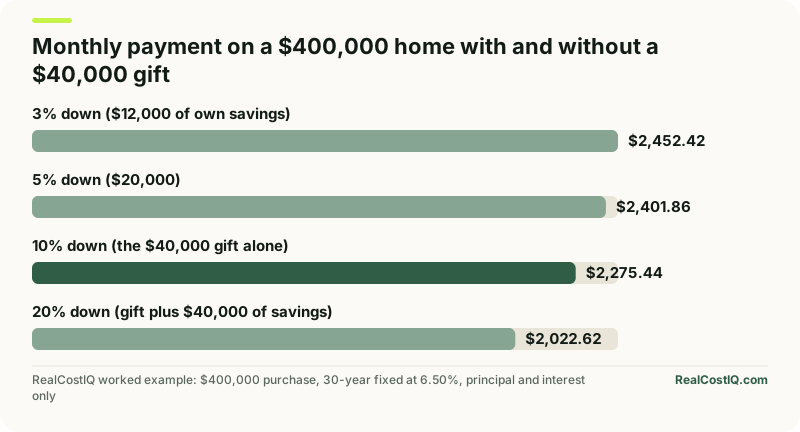
Putting the whole gift down lowers principal and interest by $176.98 a month against the 3 percent option ($2,452.42 minus $2,275.44). That is before any mortgage insurance difference, which these figures leave out. The 97 percent row is not a given either. Fannie Mae permits loans between 95.01 and 97 percent LTV only under set conditions. The loan must be fixed-rate, on a one-unit principal residence, and underwritten through DU. At least one borrower must be a first-time homebuyer, meaning a borrower with no ownership interest in a property in the last three years. HomeReady loans follow B5-6-01 instead. Homeownership education is also required (Selling Guide B2-1.3-01). The FHA loan calculator shows the same price with a 3.5 percent minimum investment funded entirely by the gift, with the FHA premiums included.
The real choice is whether to use a gift for a bigger down payment or for cash needs after closing. A buyer with $12,000 of savings and a $40,000 gift can put the whole gift down and keep the $12,000 as a cushion. That works because the cushion is the buyer's own money. Now say the plan is to stretch the gift across the down payment and the cushion. Then the program would have to let a gift count as reserves. FHA's manual-underwriting text does not allow that for surplus gift funds. VA's rental-property reserve rule does not allow it either. Run the cash-needed side in the down payment savings calculator before the donor decides the amount.
What goes wrong, and how to avoid it
- The gift arrives as an unexplained deposit. Send the gift letter and the donor's matching statement with the first large deposit, not after the underwriter asks.
- The donor is also the agent or the builder. Fannie Mae and VA both exclude donors affiliated with the builder, developer, real estate agent or another interested party. Fannie Mae bars an agent as a donor, related or not. FHA is different for a family member who is the agent. Ask which rule your loan follows.
- The gift is called a gift but repaid on the side. The lender can ask the donor to confirm in writing. If repayment is planned, treat it as a loan from the start.
- Cash is used. FHA rejects donor cash on hand, and a cash deposit gives no program a traceable source.
- The gift is counted as reserves where the rule does not allow it. Check the reserve language above before building the plan around leftover gift money. It covers FHA's manual-underwriting text and VA's rental-property reserves.
- The wrong donor signs, or the letter is incomplete. FHA wants both signatures. Trusts and estates need the trustee or representative. Use the lender's template.
- A gift of equity is used for the wrong purpose. Freddie Mac's June 2026 rule limits what an excess gift of equity can do. Ask before agreeing to a below-market price meant to give the buyer cash back.
A timeline that works
- Before you make an offer. Tell the loan officer a gift is part of the plan, and ask for the gift letter template and the program's donor rules for your loan type.
- At contract. Decide the amount. Ask the lender if it will accept "up to" a stated maximum. Fannie Mae and Freddie Mac allow this, so the figure can move with closing costs.
- Well before closing. Have the donor send the money by wire or bank transfer from their own account to yours. Or arrange a wire or official check that goes straight to the closing agent. Keep both statements.
- Upload the letter and the transfer proof together. The CFPB advises including every page of multi-page documents and responding quickly to lender requests.
- Do not move the money again. Leaving the gift in the receiving account until closing avoids a second set of transfers to explain.