An inspection report may say the roof has 'limited remaining life'. It may say the air conditioner is 'at or beyond its typical service life'. That gives you a reason to negotiate, but no number. The number has to come from you. The form the concession takes matters as much as the amount. A lender can refuse some forms outright and reprice others. This post covers the math and the lender rules. It does not explain what an inspection contingency is or how the deadlines work. The real estate contingencies guide covers that. Your contract and state forms control the mechanics.
Turn the inspector's note into a dollar figure
Home inspectors generally report conditions. They do not price repairs. An inspection report is not an estimate. It gives you an age, a condition and sometimes a guess at remaining life. You can turn that into a number in three steps. Price the replacement. Estimate how much of the system's life is already used. Then decide what share of the cost you are asking the seller to carry.
Step 1: price the replacement
Use a calculator with your own measurements, not a national headline. The RealCostIQ roof replacement cost calculator prices an installed architectural asphalt shingle roof at $4.00 to $8.50 per square foot of roof surface. A house with a 2,000 sq ft footprint has about 2,240 sq ft of roof at a standard pitch. So the calculator's estimate is $8,960 to $19,040. For cooling, the HVAC installation cost calculator puts a 2.5-ton central air conditioner at $2,344 to $4,740. That assumes existing ductwork and standard efficiency. Both are estimates built from published contractor-cost surveys, not quotes. Each calculator page shows its dates and sources. Swap them for a written quote from a licensed local contractor as soon as you can get one. A seller's agent cannot dismiss a quote as a website number.
Step 2: estimate the share of life already used
The InterNACHI life-expectancy table lists these life spans. Architectural asphalt shingles last 30 years. 3-tab asphalt shingles last 20 years. A central air conditioner lasts 7 to 15 years. A furnace lasts 15 to 25 years. A heat pump lasts 10 to 15 years. InterNACHI states that the figures assume regular care and normal wear. They vary with use, weather and installation. They are a general guide, not a guarantee. They are reference values from an industry group, not a measurement of your roof. Treat them as a starting point for the argument.
The used-up share is age divided by expected life, capped at 100%. The cap matters. Once a system is past its table life, the straight-line method says its remaining value is zero. So the used share is the whole replacement cost.
| System | Age and expected life | Used share | Low | High |
|---|---|---|---|---|
| Architectural shingle roof, 2,240 sq ft | 24 years of 30 | 80% | $7,170 | $15,230 |
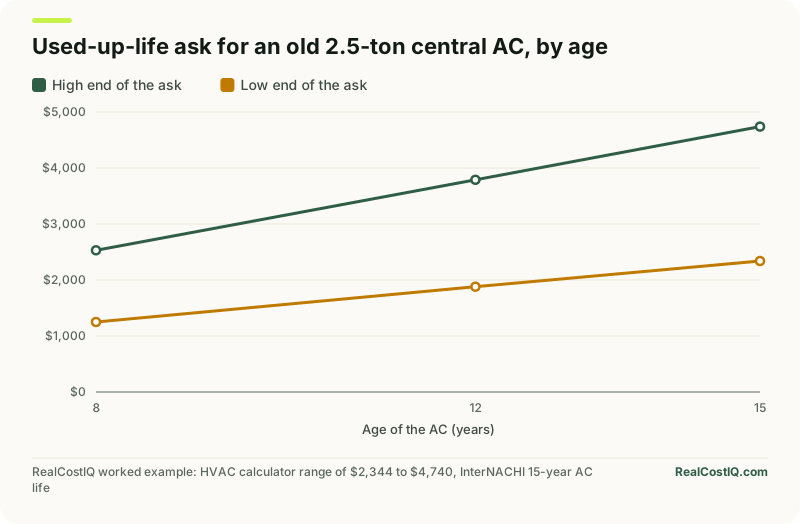
| Central AC, 2.5-ton | 8 years of 15 | 53% | $1,250 | $2,530 |
| Central AC, 2.5-ton | 12 years of 15 | 80% | $1,880 | $3,790 |
| Central AC, 2.5-ton | 15 years or more | 100% | $2,340 | $4,740 |
Low and high are the calculators' replacement-cost range multiplied by the used share and rounded to the nearest $10. The 15-year AC life is the top of InterNACHI's 7 to 15 year range, so these rows favor the seller; at the 7-year bottom of the range, any AC older than 7 years is fully used. Straight-line proration is an arithmetic convention for framing a request, not a market rule or an appraisal method.
Step 3: decide which share you are asking for
There are three fair positions, and they give three different numbers. None is the 'correct' one. Think of them as a ladder. You can open at the top and expect to settle lower.
- Full replacement cost. Your argument is that the roof or AC will need to be replaced almost right away. This is the opening position when the inspector calls the system failed or near failure. The seller's reply is betterment. You would be getting a new roof in place of an old one, so they should not pay for all of it.
- The used-up share. The seller used up 80% of the roof's life. Now they ask you to buy at a price that assumes the roof is still sound. Asking for the used share ($7,170 to $15,230 in the example) is a fair middle. A seller or listing agent can follow the math easily.
- The cost of a repair, not a replacement. A roofer may write that a repair makes the roof usable for several more years. If so, ask for the repair quote. This is the smallest ask and the one most likely to be agreed. On an FHA or VA loan, it may be exactly what the appraiser requires anyway (see the lender sections below).
Credit, price reduction, seller repair or escrow holdback
The same dollars act differently depending on the form. Four forms are in use. A lender treats each one differently.
| Form | What happens | Where it is limited |
|---|---|---|
| Closing-cost credit (seller concession) | The seller pays part of your closing costs or prepaids at the closing table. Price and loan are unchanged. | Capped as a percent of price by loan type and loan-to-value, and cannot exceed your actual costs. Cannot fund a down payment on Fannie Mae loans. |
| Price reduction | The contract price falls, so the loan, the down payment, the monthly payment and usually the tax basis fall. | Must be supported by the appraisal. A lower price can also change your loan-to-value tier and mortgage insurance. |
| Seller-performed repair | The seller hires a contractor before closing. You get the finished work, not cash. | On FHA and VA loans, repairs the appraiser requires must be done and verified before the loan closes or be escrowed. |
| Repair escrow or holdback | Funds sit with the lender or title company while work finishes after closing. | Lender-dependent. FHA allows it for repairs that cannot be finished before closing if the home is habitable and safe; Fannie Mae permits a lender to escrow for minor items. |
The credit-versus-price-cut arithmetic
Suppose you buy for $400,000 with 10% down on a 30-year loan. The repair issue is worth $15,000. Compare the two forms. The payment uses an example rate of 6.50%. That is an assumption for the math, not a quoted or forecast rate. Use your own.
| Price cut to $385,000 | $15,000 closing-cost credit | |
|---|---|---|
| Price | $385,000 | $400,000 |
| Down payment (10%) | $38,500 | $40,000 |
| Loan amount | $346,500 | $360,000 |
| Cash you need at closing, before the credit | $1,500 less | Unchanged |
| Credit applied against closing costs | None | $15,000, if you have that much in costs |
| Principal and interest at 6.50% (illustrative) | About $2,190 a month | About $2,275 a month |
| Difference in monthly payment | About $85 lower | Baseline |
Payment factor for a 30-year loan at 6.50% is $6.3207 per $1,000 borrowed; $13,500 less borrowed is about $85 a month. Taxes, insurance and mortgage insurance are excluded. A lower price can also lower the assessed value on which some jurisdictions bill property tax, but that depends on how the local assessor treats the sale price.
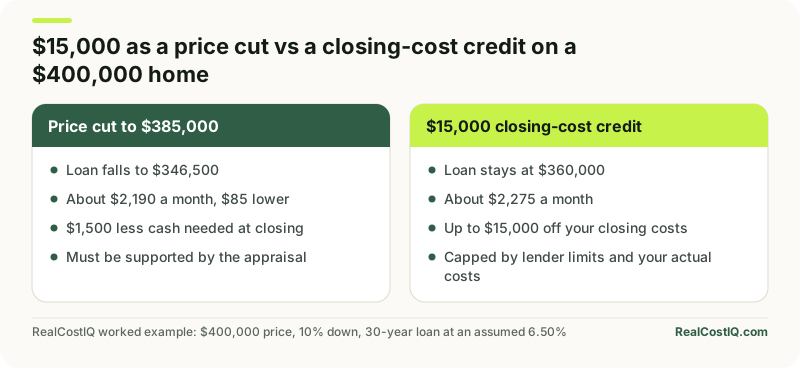
Say your closing costs are at least $15,000. The credit saves you $15,000 of cash at closing. The price cut saves $1,500. The price cut saves you about $85 a month for as long as you hold the loan. The credit puts $13,500 more in your pocket on day one. The price cut earns that back at $85 a month. So the two are even after roughly 158 payments, about 13 years. That ignores what the cash could have earned. If you expect to sell or refinance sooner than that, the credit is worth more. This holds only if the lender will let you use all of it. If you will keep the loan, the answer can reverse. It can also reverse if you are short on cash at closing but not short on income. Run your own numbers. The break-even is the cash difference divided by the monthly saving.
The words 'provided the lender will let you use all of it' carry the weight in that comparison. The next section explains why.
What Fannie Mae allows on a conventional loan
The seller's contribution toward your costs is called an interested party contribution, or IPC. The Fannie Mae Selling Guide section on IPCs (effective May 7, 2025 on the page read) caps it at 3% to 9% of the lower of sales price or appraised value, depending on loan-to-value. On an investment property the cap is 2%. We cover the caps in our first-time buyer FAQ. A lender may apply stricter limits.
Three things follow for a repair negotiation.
- The credit can only go to specific costs. The Guide lists these acceptable uses: borrower closing costs, including prepaids, and homeowners' association assessments for up to 12 months after settlement. It says IPCs cannot be used for the down payment, reserves or minimum borrower contribution. A credit is not cash in your pocket or a roof fund.
- A credit larger than your costs becomes a price cut. The Guide states that financing concessions must not exceed the borrower's closing costs. Any amount above them is treated as a sales concession. Sales concessions are deducted from the sales price. The LTV is then recalculated on the reduced price. LTV is the loan-to-value ratio, meaning the loan as a share of the home's value.
- The recalculation can push you over a tier. Take the $400,000 example with a $360,000 loan. A $15,000 credit against $12,000 of actual costs leaves $3,000 over. The price used for LTV falls to $397,000. If the loan amount stays the same, the LTV rises from 90.00% to about 90.68%. That crosses the 90% line, so the 3% tier applies. That is $11,910 on $397,000, and a $12,000 credit is now over the cap too. Ask the lender to run the tier before you sign an amendment that fixes a number.
A price reduction does not run through any of this. It is the contract price. The appraisal must support it, and the loan is sized from it. Say the credit you want would exceed your closing costs. The rules will treat it as a price reduction anyway.
Does a conventional loan require the roof or AC to be fixed?
Not on age alone. In Fannie Mae's property condition section (effective June 4, 2025 on the page read), appraisal reports must show bad conditions the appraiser sees, such as needed repairs. Properties rated C6 cannot be sold to Fannie Mae. Deficiencies that affect safety, soundness or structural integrity must be repaired before the loan is sold. The repair must bring the home to a condition rating of C5 or better. In those cases, the home must be appraised 'subject to' completion of the repairs. An old roof that still keeps water out is deferred maintenance. It is not a deficiency that must be cured. An active leak or a collapsed section is a deficiency. The sections we read set no minimum remaining-life figure for a roof or an air conditioner on a conventional loan.
When repairs are required, the Guide's completion rules (effective December 10, 2025 on the page read) apply. The lender must verify completion before the loan is sold to Fannie Mae. It can use a Form 1004D, or a borrower attestation letter with supporting documents. Some items are minor and do not affect safety, soundness or structural integrity. For those, the appraisal is done 'as-is'. The lender may, at its discretion, escrow for the items and sell the loan before the repairs are done. The escrow percentages and the 180-day completion limit on that page apply to new or proposed construction, not to an existing home. Do not carry those figures into a resale negotiation.
FHA: the appraiser sets minimums, and 'repair allowance' is a named inducement
FHA is the loan type where an old roof is most likely to turn from a talking point into a condition of the loan. The rules below are from HUD Handbook 4000.1, the FHA Single Family Housing Policy Handbook, read 2026-10-07. The combined PDF we read shows 'Last Revised: 08/14/2019' in its page footers. HUD publishes later changes in its online version. Confirm the current wording with your lender before you rely on a specific figure.
Roof: at least two years of remaining physical life
The handbook tells the appraiser to notify the mortgagee of a deficiency if the roof covering fails certain tests. It must keep out moisture. It must give reasonable future use, durability and low upkeep cost. It must have a remaining physical life of at least two years. If the roof has less than two years of remaining life, the appraiser must report it. The appraisal is then made subject to inspection by a professional roofer. That is a floor, not a standard of newness. A roof with seven years left passes. One the roofer says has under two does not. When an FHA appraisal flags a roof, the question becomes who pays for the roofer's repair or the replacement. The choice between credit and repair is then forced.
Heating and cooling
For heating, the appraiser must find several things about the permanently installed system. It must heat the living areas automatically to a minimum of 50 degrees Fahrenheit. It must be safe to operate. It must use a fuel that is easy to get, and it must have market acceptance. Central air conditioning is not required. But if it is installed, it must work. If it does not work, the handbook has the appraiser note the level of deferred maintenance. The appraiser must also report the effect on marketability and include the cost to cure. So a dead AC on an FHA purchase shows up as a cost-to-cure line in the report. It is not an automatic stop. A dead furnace in a cold climate can be one.
The 6% cap and what counts as an 'inducement to purchase'
Interested parties may pay up to 6% of the sales price toward origination fees, other closing costs, prepaid items and discount points. Contributions above 6% are inducements to purchase. So are contributions that exceed the actual costs. The handbook's list of inducements also names 'repair allowances' outright. An inducement cuts the purchase price dollar for dollar when the Adjusted Value is computed. This happens before the loan-to-value percentage is applied.
Here is an example. A $10,000 repair allowance on a $400,000 FHA purchase makes the figure the lender uses for LTV $390,000. The handbook's maximum LTV for purchases is 96.5%. At that level, the maximum base loan drops from $386,000 to $376,350, a $9,650 reduction. The effect on your cash to close depends on how the allowance is paid and documented. Ask the lender how it will treat a specific amendment before you submit it. The point is that on FHA, a credit labeled as a repair allowance is not a free-standing concession. It is treated like a price cut for LTV purposes.
Repairs: done before closing, or escrowed
Sometimes the appraiser finds the home does not meet HUD's rules. Then the handbook says the appraiser must note all repairs needed to meet HUD's property acceptability criteria. The appraiser must also note the estimated cost to cure. The mortgagee may set up a repair escrow for work that cannot be finished before closing. The home must be habitable and safe to live in at closing. The escrow funds must be enough to cover the cost. Borrower labor cannot be included. The mortgagee signs form HUD-92300 to show the escrow was set up. After the work, the mortgagee certifies completion on form HUD-92051 or on Fannie Mae/Freddie Mac Form 1004D, the Appraisal Update and/or Completion Report. In practice, a seller who agrees to fix the roof is agreeing to a second visit by an appraiser. That adds days and a fee to the closing timeline.
VA: the appraisal is not an inspection, and the notice of value lists the repairs
The VA Home Loan Guaranty Buyer's Guide (version dated April 2022 on the PDF read) describes how repairs work on a VA purchase. When the appraisal is done, the buyer gets a notice of value. It records the estimated value, comparable sales, photographs and 'a list of items requiring repair to meet VA minimum property requirements'. The guide is clear that an appraisal is not a home inspection. It recommends hiring a qualified inspector as well. It adds that the seller, lender or any other party can pay fees and charges for the buyer. The buyer can negotiate with the seller on splitting those costs 'if any concessions do not exceed 4% of the sale'.
This post can tell you less than you might hope, for two reasons. First, the guide notes that VA does not require a cash reserve. It suggests saving for large costs such as a replacement roof. Second, we could not read the VA Lenders Handbook chapter on minimum property requirements in a usable form on 2026-10-07. That chapter is where roof-life and repair-escrow thresholds sit. VA's hosting returned a page that needs a script to load. Other copies we found were summaries by third parties. So this post does not state a VA roof-life figure or a VA escrow dollar threshold. Ask your VA lender for the current rule in writing. Say the notice of value lists a roof or AC repair. VA's list says those items require repair. Ask the lender how they must be completed. Remember that who pays is negotiable.
How to structure the request so the lender can close it
- Get the repair or replacement quote in writing. Get one licensed contractor's written estimate for the roof or system. Attach the inspector's page and photos. Cite a replacement figure from the calculators only as a cross-check.
- Ask your loan officer which forms the lender will accept before you write the amendment. A concession that exceeds your closing costs changes the numbers. So does a 'repair allowance' on an FHA loan. A loan officer can run the LTV tier in minutes.
- If the credit would exceed your closing costs, ask for a price reduction instead. Fannie Mae treats the excess as a price reduction anyway. You may as well write it that way.
- If the appraiser might flag the item, ask for the repair, not the credit. On FHA and VA, the repair is required if the appraisal calls for it. A credit does not satisfy a required repair.
- Say who verifies a seller repair. Name the licensed contractor, the permit if one is required, and the paperwork the lender needs (Form 1004D or HUD-92051 on FHA). The cheapest way to fail a closing is a roof patch done by the seller's cousin that no appraiser will sign off on.
- Keep the deadline. The inspection contingency in your contract sets the window in which you may ask. Some contracts say an amendment must be signed by a date or the contingency lapses. Read it with the contingencies guide beside you.
Pricing the inspection in the first place
The roof or AC note may have come from a general inspection. If so, you may want a second opinion from a specialist roofer or HVAC technician before you negotiate. The home inspection cost calculator prices the inspector's fee and the add-ons around it. A specialist's written opinion is the most direct way to turn 'limited remaining life' into a figure you can attach to the amendment.
What weakens the ask
- Asking for everything. A report may list 40 items. A request for all 40 reads as a renegotiation of the price. A request focused on one or two systems reads as a repair negotiation. Pick systems the inspector tied to safety, water entry or near-end-of-life.
- A long wait. Your contract sets the inspection window. A request made after it closes may leave the seller with no duty to respond.
- Using a national headline as the ask. The calculator ranges are wide. Roof area, pitch, material, region and tear-off layers all drive the price. A figure with your square footage in it is harder to push back on than 'a new roof costs about $12,000'.
- A price the appraisal cannot support. Say the contract price is already at the appraised value. A large credit on top of it leaves the loan sized on a price the appraisal only just supports. A credit that is really a price cut is treated as one under the rules below.
- Forgetting the side costs. A repair that needs a permit or a second appraiser visit can add days. Build the date into the amendment.
A short decision rule
- If the item is a safety or water-entry issue on an FHA or VA loan, expect the lender to require the fix. Negotiate who pays, and ask for the repair.
- If the system works but is old, and your closing costs are big enough to absorb a credit, a credit is worth more than an equal price cut. The exception is if you will keep the loan 13 years or longer (the break-even in the worked example).
- Say the credit you want is larger than your closing costs. Or say you are using FHA and calling it a repair allowance. Then ask for a price reduction and let the appraisal decide whether it holds.
- If the dollar figure is small next to your closing costs, take the credit and move on. The paperwork is lighter, and the lender is least likely to object.
- Whatever you agree, write the exact amount, the form and the lender's required proof into the amendment. Have the lender sign off on the structure before you do.