Most people ask this question after a scare. A neighbor's basement flooded, or a quote arrived in the mail for a house the map calls low risk. You want two answers. How many dollars of cover should you buy? And is it worth buying at all if your home is outside a flood zone?
This post answers both with your own numbers. It does not cover what a mortgage lender forces you to buy. That is a different question with a different answer, and it is covered in how much homeowners insurance your lender requires. Here we look at what is wise to buy, which is often not the same as the lender minimum.
The two limits: $250,000 and $100,000
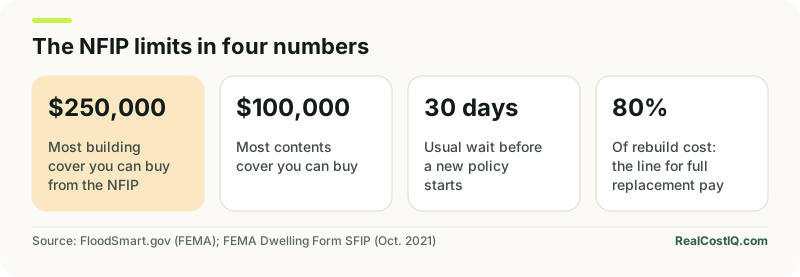
The National Flood Insurance Program (NFIP) is run by FEMA, the Federal Emergency Management Agency. It sells most flood policies in the country. FloodSmart, FEMA's consumer site, says a building policy covers up to $250,000 of flood damage. A contents policy covers your belongings for up to $100,000. They are two separate coverages, and each has its own deductible. A deductible is the part of a loss you pay first.
What building coverage pays for
Building coverage pays to repair the structure itself. FloodSmart lists the furnace, water heater, and electrical and plumbing systems under it.
What it does not pay for
The same FloodSmart page lists what a flood policy leaves out. Read this list before you decide how much to buy, because these losses are on you whatever limit you pick.
- Currency, precious metals and valuable papers such as stock certificates.
- Cars and most self-propelled vehicles, including their parts.
- Personal property kept in basements.
- Things outside the house: landscaping, septic systems, decks, patios, fences and pools.
- Temporary housing and extra living costs while the house is repaired.
- Business interruption and other financial losses.
- Sewer backups caused by clogged pipes. FloodSmart says backups from heavy rainstorms may be covered.
That list changes the math. If you keep a finished basement full of furniture, a flood policy may pay little for the contents there. If you will need a hotel for six months after a flood, the NFIP will not pay for it. Think about those costs when you decide how much cash you could pull from savings.
Step one: how much building coverage
Start with rebuild cost. That is what it would cost to rebuild the house as it is, with today's labor and materials. It is not the sale price. A home on an expensive lot may sell for far more than it would cost to rebuild. A home in a cheap market may cost more to rebuild than it would sell for. Your regular homeowners policy already uses a rebuild cost figure. Look on your declarations page for the dwelling limit and start there. You can also run the home insurance cost calculator to see how dwelling cover and premium relate.
FEMA's own policy form says what to leave out of that figure. When it works out the amount of insurance required for a dwelling, it excludes footings and foundations that sit below the lowest basement floor. It also excludes excavations, and underground pipes, wiring and drains. A flood policy does not pay for those, so you need not insure them. The Dwelling Form (F-122, October 2021) is the standard policy for a one- to four-family home.
The 80 percent rule
This rule decides how your claim is paid. Under the Dwelling Form, a single-family home that is your principal residence gets replacement cost settlement if the insurance on it is 80 percent or more of its full replacement cost. Replacement cost means the claim pays to repair with like materials, with no deduction for age. The form also gives you replacement cost if you carry the maximum the NFIP sells.
If you carry less than 80 percent, and less than the NFIP maximum, the form pays the greater of two things. One is the actual cash value of the damaged part. Actual cash value means the replacement cost minus depreciation. The other is a share of the repair cost, set by dividing what you bought by 80 percent of the rebuild cost. The policy form says both are limited to the amount of insurance you carry.
The rule applies to your principal residence. A rental home or a second home is paid at actual cash value. So is a house that is not your main home.
| Rebuild cost | 80% of rebuild cost | Buy at least | Gap above the NFIP cap |
|---|---|---|---|
| $180,000 | $144,000 | $144,000 | None |
| $300,000 | $240,000 | $240,000 | $50,000 of rebuild cost is not insured by the NFIP if you stop at $250,000 |
| $450,000 | $360,000 | $250,000 (the maximum) | $200,000 of rebuild cost sits above the cap |
Round numbers for illustration. The target is 80 percent of rebuild cost, or the $250,000 NFIP maximum when 80 percent is higher. You may buy more than the minimum. Your agent confirms the exact rule for your policy.
Look at the second row. A $300,000 rebuild cost means 80 percent is $240,000. Buy $240,000 and a full-replacement claim is paid up to that amount. Buy $250,000 and you have a little more room. A repair bill of $100,000 would be paid in full under either choice, less your deductible.
Now the third row. At a $450,000 rebuild cost, 80 percent is $360,000. That is above the $250,000 maximum. The form lets you reach replacement cost settlement by carrying the maximum available. So $250,000 is the right number to ask for. A total loss would still leave a gap above the cap. Most floods do not destroy the whole house, so the cap often fits real losses better than it first appears.
What happens if you under-insure
Say your rebuild cost is $180,000. Eighty percent is $144,000. You buy $108,000 to save on the premium. You divide $108,000 by $144,000 and get 75 percent. A repair that costs $20,000 is paid like this. Take the $20,000 repair cost and subtract your deductible. Say it is $2,000, which is an assumption for this example. That leaves $18,000. The form then pays 75 percent of it, or $13,500. If the actual cash value of the damaged part is higher, the form pays that instead. Either way you carry the gap. The savings on the premium rarely cover it.
When the cap is too low
If your rebuild cost is well above $250,000, the NFIP cap leaves a gap. The NAIC, the group of state insurance regulators, says the private flood market is small but growing. It says private policies tend to offer higher limits and optional extras. It also says you can buy excess flood coverage, but you must hold an NFIP policy first. Ask an agent for both a private quote and an excess quote, and compare them with the NFIP.
Step two: how much contents coverage
Contents coverage is optional and must be bought on its own. The NFIP sells up to $100,000. FEMA's Dwelling Form says personal property is always paid at actual cash value. That means the price of a new item minus wear and age. A five-year-old sofa that cost $2,000 new might be paid at a fraction of that.
To pick a number, walk through your home with your phone and film every room. Then add up what you own that sits above the basement floor. Use used-item prices, since that is how a claim is paid. A rough guide is the total you would need to refill the home with used goods. If that total is $40,000, a $40,000 limit is a fair target. You can buy less if you could replace the goods from savings.
Remember the basement. FloodSmart says personal property kept in basements is not covered. If your washer, dryer and storage live downstairs, ask your agent exactly what is covered there. Some building items are covered in a basement, and most personal items are not. Moving valuables up a floor is cheaper than insuring them.
Do you need flood insurance outside a flood zone?
Homeowners insurance does not cover floods. The NAIC says damage from a flood is not covered under a standard homeowner's policy. So the question is not whether your home policy has you covered. It does not. The question is whether you want a separate policy.
The zone letters
FloodSmart's zone page explains the map codes. Zones A, AE, AH, AO, AR and A99 are high-risk areas. Zones V and VE are high-risk coastal areas. Zone X is moderate or low risk. A federally backed or regulated lender must require flood insurance on a home in a high-risk zone. In Zone X the law does not force you to buy it. For the lender rules, see the lender requirement post.
| Zone | Risk level | Flood policy required by a federally backed lender? | Your decision |
|---|---|---|---|
| A, AE, AH, AO, AR, A99 | High | Yes | Buy the lender minimum, then consider more using the 80 percent rule. |
| V, VE | High (coastal) | Yes | Same. Expect the highest premiums. |
| B and X | Moderate | No, but a lender can still ask | Optional. Run the test below. |
| C and X | Low | No, but a lender can still ask | Optional. Run the test below. |
Source: FloodSmart.gov zone descriptions. Zone names on older maps use B and C. Newer maps use X. FloodSmart's own page labels the two X types inconsistently, so check your map or ask your agent which one your address is.
Why the map is not the whole story
A map line is a statistical edge. It is not a wall. FloodSmart's zone page says about one in three flood insurance claims come from low- and moderate-risk zones. On its cost of flooding page, FloodSmart reports about $8.8 billion of flood damage in 2024 and about $3.9 billion of it in communities that were not considered high-risk. That is roughly 44 percent. FloodSmart also says flooding does not only happen after a hurricane or on the coast.
Those numbers describe the nation, not your street. They do tell you a low-risk label is a reason to pay less, not a reason to pay nothing. A home can flood from heavy rain that overwhelms storm drains, from a slow-moving creek the map missed, or from a hill that sends water toward your lot.
What counts as a flood
The policy has a narrow definition. In the Dwelling Form, a flood is a general and temporary condition of partial or complete inundation of two or more acres of normally dry land, or of two or more properties, one of which is yours. The cause can be overflowing water, fast runoff of surface water from any source, or mudflow. A burst pipe in your own house is not a flood. A backup from a clogged sewer line is not either. Those losses fall under other coverage, so check whether your homeowners policy offers a water or sewer backup add-on.
What flood insurance costs by zone
NFIP prices follow a method called Risk Rating 2.0. FEMA says it looks at how often a property floods, the types of flood (river, storm surge, coastal erosion and heavy rain), distance to water, the home's elevation, and the cost to rebuild. Most rates cannot rise more than 18 percent a year by law. FEMA's page was last updated April 9, 2026.
Because every property is priced on its own, no table can give your price. What we can show is what real policies cost. The RealCostIQ flood insurance cost calculator uses FEMA's OpenFEMA data. We pulled 400,000 policy transactions on August 18, 2026 and used 303,299 single-family policies that began between May 1 and June 10, 2026. The table shows the median. Half of policies cost less and half cost more. The cost includes the premium plus federal fees. The median fee load in the sample was $253.
| Zone | Policies in sample | Median, all coverage levels | Middle half of policies | Median at up to $100,000 | Median at $250,000 |
|---|---|---|---|---|---|
| AE | 145,882 | $1,375 | $970 to $2,138 | $983 | $1,450 |
| VE | 5,258 | $1,833 | $1,300 to $3,111 | $1,573 | $1,838 |
| A | 12,430 | $972 | $684 to $1,441 | $840 | $1,007 |
| X (or B, C) | 139,729 | $989 | $675 to $1,265 | $648 | $1,021 |
Source: FEMA OpenFEMA NFIP Redacted Policies v3, policy terms starting May 1 to June 10, 2026, pulled August 18, 2026 (RealCostIQ calculator dataset). 'Middle half' is the 25th to 75th percentile. These are what policies cost, not quotes. Your elevation, rebuild cost and deductible change the price.
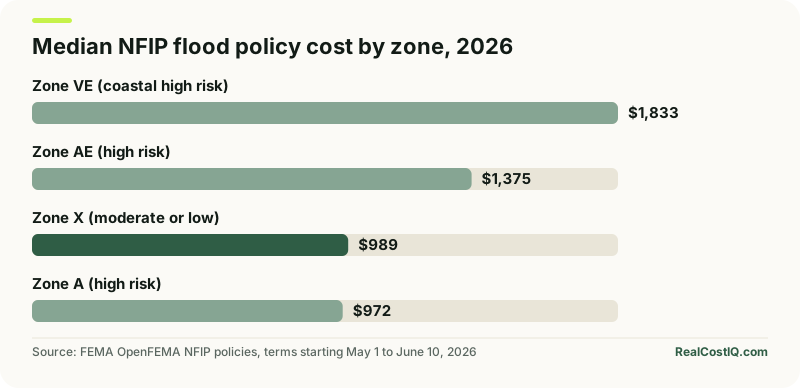
Two things stand out. First, the median in Zone X is $989. That is close to the median in Zone A, which is $972. The data cannot say why. It does fit FEMA's point that a property is priced on its own risk, not only on its map zone. Second, the price does not rise in a straight line with the limit. Look at Zone X.
| Building coverage level | Policies in sample | Median cost |
|---|---|---|
| Up to $100,000 | 5,589 | $648 |
| $100,001 to $150,000 | 5,073 | $963 |
| $150,001 to $200,000 | 6,572 | $1,045 |
| $200,001 to $249,999 | 6,324 | $979 |
| $250,000 (the maximum) | 116,171 | $1,021 |
Source: same OpenFEMA sample. Each level is a different group of homes, so medians are not a price list for one house. The levels above $150,000 cost about the same, since elevation and distance to water also shape the price.
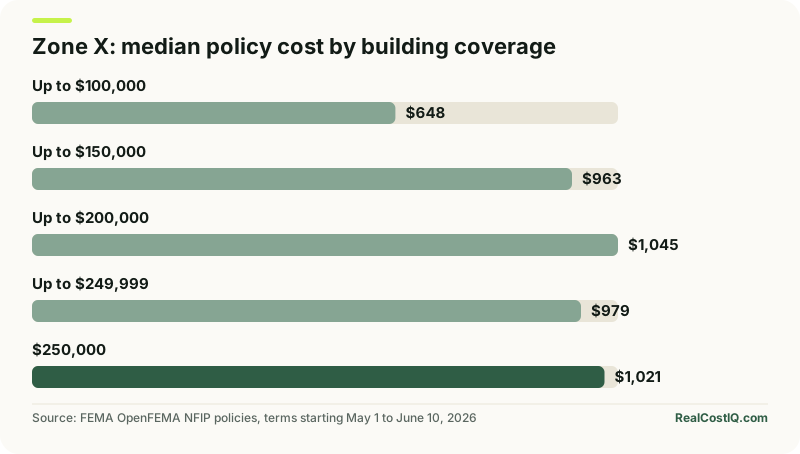
These medians come from different groups of homes, so they do not show what one house would pay for each limit. They do show that the median cost does not rise in step with the limit. So do not pick a low limit only to save a small amount. Pick the limit the 80 percent rule points to. Then get a quote for your own home and compare.
Ways to lower the price
FloodSmart says an elevation certificate can help you pay less. An elevation certificate is a surveyor's record of how high your home sits. FloodSmart also says you can pay less if you change the home, and it points to a homeowner checklist. Ask your agent which changes count, such as raising mechanical equipment.
A test for homes outside a flood zone
Skip the fear and run four checks. Each one takes a few minutes.
- Could you pay for the repairs from savings? Imagine one foot of water in the lowest level. Estimate the cost of repairs to the floors, walls and equipment. If you could pay that without borrowing, you can choose to go without. If not, buy.
- What is in the lowest level? A furnace, water heater and electrical panel in the basement turn a small flood into a large bill. Building cover pays for those. If they sit on the first floor, the risk is smaller.
- How does water move near your home? Look for a creek, a drainage ditch, a low spot, or a lot that slopes toward the house. Ask neighbors if water has ever pooled. Check the FEMA map and your town's flood records.
- What does the quote say? Get an NFIP quote and one from a private insurer. Compare the price, the limits and what each pays for.
Here is a way to think about the price. Say the quote is $1,000 a year. Over 30 years that adds up to $30,000, before any rate changes. If a single flood would cost you $40,000 in repairs, one claim pays back all 30 years. If you will likely never have a claim, you will have paid $30,000 for peace of mind. Neither outcome is wrong. The point is to see the trade clearly. This is arithmetic, not a forecast of your risk.
If the price looks high for a home outside a flood zone, check three things. Confirm the agent entered the right flood zone for your address. Ask whether an elevation certificate would lower it. And ask for a private quote, because the private market prices risk differently. The flood insurance topic page links to guides by state if you want local context.
NFIP or private insurance
The NFIP is the default. It has fixed limits and a standard policy form. Private insurers write their own policies. The NAIC says private policies tend to offer higher limits and optional coverage. It says some private insurers may not require an elevation certificate, which can save time and money. The Congressional Research Service adds that a private policy can meet the lender requirement if it meets the legal conditions, though the NFIP still provides most coverage.
Compare these points side by side.
- Limits. NFIP: $250,000 building, $100,000 contents. Private: set by the insurer. Ask for the exact numbers in writing.
- Contents. NFIP: always actual cash value. Private: some offer replacement cost. Ask.
- Extra living costs. NFIP: not covered. Private: some policies include it. Ask.
- Wait period. NFIP: usually 30 days. Private: ask each insurer for its wait.
- Rate method. NFIP: Risk Rating 2.0 with an 18 percent yearly cap on most increases. Private: set by the insurer, with no federal cap.
- Lender acceptance. If you have a mortgage in a high-risk zone, ask your lender before you switch to a private policy.
Timing: the 30-day wait and the program deadline
A new NFIP policy usually starts 30 days after you buy it. FloodSmart lists four exceptions. There is no wait if you buy while making, increasing, extending or renewing a mortgage. There is no wait if you change coverage while renewing. There is a one-day wait if your property is newly mapped as high-risk and you buy within 12 months of the update. And there is a one-day wait for a flood caused or worsened by a wildfire on federal land, if you buy within 60 days of the fire's containment.
This is why buying when a storm is on the news does not work. If a flood is a week away, a 30-day wait means the policy will not help. Buy early, in a dry week.
The program itself has a deadline. Congress has extended the NFIP in short steps. The Congressional Research Service reported on September 11, 2026 that the program is authorized until December 11, 2026. Its table shows lapses from October 1 to November 12, 2025, and from February 1 to 3, 2026. During a lapse, FEMA cannot issue new policies. CRS says policies issued before a lapse continue until the end of their one-year term. In the 2025 lapse, some lenders suspended the flood requirement. Check the current status with your agent before a closing, since CRS notes that Congress has usually reauthorized the program retroactively after a lapse.
A short list for choosing your amounts
- Find your flood zone on FEMA's map and confirm it with your agent.
- Find your rebuild cost on your homeowners policy. Remove foundation and underground items.
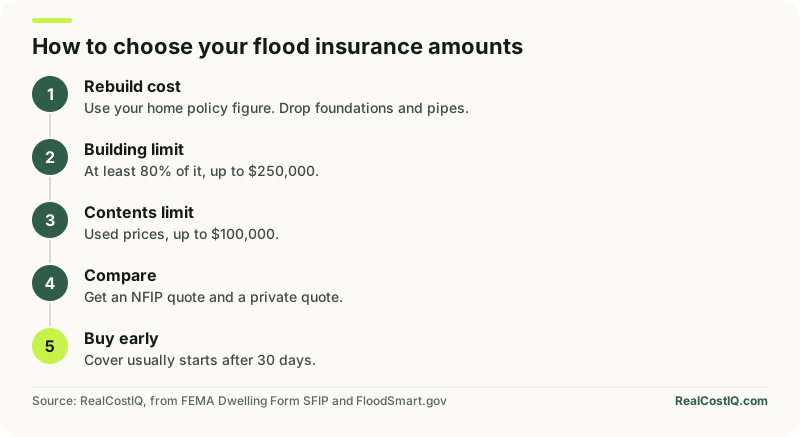
- Multiply by 0.8. Buy at least that much building cover, up to $250,000.
- Add up your belongings at used prices. Pick a contents limit up to $100,000. Move valuables out of the basement.
- Get an NFIP quote and a private quote. Compare limits, contents rules and the wait period.
- Check your premium on the flood insurance cost calculator.
- Buy at least 30 days before you need the cover, unless you qualify for an exception.