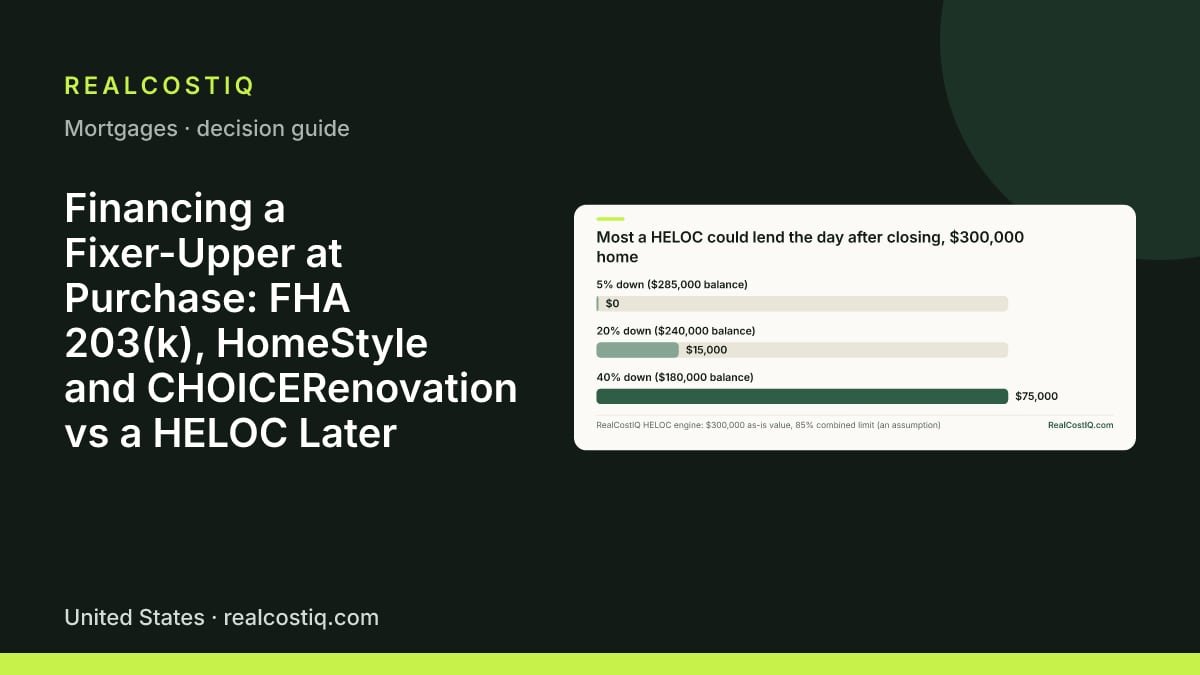
You have three ways to pay for a house that needs work. First, you can roll the repair budget into the purchase loan. This is a renovation mortgage, and its size is based on what the house will be worth once the work is done. Second, you can close on a standard loan and borrow against your equity later. Equity is the part of the home you own outright. You would use a home equity line of credit or a home equity loan. Third, you can pay cash. This post is about the first option. It covers how the three federal-backed products work. It also explains why the second option is often closed to a buyer who put little money down.
Every rule below was read today in the agency's own document. For FHA (the Federal Housing Administration), that means the mortgagee letters and handbook from HUD, the U.S. Department of Housing and Urban Development. For HomeStyle, it is Fannie Mae's Selling Guide. For CHOICERenovation, it is Freddie Mac's worksheet and FAQ. Where I could not read a primary page, the text says so. Lenders can add stricter rules of their own, so your loan officer's answer is the one that binds you. Borrowing against equity you already own is covered in the HELOC vs cash-out refinance guide, and this post does not repeat it.
The common idea: lend on the value after the repairs
All three programs solve the same problem. A house that needs a roof, a kitchen or a new heating and cooling (HVAC) system is worth less today than it will be when finished. A standard lender will only lend against today's value. A renovation mortgage works differently. Its appraisal, an expert estimate of value, covers the value after the planned work. You need a written scope of work and a contract with a contractor. The repair money goes into an escrow account at closing. An escrow account is a holding account run by the lender. The lender pays the contractor in stages as the work is checked. You get one closing, one mortgage and one monthly payment. The loan is sized to include the repair cost.
| FHA 203(k), Standard | FHA 203(k), Limited | Fannie Mae HomeStyle | Freddie Mac CHOICERenovation | |
|---|---|---|---|---|
| Minimum work | $5,000 of eligible improvements | None stated | None | Not read today |
| Maximum work | No dollar cap beyond the mortgage limit and value test | $75,000 total rehabilitation cost (ML 2024-13) | 75% of as-completed value (purchase: of the lesser of price plus renovation, or as-completed value) | Same 75% test on Freddie Mac's worksheet |
| Structural work | Allowed | Not allowed: minor, non-structural repairs only | Allowed; complete tear-down and reconstruction not allowed | Not read today |
| Consultant | Required (HUD-approved) | Optional | Not required on the pages read | Worksheet lists consultant fees as a cost |
| Time to finish | Up to 12 months | Up to 9 months | 15 months from closing; extension up to 18 months | Not read today |
| Draws | Up to 5 (four intermediate, one final) | Up to 4 per contractor | Up to 50% of renovation cost at closing; later releases after verified work | Not read today |
| Contingency reserve | 10% to 20% of repair cost, 15% minimum if utilities are off, on homes 30 years or older | Optional, up to 20% | Not required on a 1-unit; 10% on a 2-4 unit, up to 15% | Worksheet lists it as a financed cost |
| Payments while you cannot live there | Up to 12 months of payments financeable (Standard only) | Not financeable | Up to six PITIA payments on a principal residence | Up to 6 months on the worksheet |
| Loan sized on | 96.5% x the lesser of (adjusted as-is value plus costs) or 110% of after-improved value | Same test | LTV from Fannie Mae's Eligibility Matrix (not read today) | Lesser of price plus renovation, or as-completed value, times a maximum LTV of 95% on a 1-unit primary residence |
Sources: HUD ML 2024-13 and ML 2026-06; HUD Handbook 4000.1 (Update 18, issued August 12, 2026); Fannie Mae Selling Guide B5-3.2-01, -02, -04 and -06; Freddie Mac CHOICERenovation Maximum Mortgage Worksheet and FAQ. All read 2026-10-08. 'Not read today' means the page I could reach does not state it or could not be loaded.
FHA 203(k): Standard and Limited
The 203(k) is mortgage insurance from the Federal Housing Administration. This insurance protects the lender if you stop paying. It backs loans that pay for buying or refinancing an existing one- to four-unit home, plus the repairs. The home generally must already have been complete for at least a year. For a condominium unit, the work can cover only the inside of the unit. It cannot cover areas the condominium association is responsible for. There are two versions. The line between them is the most important choice in the program.
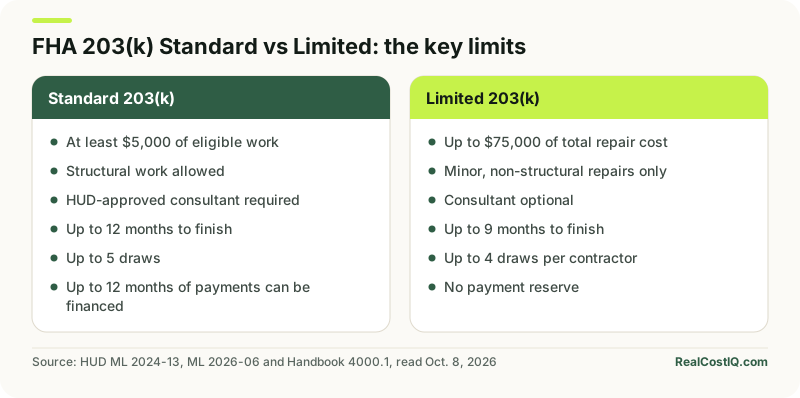
Standard 203(k): any scope, with a consultant
The Standard 203(k) requires at least $5,000 in eligible improvements. It also requires a HUD-approved 203(k) consultant. The consultant inspects the house and writes the Work Write-Up and Cost Estimate that the lender relies on. HUD's list of eligible work is long. It includes structural repair and reconstruction where the existing foundation system remains. It also includes adding space, finishing attics and basements, and replacing plumbing, heating, AC and electrical systems. Roofing, accessibility changes and well or septic work are eligible too. Luxury items such as a new swimming pool, tennis court or outdoor hot tub are not financeable. HUD's handbook says you must hire a qualified contractor before closing. The contractor must agree by contract to finish the Work Write-Up for the Cost Estimate within the allotted time. So the contractor search happens before closing, not after.
HUD's July 2024 Mortgagee Letter 2024-13 sets the time and money limits. It applies to FHA case numbers assigned on or after November 4, 2024. The lender sets a completion period of up to 12 months, based on the consultant's Work Write-Up. You can finance a mortgage payment reserve for the months when you cannot live in the home. It can cover as many as 12 months of payments, up from six. HUD caps the consultant's fees. The cap is up to $1,000 for a write-up on repairs of $50,000 or less. It is $1,200 for $50,001 to $85,000. It is $1,400 for $85,001 to $140,000. Above that, it is the lower of 1% of repair cost or $2,000. Each draw inspection may cost up to $375, a change order $120 and a reinspection $225. A draw is one payment from the escrow to the contractor. The draw fee must also be reasonable and customary for the area.
A contingency reserve is financed on top of the repair budget. It is a cushion for surprise costs. For a house 30 years old or more, the handbook requires between 10% and 20% of the repair cost. It requires at least 15% when the utilities are off at the time of the write-up. For a newer house it is up to the lender, except where there is termite damage. The lender holds any funds you do not need. They are not yours to spend as you like. Under HUD's rules, the lender may release contingency money early only in one case. That case is improvements beyond health and safety, before the work is finished. The lender must find a health or safety problem unlikely. The mortgage also must not exceed 95% of the after-improved value, which is the home's value after the work. Once the rehabilitation is complete, you may ask to use what is left on more improvements. You need a written change order. The lender must approve or reject it within five business days.
Limited 203(k): up to $75,000, no structural work
The Limited 203(k) is for minor remodeling and non-structural repairs. It does not require a consultant. HUD's current handbook states no minimum repair cost for it. Until 2024 the cap was $35,000. ML 2024-13 raised it to $75,000 in total rehabilitation cost. It also extended the repair period from six to nine months. HUD says it reviews the Limited cap each year with the nationwide mortgage limits. HUD's August 12, 2026 handbook update still sets the cap at $75,000. The rule that rules out most big projects is the definition of 'major' work, which Limited cannot finance. Work counts as major if it is expected to take more than nine months. It also counts as major if it needs more than four draws per contractor. Or if it needs a consultant's write-up or architectural plans because of what the appraisal found. Or if it keeps you out of the house for more than 30 days in total. The Limited version also cannot finance mortgage payment reserves or architect or engineering fees.
The draw limit changed this summer. HUD's Mortgagee Letter 2026-06 is dated June 23, 2026 and took effect immediately. It raised the Limited maximum from two draws per contractor to four. Those are the initial draw at closing, no more than two intermediate draws, and the final draw. A draw may now include two separate disbursements. The Standard version's limit is unchanged at five draws, four intermediate and one final. The letter also clarifies that a draw there can have multiple disbursements. The lender must release funds within five business days after a properly completed draw request and any title update.
How the 203(k) loan amount is set
For a purchase, HUD's handbook sets the maximum mortgage, subject to the nationwide FHA limit. The standard purchase loan-to-value limit is 96.5% for a borrower with a minimum decision credit score of 580 or higher. Loan-to-value (LTV) is the loan divided by the home's value. HUD applies the limit to the lesser of two amounts. The first is the property's adjusted as-is value plus the financeable repair costs, mortgage fees, contingency reserve and, for Standard only, mortgage payment reserve. The second is 110% of the after-improved value, or 100% for a condominium. The repair money is inside the amount that gets the 96.5% test. So your down payment is 3.5% of the whole package, not only of the purchase price.
FHA mortgage insurance applies as on any FHA loan. HUD's Mortgagee Letter 2023-05 sets the upfront premium at 1.75% of the base loan. It sets the annual premium at 0.55% of the base loan, per year. That applies to a 30-year loan of $726,200 or less with a loan-to-value ratio above 95%. The premium is charged for the life of the loan when the ratio is above 90%. For a 203(k), HUD's handbook measures that LTV as the base loan divided by the after-improved value. A rate of 0.50% applies between 90% and 95%. I found no later HUD letter that changes those rates. The FHA loan calculator applies them.
Fannie Mae HomeStyle and Freddie Mac CHOICERenovation
The two conventional programs are close cousins. Conventional means the loan is not insured by the government. Both programs share the same central test. For a purchase, the renovation cost may not exceed 75% of the lesser of two amounts. One is the purchase price plus the renovation costs. The other is the as-completed appraised value. For a refinance, it is 75% of the as-completed value. For manufactured homes, Fannie Mae uses 50% of as-completed value. Freddie Mac uses the lesser of 50% or $50,000. Fannie Mae also lets a do-it-yourself job be financed up to 10% of as-completed value, except on manufactured homes.
HomeStyle: what Fannie Mae's guide says
- No minimum and few restrictions. Fannie Mae's guide says there is no minimum dollar amount for renovations. It also sets no required improvements and no limits on the type of renovation. The improvements generally must be permanently affixed to the real property. The exception is appliances installed in a kitchen or utility room remodel. Outbuildings such as accessory units, garages and pools are allowed if zoning and code permit. Complete tear-down and reconstruction is not allowed.
- Eligible homes. These are principal residences of one to four units, one-unit second homes and one-unit investment properties. Manufactured homes qualify too, without structural changes such as adding a garage. So do units in eligible planned unit developments (PUDs), condo or co-op projects, if the work is limited to the unit interior and the association's documents permit it. Fixed-rate and adjustable-rate loans are eligible.
- Appraisal. The appraisal must give an 'as completed' value based on the plans and specifications. A change to the plans needs a written change order. Say a disaster or other unforeseen event changes the work. Then the lender must get an updated appraisal to see whether the as-completed value is affected.
- Escrow and draws. Renovation costs go into an escrow account for the borrower's benefit. So do the contingency reserve and any payment reserve. Any closing draw is subtracted from the renovation costs first. The lender may fund up to 50% of total planned renovation costs at closing as an initial draw. Later releases follow completed work and a specific request, with periodic inspections.
- Contingency. It is not required on a one-unit property, though the lender may set one. On two- to four-unit properties it is required at 10% of repair and renovation costs. It may be raised to 15% when the scope warrants.
- Payment reserve. Suppose you cannot live in a principal residence during the work. Then up to six PITIA payments can be included in renovation costs. PITIA means principal, interest, taxes, insurance and association dues.
- Deadline. Work must be finished no later than 15 months from closing. For causes outside the borrower's control, an extension is capped at 18 months. It must be in writing, and the borrower must not be in default.
- Overruns are yours. The borrower or lender must fund any cost increase. The lender may not increase the loan amount to cover it.
- Contractor documents. The renovation contract has to be fully signed before closing. It must state the agreed cost and subcontractors and tie payments to completion stages. The contractor must hold any required license. The contractor must also carry all-risk insurance equal to 100% of the full replacement cost of the improvements. Before the final payment, the lender needs lien waivers from the contractor, subcontractors and suppliers, or a clear title report. A lien waiver is a signed promise not to claim a lien on the house.
The loan-to-value limit for HomeStyle is not in the pages I could read. Fannie Mae's guide refers to its Eligibility Matrix, which I did not open. Do not assume the 95% on Freddie Mac's worksheet applies to Fannie Mae.
CHOICERenovation: what Freddie Mac publishes
Freddie Mac's Maximum Mortgage Worksheet lists the maximum loan-to-value ratios. They are 95% for a one-unit primary residence and 97% for one-unit HomeOne or Home Possible loans. They are 85% for two units and 80% for three or four units. They are 90% for a one-unit second home and 85% for a one-unit investment property. On a purchase, the maximum loan is the maximum LTV times the lesser of two amounts. One is the purchase price plus total renovation costs. The other is the as-completed value. Total renovation costs include hard and soft costs and a financed contingency reserve. They also include architect and engineer fees, consultant fees (the worksheet names an FHA consultant), inspections, title updates and permits. Up to six months of payment reserve counts too. Freddie Mac's FAQ adds three points. Properties rated C5 or C6 may be eligible when the issues that cause the rating are cured. The as-completed appraisal includes land value. And both CHOICERenovation products use a single closing with no interim construction financing.
I could not load Freddie Mac's Seller/Servicer Guide chapter or its offering job aid today. So I am not stating a CHOICERenovation completion deadline, contingency percentage or consultant rule. A lender who offers the product can give you those.
A worked example: $300,000 house, $60,000 of work
Take a house priced at $300,000 that needs $60,000 of work, with an as-completed appraisal of $390,000. All three numbers are placeholders chosen for the arithmetic. The $60,000 is not a calculator estimate. Replace it with a priced scope from the home renovation cost calculator and your contractor's bid. The interest rate is 6.50% on a 30-year term for both loans. That rate is a named input, not a market quote, and lenders price FHA and conventional loans differently. Payments below are principal and interest, plus FHA mortgage insurance where stated. They leave out property tax and homeowners insurance. I computed them with RealCostIQ's FHA loan and mortgage engines.
| FHA Standard 203(k) | Conventional (CHOICERenovation rules) | |
|---|---|---|
| Cost basis | $300,000 + $60,000 work + $6,000 contingency (10%) + $1,200 consultant write-up = $367,200 | $300,000 + $60,000 work = $360,000 (lesser of this or $390,000) |
| Renovation test | $60,000 is above the $5,000 minimum | 75% of $360,000 = $270,000; $60,000 passes |
| Loan-to-value applied | 96.5% x the lesser of $367,200 or 110% x $390,000 ($429,000) = $354,348 base loan | 95% x $360,000 = $342,000 loan |
| Down payment | $12,852 | $18,000 |
| Financed upfront premium | 1.75% = $6,201.09, so the loan is $360,549.09 | None |
| Principal and interest | $2,278.92 a month | $2,161.67 a month |
| Monthly mortgage insurance | 0.50% annual premium on the $354,348 base loan = $147.65 (HUD measures 203(k) LTV for the premium as base loan / after-improved value: 90.9%) | Private mortgage insurance usually applies with a small down payment; not read or computed here |
| Payment shown | $2,426.57 a month with insurance | $2,161.67 before private mortgage insurance |
Computed with the site's FHA loan engine (home price $367,200, down payment $12,852, 6.50%, 30 years, taxes and insurance 0) and mortgage engine (price $360,000, down payment $18,000, same rate and term). The FHA cost basis omits origination fees, discount points, per-draw inspection fees (up to $375 each), permits and any payment reserve, all of which can be financed or paid. The conventional loan omits soft costs, contingency and fees for the same reason. The comparison is of structure, not a rate shopping result. The engine prices the annual premium on price-based LTV (0.55%); it was recomputed at HUD's 203(k) after-improved-value LTV (0.50%): $354,348 x 0.50% / 12 = $147.65, plus $2,278.92 principal and interest = $2,426.57.
Read the table for structure, not for a winner. The FHA loan puts less cash down ($12,852 against $18,000) but costs more per month. There are three reasons. The base loan is higher. The 1.75% upfront premium is financed on top of it. And the annual premium is charged for the life of the loan when the starting LTV is above 90%. The conventional loan needs more cash up front. With this little down, it usually carries private mortgage insurance, which I did not price. That cost varies by credit score and is not in the sources I read. The FHA vs conventional calculator is the place to compare the two with your own score and price. The table does show two things. The 75% renovation test and the loan-to-value test are separate. And the lender sizes the loan on the as-completed value, not on today's value.
When a HELOC after closing is not available
The alternative is to close on the house and borrow against it afterward. That depends on your equity. The Consumer Financial Protection Bureau (CFPB) describes a home equity line of credit (HELOC) as an open-end line. You can borrow against it again and again during a draw period. The CFPB's example is 10 years. A repayment period follows, often 10 or 20 years, in which payments are often much higher. HELOCs usually carry a variable rate. The CFPB's page was last reviewed August 28, 2026. It also says a lender may stop more borrowing if the home's value drops a lot or your finances change.
The size of the line comes from your equity. RealCostIQ's HELOC engine assumes combined borrowing of up to 85% of the home's value. So the maximum line is 85% of value minus the mortgage balance. The 85% is the calculator's assumption, and lenders set their own limit. But the pattern is general. Take the same $300,000 house. It is valued at $300,000 on the day you close, because the work has not been done:
| Down payment | Mortgage balance | Maximum line (85% x $300,000 minus balance) |
|---|---|---|
| 5% ($15,000) | $285,000 | $0 (the calculation is negative: -$30,000) |
| 20% ($60,000) | $240,000 | $15,000 |
| 40% ($120,000) | $180,000 | $75,000 |
Computed with the site's HELOC engine (home value $300,000; maximum line = max(0, 0.85 x value - balance)). The 85% limit is the calculator's assumption; actual lenders vary. The line is sized on the value at the time of application, so it does not yet include the value the renovation will add.
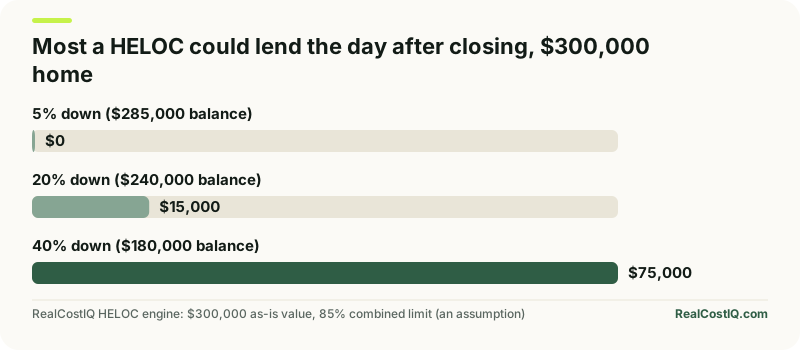
A buyer with 5% down has no room to borrow. A buyer with 20% down could borrow only $15,000 of a $60,000 job. Only the buyer with 40% down could draw the full $60,000 against the house. A renovation mortgage works around this. It lends on the as-completed value from the start, which is exactly what a HELOC cannot do.
What the borrowing costs, at named rates
If you do have the equity, the cost of the money depends on the product and the rate. Take the $60,000 level with a 40%-down mortgage balance of $180,000. The rates are named inputs, not quotes. The site's engine gives:
- $60,000 inside a 30-year mortgage at 6.50%: $379.24 a month and $76,526.69 of interest over 30 years. The longer term lowers the payment but raises the interest.
- HELOC at 8.50% variable, 10-year draw, 20-year repayment: $425.00 a month, interest only, while you draw. Then $520.69 a month for 240 months. Total interest is $115,966.55 on the full $60,000 if you never pay principal early. A HELOC rate is variable, so those figures change with the index it follows.
- Fixed home equity loan at 8.75%, 15 years: $599.67 a month and $47,940.45 of interest.
These are illustrations from different named rates. The comparison is not a statement about what any lender would offer you. Two points are worth carrying away. Renovation money inside a long mortgage has the lowest monthly payment and the highest lifetime interest. And a HELOC's interest-only draw period hides the principal you still owe.
Contractors, draws and the 203(k) consultant
The repair money does not go to you or to the contractor at closing. It sits in the lender's escrow. The contractor gets paid in draws, after the work is checked. That is the main way these loans differ from a cash job. A Standard 203(k) allows up to five draws, with the last one at completion. Under HUD's June 2026 letter, the lender must release funds within five business days after a complete draw request and any title update. Fannie Mae HomeStyle can fund up to 50% of the renovation cost at closing. Later payments follow verified work. Before the final payment, the lender needs lien waivers from the contractor, subcontractors and suppliers, or a clear title report.
What the 203(k) consultant costs
HUD sets maximum fees for the consultant. Its fee schedule, first issued in Mortgagee Letter 2024-13 and now part of Handbook 4000.1, reads as follows. The work write-up costs up to $1,000 for repairs of $50,000 or less, and up to $1,200 for $50,001 to $85,000. It costs up to $1,400 for $85,001 to $140,000. Above that, it is the lower of 1% of repair costs or $2,000. Each draw inspection is capped at $375, a change order at $120 and a reinspection at $225. A feasibility study, if you ask for one, is up to $375. I re-read the letter on 2026-10-21. Check the handbook for any later change.
| Item | Ceiling | How it is figured |
|---|---|---|
| Work write-up | $1,200 | Repairs of $50,001 to $85,000 |
| Draw inspections, if all five draws are inspected | $1,875 | 5 x $375 |
| Total at the caps | $3,075 | $1,200 + $1,875 |
| Add-ons if needed | $375, $120, $225 | Feasibility study, per change order, per reinspection |
RealCostIQ arithmetic on the maximums in HUD ML 2024-13. Fees must also be reasonable and customary for your area, so many will be lower. Mileage and change orders can add to the total. Lender fees and FHA premiums are separate.
Why some contractors pass on these jobs
I found no published count of contractors who decline renovation loans. But the rules show what is asked of them. They must sign a contract with an agreed cost and an itemized payment schedule before closing. Under HUD's rules, they must agree to finish the write-up in the allotted time. They wait for an inspection before each payment. They must hold the license and insurance the contract names. Fannie Mae asks for all-risk coverage at 100% of the full replacement cost, plus public liability and workers' compensation. A contractor who is used to a deposit up front may not want that.
Interview contractors before you make an offer. Ask each one three things. Have you worked with a draw schedule before? What payment do you need at the start? How soon after an inspection do you expect to be paid? A contractor who has done it before saves you weeks. Ask your lender for names of contractors it has seen finish these loans.
Will a seller take a renovation-loan offer?
Sellers often fear a slow or failed closing. A renovation loan adds steps before closing. The loan needs a scope of work, a signed contract with a contractor, and an appraisal of the as-completed value. A Standard 203(k) also needs the consultant's write-up. I did not find a published closing time from HUD, Fannie Mae or Freddie Mac. Ask your lender how long its renovation closings take, and put that in your offer instead of guessing.
Here is how to write an offer that a seller can say yes to.
- Include the required clause. HUD's handbook requires the sales contract to say you applied for 203(k) financing. It must say the contract depends on mortgage approval and your acceptance of the required improvements.
- Get a preapproval from a lender that does the product. Many lenders do not. A letter from one that does shows the seller the loan is real.
- Line up the consultant and contractor first. Book the consultant visit and collect a written bid during your inspection period. The more done before the offer, the shorter the closing needs to be.
- Ask for a closing date that fits the steps. Use the lender's own estimate, plus a few days of room. A date the loan cannot meet is the quickest way to lose the house.
- Keep your repair list inside the program. FHA's Limited 203(k) cannot cover structural work. HomeStyle does not allow a complete tear-down. A house that fails the product's rules fails the loan.
- Know the weak spot. Say another buyer offers cash or a plain loan with no repair steps. A seller may pick that offer even at the same price. That is a negotiating fact, not a rule from the sources. A price or credit that makes up for the added risk can help.
Choosing between them
- Is the work structural, or longer than nine months, or does it need plans? If so, the Limited 203(k) is out. Choose the Standard 203(k) or a conventional product.
- Is the work under $75,000 and cosmetic or mechanical? The Limited 203(k) skips the consultant and its fees. But it caps draws at four per contractor. It also cannot finance a payment reserve or architect fees.
- Is your credit and down payment strong enough for a conventional loan? Then compare HomeStyle or CHOICERenovation on mortgage insurance cost, not only on rate. The FHA annual premium is 0.50% at 90-95% LTV and 0.55% above 95%, on a 30-year loan of $726,200 or less. It runs for the life of the loan above 90% LTV.
- Is it a second home or investment property? HomeStyle allows one-unit second homes and investment properties. Freddie Mac's worksheet lists LTVs for both. I did not read FHA's 203(k) occupancy rule today. Confirm it before assuming 203(k) is available.
- Do you have 40% or more of the price in cash after closing costs? Then closing on a standard loan and borrowing with a HELOC later may be simpler. It avoids the consultant, the escrow and the 15-month clock. The rates on a HELOC are variable.
- Do you need a place to live during the work? A payment reserve covering up to six months is available on HomeStyle and CHOICERenovation. It covers up to 12 months on the Standard 203(k). It is not available on the Limited version.
VA and USDA renovation programs exist. VA is the Department of Veterans Affairs, and USDA is the U.S. Department of Agriculture. I did not read their primary rules for this post, so I left them out rather than describe them from memory.
What changes about the purchase itself
A renovation loan changes the order of events. HUD's handbook requires the sales contract to include a clause. The clause must say you applied for 203(k) financing. It must also say the contract depends on mortgage approval and your acceptance of required improvements. Fannie Mae requires the renovation contract to be signed before closing. So both need a scope of work, a priced bid and a licensed contractor before closing. That pushes the contractor search into the offer period. Sellers sometimes prefer offers that look simpler. That is a negotiating fact, not a rule from these sources.
Before you make an offer, get the cost side right. A bid you cannot defend turns into a larger contingency, a smaller cash cushion or a project that stalls when the escrow money runs short. Price the scope on the home renovation cost calculator, then compare it with two or three written bids. Before you write an offer, ask the lender which of its products fits the house and the work.