The pitch for tankless water heaters is simple: no tank means no heat lost from a tank sitting full of hot water all day. That part is true. The question is how much money it saves, and whether that covers what you pay to switch. This post puts a number on the savings for gas and for electric homes, then shows how long the extra cost takes to pay back. It does not repeat the price tables on this site's calculators. It uses them as a starting point and asks a different question: is the switch worth making?
Where the savings come from, and how big they are
Water heaters lose heat in two ways. A tank loses heat through its walls all day and night. This is called standby loss. Every heater also wastes some energy making the heat, because no burner or heating element is perfect. The rating that covers both is the Uniform Energy Factor, or UEF. A UEF of 0.80 means that 80 percent of the energy you pay for ends up as hot water. The rest is lost. A higher UEF is better.
The U.S. Department of Energy sets a legal minimum UEF for every new water heater. In the federal rule (figures below are for the common medium draw pattern), 10 CFR 430.32, a gas tank of 40 gallons must score at least 0.58. That comes from the rule's formula: 0.6483 minus 0.0017 times the tank size. A gas tankless heater must score at least 0.81. For electric heaters the gap is the other way. An electric tank of 40 gallons must score at least 0.92 (the formula is 0.9307 minus 0.0002 times the tank size), and an electric tankless heater must score at least 0.91. Those are minimums. Most units on the market beat them, and the gap between brands is wide, so read the label on the model you are quoted.
ENERGY STAR gives a real-world check. It says a family of four saves $95 a year on gas, or $1,800 over a 20-year life, with an ENERGY STAR gas tankless heater instead of a standard gas tank. It lists 20 years as the life of a tankless heater, longer than a tank. It says the savings against an ordinary gas tankless unit are much smaller, about $20 a year. The page does not say what prices or household size it assumes beyond the family of four, so treat $95 as a ceiling for a typical family.
An older field study points the same way. Green Building Advisor reported on a Minnesota study that watched water heaters in ten homes for over a year. In its editor's summary, tankless units used 37 percent less energy on average, and the yearly savings ran from $42 for a low-use household to $121 for a high-use one. The article is from 2012, so the dollar figures reflect older prices. It still shows the shape of the answer: savings are real but small.
A worked example with round numbers
Start with a home that uses 50 gallons of hot water a day. Water must be warmed about 70 degrees Fahrenheit, from cold supply to shower temperature. That 70-degree rise is an assumption for this example, because supply water is colder in the north and warmer in the south. One Btu is the heat that warms one pound of water by one degree (EIA). A gallon of water weighs about 8.34 pounds. So 50 gallons times 8.34 pounds times 70 degrees is 29,190 Btu a day. Over a year that is about 10.65 million Btu. In electric terms, one kilowatt-hour equals 3,412 Btu, so it is about 3,123 kilowatt-hours.
That is the heat you actually use. The heater has to buy more than that, because of the losses. Divide by the UEF. A gas tank at 0.58 buys 18.35 million Btu to deliver 10.65 million. A gas tankless heater at 0.81 buys 13.15 million.
Now price the gas. The U.S. Energy Information Administration (EIA) put the 2025 U.S. average residential gas price at $15.34 per thousand cubic feet. EIA lists gas at 1,036 Btu per cubic foot, so one thousand cubic feet holds 1.036 million Btu. That makes gas cost about $14.81 per million Btu, or $1.48 per therm. The gas tank then costs about $272 a year to run, and the tankless unit about $195. The saving is $77 a year.
| Hot water a day | Heat needed (million Btu a year) | Gas tank, UEF 0.58 | Gas tankless, UEF 0.81 | Yearly saving |
|---|---|---|---|---|
| 30 gallons (1 to 2 people) | 6.39 | $163 | $117 | $46 |
| 50 gallons (a typical family) | 10.65 | $272 | $195 | $77 |
| 80 gallons (a large family) | 17.05 | $435 | $312 | $123 |
Hypothetical household. Uses the legal-minimum UEF for a 40-gallon gas tank (0.58) and for a gas tankless heater (0.81), a 70-degree water rise, and the EIA 2025 average residential gas price of $15.34 per thousand cubic feet at 1,036 Btu per cubic foot. Gas prices vary by state and by month. Figures rounded to the dollar.
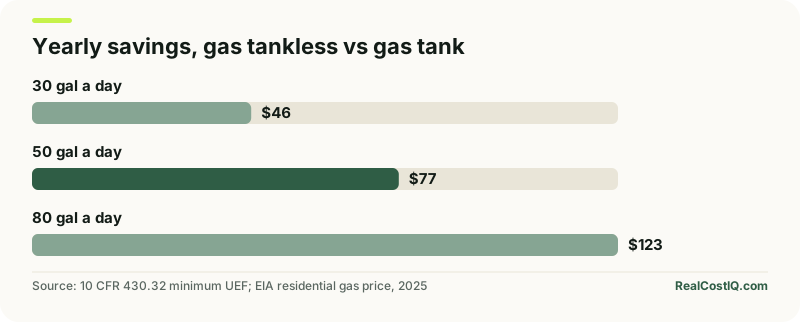
The $77 sits between the $42 low case from the 2012 study and ENERGY STAR's $95, so it is in a believable range. If the unit you buy scores 0.95 on its label instead of the 0.81 minimum, the 50-gallon saving rises from $77 to about $106. That is a case where reading the label pays off.
Gas prices swing through the year
The yearly average hides a lot. EIA's monthly residential price was $13.96 per thousand cubic feet in January 2026 and $26.45 in July 2026. A higher summer price per unit is common because fixed charges get spread over fewer units of gas, though that is this post's reading and not something EIA states on that page. For a payback estimate, the yearly figure is the right one. If your own bill shows a much higher or lower price per therm, scale the savings in proportion.
Electric: why tankless saves almost nothing
Electric water heaters turn nearly all the power they use into heat. The tank loses some heat through its walls, but a well-insulated modern tank loses little. That is why the legal minimums are so close: 0.92 for a 40-gallon electric tank and 0.91 for an electric tankless unit.
EIA reported an average U.S. residential electricity price of 18.16 cents per kilowatt-hour in August 2026, up from 17.57 cents a year earlier. That is a single month, not a yearly average, so treat it as a guide. For the same 50-gallon home, the heat you need is 3,123 kilowatt-hours a year. An electric tank at 0.92 buys about 3,385 kilowatt-hours and costs about $615 a year. An electric tankless unit at the 0.91 minimum buys 3,432 and costs about $623. At the legal minimums the tankless unit costs $8 a year more, not less.
Real products can do better than the minimum. If a tankless electric unit scores 0.98, the 50-gallon saving is about $36 a year. That is a hypothetical score. This post did not find a published average UEF for electric tankless units, so check the label. Even $36 a year will not repay an electric tankless install that needs a new heavy-duty circuit or a panel upgrade. Consumer Reports warns that electric tankless models may need an expensive upgrade of the home's electrical capacity.
| Heater | UEF used | Power bought (kWh a year) | Yearly cost at 18.16 cents |
|---|---|---|---|
| Electric tank, 40 gallons | 0.92 (legal minimum) | 3,385 | $615 |
| Electric tankless | 0.91 (legal minimum) | 3,432 | $623 |
| Electric tankless, hypothetical | 0.98 (assumed) | 3,187 | $579 |
Hypothetical household using 3,123 kWh of heat a year. The 0.98 row is an assumption to show what a better unit would do, not a published average. Electricity prices vary by state; 18.16 cents is the EIA U.S. residential average for August 2026.
If you heat water with electricity and want a lower bill, the better move is usually a heat pump water heater, which moves heat instead of making it. The federal rules point the same way. Under 10 CFR 430.32, electric tanks of 20 to 55 gallons made on or after May 6, 2029 must reach a UEF of 2.30. In this post's reading, only heat pump models can reach that. You can see installed prices for each type on the water heater replacement cost calculator.
The tax credit is gone
Older guides still say a tankless gas heater earns a federal tax credit. That is out of date for new installs. The IRS page on the Energy Efficient Home Improvement Credit (known as the 25C credit) says it applies to qualifying property placed in service after December 31, 2022 and before December 31, 2025. The statute is 26 U.S.C. 25C. A heater installed in 2026 gets nothing from this credit, so this post counts none. Some state or utility rebates may still exist. Check yours before you buy, and count a rebate only if it is in writing.
What conversion adds: the extras that decide the answer
The unit price is only part of the bill. Swapping a tank for a tankless heater is a different job from swapping one tank for another, because the old tank used a small gas line, a simple vent and the existing power. A tankless unit may need more of each.
- Gas line. A tankless burner can draw a lot of gas for a short time. A common upgrade is a larger pipe. A Rinnai trainer writing in Contractor Magazine in 2022 says many newer models run on lower gas pressure, so an upgrade is often not needed. He also gives $500 to $2,000 for the work when it is needed, citing HomeGuide, and about $12 to $25 per foot. He works for a tankless maker, so weigh that. The right answer depends on the unit's gas demand, the pipe length and the other gas appliances on the same line. Ask the installer to show the sizing math.
- Venting. Many tankless models need their own vent made of approved materials. A tank vent shared with a furnace may not work. Ask for a quote that lists the vent separately.
- Electric service. Electric tankless units draw a large current while they run. Consumer Reports notes this can mean an electrical upgrade. If your panel is full or old, this one line can cost more than the savings.
- Water quality. Hard water leaves scale inside the heat exchanger. Consumer Reports advises flushing it every one to two years. If you pay a pro each time, that cost eats into the yearly savings.
- Permits. Gas and electric work usually needs a permit and an inspection. Fees vary by city.
Prices for all of this move around, so this post does not publish a single conversion number. For installed ranges by type, use the water heater installation cost calculator. Ask for two things from any quote: the tankless unit and the tank unit, each fully installed, in writing. The gap between the two is the number that matters. This post calls it the premium.
Payback: the premium divided by the yearly saving
Payback in years is the premium divided by the yearly saving. The table uses the gas savings from earlier and a range of premiums. The premium is the fully installed tankless price minus the fully installed tank price. These premiums are examples, not quotes.
| Premium (tankless minus tank) | 30 gal a day, saves $46 | 50 gal a day, saves $77 | 80 gal a day, saves $123 |
|---|---|---|---|
| $1,000 | 21.7 years | 13.0 years | 8.1 years |
| $2,500 | 54.3 years | 32.5 years | 20.3 years |
| $4,000 | 87.0 years | 51.9 years | 32.5 years |
| $6,000 | 130.4 years | 77.9 years | 48.8 years |
Hypothetical. Payback = premium divided by yearly saving, using the yearly savings in the gas table above. Prices are held flat. Compare the result with a tankless life of about 20 years (ENERGY STAR).
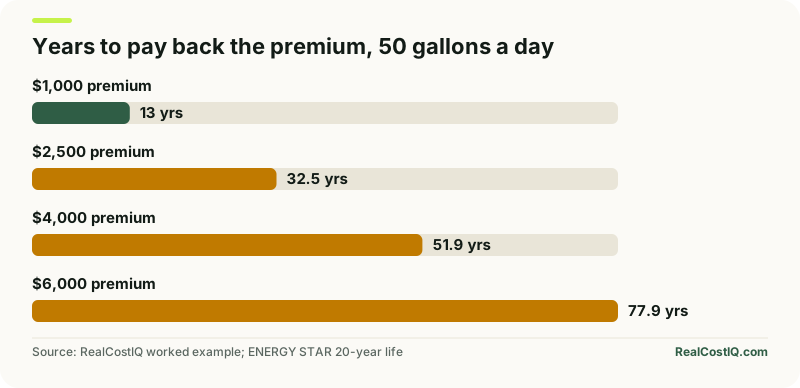
Read it with the 20-year life in mind. A tankless heater that lasts 20 years has to pay back in fewer than 20 years to come out ahead on energy alone. Spread over 20 years, a $1,000 premium needs $50 a year in savings. A $2,500 premium needs $125. A $4,000 premium needs $200. A $6,000 premium needs $300. The medium household saves $77, so only the first one clears the bar. Even the large family, at $123 a year, clears the $2,500 premium only by a hair: 20.3 years against a 20-year life.
The one thing the table leaves out: a second tank
A tank does not last 20 years. ENERGY STAR lists 20 years for tankless, and says it is longer than any tank. Consumer Reports gives only a warranty range of 3 to 15 years for tanks. If your tank fails around year 13 and a replacement costs $1,500, a tankless buyer avoids that purchase. That is worth something. Suppose the tank price is $1,500, a number chosen for the example. Over 20 years, a medium household saves $77 times 20, which is $1,540 in fuel. Add the $1,500 second tank not bought, and the benefit is $3,040. Against a $2,500 premium, tankless comes out about $540 ahead over 20 years, with no allowance for the time value of money or for repairs. Against a $4,000 premium, it loses by about $960.
So the second-tank credit can tip a close call, but it does not rescue a $4,000 premium. Both numbers in this paragraph rest on a tank price you choose. Plug in your own quote.
When a tank wins, and when tankless wins
A tank wins when
- The premium is above about $2,000 and your household uses 50 gallons a day or less.
- Conversion needs a new gas line, a new vent and a bigger circuit, all in one job.
- You heat water with electricity. Pick a tank, or a heat pump model if it fits your space.
- You plan to move within a few years. The buyer will not pay you back for energy savings you never collected.
- Your water is hard and you will not flush the unit. A neglected heat exchanger can fail early.
Tankless wins when
- Space is tight. A wall-mounted unit frees a closet.
- You use a lot of hot water (80 gallons a day or more) and the premium is $1,000 or less.
- The old tank has failed in a way that risks a flood, and a basement leak would be costly.
- You already have a large gas line and a vent that a new unit can use.
- You value never running out of hot water. Output is limited by flow rate, though. Consumer Reports puts a typical shower at about 2 gallons a minute, so two showers and a dishwasher at once can still exceed a small unit.
If your heater is old and you are deciding whether to repair it, run the numbers on the water heater repair cost calculator first. For how long each type lasts and what a plain swap costs, the water heater replacement cost guide covers it, and this post does not repeat it.
A short checklist before you sign
- Get two written quotes, tank and tankless, each fully installed. Subtract to find the premium.
- Ask the installer for the gas-line sizing, the vent type and the permit fee as separate lines.
- Find the UEF on the tankless model's label. Compare it with the 0.81 minimum used here.
- Look at your gas or power bill for the price per therm or per kilowatt-hour. Scale the savings in this post to match.
- Divide the premium by the yearly saving. If the answer is over 20, tankless is a comfort purchase.
- Ask about local rebates, in writing. Do not count the federal credit.
What this post does not cover
Propane homes may see different savings. This post did not find a current EIA propane price it could read, so it does not model propane. It also leaves out the cost of money, rising fuel prices, water use and maintenance. Rising fuel prices help tankless. Maintenance and the time value of money hurt it. The 50-gallon household is a round-number example, not an average. And UEF minimums are a floor. A good condensing unit can beat them, which raises the saving.