A temporary rate buydown is a prepaid subsidy. Someone, usually the seller or a builder, deposits money in an escrow account at closing. That account tops up your payment, so you pay as if the rate were lower for the first one to three years. After that, you pay the real payment on the real note. The mechanics are easy to describe and easy to misread. The headline figure is a payment that is hundreds of dollars lower. That is true only while the subsidy lasts. The loan is underwritten as if the subsidy did not exist. This post works the numbers for 1-0, 2-1 and 3-2-1 buydowns on one hypothetical loan. It also sets out the rules on who may fund them, how much can be funded, and where the money goes. I read every program rule in the agency or guide page itself on 2026-10-10.
Buydown or price cut: the same builder dollars, three ways
The usual offer is "a 2-1 buydown, or the same money off the price." The dollars are equal, so the question is where they do the most good. I compared three uses of one pot of money on a $400,000 home with $40,000 down. The loan is $360,000 for 30 years. The note rate is 7.40%, the 30-year fixed average in Freddie Mac's Primary Mortgage Market Survey released October 15, 2026 (read 2026-10-21). Your builder's rate will differ.
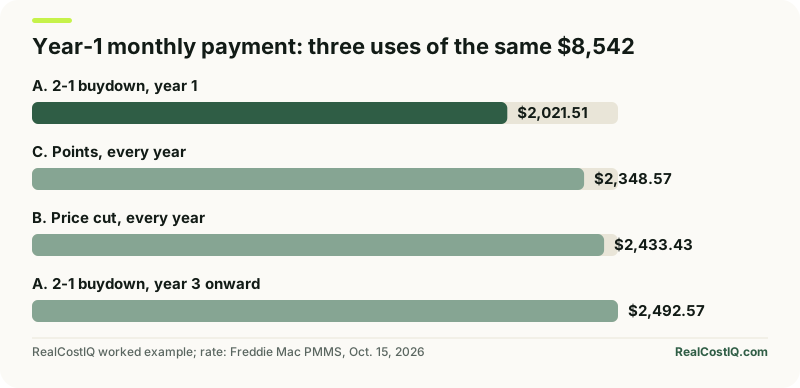
The 2-1 buydown costs $8,541.63 at that rate: $5,652.68 for year 1 and $2,888.95 for year 2. Each option uses that exact amount. A is the 2-1 buydown. B takes it off the price, so the loan falls to $351,458 with the same $40,000 down. C spends it on permanent points. That is 2.37 points on the $360,000 loan. I assumed each point cuts the rate by 0.25%, which gives 6.81%. That rate cut is an assumption. Your Loan Estimate shows the real price of a point.
| A. 2-1 buydown | B. Same dollars off the price | C. Same dollars as points | |
|---|---|---|---|
| Loan and rate | $360,000 at 7.40% | $351,458 at 7.40% | $360,000 at 6.81% |
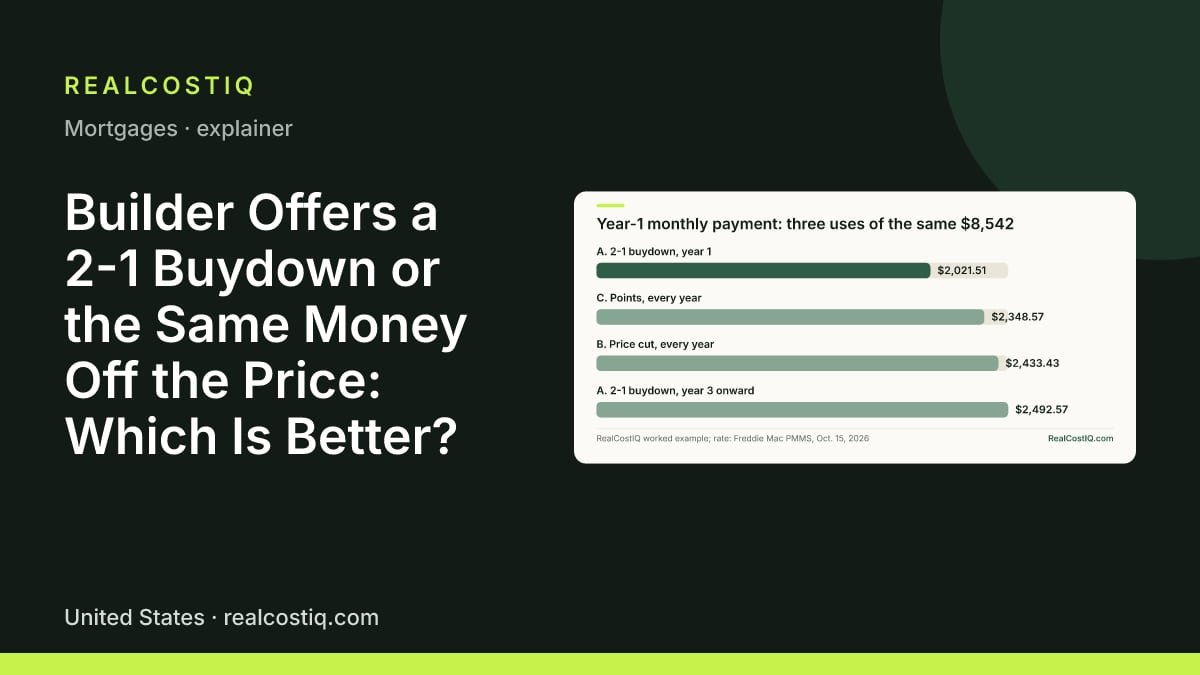
| Payment, year 1 | $2,021.51 | $2,433.43 | $2,348.57 |
| Payment, year 2 | $2,251.82 | $2,433.43 | $2,348.57 |
| Payment, year 3 onward | $2,492.57 | $2,433.43 | $2,348.57 |
Computed 2026-10-21 with the same payment formula as the site's mortgage calculator. Principal and interest only. In A, the escrow pays the gap, so the loan balance follows the 7.40% schedule.
The buydown wins the first two years on cash flow. Its year-1 payment is $411.92 below the price-cut payment. In year 3 it flips. The buydown payment is then $59.14 above the price-cut payment, and it stays there. Cash flow is only half the picture, so the next table adds up everything paid.
| If you sell or refinance at | A. 2-1 buydown | B. Price cut | C. Points | Best |
|---|---|---|---|---|
| Month 12 (unused year-2 subsidy applied to the payoff) | $377,985 | $377,356 | $384,388 | B, by $629 |
| Year 2 | $404,253 | $403,000 | $408,509 | B, by $1,253 |
| Year 5 | $481,295 | $478,215 | $479,079 | B, by $864 over points ($3,081 over the buydown) |
| Year 10 | $602,336 | $596,384 | $589,335 | C, by $7,049 |
Total = principal and interest paid to that point plus the balance owed. The $40,000 down payment is the same in every column and is left out. Taxes, insurance and closing costs are left out. The month-12 row assumes the $2,888.95 of unused year-2 funds goes toward the payoff, as VA and FHA describe. Fannie Mae leaves it to the agreement.
Why the price cut beats the buydown on total cost
A price cut removes $8,542 of debt on day one. You stop paying interest on it for the life of the loan. The buydown returns the same dollars to you over 24 months, and you keep paying interest on the full loan. That is why B is ahead at months 12 and 24 and at year 5 in the totals above. The points option is slower. It costs the most in the early months and pays back later. It pulls ahead of the price cut at about month 67. By year 10 it leads the price cut by $7,049 and the buydown by $13,001. If you expect to sell or refinance in five years or less, points are the weakest use.
When the buydown is still the right pick
- You need the lowest payment now. The buydown is $411.92 a month below the price cut in year 1. If you are moving in, buying furniture or paying a second rent, that cash has value.
- The builder will not cut the price. Some builders will not change a listed price. If the only choices are a buydown or nothing, the buydown still returns $8,542 of value.
- Your income will rise. The year-3 payment is $2,492.57. If a raise or a second income is certain, the step is easier to carry.
- A price cut would not fit the appraisal. If the appraised value is below the new price, a cut could pull the value below what the loan needs. Ask the lender.
What the price cut does that the buydown cannot
A lender qualifies you on the note-rate payment, with or without a buydown. Fannie Mae's guide says the lender must qualify the borrower "based on the note rate without consideration of the bought-down rate" (B2-1.4-04, 08/07/2024, read 2026-10-21). So a buydown does not help you qualify. A price cut lowers the payment that is tested. In some places it can also lower the property tax bill, since assessments can follow the price paid. If your debt-to-income ratio is tight, the price cut helps and the buydown does not. You can test that in the DTI calculator.
If you refinance or sell in year 1 or 2
This is the case that worries most buyers. If you refinance before the escrow is used up, the unused money does not come back to you as cash under VA or FHA rules. VA's page says "Any remaining funds in the temporary buydown account must be applied to the outstanding indebtedness" and cannot be returned to the party that funded them (updated 01/14/2026, read 2026-10-21). Fannie Mae says buydown funds are "not refundable unless the mortgage is paid off before all the funds have been applied," and the agreement may send them back to the borrower or the lender. In the month-12 row above, the unused $2,888.95 goes to the payoff, and the price cut still comes out $629 ahead. If you plan to refinance when rates fall, the price cut is the safer pick. Ask for the agreement's wording before you sign.
Questions to put to the builder
- Are the dollars equal? Ask the builder for the exact cost of the 2-1 and the exact price cut. The cost should match the sum of the payment gaps, as in the table above.
- Is the note rate the same in both offers? If the buydown loan has a higher note rate, option A loses more than shown here.
- Does the price cut change the appraisal or the loan type? Ask the lender before you choose.
- What does the agreement say about unused funds?
How a temporary buydown works, in short
Someone, usually a seller or builder, deposits money in escrow at closing. That account tops up your payment so you pay as if the rate were lower. A 1-0 buydown cuts the rate one point in year 1. A 2-1 cuts it two points in year 1 and one point in year 2. A 3-2-1 cuts it three, two and one points over three years. The mortgage note does not change. You owe the full note-rate payment, and the escrow covers the gap month by month (Fannie Mae B2-1.4-04). Fannie Mae requires the account to be fully funded before the lender delivers the loan, and held apart from the lender's funds.
The payment tables below use a different loan: $360,000 at a 6.50% note rate, an example set up on 2026-10-10. They show the pattern of the steps. The rates differ from the 7.40% comparison above, so do not mix the two sets of dollars. In both, the lender qualifies you at the full note-rate payment, and the buydown does not raise how much you can borrow.
Mechanics example: the payment table at 6.50%
Hypothetical inputs, not a quote. A $400,000 purchase with $40,000 down gives a $360,000 loan. The note rate is 6.50 percent on a 30-year fixed term. Each reduced payment is an ordinary amortizing payment (one that pays the loan off over the full term) on the original loan amount and the original 30-year term at the reduced rate, with no recast. That is how VA's own example works. VA's page shows a 2-1 buydown on a loan at a 5 percent note rate, with year-1 payments at 3 percent and year-2 payments at 4 percent. VA's page does not state the loan amount, and $300,000 reproduces its figures. Figures are principal and interest only. They come from the amortization formula in the site's mortgage engine (the temporary buydown calculator returns the same subsidies for this loan). Taxes, insurance and mortgage insurance are the same with or without a buydown, so they are excluded.
| Year | No buydown | 1-0 buydown | 2-1 buydown | 3-2-1 buydown |
|---|---|---|---|---|
| Year 1 rate | 6.50% | 5.50% | 4.50% | 3.50% |
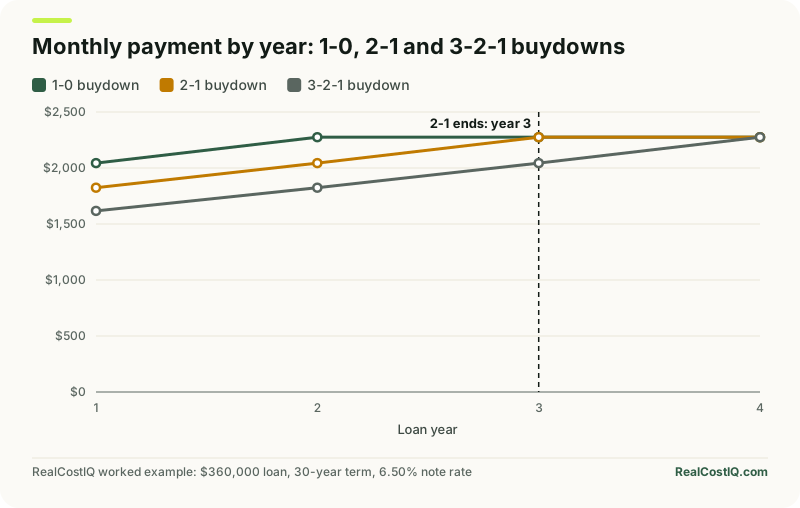
| Year 1 payment | $2,275.44 | $2,044.04 | $1,824.07 | $1,616.56 |
| Year 2 rate | 6.50% | 6.50% | 5.50% | 4.50% |
| Year 2 payment | $2,275.44 | $2,275.44 | $2,044.04 | $1,824.07 |
| Year 3 rate | 6.50% | 6.50% | 6.50% | 5.50% |
| Year 3 payment | $2,275.44 | $2,275.44 | $2,275.44 | $2,044.04 |
| Year 4 onward | $2,275.44 | $2,275.44 | $2,275.44 | $2,275.44 |
Computed with the site's mortgage engine: payment = P x r(1+r)^n / ((1+r)^n - 1) with P = $360,000, n = 360, r = annual rate / 12. Check against VA's example: the same method on a $300,000 loan at 5.00 / 3.00 / 4.00 percent gives $1,610.46, $1,264.81 and $1,432.25, matching the $1,610, $1,265 and $1,432 on VA's page to the dollar.
The subsidy cost is the sum of the differences
What the escrow must hold is not a guess. It is the difference between the note-rate payment and the reduced payment, added up over the buydown period. This is the number a seller or builder is actually paying.
| Buydown | Monthly saving, year 1 | Monthly saving, year 2 | Monthly saving, year 3 | Total subsidy | As % of loan | As % of $400,000 price |
|---|---|---|---|---|---|---|
| 1-0 | $231.40 | none | none | $2,776.85 | 0.77% | 0.69% |
| 2-1 | $451.38 | $231.40 | none | $8,193.39 | 2.28% | 2.05% |
| 3-2-1 | $658.88 | $451.38 | $231.40 | $16,100.00 | 4.47% | 4.03% |
Totals use unrounded monthly differences ($451.3778 and $231.4045): $5,416.53 + $2,776.85 = $8,193.39. Using payments rounded to the cent first, the sum is $8,193.24. Any quoted subsidy that is far from these figures for the same loan and rates is worth asking about.
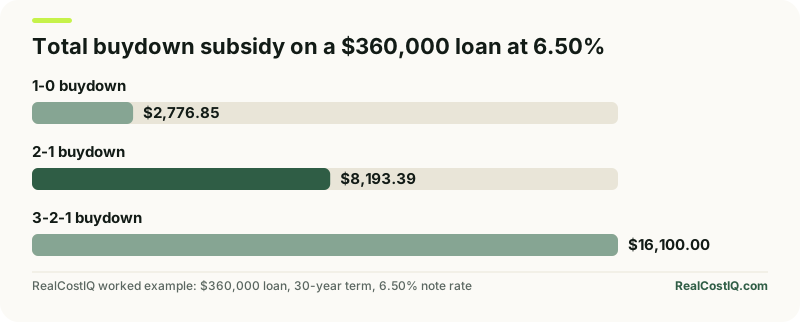
The buyer's cumulative saving equals the subsidy, by construction. The buydown does not create value. It moves $8,193 of someone's money into the buyer's first 24 payments. Whether that is a good use of the seller's concession is a negotiation question. The same $8,193 could instead have been a credit toward closing costs or a lower price. A permanent rate reduction is the other use of that money. The CFPB describes points as paying more at closing for a lower interest rate. The points break-even calculator shows the break-even for that alternative, using the actual quoted price of a point. This post does not restate it.
What happens in year 3
On the 2-1 above, the payment steps up twice. It goes from $1,824.07 to $2,044.04 at the start of year 2. It goes from $2,044.04 to $2,275.44 at the start of year 3. From the first year to the third, the payment rises by $451.38, a 24.7 percent increase. It stays there for the remaining 28 years. Two points about that step.
- It is built into the schedule, not caused by a rate adjustment. The rate on the loan never changed. Only the part of the payment the escrow covers shrinks. Fannie Mae's guide caps the borrower's portion at a rise of no more than 1 percent in each 1-year interval, and VA's page says the same. So a 2-1 and a 3-2-1 are the standard shapes.
- The step is the reason to ask about income, not the rate. The buydown assumes your budget can carry the year-3 payment. The underwriting already tested the full payment against your income. If your income is expected to rise by year 3, the step is easier. If it is not, a buydown has delayed the payment, not removed it. A refinance in the first two years is not a reliable way out. At closing, you do not know what a refinance will cost. You also do not know whether a better rate will be available when you want it.
The programs differ on what happens to the unspent money if you pay off or sell early. This matters because buyers often plan to move or refinance.
| Program | Early payoff, sale or refinance | Source |
|---|---|---|
| Fannie Mae | Funds are refundable only if the loan is paid off before they are fully applied. The agreement may return unused funds to the borrower or, if the lender funded the buydown, to the lender. In a foreclosure they reduce the mortgage debt. If the home is sold and the loan assumed, they may continue reducing payments. | Selling Guide B2-1.4-04 (08/07/2024) |
| FHA | The escrow agreement must not allow undistributed funds to revert to the provider if the property is sold or the mortgage is prepaid in full, and must not give leftover funds to the borrower in cash unless the borrower's own funds set up the escrow. | HUD Handbook 4000.1, II.A.6.a.ix (Update 18, 08/12/2026) |
| VA | Funds must be held in a separate escrow account, cannot be returned to the party who funded them, and if the loan is paid off or the home is foreclosed on or sold short, the remaining funds go toward the outstanding debt. If another party assumes the loan, remaining funds may be applied only to payments under the buydown agreement. | VA Home Loans, Temporary Buydowns (updated 01/14/2026) |
| Freddie Mac | The product page read does not address who funds, escrow or disposition. Those details sit in the Seller/Servicer Guide, which was not opened. | Freddie Mac Single-Family, Mortgages with Temporary Subsidy Buydown Plans |
So an early payoff does not generally hand the buyer the unused subsidy under FHA or VA. Under Fannie Mae, it depends on the buydown agreement. Suppose you plan to sell or refinance within two years. Ask what the agreement says about unused funds before you rely on the buydown as a refinance-friendly feature.
Who may pay, and how much the rules allow
The payer matters because the money counts against a cap on what interested parties may contribute. An interested party is anyone with a stake in the sale, such as the seller or builder. The caps differ by program. The buydown shares them with every other seller-paid cost.
| Program | Who may fund it | Limit that applies | Source |
|---|---|---|---|
| Fannie Mae | The party providing the funds, under a written agreement with the borrower (Fannie Mae does not list permitted sources). If the source is an interested party, the interested-party contribution limits apply. If the lender funds it, the funds must transfer to a new servicer. | Interested-party contributions are capped by loan-to-value for a principal residence or second home: 3% above 90% LTV/CLTV, 6% from 75.01% to 90%, 9% at 75% or less. Investment property: 2%. Amounts above the limit are sales concessions and reduce the price used for the loan. | B2-1.4-04; B3-4.1-02 (05/07/2025) |
| FHA | The handbook's interested-party rules cover sellers, real estate agents, builders, developers, mortgagees and other parties with an interest in the transaction. | Interested parties may contribute up to 6% of the sales price toward closing costs and prepaids, and the 6% includes interested-party payment for permanent and temporary buydowns. | HUD Handbook 4000.1, II.A.4 (Update 18) |
| VA | The page says seller, lender, builder or Veteran. | Buydowns from the builder or seller are seller concessions, capped at 4% of the reasonable value. | VA Temporary Buydowns page |
| Freddie Mac | Not stated on the page read. | Maximum rate reduction of three points below the note rate; term no more than three years after the first scheduled payment date. Contribution limits sit elsewhere in the Guide and were not read. | Freddie Mac product page |
These caps are why the choice between a 2-1 and a 3-2-1 is not only about taste. In the example, a 3-2-1 subsidy is $16,100, or 4.03 percent of a $400,000 price. That exceeds VA's 4 percent seller-concession cap if the reasonable value equals the price (VA applies the cap to reasonable value). It fits under FHA's 6 percent only if no other seller-paid costs use the room. Now take a buyer financing 95 percent of the price. The same buydown scales with the larger loan to about $16,994. That is above the $12,000 that Fannie Mae's 3 percent cap would allow on a $400,000 price. A 2-1 on that larger loan costs about $8,649. That is comfortably under the cap, but it shares the room with every other seller-paid item.
Which loans and borrowers can use one
- Fannie Mae. Fixed-rate mortgages and certain ARM (adjustable-rate mortgage) plans on principal residences and second homes. Investor properties and cash-out refinances are ineligible. The reduction may not exceed 3 percent. The borrower's rate may rise no more than 1 percent per year. The period may not exceed 3 years. Fannie Mae classes a buydown as moderate if the reduction is 2 percentage points or less and the period is 2 years or less. Otherwise it is significant. A 1-0 and a 2-1 are moderate. A 3-2-1 is significant, and significant buydowns face a cap on how many loans can be pooled.
- Freddie Mac. Primary residences of one to four units and one-unit second homes, on fixed-rate loans and several ARMs. There are fewer ARM options for 3- to 4-unit homes, and no buydowns on Home Possible 3- to 4-unit loans. The ineligible list includes 3/6-month ARMs, cash-out refinances, investment properties and certain no-cash-out refinances funded by a lender credit from a rate increase. The initial rate may not be more than three points below the note rate. The plan may not run past three years after the first payment date.
- FHA. The handbook says temporary buydowns are not permitted with refinance transactions and not permitted with ARM transactions. It also bars temporary and permanent buydowns on HECM (FHA reverse mortgage) for purchase loans. For a standard forward purchase mortgage, the escrow rules and the 6 percent interested-party limit apply.
- VA. The page says temporary buydowns can be applied to all fixed-rate VA home loans, including purchases, cash-out refinances and IRRRLs (VA streamline refinances), if they meet VA requirements. Lenders must give a clear written explanation of the buydown agreement. It must include the property address, length and amount, the payment rates, the original rate and who holds the funds.
What to confirm before you agree to one
- The note rate and the full payment. Ask for the year-3 payment in writing, with taxes and insurance. That is the payment you must be able to carry.
- The subsidy amount, and how it was computed. It should equal the sum of the payment differences, as in the table above. A figure far from it needs an explanation.
- Where the money is counted. Ask which cap applies and how much room the buydown leaves for other seller-paid costs. A buydown that uses the whole allowance leaves nothing for a closing-cost credit.
- What the escrow agreement says about unused funds. Early payoff, sale and refinance are treated differently by the programs above.
- Whether a permanent reduction would cost the same money. The points break-even calculator answers this with the price of a point from your actual Loan Estimate. The right answer depends on how long you keep the loan. No one knows that at closing.
- Whether the price already reflects the concession. Ask whether the price or other terms changed when the buydown was offered. The guide to buying a house without a realtor covers how builder incentives show up in a negotiation.
What this post did not verify
I could not open Freddie Mac's Seller/Servicer Guide text for temporary buydowns (Section 4204.3 and related). So the Freddie Mac rows rest on its product page, which is silent on funding, escrow and contribution limits. The VA rules come from the VA Home Loans temporary-buydown page. It points to Chapter 7, Section 7 of the Lenders Handbook for detail, and I did not read the Handbook itself. The CFPB page on points and credits does not mention buydowns or seller credits. So it supports only the description of permanent points. I used no lender's actual price for a point, no market rate and no state rule. The 2-1 and 3-2-1 amounts are arithmetic on hypothetical inputs and are not an offer.
Putting it together
A temporary buydown is prepaid payment relief. At today's 7.40% average rate, the same $8,542 off the price beat a 2-1 buydown through year 5, and points won only after about month 67. The buydown wins on early cash flow. In the 6.50% mechanics example, a 2-1 costs the payer about $8,193. It saves the buyer $451 a month in year 1 and $231 in year 2. Then the payment returns to $2,275 for the rest of the term. The loan is qualified at that full payment. The money must be in escrow at closing. The program caps decide how much of it the seller or builder may pay. Compare it with the same dollars as a closing credit, a price cut or permanent points. And make sure the year-3 payment fits.