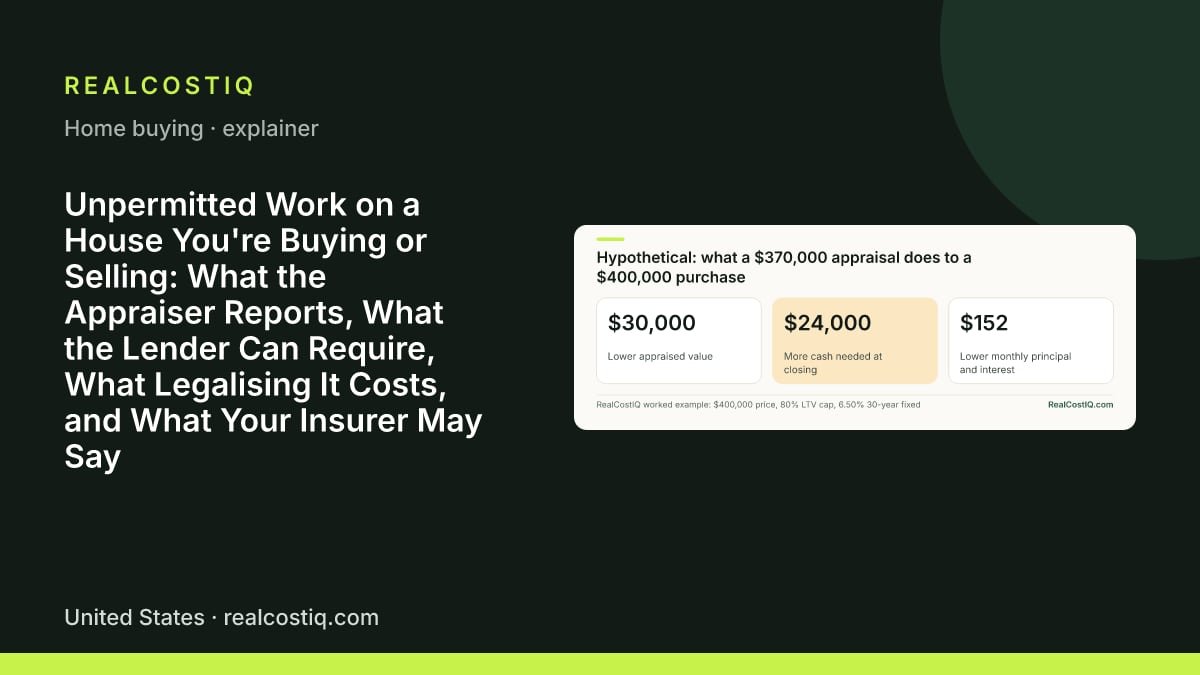
Most advice about unpermitted work assumes a rule that does not exist: that a lender will refuse the loan, or that an appraiser must ignore the space. The real text is narrower and stranger. This post reads what Fannie Mae, FHA and Freddie Mac actually write (all read on 2026-10-13). It separates a missing permit from a different question: whether the use is legal under zoning. It shows what a lower appraisal does to a purchase, using named inputs. It also explains how cities price a retroactive permit, using two places' published rules as examples. It names no national legalisation cost. No primary source gives one, because each city sets its own fee.
What the appraiser must report: a comment, not a verdict
Fannie Mae's Selling Guide, section B4-1.3-05 (the page I read carries a 06/04/2025 date), has a short subsection headed “Additions without Permits.” It is one sentence long. When an appraiser finds an addition that lacks the required permit, the appraiser must comment on the quality and appearance of the work. The appraiser must also comment on its impact, if any, on the property's market value. That is the whole instruction. The subsection does not say the space must be left out of the square footage. It does not say the loan is ineligible. It does not tell the lender to do anything. I read the rest of the page and found no lender-level permit rule on it.
Two things follow. First, a missing permit is a fact about the property that the appraiser reports on, much like a dated kitchen. The effect runs through value. It is not a pass/fail eligibility gate. Second, the word “required” does the work. The appraiser comments on work that needed a permit and did not get one. So someone has to know or suspect that. Usually the appraiser compares what they see with public records, or the buyer or seller tells them.
FHA's handbook is more specific about what counts as living area. It does not mention permits at all. In HUD Handbook 4000.1 (Update 18, issued August 12, 2026), the appraiser counts a room addition or garage conversion as part of gross living area only if three things are true. The space can be reached from inside the main dwelling in a functional way. It has a permanent and sufficient heat source. It was built in keeping with the design, appeal and quality of the main dwelling. Space that fails those tests goes on a separate line in the sales comparison grid, outside gross living area. The appraiser must also address how inferior-quality conversions and additions affect marketability and contributory value, if any.
Read together, the two guides describe the same mechanism from different ends. The test for crediting finished space is physical and functional: access, heat, quality and market reaction. A permit is evidence that the work was inspected. An inspected build is more likely to pass those tests. But neither guide makes the permit itself the test. That is why two houses with identical unpermitted basements can appraise differently. One has comparable sales with similar finished space, a good heat source and a proper stair. The other has a basement reached by a ladder-steep stair, with space heaters. The appraiser is judging how usable the space is and what the local market pays for it.
What neither guide settles
- Whether a given unpermitted space is counted. Fannie Mae asks for a comment on value impact. FHA sets conditions for gross living area. Neither says unpermitted space is automatically left out or automatically credited.
- How a lender reacts to the appraiser's comment. Fannie Mae's section is silent on lender action. Individual lenders may add their own rules, and these guides do not publish them. Ask for the lender's position in writing.
- Whether anything has to be legalised before closing. Nothing in the sections read here requires it. That is for buyer and seller to negotiate, and sometimes it is a lender condition.
Where a lender can actually say no: zoning legality, not the permit file
The sharper eligibility language in all three guides is about zoning. A missing permit and an illegal use are different problems. Mixing them up is the most common mistake in buyer forums. A basement bedroom without a permit may be a use that zoning allows. That is a paperwork gap a city can close. A second kitchen that turns a single-family house into an unapproved two-unit property is different. Zoning may not allow that use at all, and no permit fee fixes it.
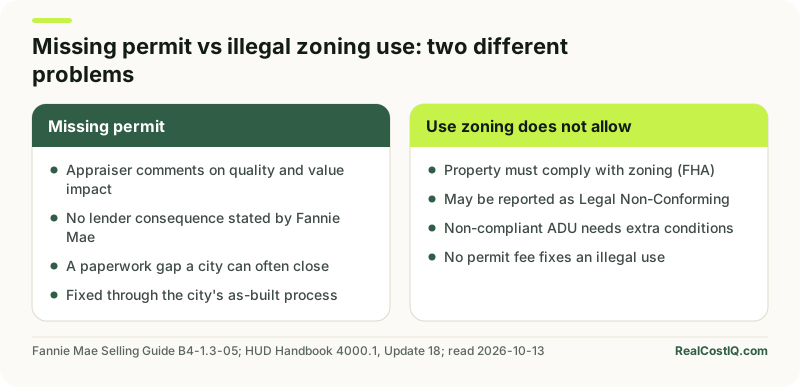
FHA states the standard directly. The property must comply with all applicable zoning ordinances, and the appraiser must decide whether the current use does. Suppose the property does not comply but the local zoning authority accepts it. Then the appraiser reports it as “Legal Non-Conforming” and explains briefly. The appraiser also analyses any adverse effect on value and marketability, and states whether the property may be legally rebuilt if destroyed. That last question matters most for a buyer's long-term risk. A legal non-conforming structure that cannot be rebuilt after a fire is worth less than one that can.
Fannie Mae handles the ADU version of this problem in the same section. An ADU is an accessory dwelling unit, such as a basement apartment or a backyard cottage. The unit is assessed for whether it can be legally rented. That affects whether the property counts as one unit with an ADU or as a two- to four-unit property. Suppose the ADU is not allowed under zoning. The property may still be eligible under added conditions. The appraisal states that the improvements are a use that does not comply with zoning. The lender confirms the unit's existence will not jeopardize any future property insurance claim. And the report includes at least three comparable sales in total, at least two of which share the same non-compliant zoning use. Freddie Mac's single-family ADU page sets the baseline for one-to-three unit properties. An ADU must be legally permissible by jurisdiction, legal non-conforming, or in an area without zoning. There is an exception for an ADU on a one-unit property with illegal zoning, and it points to Guide section 5601.2(c). The page does not list those criteria. It does not mention permits.
| Source | Missing permit | Zoning legality |
|---|---|---|
| Fannie Mae Selling Guide B4-1.3-05 | Appraiser comments on quality, appearance and any effect on market value. No lender consequence stated. | ADU not allowed under zoning is eligible only with extra conditions: appraisal says so, lender confirms insurance claims will not be jeopardized, three comparable sales with two sharing the non-compliant use. |
| HUD Handbook 4000.1, Update 18 | Not addressed as a permit question; additions count as living area only if accessible, heated and built in keeping with the house. | Property must comply with zoning. Non-complying but accepted use is reported as Legal Non-Conforming, with value effect and rebuild-if-destroyed status. |
| Freddie Mac single-family ADU page | Not mentioned on the page. | ADU must be legally permissible, legal non-conforming, or in an unzoned area; a one-unit exception points to Guide section 5601.2(c), whose criteria the page does not list. |
Paraphrased from the pages as read. Freddie Mac's Guide sections themselves did not render in the tool used, so only the ADU page is cited for Freddie Mac. Lenders can apply stricter overlays than any of these.
What a lower appraisal does to a purchase: a worked example
When an appraiser does not credit finished space, the usual result is a lower appraised value. A lower value changes the loan and the cash needed at closing. The CFPB lists “the home was appraised at less than the sales price” as a reason a lender may send a revised Loan Estimate. It tells borrowers to ask how the change affects loan amount, interest rate, monthly payment and cash needed at closing. The example below uses the same site mortgage engine as the mortgage calculator. It is hypothetical. The price, the rate, the appraisal and the lender's 80 percent loan-to-value cap are all assumptions. Loan-to-value (LTV) is the loan divided by the home's value. Confirm the lender's real rule with the lender.
| Scenario | Value used | Loan (80%) | Cash down | Monthly principal and interest |
|---|---|---|---|---|
| Appraisal supports the price | $400,000 | $320,000 | $80,000 | $2,023 |
| Appraisal $370,000 (finished space not credited) | $370,000 | $296,000 | $104,000 | $1,871 |
| Difference | $30,000 | $24,000 less | $24,000 more | $152 less |
Computed with calculateMortgage at 6.50% over 30 years; principal and interest only, no taxes, insurance or mortgage insurance. The lesser-of-price-and-appraisal sizing is an assumption of the example, not a statement of any one lender's policy. If the buyer keeps paying $400,000, the extra $24,000 is cash.
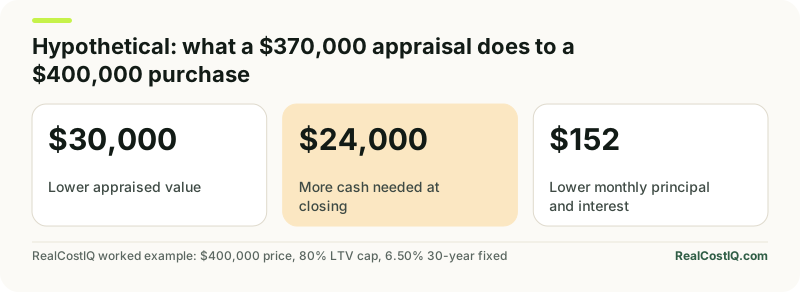
The lower payment is not good news. It reflects a smaller loan, and the buyer must replace the gap with cash. Most buyers in this spot choose among three moves: bring the extra cash, renegotiate the price, or walk away if the contract has an appraisal contingency. For a seller, the example reads in reverse. A house with a finished basement that cannot be credited sells at the price the comparable sales support. The gap comes out of the seller's net, or it kills the deal. Neither side can know the number in advance. So the cheapest protection is to ask early how the appraiser is likely to treat the space, through the agent or the lender, rather than at the end.
What legalising costs: a rule set by each city, shown through two examples
There is no national retroactive-permit fee, and this post will not invent one. The primary sources show a structure that repeats from place to place. There is a standard permit fee. There is an extra charge because the work started without a permit. And there is the cost of proving what is behind the walls. Two published examples show the shape.
Larimer County, Colorado, runs an as-built process for work done without a permit or without required inspections. This includes additions, alterations and basements finished without a permit. Code Compliance may schedule a life-safety inspection before an application, to decide whether urgent corrections are needed. Concealed construction must be exposed and fully inspected before the county will issue a regular certificate of occupancy or letter of completion. Plumbing and heating may need review by independent licensed professionals. Structural and foundation work may need evaluation by a Colorado-licensed engineer. If everything is approved, the county issues an “As-Built Certificate of Observable Compliance.” On fees, the county's page says an investigation fee may be collected in addition to the permit fee when work started without a permit. It is set at the building fee amount. It may be waived if a previous owner completed the work. A code compliance administrative fee applies to all as-built building permits. The page lists no dollar amounts. The fee schedules are linked separately.
Minnesota shows the same idea at the state-rule level. Minnesota Rule 1300.0160, subpart 8, says that when work requiring a permit starts without one, a special investigation must be made before a permit can be issued. The municipality sets an investigation fee. It is collected whether or not a permit is ultimately issued, and it is charged in addition to the regular permit fees. The rule caps it: it may not exceed the permit fee. The permit fee itself comes from the municipality's adopted schedule under subpart 1. So the statewide rule sets a ceiling of twice the ordinary fee for the fee part. A city may charge less or waive it.
What this means for a buyer or seller pricing the fix
- Get the jurisdiction's own fee schedule. Search the building department's schedule for “investigation fee,” “work without permit” or “as-built.” Treat any figure on a consumer website as unverified until it matches that schedule.
- Ask whether a prior-owner waiver exists. Larimer County's page says the investigation fee may be waived where a previous owner did the work. A buyer who learns of the work after purchase is in a different position from the person who did it. A seller who did the work is not.
- Budget for the proof, not just the fee. Opening walls so inspectors can see wiring, plumbing and framing can cost more than the fee. So can paying a licensed professional or engineer to document the work. The sources read describe the steps but do not price them, so get quotes. The home renovation cost calculator prices the repair and finish work that follows if inspection finds something to correct.
- Know that legalising can mean redoing. The as-built process checks work against code. Work that fails may have to be corrected. A space that cannot meet code or zoning (for example, a bedroom without a legal exit) may not be legalisable as built.
For a specific finished-basement case, the site's basement finishing cost calculator already covers the permit line items and how appraisers treat unpermitted finished space. This post does not restate them.
What your insurer may say: the gap in the public record
I looked for a state insurance regulator or National Association of Insurance Commissioners (NAIC) page that states how insurers treat unpermitted work. I did not find one that loaded and said so. What came back was trade-press, forum and broker material, which is not a source here. The honest position is this. The policy wording and the insurer's underwriting and claims practice set the treatment. Both differ by company and state. Neither is published in the sources read.
Two documented facts are still useful. First, Fannie Mae's own conditions for a non-compliant ADU include the lender confirming that the unit's existence will not jeopardize any future property insurance claim. That tells you the secondary market treats insurance claim risk as a real consequence of non-compliant space. It expects the lender to check it. Second, building-code upgrade coverage exists and is regulated in at least one large state. This coverage pays the extra cost of rebuilding to current codes after a covered loss. California Insurance Code section 10103 requires that an open residential policy with replacement cost coverage include building code upgrade coverage of at least 10 percent of the dwelling limit. It is additional coverage that does not reduce the dwelling limit. The declarations must state the limit. They must carry a specific warning if the policy lacks the coverage. The statute does not say how an insurer treats work that was never permitted, and this post does not claim it does.
A buyer or seller can do three things with that. Read the policy's conditions and exclusions on alterations. Ask the agent in writing whether unpermitted improvements affect coverage or underwriting. And get the answer before closing, not after a loss. The cost of insuring the home at all is covered by the home insurance cost calculator inputs, not by anything in this post. You can test the closing-cost side of any negotiated credit or legalisation holdback (money held back at closing to pay for the fix) in the closing costs calculator.
The contrast case: renovation loans require the permits
If you are financing the fix, the rules change. This kind of FHA renovation loan rolls repair costs into the mortgage. In HUD Handbook 4000.1, a 203(k) mortgagee (the lender) may release draw funds (repair money paid out in stages) only when repairs and improvements meet all federal, state and local laws, codes and ordinances. That includes any required permits and inspections. The consultant's draw request form also requires that repairs meet local codes and ordinances, including required permits and inspections. So an unpermitted addition and a 203(k) repair are treated in opposite ways. The appraiser comments on the first. The second cannot be paid for without the paperwork. A buyer who plans to finish or legalise a house with a renovation loan should assume permits are part of the job, not an afterthought.
Practical sequence for each side
If you are selling
- Inventory what changed since you bought. Finished basement, converted garage, added bath, moved walls, new circuits, deck. Compare it to the permit history at the building department, which is often searchable by address.
- Decide before listing whether to legalise, credit or disclose. Legalising takes time and can surface problems. A price cut or credit shifts the fix to the buyer. Disclosure rules vary by state and are not covered by the sources read. Ask a licensed agent or attorney what your state requires you to disclose.
- Do not describe unpermitted space as bedrooms or finished square feet in the listing without checking. The appraiser reports on what the space is and whether it meets the access, heat and quality tests. A listing that overstates it invites a low appraisal and a collapsed contract.
If you are buying
- Ask for the permit history during the inspection period. A missing line in the permit record for finished space is the signal. Ask the seller directly about work done and by whom.
- Ask the lender whether it applies any overlay (a rule stricter than the agency's) to unpermitted additions or to non-compliant units, and ask the agent to raise the finished space with the appraiser. Write the answers down.
- Price the three outcomes separately: the appraisal gap in cash (the example above); the legalisation cost from the city's own schedule, plus proof and corrections; and the risk that the space cannot be legalised at all. Decide which one you would absorb.
- Keep the contract protections in view. An appraisal contingency and an inspection contingency exist to cover exactly this. Their wording and deadlines are in your contract, not in this post.
What could not be verified, and why it matters
The gaps are part of the answer. Freddie Mac's Selling Guide sections are served by a page that did not render in the tool used. So I read no Freddie Mac text on unpermitted additions. I read only its ADU page. The HUD handbook text read is the Update 18 PDF. The passages cited are the zoning, additions and 203(k) rules. I found no dedicated unpermitted-additions rule in it. No state insurance regulator page on unpermitted work was located. No source read gives a national cost for legalising work, and two local examples do not make one. Any of these may change. The Fannie Mae section and the HUD handbook are revised several times a year. Confirm the current text if a transaction depends on it.