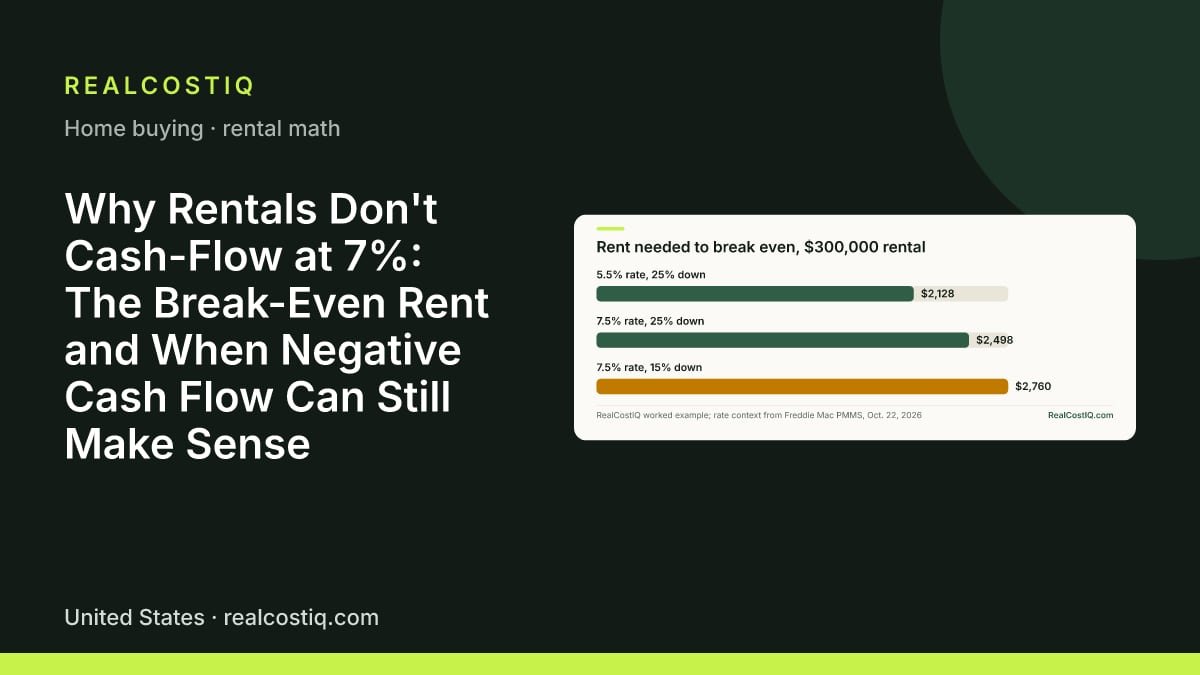
A rental that made money at a 5.5 percent loan rate can lose money at 7.5 percent. The house is the same. The tenant is the same. Only the bank payment changed. This post puts numbers on that change for one $300,000 house, finds the exact rent that makes the monthly result zero, and then asks a harder question: when is a monthly loss still a smart buy?
It is a stress test, not a forecast. It does not teach you how to rate a deal from scratch (the guide on how to analyze a rental property does that), and it does not cover cap rate, lender income tests or income tax. It stays on one question: what rent do I need, and what do I give up if I do not get it?
The rate today and what investors pay
Freddie Mac, the government-backed mortgage buyer, reported an average 30-year fixed rate of 7.32 percent for the week of October 22, 2026. A year earlier the same survey showed 6.19 percent (Freddie Mac, Primary Mortgage Market Survey). So the loan on a typical home has become more expensive by about 1.1 points in a year.
That survey is for homes you will live in. A loan on a rental usually costs more. A LendingTree guide, last updated August 7, 2026, says investors generally pay a half point to a full point above the rate on a primary home (LendingTree, investment property mortgage rates). It also lists a minimum down payment of 15 percent to 25 percent for these loans from Fannie Mae and Freddie Mac. In plain terms, the lender wants more cash from you and charges more for the money it lends.
This post uses 7.5 percent as the stress rate and 5.5 percent as the comparison. Treat 7.5 as a round number, not a quote. If the investor premium applies to today's average, a real offer could land near 7.8 to 8.3 percent. We show what that does to the break-even a little later. Your own rate depends on your credit score, the size of your down payment and the lender. Get written quotes before you trust any of these numbers.
The test house and its monthly bills
Here is the house. It costs $300,000. It rents for $2,300 a month. That is about 0.77 percent of the price. Closing costs are 3 percent of the price, or $9,000. The loan is a 30-year fixed loan. You manage the house yourself, so there is no management fee. We add that fee later.
Yearly property tax is $3,300 (1.1 percent of the price) and insurance is $1,800. Those two are round placeholders. Your county and your insurer will decide the real ones, and they vary a lot by state. We also set aside money for three things that do not show up as a bill every month but always show up in the end.
- Vacancy: 7 percent of rent. This is the share of the year the house sits empty between tenants. The Census Bureau reports a national rental vacancy rate of 7.3 percent for the second quarter of 2026 (FRED, Rental Vacancy Rate, Census Bureau data, updated July 28, 2026). Your street may be better or worse than the nation.
- Repairs: 8 percent of rent. A lender that finances rental homes, CoreVest, uses 8 percent of rent as its example for a repair budget and says the right number depends on age, condition and how often tenants move (CoreVest Finance, maintenance and capital expenditure budgeting).
- Big-ticket replacements: 5 percent of rent. This is for roofs, furnaces, water heaters and floors. The same CoreVest page does not give a percent here. It tells you to divide each part's replacement cost by its remaining life. We use 5 percent of rent as a simple stand-in. An old house needs more.
Together those three take 20 percent of the rent before you pay a single bill. That is $460 a month on $2,300 of rent. Now add the loan payment, tax and insurance and see where the 7.5 percent loan leaves you.
| Line | Per month | How it is found |
|---|---|---|
| Rent coming in | $2,300 | Your estimate |
| Loan payment (principal and interest) | $1,573 | $225,000 over 30 years at 7.5% |
| Property tax | $275 | $3,300 a year |
| Insurance | $150 | $1,800 a year |
| Vacancy | $161 | 7% of rent |
| Repairs | $184 | 8% of rent |
| Big-ticket replacements | $115 | 5% of rent |
| Total going out | $2,458 | Sum of the lines above |
| Left over each month | -$158 | A loss of about $1,899 a year |
Hypothetical example. Tax and insurance are placeholders. Before income tax, which this post leaves out.
The house loses $158 a month. That is small enough to look harmless. Look at what it takes to fix it, though. Run the same house at 5.5 percent and the loan payment is $1,278. The month ends $137 ahead. A two-point jump in the rate moved the result by $295 a month, and it flipped the sign.
The break-even rent line
The break-even rent is the rent at which cash flow is exactly zero. It is the most useful number in this post, because you can compare it to what the house will actually rent for. It is not the same as a profit. At break-even you earn nothing in cash and you tie up tens of thousands of dollars.
Rent affects its own costs. When rent goes up, vacancy, repairs and replacements go up with it, because they are percents of rent. So every extra dollar of rent only helps you keep 80 cents. That is why the break-even rent is higher than a simple add-up of bills. We solved for it with the same 20 percent set-aside in each case.
| Loan rate | Down payment | Loan | Loan payment | Break-even rent | Break-even as % of price |
|---|---|---|---|---|---|
| 5.5% | 25% | $225,000 | $1,278 | $2,128 | 0.71% |
| 5.5% | 15% | $255,000 | $1,448 | $2,341 | 0.78% |
| 7.0% | 25% | $225,000 | $1,497 | $2,402 | 0.80% |
| 7.5% | 25% | $225,000 | $1,573 | $2,498 | 0.83% |
| 7.5% | 15% | $255,000 | $1,783 | $2,760 | 0.92% |
Self-managed. Property tax $3,300 and insurance $1,800 a year; vacancy 7%, repairs 8% and replacements 5% of rent. Hypothetical.
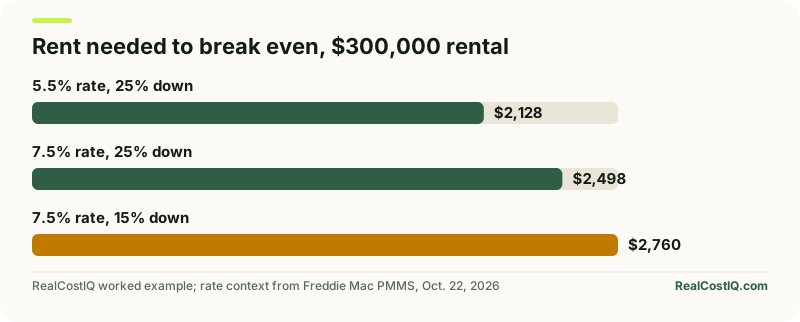
Read the first and fourth rows together. The same house, with the same 25 percent down, needs $2,498 at 7.5 percent and $2,128 at 5.5 percent. That is a gap of $370 a month in required rent, from the rate alone. Rents in most places do not jump 17 percent in a year or two. So when the rate rises, the number of houses that clear the bar falls fast.
Now read the last two rows. Putting down 15 percent instead of 25 percent leaves a bigger loan. At 7.5 percent, the bigger loan costs $210 more each month, and the break-even rent rises to $2,760. That is 0.92 percent of the price. The smaller down payment feels cheaper at the closing table. It is not cheaper in the monthly budget. We cover that trade in a later section.
What if the real rate is 8%
If the investor premium puts your quote closer to 8.0 percent, the 25-percent-down payment becomes $1,651 and the break-even rent rises to $2,595. The $2,300 rent then loses $236 a month. Each extra quarter point of rate adds about $39 a month to the payment on this loan. A small rate difference matters more on a rental than people expect, because you cannot raise the rent to cover it.
What if you hire a manager
A property manager usually charges a share of the rent. This post assumes 9 percent as a round figure, and fees vary by market and by manager. If the manager takes 9 percent of the rent you actually collect, the break-even rent in the three main cases rises to $2,377, $2,790 and $3,083. The 7.5 percent, 15 percent down case needs $3,083, which is about 1.03 percent of the price. Hiring help is a choice that moves a break-even by hundreds of dollars a month. Price it before you decide that you will "just manage it" and before you decide that you will not.
Why the 1 percent rule does not rescue you
The 1 percent rule says monthly rent should be at least 1 percent of the purchase price. On a $300,000 house that is $3,000. Many investors use it as a quick filter. You can test it on the site's 1 percent rule calculator.
Notice what the table says. At 7.5 percent and 25 percent down, break-even is 0.83 percent of the price. The rule would have you demand a rent of $3,000, which is $502 above break-even. That gap is your margin of safety, so the rule is not wrong. It is just hard to meet. A house that rents for $2,300 fails the rule by a mile, and it also loses money. A house that rents for $3,000 passes, and it earns about $400 a month at 25 percent down. The rule is a screen. Use the break-even rent to see how near you are, and use the rule to see how much room you have.
Why the down payment is a real choice
Fifteen percent down gets you into the house with less cash. On our test house, 15 percent down plus closing costs is $54,000 in cash. At 25 percent down it is $84,000. That is $30,000 saved at the closing table. But the extra $30,000 you borrow at 7.5 percent costs about $210 a month, or $2,520 a year.
Put another way, the extra loan carries a 7.5 percent cost. If you can reliably earn more than that on the $30,000 somewhere else, borrowing more makes sense on paper. If you cannot, putting more down is a safe 7.5 percent "return" that also lowers your monthly risk. Most people cannot beat 7.5 percent without risk, and they should be honest with themselves about that. This is not investment advice. It is arithmetic.
There is a second reason to be careful with low down payments. The smaller the down payment, the more the monthly loss grows. On the test house at 7.5 percent and $2,300 rent, 25 percent down loses $158 a month. Fifteen percent down loses $368 a month, or $4,416 a year. A two-person budget can absorb the first. The second makes you nervous every time a repair bill shows up.
A reminder on the loan side. Fannie Mae and Freddie Mac set the floor on down payments. Lenders may ask for more. Ask each lender for its minimum before you plan your cash.
When a monthly loss can still make sense
A negative cash flow is not the whole story, because the loan balance falls every month. In the first year of the 7.5 percent loan with 25 percent down, about $2,074 of your payments go to paying down the loan instead of to the bank's profit. That is real money. It comes back to you when you sell, as a bigger share of the sale price. So the first-year loss of $1,899 is closer to a gain of about $175 if you count the loan balance falling.
That math is why a lender on a BiggerPockets forum thread (replies from March 2026) argued to hold a rental with a shortfall, citing principal paydown, appreciation and rent growth. Others on the same thread said to sell, mostly because a condo's fees and surprise bills can make a thin margin disappear. A property manager on the thread said high-end rentals often do not cash-flow for three to five years. The thread is a good picture of the split. Nobody there claimed a loss was fine in itself. They argued about how long it would last and how much risk you can carry (BiggerPockets forum, 1st rental with negative cash flow).
To see how this plays out, we ran each case for ten years. We let rent, tax and insurance grow 3 percent a year, left the loan payment fixed, and used a 6.5 percent cost to sell. Profit below is what you would have after selling, minus the cash you put in, plus all the monthly results. It is before income tax. The house price either stays flat, rises 2 percent a year or rises 4 percent a year.
| Case | Cash put in | Price flat | Price +2% a year | Price +4% a year | First year the month is positive |
|---|---|---|---|---|---|
| 5.5% rate, 25% down | $84,000 | $52,136 | $113,564 | $186,845 | Year 1 |
| 7.5% rate, 25% down | $84,000 | $7,080 | $68,508 | $141,789 | Year 5 |
| 7.5% rate, 15% down | $54,000 | -$14,130 | $47,298 | $120,578 | Year 9 |
Starting rent $2,300; rent, tax and insurance grow 3% a year; vacancy 7%, repairs 8%, replacements 5% of rent; selling cost 6.5% of price; closing costs 3% of price. Hypothetical, not a forecast.
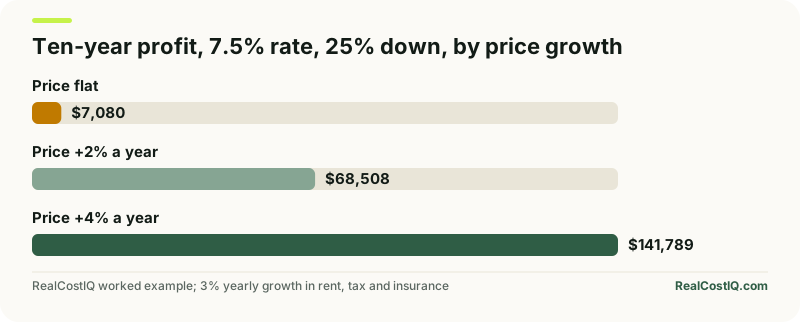
Three things stand out. First, even the stress case is not a disaster when prices rise. A house that gains 2 percent a year turns the 7.5 percent, 25 percent down deal into a $68,508 profit over ten years. Second, with flat prices the same deal earns $7,080 on $84,000 over ten years. That is less than one percent a year and you took on all the work and risk of being a landlord. Third, the 15-percent-down case loses $14,130 if prices stay flat. The extra loan and the lower cash put in made it fragile.
The lesson is plain. A negative first year is survivable when four things are true. The loss is small compared with your savings. The house is in good repair, so you are not facing a big bill soon. Rents in the area have been rising. And you could hold on if prices went flat for years. If any one of those is missing, a monthly loss is just a monthly loss.
Questions to ask before you accept a loss
- How big is the monthly hole, in dollars, with my own tax and insurance? Get the actual property tax bill and an insurance quote. On a rental, insurance is for a landlord policy, and it often costs more than a home policy.
- Can I pay it for five years without borrowing? Add up the monthly loss for five years. In the 7.5 percent, 25 percent down case that is about $9,500 if rent never grew. Rent growth shrinks it. Do you have that cash in addition to your repair fund?
- What is my repair reserve? An old roof or furnace can cost more than a year of rent growth. Ask the seller for the age of each big part. If the inspection finds an old roof or furnace, ask the seller for a credit.
- Who is the tenant, and what is the rent really? Check what similar homes nearby are actually leasing for, not what they are listed for. The ask is often higher than the rent signed.
- What happens if I have to sell in year two? The seller's cost to sell is about 6.5 percent in our model, or $19,500 on a $300,000 house. A short hold almost never pays after that.
- Would the cash earn more elsewhere? Compare the profit above with a safe use of the same cash. If the safe use matches it, the rental is only worth it for reasons beyond money, such as owning a home you may live in one day.
Run your own numbers
The site's investment property cash flow calculator takes your price, down payment, rate, rent, tax and insurance and shows the monthly result, equity at sale and a yearly return over your hold period. The rental property calculator adds fields for vacancy, repairs, and a management fee. Use it to find the rent where your own result reaches zero, then compare that rent with what similar homes really lease for.
A simple routine works well. First, enter the deal with your real quote. Second, raise the rate by one point and see how far the monthly result falls. Third, lower the rent by 5 percent. Fourth, add a 9 percent management fee. If the deal still works when it is hit by all three, it has a margin. If it only works at the most favorable numbers, you are counting on luck.
What this post does not cover
- Income tax. Rent is income, and rental owners may deduct expenses and depreciation. That depends on your return and sits outside this site's scope. Every profit above is before income tax.
- Cap rate and lender income tests. Those are different tools. This post asks only whether the monthly result is above zero and what happens if it is not.
- Your market. Our $300,000 house is a placeholder. Prices, rents, taxes and insurance vary by state and by street. A high-tax or high-insurance area pushes the break-even up.
- Rate moves. The 7.32 percent average is one weekly reading, and Freddie Mac updates it every Thursday. If rates fall, the break-even falls with them, and you may be able to refinance. Do not count on that when you buy.
- Appreciation. We showed 0, 2 and 4 percent a year as what-ifs. Nobody knows which is closer to your future. A buyer who needs prices to rise to come out ahead is speculating, and should say so honestly.
A short checklist
- Find the break-even rent for your house with your own quote, tax and insurance.
- Compare it with rents that have actually been signed nearby.
- Test the deal at a rate one point higher and at rent 5 percent lower.
- Price a manager at 9 percent, even if you plan to self-manage.
- Compare 15 percent and 25 percent down by monthly loss, not just by cash at closing.
- Add up five years of monthly loss and confirm you can pay it without new debt.
- Keep a repair fund apart from the down payment.