The inspection report says the old floor tile, the textured ceiling or the pipe wrap in the basement 'may contain asbestos.' The word alone can make a deal feel dead. It does not have to be. Asbestos is a known material with a standard set of rules, and most of the choices you face come down to one question: will you disturb it?
This post gives the steps in order. It covers how to decide whether the finding matters, how to test, what the three fixes are, what the law and the lender say, and how to ask the seller to pay. It does not price the work. Removal, testing and sealing prices depend on the material and the square footage, and the asbestos removal cost calculator already handles that. Run your numbers there and bring the result back here. The wider question of how to ask a seller for repair money is in our repair credit post, and this post leans on it rather than repeating it.
What the finding actually means
The EPA's page on learning about asbestos, last updated July 13, 2026, describes it as a mineral fiber found in rock and soil. Its strength and resistance to heat made it common in building materials and insulation. Fibers can enter the air when asbestos-containing materials are disturbed, for example during demolition, home repair or remodeling. The page says exposure generally happens only when the material is damaged or disturbed enough to release particles and fibers.
The harm is real, which is why the rules exist. The same EPA page names three major conditions linked to asbestos. They are lung cancer, mesothelioma (a rare cancer of the lining of the lung, chest, abdomen and heart) and asbestosis (a serious, lasting lung disease that is not cancer). It says that greater exposure generally means a greater chance of harm, that smoking makes the lung risk worse, and that symptoms can take many years to appear. That last point is why you handle it carefully now, even though nothing seems wrong.
Now the other half. You are not buying a house that is leaking fibers because it has old tile. The EPA's page on protecting your family from asbestos, last updated June 25, 2026, says material in good condition that will not be disturbed generally does not release fibers. It adds that testing is not needed if the material is undamaged and will not be disturbed. Millions of older homes have some. Many owners live in them for decades and never touch it.
Why the inspector said 'may,' and why you need a lab
You cannot identify asbestos by looking at it. The EPA page on remodeling and asbestos, last updated April 2, 2026, says it is not possible to tell whether a material contains asbestos simply by looking at it. It gives floor tile, ceiling tile and old pipe wrap as examples of materials to be concerned about. A home inspector is looking for visible conditions. Most are not asbestos testers. 'May contain' is an honest note that the material is the right age and type to be suspect.
Only a laboratory can settle it. The EPA recommends that a trained, accredited professional collect the sample and send it to a qualified lab. The agency warns against taking the sample yourself. Its protect-your-family page says that improper sampling can be more hazardous than leaving the material alone. That matters in a purchase, because buyers often want to scrape a bit of ceiling off on a second visit. Don't. It also puts the sample's chain of custody in doubt, which gives the seller a reason to dismiss the result.
Vermiculite insulation is a special case
If the inspector found loose, pebble-like gray or gold insulation in the attic, treat it differently. The EPA's page on vermiculite insulation says to assume it may contain asbestos, especially if it could have come from Libby, Montana, a major source of U.S. vermiculite that was often sold as Zonolite. It tells owners to leave it undisturbed, to keep trips into the attic few and brief, to avoid storing things there, and not to let children play there. It says not to try to remove it yourself and not to open walls to check for it. If the house has it, plan for a trained professional before any work touches the attic, and price that into your offer.
Step one: decide whether it matters for your plans
The decision depends on two things: the condition of the material and what you plan to do. The table pulls the EPA's guidance into a short chart. The last column is our reading of that guidance, not an EPA rule.
| Condition | Your plan | What the EPA guidance points to | What it means for your deal |
|---|---|---|---|
| Good, intact, covered or painted | Live with it as is | Leave it alone. No test needed if undamaged and undisturbed. | Usually a note in your file, not a negotiation item. |
| Good | Remodel the room or drill into it | Test before you start. Remodeling can disturb the material. | Test during your inspection period and price the work. |
| Slightly damaged | No remodel | Limit access to the area. Do not touch or disturb it. Repair may be needed. | Ask for a repair or a credit. Seal it or have it covered. |
| Damaged or crumbling | Any | Repair or removal by a trained, accredited professional. | Ask the seller to fix it, or reprice the house. |
| Vermiculite insulation in the attic | Any work in the attic or walls | Leave undisturbed. Hire a trained professional for removal or for work that disturbs it. | Get a professional's written opinion before your deadline. |
Source: EPA, Protect Your Family from Exposures to Asbestos (updated June 25, 2026); EPA, remodeling and asbestos (updated Apr. 2, 2026); EPA, vermiculite insulation. The last column is our reading.
Notice what the table says about timing. The first row asks you to do nothing. If you would not touch the floor tile for ten years, and it is intact, you have found a fact about the house and not a repair bill. But the second row is the common one. Many buyers of older houses plan to redo the kitchen or the floors, and that is exactly when the EPA says to test. If you are in that group, the finding belongs in your renovation budget. The home renovation cost calculator can help you size the larger project that the asbestos work sits inside.
Step two: test, and hire two separate firms
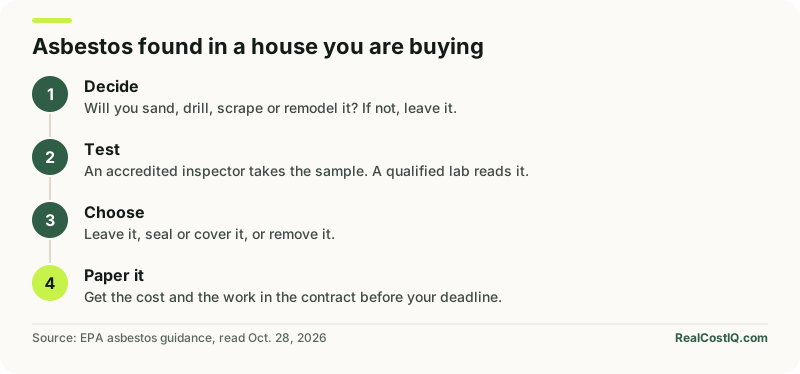
If your plan will disturb the material, or it is damaged, test. The EPA says to use a trained, accredited professional for sampling, and the sample goes to a qualified lab. Your state agency keeps the current list of accredited professionals. Ask your real estate agent to get the test scheduled the same week as the inspection, because the lab turnaround eats into a short deadline. If the deadline is too tight, ask the seller in writing for a short extension and name the reason.
The EPA gives a second rule that buyers often miss. Use separate firms for the assessment and for the repair or removal. The reason is a conflict of interest. A company that is paid to remove asbestos has a reason to find more of it. A firm that only tests has no stake in the answer. So when you get a bid for the work, get it from a different company than the one that took the samples. The EPA also says to ask every worker for proof of accreditation. Check the firm's record with your local air pollution control board, the state worker safety agency and the Better Business Bureau.
What does a test cost? That is part of the asbestos removal cost calculator, which prices testing separately from removal and from sealing. For this decision you only need the shape. Testing is the cheap step. Removal is the costly one. If the lab comes back negative, you spent a small amount to remove a worry. If it comes back positive, you now have a document to hand the seller.
Step three: the three things you can do
The EPA's protect-your-family page lays out the options. There are really three: leave it alone, repair it (which keeps the asbestos in place), or remove it. The EPA splits repair in two. Sealing, also called encapsulation, treats the material with a sealant that binds the fibers or covers them with a coating. Covering, also called enclosure, wraps or encloses the material so it cannot be reached.
| Option | What it is | When the EPA guidance fits it | Watch out for |
|---|---|---|---|
| Leave it | No work. Keep the area undisturbed. | Material is in good condition and will not be disturbed. | Any later remodel changes the answer. |
| Seal (encapsulate) | A sealant treats the material and keeps it in place. | Material is slightly damaged or needs repair and can stay. | Not for anything you will cut, drill or demolish. |
| Cover (enclose) | The material is wrapped or enclosed. | Material can stay and needs to be kept from being touched. | The enclosure has to survive future work. |
| Remove | A trained, accredited crew takes it out and disposes of it. | Remodeling will disturb it, or damage is too extensive to repair. | Done wrong, it can raise exposure. Do not DIY. |
Source: EPA, Protect Your Family from Exposures to Asbestos (updated June 25, 2026). The 'watch out' column is our reading.
The EPA says removal may be required when remodeling will disturb the material or when damage is too extensive to repair. It also says removal is complex, must be done by a trained and accredited professional, and that improper removal may increase exposure. That is the whole reason not to treat removal as the 'safe' option by default. A job done badly can leave more fibers in the air than leaving the material in place.
A practical way to choose is to match the fix to your renovation plan. If you will tear out the kitchen floor in month three, sealing it first wastes money, because the sealant will be demolished with the floor. Remove it as part of the project. If the old tile sits under a floor you will never lift, sealing or covering it may be all you need. And if your plan keeps the material in place for years, leaving it alone costs nothing today. The only wrong answer is a plan that quietly includes sanding or scraping.
What not to do before closing
- Do not sand, saw, scrape or drill it. The EPA lists this for any suspect material.
- Do not sweep, dust or vacuum debris that may contain asbestos.
- Do not take your own sample. The EPA says an untrained sample can be more hazardous than leaving the material alone.
- Do not open walls to look for vermiculite. The EPA says to leave that insulation undisturbed.
- Do not have a handyman 'just pull it up' after closing. A casual demolition is exactly the disturbance the rules exist to prevent.
What the law requires, and why it depends on your state
Buyers often assume a federal rule makes the seller clean up asbestos before a sale. It does not. The EPA's asbestos laws and regulations page, last updated Dec. 11, 2025, describes the federal work-practice rules for demolition and renovation under the Clean Air Act (known as NESHAP). They cover structures, installations and buildings, but exclude residential buildings with four or fewer dwelling units. A single-family house is outside that rule, so it does not by itself require a notice or an abatement.
The same point appears in the EPA's protect-your-family page. It says federal law does not require accreditation for inspecting, repairing or removing asbestos in detached single-family homes, but that some states and localities do. It still recommends hiring accredited workers, for safety. So the legal requirement for your crew comes from your state or town. Ask the building department or the state agency in your area, and ask the abatement firm to show you the license or accreditation the local rules require.
Owner exemptions are another state-by-state issue. Florida is one example. Under Section 469.002 of the Florida Statutes, an owner can be exempt from the asbestos contractor licensing requirement for certain work on a residential building. The exemption applies when the owner lives in the building and it is not for sale or lease. The work must follow the owner-builder limits in that paragraph. The owner must also appear in person and sign the building permit application. For a buyer, the point is simple. You cannot use an owner exemption before you own the house. A home you plan to sell or rent soon may not qualify. Do not assume your state works the same way. Check it before you plan any do-it-yourself work, which the EPA advises against anyway.
Federal rules also reach waste. The EPA page notes that waste removal requirements sit in 40 CFR section 61.150. For you, the practical point is to ask the abatement firm to explain how and where the material will be disposed of, and to give you the paperwork after the job.
Who pays: the five ways to ask the seller
No federal rule says who pays. Your purchase contract and your inspection contingency decide it. The contingency usually gives you a short window to inspect, then to ask for repairs, a credit, a price cut or to cancel. Within the window, the asbestos finding gives you five asks, from simplest to most involved.
| Ask | How it works | Best when | Risk to you |
|---|---|---|---|
| Seller removes it before closing | The seller hires an accredited abatement firm and gives you the paperwork. | The material is in the way of the work you plan, and you trust the seller to follow through. | Seller picks the crew. Insist on accredited workers and a written scope. |
| Price reduction | The price drops by the amount of the bid. | You want control of the work and its timing. | Your loan is based on the lower price, so you need more cash if the work costs more. |
| Closing cost credit | The seller pays part of your closing costs. | Your lender allows it and you have costs to cover. | Lender limits cap it, and it cannot exceed your actual closing costs. |
| Escrow holdback for the work | Money is held at closing until the job is done. | The work can happen after closing, within the lender's rules. | Needs the lender to agree, and a completion check. |
| Cancel under the contingency | You use your inspection right to end the contract. | The finding is large, or the seller will not move. | You lose the inspection and lab fees and the house. |
Our reading of how contingencies and lender rules interact. Your contract and loan program decide what is allowed.
Two of these asks lean on lender rules, so it helps to know them. For credits, the limits are in the repair credit post: the seller credit cannot exceed your closing costs, and each loan program has its own cap. For a holdback on an existing home, Fannie Mae's Selling Guide section B4-1.2-05 (topic dated Dec. 10, 2025) splits the case in two. If the condition affects safety, soundness or structural integrity, the appraisal is made 'subject to' the repair, and completion must be verified before the lender sells the loan. For minor items, the lender may set up an escrow at its own discretion, and the guide sets no amount or deadline for that. The 180-day, 120% and 10% figures in that section are for new or proposed construction, and renovation loans such as HomeStyle have their own rules. Ask your lender which route it allows.
How to size the ask
Do not ask for a number from the air. Ask for a written bid. The steps are short. Test, then get one or two written bids for the exact scope you need from an abatement firm that is separate from the tester. Add the cost of any testing you paid for. Then ask the seller for the bid, plus a cushion if the work is likely to uncover more. A bid is hard to argue with. It moves the talk from whether this is a problem to who handles the work.
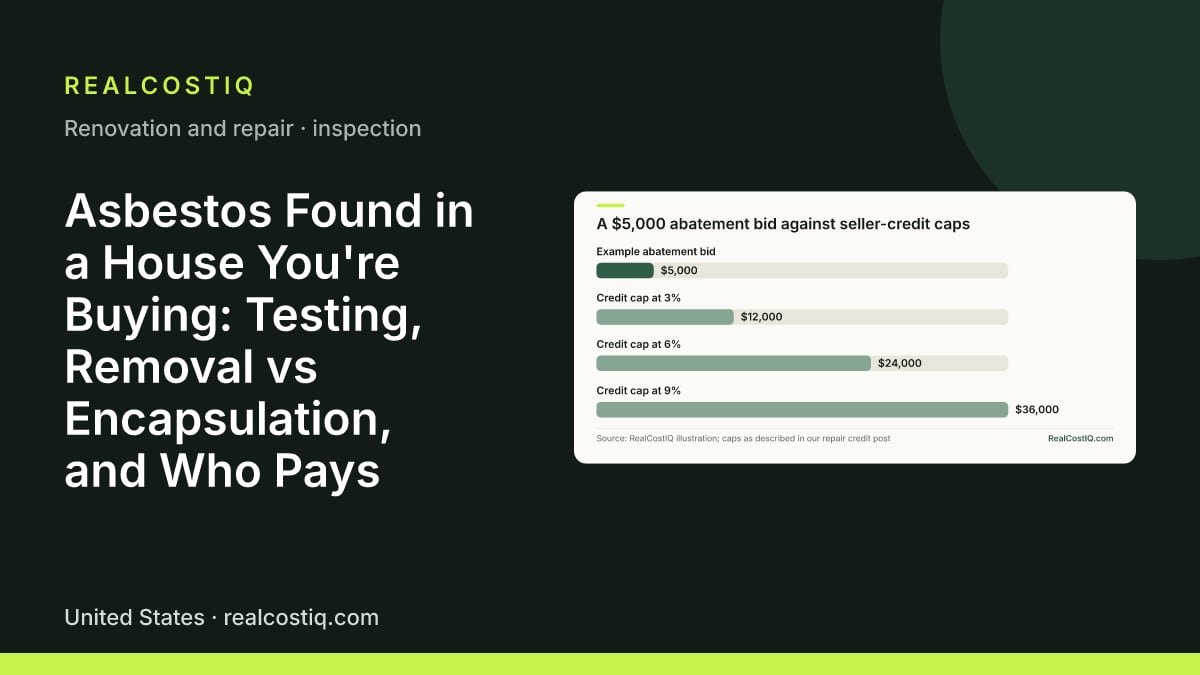
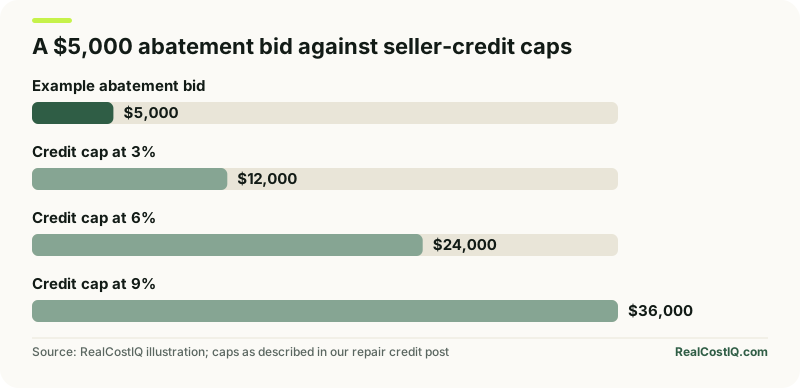
Here is a made-up example to show the size of the issue. Say the lab confirms asbestos in the kitchen floor tile, you plan to gut the kitchen, and an accredited firm bids $5,000 for the removal. On a $400,000 house, that is 1.25% of the price. That is small enough that a seller may prefer a credit or a modest price cut to losing the sale. A credit of that size would sit well under the seller-credit caps covered in the repair credit post. Those caps run from 3% to 9% of the price. On $400,000 that is $12,000 at 3%, $24,000 at 6% and $36,000 at 9%. If the bid were instead $30,000 for an attic full of vermiculite, that would be 7.5% of the same price, and you would be asking the seller to reprice the house. The number sets the strategy. The figures here are an illustration, not a quote. Use the asbestos removal cost calculator to get a realistic range for your material and area, and the written bids to replace it.
What the lender and the appraiser will do
Asbestos in a house with a mortgage raises a fair question: will the lender object? The honest answer is that the main conventional loan guide does not name asbestos. Fannie Mae's Selling Guide section B4-1.3-06 on property condition (topic dated June 4, 2025) says the appraisal must describe physical deficiencies that could affect safety, soundness or structural integrity. The property is then appraised 'subject to' the specific repairs. It also says reports must reflect adverse conditions, including the presence of hazardous wastes, toxic substances or adverse environmental conditions.
Read that carefully. It does not say that every asbestos-containing material blocks a loan. It says the appraiser reports conditions that affect safety and condition, and the lender decides what to require. In practice, damaged or crumbling material is more likely to draw a repair condition than intact tile under a floor covering. The guide says a property rated C6, the worst condition rating, is not eligible for sale to Fannie Mae until the deficiencies are repaired to at least a C5. Loan programs differ, and government-backed loans have their own property rules, so ask your loan officer. Do it before the inspection deadline, not after, because a repair condition can change both the timeline and who must pay.
If you plan to finance the work too, the cost of asbestos removal may fit into a renovation loan. Those programs are different from a regular mortgage, and our post on renovation loans (FHA 203(k) and HomeStyle) is the place to start. We mention it only as a pointer, because the rules depend on the program.
Walk away, negotiate or buy as is?
Most asbestos findings are negotiation items, not reasons to walk. Here is a way to sort them.
- Buy as is when the material is intact, you will not disturb it, and the price already reflects an older house. Get the lab report if you tested, and keep it for your own records and for a future sale.
- Negotiate when you plan to disturb it, or it is damaged. Get a written bid and ask for the work, a credit or a price cut. The EPA's rules back you: damaged material or material that will be disturbed calls for a trained, accredited crew.
- Reprice hard or walk when the bid is a large share of the price or the seller will not engage. The same goes for vermiculite in an attic you cannot avoid, if you have no cushion for the cost. Your inspection contingency is your exit, so know its date.
Two quieter points. First, the seller's own knowledge matters. If a seller has had a test or past work done, ask for the records. They may save you a test, or reveal a patch that was done wrongly. Second, document what you decide. If you buy a house with intact asbestos and later sell, the person on the other side of the table will have the same questions. A one-page file with the lab report, the date and where the material sits answers them.
Before you commit to either path, price the whole picture. The home inspection cost calculator shows what the inspection and specialty tests add to your buying budget. Combine that with the asbestos estimate and your renovation plan, and you can compare the house at asking price with the house at asking price plus the work.
A short checklist before your inspection deadline
- Write down what you plan to change in the rooms or areas where the material sits.
- Ask the seller for any past asbestos test, abatement record or survey.
- Hire an accredited inspector to sample only the materials your plan will disturb, or any that are damaged.
- Ask for the lab report in writing, with the lab's name and the date.
- Get one or two written bids from an abatement firm that did not do the testing. Ask each for its accreditation or license and for how it will dispose of the material.
- Ask your loan officer whether the appraisal or the loan program needs a repair or a holdback.
- Send the seller a written request that names the finding, attaches the lab report and bid, and states what you want: the work, a credit or a price change.
- Get any agreement in a signed contract amendment before the inspection period ends.