A house on city water comes with a utility that tests the water for you. A house with a private well does not. You are the utility. That is the main thing a buyer needs to learn, and it changes what you should do between the offer and the closing.
This post is about the well only. If the house also has a septic tank, read the septic system maintenance and sale inspection guide for that half. For a house on a city sewer line, the post on a sewer scope that finds a problem is the match. The well pump replacement cost calculator prices a pump by type, so this post does not repeat its table. Here you get the buying steps, the lender rules and the budget cases.
Who checks the water? You do
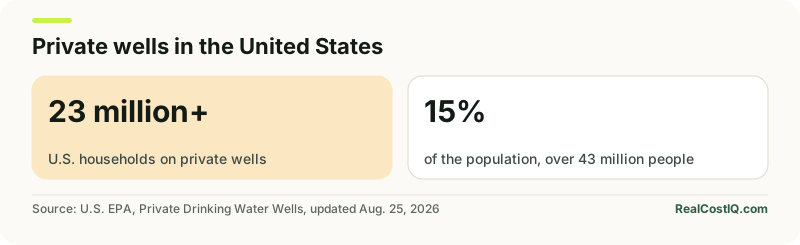
The EPA's private wells page, last updated August 25, 2026, says more than 23 million U.S. households rely on private wells. That is about 15 percent of the population, over 43 million people. It says private well owners are responsible for delivering safe drinking water to their households. It also says the quality and safety of water from private wells is not regulated by the federal government under the Safe Drinking Water Act, nor by most state governments.
So there is no yearly report, no utility letter and no free lab. The seller may have tested the water a long time ago, or never. A seller test is useful as a starting point, but it is not a promise about today.
The two tests to order before you close
Test one: the water
The EPA's guide to protecting your home's water, updated February 26, 2026, tells owners to test every year for total coliform bacteria, nitrates, total dissolved solids and pH. It also lists other reasons to test right away: a problem in your area, a flood, nearby construction, a repair to the well, or a change in the water's smell, color or taste. It says to use a laboratory certified for drinking water testing and to ask your state agency or local health department what is common in local groundwater.
Coliform bacteria are germs that show water may be contaminated by surface water or waste. Nitrates come from fertilizer, animal waste and septic systems. A high level is a particular danger for babies. TDS is the amount of dissolved minerals. pH shows how acidic the water is, which affects pipes. You do not need the chemistry. You need the lab to tell you pass or fail for each one.
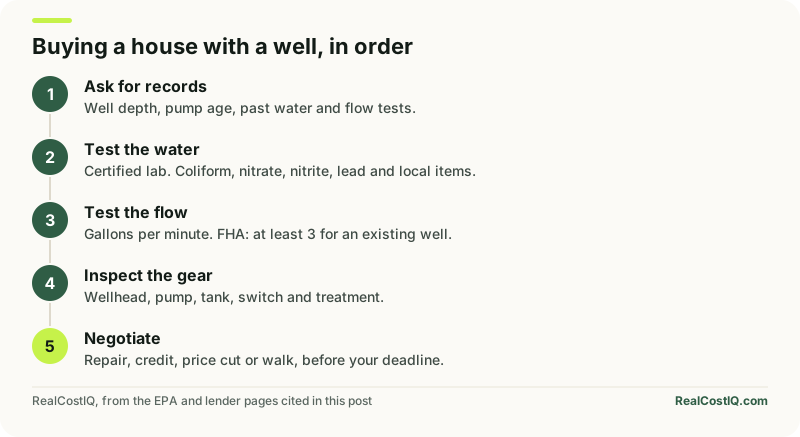
For a purchase, ask the lab or your inspector to add the tests your lender and your county require. Veterans United's VA well test page, updated August 24, 2023, says VA lenders generally look at nitrates, nitrites, coliform and lead. It says to follow local rules where they differ. The HomeYou guide, updated July 23, 2026, lists water testing as an add-on at $169 to $592.
Test two: the flow
A well can have perfect water and still run dry in August. A flow or yield test measures how much water the well can supply, usually over a few hours, and shows how fast the water level drops. HomeYou lists a well flow test at $350 to $1,487. HUD's Handbook 4000.1 (Update 18, August 12, 2026) says an existing well must deliver a continuous flow of at least 3 gallons per minute for an FHA loan. If a well ran nonstop at 3 gpm, it would supply 4,320 gallons a day (3 × 60 × 24). That is our arithmetic. The lender number is a floor, not a comfort level for a large family.
Ask the seller for the well's depth, the age of the pump and the reason it was last replaced, and any past flow figures. A BiggerPockets thread from 2020 on a well inspection that went wrong shows why: the buyers' yield test measured 12 gpm and passed. The next morning the house had no water, and a well company found the 4-year-old pump had burned out. The $1,800 repair ended in a 50/50 split. It is one story and old, but it shows two things. A pass today does not guarantee the pump tomorrow. And the contract should say who pays if a test causes damage.
Who should collect the sample
Do not let the seller or the buyer collect the water sample on a loan that needs it. HUD's handbook says FHA tests must be done by a disinterested third party, including collecting and carrying the sample, and that the borrower, the owner or any other interested party may never do it. Veterans United says that for a VA loan, the sample should ideally be taken by a local health authority employee. If none is available, a commercial lab or independent third party must collect and deliver it, and the borrower or anyone linked to the deal cannot. HUD's handbook says that when a test is required, the report may not be more than 180 days old at disbursement. Veterans United says VA results are valid for 90 days. So time the test close to closing day, or you may need to repeat it.
What lenders may require
Rules differ by loan type and lender, so confirm with your lender in writing. The FHA row comes from HUD's handbook. The conventional and VA rows come from lender pages.
| Loan | Water test | Other requirements | Source |
|---|---|---|---|
| Conventional | Generally only if a hazard is nearby or an inspector or appraiser flags a problem | No yield or setback figures listed. Shared wells need a deeded right of access and a maintenance agreement | MortgageResearch, Feb. 6, 2025 |
| FHA | Required for new construction, when the appraiser reports a well or water deficiency, when water is known or reported unsafe, or near dumps, landfills, industrial sites or farms. Sample taken and carried by a disinterested third party. Report no more than 180 days old at disbursement | Existing well must deliver a continuous flow of at least 3 gpm. Setbacks: 10 ft from property line, 50 ft from septic tank, 100 ft from drain field (75 ft if local authority allows; local distances prevail if greater). Springs, lakes, rivers, sand-point or artesian wells, or a mechanical chlorinator make the home ineligible | HUD Handbook 4000.1 Update 18 (Aug. 12, 2026), II.A.3 |
| VA | Required, must meet local or EPA standards. Valid 90 days | Unsafe water must be treated and retested. A purification system alone does not satisfy the lender | Veterans United, Aug. 24, 2023; MortgageResearch |
FHA row from HUD Handbook 4000.1, Update 18 (Aug. 12, 2026). Conventional and VA rows are from secondary lender pages. A lender can add its own rules.
Take two lessons from the table. First, a well that fails the test is not just a repair item. It can stop a government-backed loan until the water passes again. Second, the septic setbacks matter. A well too close to a tank or drain field can fail the appraisal. Moving a well is costly. Ask the inspector to measure.
What the well pro should look at
A general home inspector may only check that water comes out of the tap. Hire a licensed well contractor or a well-inspection specialist for the equipment. The EPA's owner guide suggests checking for cracked or damaged casing, a broken cap and settling around the seals. A well pro can also check the items below.
- The wellhead. Is the cap sealed and the casing intact and above ground level? A damaged cap lets surface water in.
- The pump. What type is it, how old, and how hard does it work? Pumps do not last forever. Ask for the install date.
- The pressure tank. Does it hold pressure, or does the pump switch on and off too often?
- The electrical parts. Wiring, control box and pressure switch.
- Records. Drilling log, depth, permits and past tests. The EPA also suggests owners keep maintenance records.
- Treatment equipment. Softener, filter or UV light. Ask who services it and when it was last serviced.
What things cost
Pump replacement
A pump swap is the most likely surprise. The site's well pump replacement cost calculator uses HomeAdvisor's published average of $1,898 for the job and a normal range of roughly $975 to $2,821. The 2020 BiggerPockets story above put one repair at $1,800. Pump prices in the HomeYou guide run higher: it lists submersible pump installation at $1,991 to $8,956, with an average of $4,414. Those are different jobs. HomeYou's range reads like a new-well installation that includes the pump. A like-for-like swap on an existing well is the lower figure.
A new well
If the old well is dry, weak or too close to the septic system, the next step is a new one. Two 2026 guides give totals. Always Do Better says $5,500 to $15,000 for a complete residential well. HomeYou says $3,318 to $24,605, with most jobs near $12,599. Both agree that depth and rock type drive the price.
| Piece | Price basis (Always Do Better, 2026) | 200-foot well |
|---|---|---|
| Drilling | $25 to $65 per foot | $5,000 to $13,000 |
| Casing and grouting | $10 to $50 per foot | $2,000 to $10,000 |
| Pump, pressure tank and wiring | $2,000 to $5,000 | $2,000 to $5,000 |
| Permits and testing | $300 to $1,500 | $300 to $1,500 |
| Add up the pieces | $9,300 to $29,500 | |
| The same guide's complete-well range | $5,500 to $15,000 |
RealCostIQ arithmetic: per-foot prices times 200 feet, then summed. The sum runs well above the guide's own typical total, which probably assumes a shallower well or a lower casing cost. Ask drillers for one all-in price, not a per-foot rate.
That gap is a warning. Per-foot prices sound small, and they add up fast. Hard rock raises the rate, and a deep well costs more twice: more drilling and more casing. Get two or three written quotes with a total, and ask what happens if the driller hits rock or water is not found at the quoted depth.
Water treatment
Many wells need treatment for hardness, iron, bacteria or other items. The right fix depends on what the test finds, and prices vary a lot, so I will not give one number. For hardness only, the water softener installation cost guide shows how to read a hardness test and what a softener costs to run. For bacteria, nitrate or arsenic, ask a water treatment company for a quote based on your lab report. Keep in mind the VA rule above: treatment alone does not clear a failed test.
Four budget cases
Start with round numbers, then the sum. We assume a $1,000 testing budget: a $400 water test (inside the $169 to $592 range) and a $600 flow test (inside $350 to $1,487). The other lines come from the sources above. The cases are hypothetical.
| Case | What happens | Costs | Total |
|---|---|---|---|
| A. Healthy well | Water passes, flow passes, equipment is fine | $1,000 tests | $1,000 |
| B. Old pump | Tests pass, but the pump is near end of life and you replace it | $1,000 tests + $1,898 pump | $2,898 |
| C. Weak well, new well | Water passes, flow fails, you drill a new well at the typical price | $1,000 tests + $12,599 new well | $13,599 |
| D. High case | Same as C at the top of the HomeYou range | $1,000 tests + $24,605 new well | $25,605 |
RealCostIQ arithmetic. Pump: HomeAdvisor average used by the site's calculator. New well: HomeYou's typical and top-of-range figures, July 23, 2026. Treatment and a possible second test are not included.
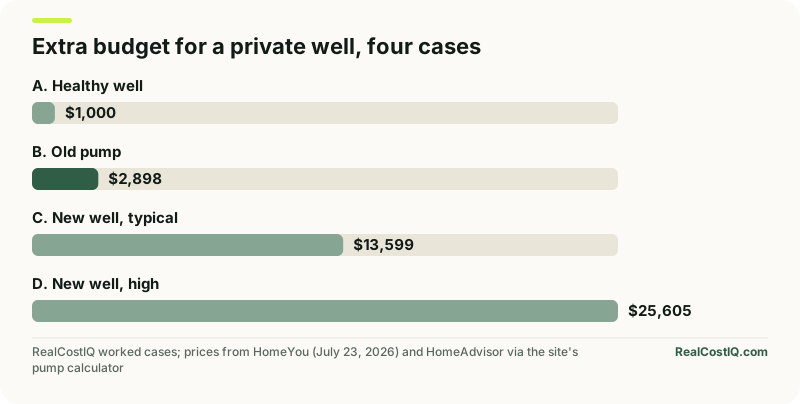
I called cases A and B the likely ones because pumps and tests are routine, and a new well is not. That is judgment, not a statistic. No source in this post says how often wells fail a purchase test.
Who pays
Usually you pay for the tests. Veterans United notes that buyers may have to pay upfront but can ask the seller to cover the cost in closing-cost talks. Repairs are a negotiation. If the pump is near the end of its life, ask for a credit near the replacement price. Do the same if the flow is weak. If the water fails, ask the seller to treat it and retest before closing, or to give you a credit and a price cut that cover the fix.
Put your tests in the contract as a contingency with a deadline. Say which tests, who collects the sample and what counts as a pass. Add one line that covers damage caused during testing, as the 2020 BiggerPockets seller did. And remember lender rules: a failed test can block FHA and VA loans, so a contingency is also your way out. The home inspection cost calculator helps you budget the rest of the inspection visits.
| Ask for | Why |
|---|---|
| A credit near the pump replacement cost | Pump is old, tank is failing or the switch cycles often |
| Seller treatment plus a retest before closing | Water fails coliform, nitrate or lead |
| A price cut or credit for a new well | Flow is under the lender's floor, or the well is too close to septic |
| Seller pays for the tests | Common to ask. It is a negotiation, not a right |
| A longer inspection period | Labs and well pros need days, not hours |
After you close
The EPA says to test every year for coliform, nitrate, TDS and pH, and sooner after a flood, a repair, construction nearby or a change in the water. Keep the results with your records. Put a yearly reminder in your phone. The cost is small next to a repair. HomeYou's testing add-on range is $169 to $592.
After a flood, the EPA says to stay away from the pump, not to drink or wash with the water, and to have a contractor disinfect the well. The cost of the yearly test is the cheapest insurance on the house.