
You paid for a sewer scope, and the report came back with a problem. Now you have a deadline and a question. Is this a small fix or a five-figure bill? And can you make the seller pay for it? This post helps you sort the finding, put a price range on it and ask for money back. It does not repeat the full cost tables on the sewer line replacement cost calculator. Use that page to price your own pipe length. Use this one to decide what to do with the answer.
What a sewer scope can and cannot tell you
A standard home inspection checks what the inspector can see. The pipe under your yard is not one of those things. A scope fills that gap. A technician feeds a camera into the line, usually through a cleanout, and records the trip. A cleanout is a capped pipe with an access point near the house or the property line.
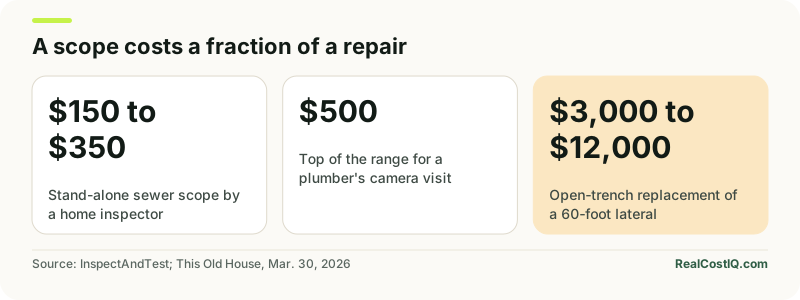
Inspection-industry cost guides put the fee at about $100 to $250 when it is added to a home inspection. A stand-alone visit by a home inspector runs about $150 to $350, and a plumber's camera visit about $150 to $500 (InspectAndTest, sewer scope cost guide). If there is no accessible cleanout, the crew may have to pull a toilet or go through a roof vent, which adds about $75 to $200 or more. This Old House, in a guide updated March 30, 2026, gives the same $100 to $500 for a camera inspection (This Old House, sewer line replacement cost). So $100 to $500 is the full spread, and the home inspection cost calculator uses that band. Treat these as estimates, not quotes.
The same guide lists what the camera tends to find. Tree roots enter through joints and cracks. A belly is a low spot, a sag, where water and waste collect. An offset is a joint that has slipped out of line. Cracks, breaks and collapses are damage to the pipe wall. The camera also shows the pipe material. Clay lasts a long time but is weak at the joints. Orangeburg, a pipe made of pressed fiber and common in homes from roughly the 1940s to the 1970s, can deform and blister, and many plumbers suggest replacing it when they find it. Cast iron can rust and scale on the inside. PVC and ABS plastic are durable but can sag or separate if they were laid on poor bedding.
Know the limits too. The camera sees only the inside surface of the pipe. It cannot see the soil around it. It cannot pass a blockage or a sharp bend. Standing water can hide the pipe floor. A clean scope does not promise the pipe will work for years. A scope of a line that was just cleaned or jetted can also look better than it is. That is why you should ask for the full video file and a written summary, with distance markers so a contractor can find each defect.
Read the finding before you panic: five outcomes, five price levels
Not every finding is a replacement. The words in the report matter. Sort what you got into one of these five levels. The cost ranges below come from the sources named in this post. They are national, they move with local labor, and they are no substitute for a quote.
| What the camera shows | Usual next step | Cost signal |
|---|---|---|
| Clear pipe, no defects | Nothing. Keep the video. | The scope fee only |
| Light roots, grease or debris | Clean or hydro-jet the line, then plan to re-check | Often several hundred dollars to clean |
| One crack, offset or root-filled joint | Spot repair of that section, or lining | A few thousand dollars |
| Belly, collapse or failing pipe material | Excavate and replace that part or the whole run | Thousands to over ten thousand dollars |
| Defect where the city owns the pipe | Report it to the utility. Do not pay a plumber first. | Ask the utility who pays |
Sources: InspectAndTest sewer scope guide (cleaning and what needs excavation); This Old House sewer replacement guide (total and per-foot ranges, updated March 30, 2026). Both read October 25, 2026.
Two points from that table drive most deals. First, a root problem is not always a pipe problem. Roots that are a fine, hair-like mass can often be cleared by cutting or jetting. Dense roots that fill a joint often point to a joint that needs repair. The camera should show the difference. Ask the technician which one it is.
Second, a belly or a collapse is different from a crack. A deep sag holds water and waste, so it clogs again and again. InspectAndTest says deep bellies and collapses usually need excavation. A small sag with little standing water may only need to be watched. Ask the plumber to say in writing which one it is.
Who owns the pipe: the line your seller may not owe you
Before you ask the seller for money, find out who owns the failing section. In most places the owner of the house owns the pipe from the house to the public main. The public main is the big sewer pipe under the street. Where the owner's part ends and the city's part begins depends on the local code. The answer changes what you ask for.
Here are three real examples of how far the line can run. Los Angeles County's public works department says the owner is responsible for the entire length of the lateral, including the part under the street (LA County Public Works, homeowner responsibility). A lateral is the pipe that branches from your house to the main. Gwinnett County, Georgia, splits it. The owner maintains the private lateral from the house to the edge of the right-of-way, and the county maintains the cleanout at the right-of-way (Gwinnett County Water Resources, sewer lateral). East Bay Municipal Utility District in California says the owner is responsible for the whole private lateral from the home to the public main, with a different rule in two cities (EBMUD, private sewer lateral FAQ).
So there are three cases. If the defect is on the owner's side, the seller owns the problem and you can negotiate. If the defect is past the line, in the city's part, the seller does not own it and the utility may fix it. If the camera could not see far enough to tell, ask the technician for the footage marker where the defect sits. Then ask the utility or the public works office where the cleanout and the property line are. Many offices post a diagram. Do this in the first two days. It decides whether a quote is the seller's problem at all.
Repair or replace: how to think about it
There are three kinds of work. A spot repair fixes one section. Lining puts a new inner pipe inside the old one, without digging the whole yard. A full replacement puts in a new pipe, either in an open trench or by a trenchless method such as pipe bursting, where a new pipe is pulled through the old path and breaks the old pipe apart as it goes.
This Old House, in a guide updated on March 30, 2026, puts traditional open-trench replacement at $50 to $200 per linear foot and trenchless work at $60 to $250 per linear foot. The same guide gives $1,390 to $5,320 for a total replacement, with a $3,320 average. It also lists a camera inspection at $100 to $500 and a permit at $100 to $1,000 (This Old House, sewer line replacement cost). That total looks low next to the per-foot rates for a long line. It reflects short runs and simple jobs. A long, deep run under a driveway costs far more. Do not plan on the average.
Here is a worked example with round numbers. Say your lateral is 60 feet long. The table shows what the published per-foot ranges give for that length, before permits, camera checks or surface repair.
| Method | Per foot | 60 feet, low end | 60 feet, high end |
|---|---|---|---|
| Open trench | $50 to $200 | $3,000 | $12,000 |
| Trenchless | $60 to $250 | $3,600 | $15,000 |
Arithmetic: 60 feet times each per-foot rate. Rates from This Old House, updated March 30, 2026. Permits ($100 to $1,000), camera checks ($100 to $500) and surface repair are extra.
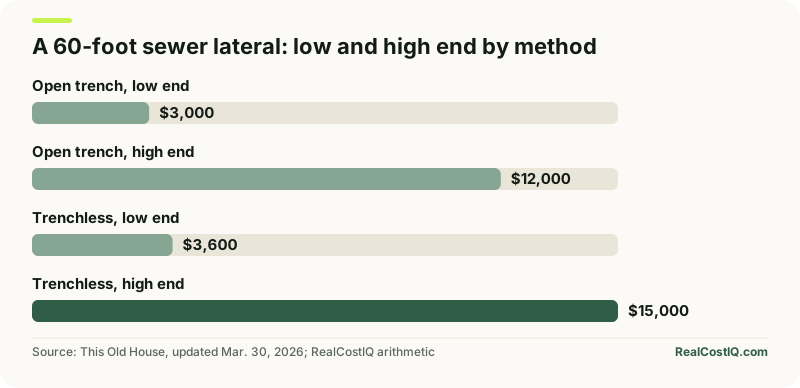
Look at the spread. A trench on a 60-foot run can cost $3,000 or $12,000. That is a four-times gap inside one method. The gap comes from depth, from what is on top of the pipe, and from how hard the crew can reach it. A trenchless method does not always cost less. It avoids digging up the whole yard, so it can save money when the pipe runs under a driveway, a patio or a mature garden. It cannot fix every problem. Ask each plumber why they chose a method, and ask what would make them change it.
When a spot repair is enough
A spot repair makes sense when one defect sits in an otherwise good pipe. The pipe material matters. A single offset joint in good clay or PVC is a small job. The same offset in Orangeburg, which tends to deform over time, is a warning that other sections may be next. InspectAndTest describes a spot repair as running a few thousand dollars, with full replacement costing well beyond that. Ask the plumber: if you fix this spot, what is the chance another spot fails in five years? A plumber who has seen the video can answer that.
When to replace the whole run
Replace the run when the pipe material itself is the problem, when there are defects in several places, or when a belly or collapse needs a dig anyway. If a trench is needed for one section, it can cost little more to do the rest while the crew is there. Ask for two prices: the spot repair and the full run. A buyer who has both can decide with the seller on one of them, and can see how much more the safer option costs.
How to turn a finding into a credit: a worked negotiation
Here is how it can go. You are buying a home for $400,000. Your inspection period ends in seven days. The scope shows a belly 40 feet from the house and a root-filled joint at 52 feet. The line is 60 feet long. The pipe is clay.
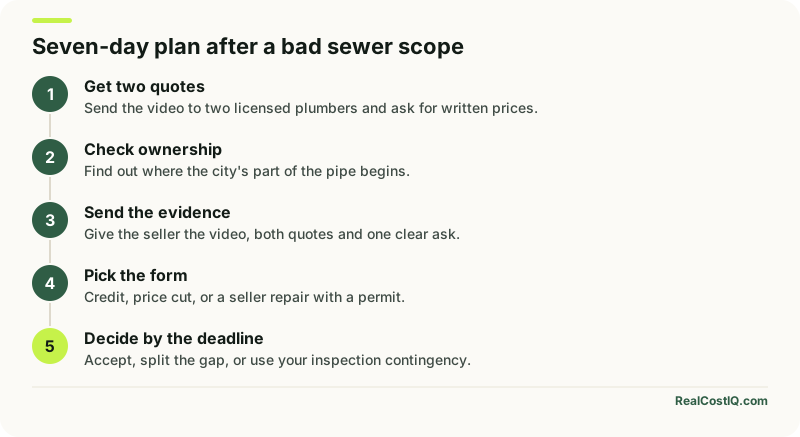
- Day 1. Send the video to two licensed plumbers. Ask each for a written quote for a full replacement and, if they think it is possible, a repair of only the bad sections.
- Day 3. Plumber A quotes $9,800 for a full replacement: $9,000 for 60 feet at $150 a foot, $500 for the permit and $300 for a camera check after the work. Plumber B quotes $11,200. Neither will do a spot repair because of the belly.
- Day 4. Confirm where the city's part of the pipe begins. Here the defects are on the owner's side.
- Day 5. Send the seller the video, both quotes and a request. Ask for a $9,800 credit at closing, or a $9,800 price cut, or a seller-paid replacement with a permit and a passed final inspection.
- Day 6. The seller counters at $6,000. You can take the credit, split the gap or walk away within your contingency.
In this example the ask is $9,800 on a $400,000 home. That is 2.45 percent of the price. Start with the lower of the two quotes. It is easier for the seller to accept because it is a number from a licensed plumber, not a guess. Keep the higher quote as backup if the work turns out harder than the first plumber said.
Credit, price cut or seller repair
Each form of payment has a trade-off. A price cut lowers your loan, but your lender's appraisal still has to support the new price. A credit at closing puts cash toward your costs. Lenders cap how much seller credit they allow, so ask your loan officer first. Our post on repair credits after a home inspection explains those limits and how to word the ask. A seller repair sounds simple, but you lose control of the work. The seller may hire the cheapest crew. If you take a repair, ask for a permit, a passed city inspection and a new camera scan after the work, with the video sent to you.
An escrow holdback is a fourth option
If the seller cannot fix the line before closing, for example because of weather or the city's schedule, ask the title or escrow company whether it can hold money back until the work is done. That is called a holdback. The seller does not get the money until the work passes inspection. Not every lender allows it. Ask early.
What to say when the seller says no
Sometimes the seller refuses. The home may be sold as is. The market may be hot. You have three choices. You can accept the home as it is and plan for the cost. You can walk away if your contract lets you. Or you can use the quote to decide what you are willing to pay.
If you stay, the repair is now your bill, so put it in your budget. Add the replacement cost to your cash needs next to your closing costs. A BiggerPockets thread from June 2026 makes the same point from the investor side. The original poster says sewer repairs can run from a few hundred dollars to well over $10,000 and that a scope costs a fraction of a major repair (BiggerPockets forum, the most expensive plumbing issue that investors miss). That is one person's view, but it matches the other sources here.
If you walk, check your contract first. Your inspection contingency usually sets a date and a way to cancel without losing your deposit. Missing that date can cost you the deposit. Talk to your agent or a real estate attorney before you send a cancellation. This post is general information, not legal advice.
Red flags in the scope and in the quotes
Watch for these. InspectAndTest lists several: no video provided, findings without distance markers, an incomplete scope with no explanation, a clean report on a line that was recently jetted, and pressure to replace the whole line by the company that did the scope. The last one matters most. The company that scopes your line should not also sell you the biggest job without a second opinion. Get the second quote from a different company.
In the quotes, look for these things. Does the price include the permit? Does it include fixing the lawn, the driveway or the patio? Does it include a camera check after the work? How long is the warranty on the work, and is it written? A quote without those answers is not comparable to one with them. Ask both plumbers to answer the same list so you compare like with like.
Is a sewer scope worth buying before the next deal
Yes, for most older homes, and it is cheap next to the risk. At about $100 to $500 it costs a small share of the lowest replacement figure above. It gives you a bargaining tool and a baseline. Our home inspection cost calculator uses that same $100 to $500 band for the scope, next to the other add-on tests, so you can see the whole stack. Do it early in the inspection period, because you need time to get two quotes. A scope ordered on the last day leaves you no room to negotiate.
A scope matters most for homes with mature trees, for older pipes made of clay, cast iron or Orangeburg, and for homes where the seller does not know the age of the line. It matters less in a new build with plastic pipe, although a poorly bedded plastic pipe can still sag.
After you close: what to do with the video and the repair
Keep the video and the quotes in a file. If the seller repaired the line, keep the permit, the final inspection and the post-repair video. They help you at resale, and they help if a problem shows up later. If you took a credit and did the work yourself, hire a licensed plumber, pull the permit and keep the paperwork. If the pipe is fine but old, plan to re-scope every few years and keep the line clear of grease and roots.
Small plumbing jobs that come up along the way, such as a cleanout that needs to be added, are priced in our plumbing repair cost calculator. Check the price of the cleanout before you agree to a number with the seller, because a missing cleanout can make the scope itself cost more.
A short checklist
- Ask for the full video and a written summary with distance markers.
- Find out where the owner's pipe ends and the city's begins.
- Ask whether your city or utility requires a test or certificate at sale.
- Get two written quotes from different licensed plumbers.
- Ask each plumber for a spot repair price and a full replacement price.
- Make one clear request: credit, price cut or seller repair with a permit.
- Check lender limits on seller credits before you pick the form.
- Decide before the inspection deadline, not after it.
The scope did its job. It found the problem while you still have leverage. Use the quotes, not the fear, to decide what the problem is worth.