The sign in the store says "No interest if paid in full within 12 months." It sounds like a free loan. It is a loan with a trap door. Interest has been adding up in the background since the day you swiped the card, and the lender is only agreeing not to collect it if you reach zero by the deadline.
This post works through one example, an $8,000 purchase such as a set of windows, a flooring order or a kitchen appliance package. It shows what each monthly payment does to the bill at the deadline, how federal rules decide where your extra payments go, how a deferred plan differs from a true 0% plan, and what to do before you sign. All rates are the ones published by the lenders and the Federal Reserve, with the dates they apply to.
How the cliff works, step by step
The Consumer Financial Protection Bureau (CFPB) explains the plan on its deferred interest page, last reviewed Jan. 22, 2024. If you do not pay off the purchase within the period, interest is charged on the balance from the purchase date. The same happens if you are more than 60 days late on a minimum payment. The CFPB adds that the minimum payment will usually not clear the purchase in time, so you have to pay more than the minimum.
A lender's own wording says the same thing. In a Lowe's offer sheet for a 12-month appliance promotion on its store card, valid through Jan. 31, 2025, the lender states that interest will be charged from the purchase date if the purchase is not paid in full within 12 months. It also warns that the required minimum payment "may or may not" pay the purchase off by the end of the period. That offer has expired. We use it only because it shows the standard wording, and it was read on Oct. 30, 2026 at Lowe's own site.
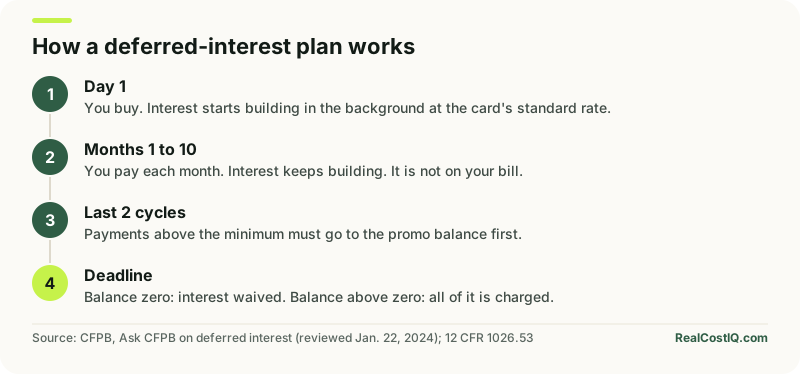
Three words in that wording deserve attention. "From the purchase date" means the whole period is billed, not just the month you missed. "Paid in full" means zero, not "almost." And "minimum" means the lender's formula, which is built to keep your account in good standing, not to finish the plan on time.
The numbers: one $8,000 purchase, four payment levels
Take an $8,000 purchase on a store card with a 12-month deferred plan. The standard purchase rate is 31.99%, which is the rate Lowe's lists for new accounts as of March 7, 2024 in its current promotional terms (read Oct. 30, 2026 at Lowe's). Your own card may differ. The agreement and the monthly statement show the real rate.
The table adds each month's interest at 31.99% divided by 12 on the balance still owed, and assumes the card has no other balance and you make 12 equal payments. Real issuers count interest daily on the average daily balance, so the real bill can differ by a few dollars. The shape of the result does not change.
| Monthly payment | Total paid in 12 months | Balance left at month 12 | Back interest charged | What you owe at the deadline |
|---|---|---|---|---|
| $666.67 (price ÷ 12) | $8,000 | $0 | $0 (waived) | $0 |
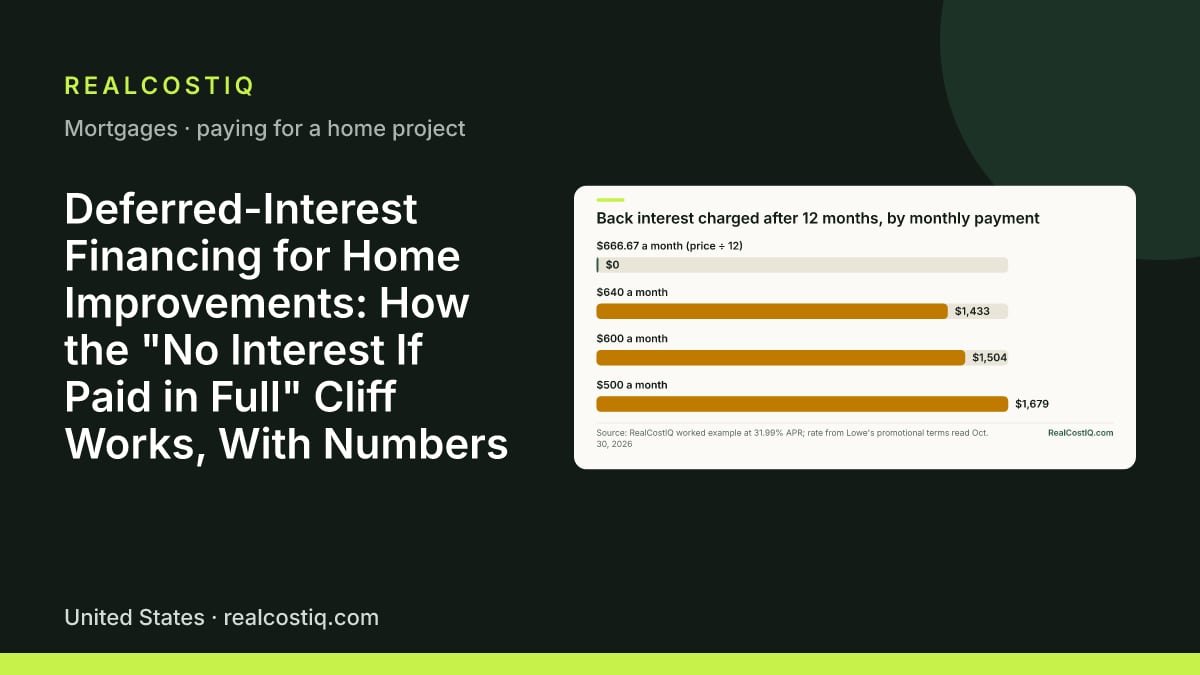
| $640 | $7,680 | $320 | $1,433 | $1,753 |
| $600 | $7,200 | $800 | $1,504 | $2,304 |
| $500 | $6,000 | $2,000 | $1,679 | $3,679 |
Back interest is the sum of 12 months of interest at 31.99% a year (2.666% a month) on the balance owed at the start of each month, with no compounding. If interest is also added to the balance, the charge is slightly higher. $8,000 ÷ 12 = $666.67; the last payment is a cent short, which is why the first row shows $0.
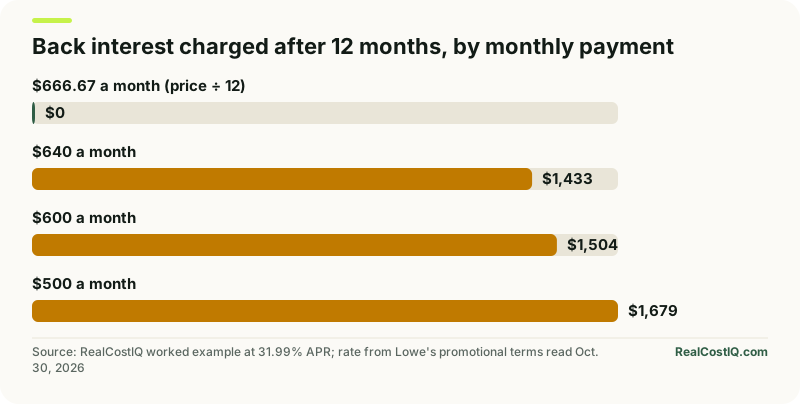
Read the second row slowly. A payment of $640 looks close to $666.67. It is $26.67 short each month, which adds up to $320 at the deadline. That $320 shortfall is 4% of the purchase. It produces back interest of $1,433, or 17.9% of the purchase price. In effect the plan gave you nothing. The charge equals what an ordinary card at the same rate would have billed month by month over the same payments. The plan treats a near miss almost like a miss by a mile.
This is the pattern the CFPB flagged when it wrote to large retail card issuers on June 8, 2017. Citing its 2015 report, the agency said purchases made under deferred-interest promotions rose 21% from 2010 to 2013, that many consumers who missed the payoff date cleared the balance and the deferred charges soon after, and that this suggested the charge came as a surprise. It encouraged retailers to move to promotions where interest only applies to what is left at the end, and it noted that store cards generally carry rates of about 25%. The CFPB release is in its archive.
Where your extra payments go: what the federal rule says
If the card has other balances on it, your payment is split between them, and the split can work against the plan. The rule sits in Regulation Z, section 1026.53. Anything you pay above the required minimum normally goes to the balance with the highest rate first. A deferred-interest purchase usually carries the standard rate, so it may compete with other balances for your extra money. The exception is narrow. In the two billing cycles before the deferred period ends, the issuer must send the excess payment to the deferred-interest balance first. The current text is on the CFPB's Regulation Z page (read Oct. 30, 2026; the page does not state an effective date).
The CFPB's consumer page reads the rule the same way. Amounts above the minimum go to any higher-rate balance first. In the last two cycles they must go to the deferred purchase. You can ask the card company to apply extra payments to the deferred balance earlier, but it may refuse. The practical lesson is that you cannot count on those last two cycles to rescue a plan. By then the balance is too large to clear in two payments unless you have been paying the full amount all along.
- Keep the card clean. Do not put other purchases on a card that carries a deferred plan. Every other balance pulls payment dollars away from the plan, and the CFPB notes that new purchases can lose their grace period if the full balance is not paid by the next due date.
- Pay the full plan amount, not the minimum. The statement's minimum is set so the account stays current. The lender's own sheet says it may or may not pay the purchase off in time.
- Set the payment on day one. Divide the purchase price by the number of months, round up to the next whole dollar, and set an automatic payment for that amount. Rounding up leaves room for the final cent.
- Stay current. The CFPB says that being more than 60 days late on a minimum payment can cost you the deferred period.
- Know the real end date. The CFPB advises checking the front of the bill, because the end of the plan may fall on a different day from your payment due date.
Deferred interest versus a true 0% plan
Not every "no interest" offer works this way. Some are true 0% plans, where interest is only charged on what remains after the deadline, or not charged at all as long as the equal payments are made. The two can look the same on a shelf sign. The difference is in the fine print and costs real money.
A current Lowe's offer shows the other kind. For special-order carpet of $499 or more, valid Oct. 22 to Nov. 4, 2026, it offers 0% APR with 36 equal monthly payments. The terms say no interest will be charged, and the payment equals the purchase amount divided by the number of months, rounded up to the next whole dollar. It warns that this payment may be higher than the payment a non-promotional purchase would require. In that structure there is no back interest to trigger. If you miss payments, the problem is late fees and the card's standard terms, not a retroactive bill for three years of interest. This is the same card, issued by the same lender, with a different promotion.
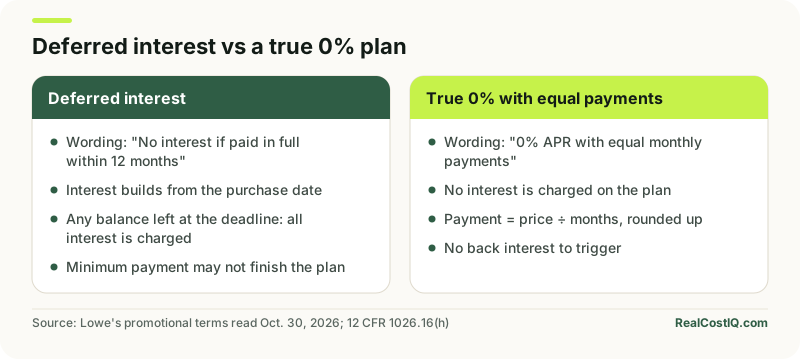
Federal advertising rules are meant to make the difference visible. Under Regulation Z section 1026.16(h), an ad for a deferred-interest plan on an open-end credit account that is not secured by your home must state the deferred interest period clearly. If it says "no interest," the words "if paid in full" must appear before the period, in immediate proximity to the "no interest" statement. The ad must also say that interest will be charged from the date you became obligated if the balance is not paid in full within the period, and that statement cannot be placed in a footnote. Home-equity lines of credit are excluded. The rule is at the CFPB's Regulation Z, section 16, read Oct. 30, 2026. The official commentary adds that a 0% APR offer is not a deferred-interest offer.
So when you read a sign, look for two things. Does it say "if paid in full"? Does it say interest will be charged from the purchase date? If both are present, you are looking at a deferred plan. If the offer is labeled 0% APR with equal payments, it is not.
What the same $8,000 costs on other kinds of credit
A deferred plan is cheap if you clear it, and expensive if you do not. To judge it, compare it with the alternatives. The Federal Reserve's G.19 consumer credit release, published Oct. 7, 2026, gives the latest published averages for commercial banks (August 2026, preliminary): 22.36% on credit card accounts assessed interest and 11.90% on 24-month personal loans. Those are national averages, not offers. Your own credit decides your own rate. The Fed's G.19 page has the full table.
| Option | Rate used | Monthly payment | Interest if paid on schedule | If $320 is left at month 12 |
|---|---|---|---|---|
| Deferred plan, store card | 31.99% (deferred) | $666.67 | $0 | $1,433 back interest, plus the $320 |
| Personal loan, 12 months | 11.90% | $710.42 | $525 | Not applicable: the loan ends at zero |
| Personal loan, 24 months | 11.90% | $376.21 | $1,029 | Not applicable |
| Average credit card | 22.36% | $666.67 plus interest | About $969 if paid down evenly | Interest continues only on the balance left |
Personal loan figures use the 24-month average rate for both terms as an illustration; a 12-month loan may be priced differently. Card interest on the 12-payment line is the sum of monthly interest at 22.36% ÷ 12 on a balance that falls by $666.67 a month.
The comparison is lopsided in one direction only. A deferred plan beats every loan on the table if you clear it: $0 against $525 for a 12-month personal loan. It loses to all of them if you do not, and the $1,433 back charge is nearly three times the $525 a 12-month personal loan would have cost. The choice is really a bet on yourself. If you can show on paper that your monthly cash flow covers $666.67 for 12 months, the deferred plan is the cheapest option. If the payment would strain you, take the loan with a predictable end.
Why remodeling jobs make the cliff harder to see
A single appliance purchase has one date. A renovation does not. Windows are ordered, then installed weeks later. A contractor asks for a deposit, then a progress payment, then a final payment. If each payment is a separate charge, each charge starts its own deferred clock. The Lowe's terms say the purchase date for an item is the date it is charged to your account, which is not always the day the product arrives.
- Write down each charge date and its deadline. If you buy in three batches, you have three deadlines, and the oldest comes first.
- Do the total, not each piece. The payment you set needs to cover every promotional charge on the card, each divided by its own number of months.
- Check what counts as a purchase. Offers often have a minimum, such as $299 at Lowe's, and may exclude delivery, tax or services. Ask which part of the bill the plan covers.
- Keep receipts for returns. A refund of part of the purchase changes the balance and the payment you need. Recalculate after any return.
- Stop at the contract. If the total job is more than the card can carry, a plan covering part of the project and a different loan for the rest is easier to track than one card carrying everything.
Estimate the whole job first. The home renovation cost calculator gives a range by room and scope, and the guide to reading a contractor quote shows which line items are the contractor's and which you may be buying separately at a store. The split matters here because a store card only finances what you buy from that store.
A pre-purchase checklist
- Find the words. Is it "if paid in full," or is it 0% APR with equal payments? Ask the cashier to point to it in writing.
- Find the standard rate. This is the rate that will be applied to the full purchase if you miss. On a store card it is high: the CFPB's 2017 release put store-card rates at about 25%, and Lowe's current terms list 31.99% for new accounts.
- Divide. Price ÷ months, rounded up. Ask whether you can afford that payment on top of everything else, for every month of the plan.
- Automate. Set the payment amount yourself. Do not accept the minimum as the default.
- Mark the deadline on the calendar two months early, using the date on the statement, not the due date.
- Do not add other purchases to the card until the plan is cleared.
- If the numbers do not work, choose a loan with a fixed end instead. The APR calculator will turn a lender's fees and rate into one comparable number.
When a deferred plan is still a good deal
None of this makes deferred plans a bad idea. For a project with a clear price and a clear end, they can be the cheapest credit available. Three conditions make them work. The balance is small enough that price divided by months fits comfortably in your monthly budget. You have no other balance on the card. And you will set the automatic payment before you leave the store.
They work badly when the project is open-ended, when the total is larger than what you can pay off in the plan's months, or when you are using the plan because there is no room in the budget for the alternative. In those cases, a loan sized for the whole project is safer. We compare the options for a larger job in the post on how to pay for a $40,000 renovation.
What this does not cover
- Your card's real terms. The 31.99% rate is one lender's published rate for new accounts as of March 2024. Yours may be lower or higher, and a penalty rate may apply after a late payment. The same Lowe's terms list a 36.99% penalty rate for new accounts.
- Daily interest. Issuers calculate interest daily. The monthly method used here is a close approximation, not your statement.
- Lender-specific rules. Some plans require the minimum payment to be made on time or the plan ends early. Others exclude certain products. Read the offer sheet and the account agreement before signing.
- Credit approval. Every plan in this post is subject to credit approval, and approval, rate and limit vary by applicant.
- Expired offers. The wording shown from the 2025 appliance sheet is for illustration and is not a current offer.
- Fees and credit score effects. Opening a card creates a hard inquiry and may change your credit utilization. This post does not model those effects.