There is no single best way to pay for a $40,000 renovation. There is a best way for your equity, your credit, your first mortgage rate and how quickly you need the money. This post prices five options on one example house with rates published in the last two weeks, so you can see which of the three facts matters most for you.
The short version: the first mortgage rate decides everything. If it is low, you want a second loan and you want to leave the first mortgage alone. If it is as high as today's market, a cash-out refinance becomes a real option. For a second loan, the HELOC is cheaper on average, and the home equity loan is steadier. A personal loan costs more but needs no collateral. Contractor and store financing can be cheaper or much costlier, depending on one clause.
The example house
All numbers below use one made-up but typical case. The house is worth $450,000. The first mortgage balance is $280,000 at a fixed 3.5%, with 25 years left, which is a payment of $1,401.75 for principal and interest. The owner wants $40,000 for a kitchen and a bathroom. You can change any of these on your own file, so treat them as a model, not a quote.
How much can this owner borrow? Bankrate says most lenders let you borrow up to 80% of the home's value minus the mortgage balance, and that some go higher (read Oct. 21, 2026 data on its home equity loan and HELOC pages). Eighty percent of $450,000 is $360,000. Subtract the $280,000 balance and the room is $80,000. The $40,000 renovation uses half of it. After borrowing, the owner would owe $320,000 on a $450,000 house, which is 71.1% of the value.
This week's rates, with their dates
| Product | Rate | Source and date |
|---|---|---|
| HELOC, national average | 7.36% (variable) | Bankrate, Oct. 21, 2026 |
| Home equity loan, 15-year | 8.76% (fixed) | Bankrate, Oct. 21, 2026 (10-year: 8.77%) |
| 30-year fixed mortgage | 7.24% | Freddie Mac PMMS, Oct. 29, 2026 |
| 15-year fixed mortgage | 6.60% | Freddie Mac PMMS, Oct. 29, 2026 |
| 24-month personal loan, commercial banks | 11.90% | Federal Reserve G.19, August 2026 (preliminary) |
| Credit card accounts assessed interest | 22.36% | Federal Reserve G.19, August 2026 (preliminary) |
Bankrate's rates come from a survey of large lenders and assume a 700 FICO score and an 80% combined loan-to-value ratio on a $30,000 loan. Your offer can be higher or lower. Freddie Mac updates its survey weekly on Thursdays.
Sources: Bankrate HELOC rates, Bankrate home equity loan rates, Freddie Mac's mortgage survey and the Federal Reserve's G.19 release. They are averages, not offers.
The five options, priced
1. A HELOC
A home equity line of credit works like a credit line backed by the house. The Consumer Financial Protection Bureau (CFPB) says a HELOC lets you borrow in multiple draws up to a set maximum, repayments restore your available credit, and the rate is usually adjustable (page last reviewed Aug. 28, 2026, at the CFPB). Bankrate says HELOCs typically have lower upfront costs than home equity loans and often have little or no closing costs, though lenders can charge annual, application or early-closure fees. Most of the lenders it lists use a 10-year draw period followed by a 20-year repayment period.
The strength for a renovation is that you pay interest only on what you have drawn. If a contractor takes a deposit now and the balance in three stages, your interest follows the work. The risk is that the rate moves. If the average 7.36% rate stayed fixed and you repaid the full $40,000 over 15 years, the payment would be $367.63 and the interest $26,173. If it averaged two points higher, 9.36%, the payment would be $414.32 and the interest $34,577.
2. A home equity loan
A home equity loan pays you the full amount at once and you repay it on a schedule. Bankrate's 15-year average is 8.76% fixed. On $40,000 that is a payment of $400.02 and total interest of $32,003. A 10-year term at 8.77% is $501.74 a month and $20,209 of interest. The payment is known on day one, which suits a job with a set price. You also pay interest on the whole sum from the start, even if the contractor will not need all of it for months.
Which of the two is cheaper depends on where the HELOC rate goes. On a 15-year basis, the HELOC and the loan break even if the HELOC averages 8.76% over the life of the balance, 1.40 points above today's average. We work through that break-even in the post on home equity loan vs HELOC, so we do not repeat it here.
3. A cash-out refinance
A cash-out refinance replaces your first mortgage with a larger one and pays you the difference. Fannie Mae's Selling Guide (page B2-1.3-03, read Oct. 30, 2026 at Fannie Mae) requires that at least one borrower has been on title for six months, that the mortgage being paid off is at least 12 months old, and it allows the cash to be taken out for any purpose. Maximum loan-to-value ratios sit in a separate eligibility matrix, and the guide notes that cash-out pricing depends on loan-to-value and credit score.
Here is what it does to the example. The new loan is $320,000, the old balance plus $40,000, and for simplicity we ignore the closing costs a refinance adds. At the Freddie Mac 30-year average of 7.24%, the payment is $2,180.79. The old payment was $1,401.75. That is $779.05 more every month to borrow $40,000. Compare that with the $400.02 of a home equity loan, which also borrows $40,000.
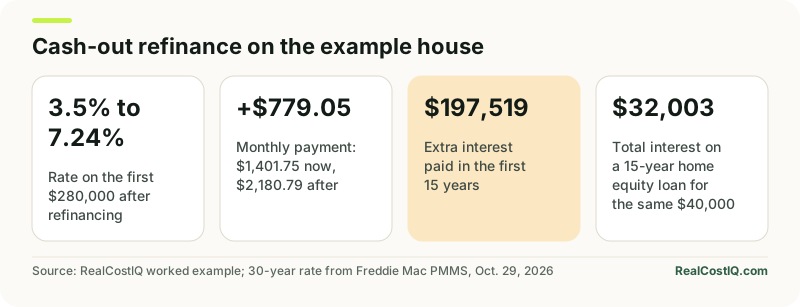
The $197,519 comes from comparing the two mortgages over the next 15 years. The old loan would have charged $114,068 of interest in that time. The new one charges $311,587. The difference is the price of borrowing the $40,000, and it is far more than the $32,003 a home equity loan costs. Most of it comes from the $280,000 you did not need to borrow again. The new loan also restarts a 30-year clock: after 15 years you would still owe $239,044, against $141,754 on the old loan.
This is not a rule that cash-out refinances are bad. It is a rule that they are priced on the whole balance. If your current mortgage is at 7% or higher, the extra rate on the old balance is small or zero and the argument flips: one closing-cost bill, one payment and a rate around the market average can beat a second loan at 8.76%. The calculation to run is the one above, with your own numbers and a Loan Estimate from a lender. Our guide to HELOC vs cash-out refinance sets out the test.
4. A personal loan
A personal loan is unsecured, so the house is not collateral. The Federal Reserve's G.19 shows 11.90% as the August 2026 average on 24-month loans at commercial banks. We use that rate as an illustration for longer terms too, which lenders may price differently. Over five years, $40,000 at 11.90% is a payment of $887.76 and total interest of $13,265.
The benefits are speed and simplicity. There is no appraisal and no lien on the home. You may qualify with little equity or with a house you do not want to risk. The cost is the rate, and the term: lenders usually offer shorter terms than home-equity products, so the payment is higher for the same amount.
5. Contractor or store financing
Financing offered by the contractor or by a retailer is the most variable option. The FTC's advice is blunt: do not accept financing through your contractor until you have compared loan options, and do not sign papers that are blank or that you have not read. It describes a common pattern in which the contractor arranges a high-rate home equity loan with points and fees and then leaves the job unfinished, having already been paid by the lender (the FTC's home improvement page, read Oct. 30, 2026). It also advises limiting up-front payments and making the final payment only after the work is done.
Store plans are a separate case. A "no interest if paid in full" offer on materials can cost $0 if you clear it by the deadline and thousands if you do not. Because the clause that matters is the retroactive interest, we cover it in its own post on deferred-interest financing for home improvements. Use it for a part of the job you can pay off on schedule, not as the funding for the whole $40,000.
Side by side: what each costs to pay off in five years
The options come with different terms, which makes comparison unfair. To level the field, the table below pays off the full $40,000 in 60 months with each product's rate held constant. That shows the price of the rate and nothing else. A longer term lowers the payment and raises the interest.
| Option | Rate | Monthly payment | Total interest | Secured by the house? |
|---|---|---|---|---|
| HELOC (rate held constant) | 7.36% | $798.86 | $7,932 | Yes |
| Home equity loan | 8.76% | $825.68 | $9,541 | Yes |
| Personal loan | 11.90% | $887.76 | $13,265 | No |
| Credit card | 22.36% | Not modeled | $8,944 in year one if the balance is not reduced | No |
Calculated by RealCostIQ with standard amortization. The HELOC row assumes the variable rate does not move, which will not be true. The credit card row is simple interest on $40,000 for one year (22.36% × $40,000) to show the scale; it is not a recommendation. Closing costs and fees are excluded from every row.
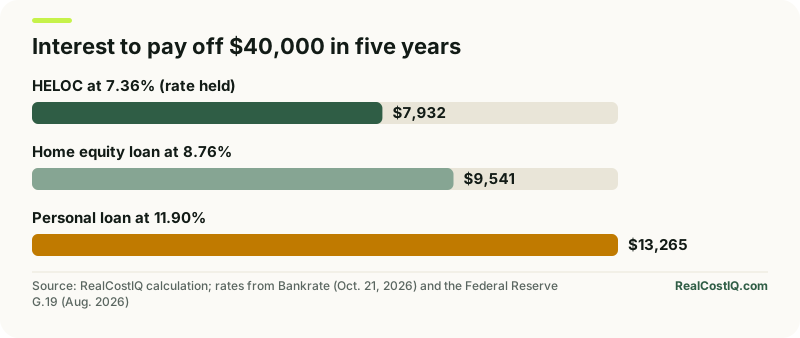
The personal loan costs $3,724 more than the home equity loan and $5,333 more than the HELOC, over five years. In exchange the lender cannot foreclose on your house. A lender with a lien can. The CFPB says that with either a home equity loan or a HELOC you would owe a second mortgage on top of your first, and it advises talking to a housing counselor before borrowing if you are already struggling to pay your mortgage. That risk is the real price of the lower rate, and it is why the personal loan is a legitimate choice for people who value the distance from the house.
How to choose: four questions in order
- What is your first mortgage rate? If it is well below the 7.24% market average, do not refinance it for a $40,000 job. Go to question 2. If it is at or above the market average, price a cash-out refinance against a second loan, and run both with a Loan Estimate in hand.
- How much equity do you have? Take 80% of your home's value and subtract your mortgage balance. If the result is less than your renovation budget plus a cushion for overruns, a second loan will not fit. That points to a personal loan, a smaller project, or phasing the work.
- Is the job fixed or open? A fixed-price contract with a deposit schedule fits a home equity loan or a draw on a HELOC. An open job, such as an old house where the walls may hold surprises, fits a HELOC because the unused part costs nothing.
- How does a rate move affect you? If a two-point rise in the HELOC rate would strain your budget, take the fixed loan. At 9.36% on a fully drawn $40,000 over 15 years, the HELOC payment rises from $367.63 to $414.32.
The renovation cost itself is the first number to pin down, because every loan above scales with it. The site's home renovation cost calculator and the guide on home renovation costs give ranges by room and scope. For your own payment and total interest under a HELOC, the HELOC calculator takes your balance, rate and term. A purpose-built renovation loan tool, the renovation loan calculator, compares several products on the same amount.
Before you sign anything
- Get at least three written bids first. The FTC recommends getting multiple estimates and a written contract before work starts. Our guide to reading a contractor quote shows what to look for in the line items.
- Ask each lender for a written estimate. For a second loan or a refinance, compare the annual percentage rate and the closing costs, not only the interest rate.
- Add a contingency. Older homes hide surprises. Size the loan or credit line with room above the contract price, and leave any unused credit unused.
- Pay in stages. The FTC says not to pay the full amount in advance and to make the last payment only after the work is done and you are satisfied.
- Know your cancellation rights. The FTC notes that a contract signed away from the seller's permanent business location should include a written right to cancel within three business days.
- Tax treatment is your own question. The IRS says in Publication 936 that interest on a home equity loan or HELOC is deductible only if the money was used to buy, build or substantially improve the home that secures the loan, and only if you itemize. See the IRS publication and a tax preparer for your own situation. This post does not model it.
What this does not cover
- Your approval and your rate. Averages assume a 700 FICO score and about 80% combined loan-to-value. A lower score or higher loan-to-value raises the rate, and some lenders will not lend at all.
- Fees. Closing costs, annual fees, appraisal fees and prepayment penalties are excluded from every figure. They can change the order of the options on a smaller loan.
- Variable rates. The HELOC rows hold the rate constant. The actual rate can move with the index each month or quarter, as the account agreement states.
- Construction loans and renovation mortgages. FHA 203(k), Fannie Mae HomeStyle and construction-to-permanent loans suit larger, structural projects. We cover them in the post on renovation loans.
- Paying cash. If you have the cash, the borrowing cost is zero, and the trade-offs of using savings are personal and outside this site's scope.
- Your first mortgage. The example assumes a fixed 3.5% loan with 25 years left. Your own rate, term and escrow can change the cash-out result a lot.