You found a rental. Two loan types keep coming up. One is a conventional investment loan, sold to Fannie Mae or Freddie Mac. The other is a DSCR loan, which looks at the rent instead of your pay stubs. Lender pages tell you the DSCR loan is flexible. They rarely tell you what the flexibility costs in dollars. This post does that for one example, with the numbers shown.
It does not teach the DSCR formula or how to run it on a deal. The DSCR calculator does that. It also does not explain why many rentals lose money at today's rates. The post on why rentals don't cash flow at 7 percent covers that. This post compares the two loans side by side: the monthly payment, the cash you bring to closing, and the fee you may owe if you sell or refinance early.
How each loan decides if you qualify
The two loans start from different questions. That is the root of every other difference in this post.
Conventional: your income and your debts
A conventional loan looks at you. The lender adds up your income and your monthly debts. It compares them as a share of income. That share is called the debt-to-income ratio, or DTI. The Fannie Mae Selling Guide, section B3-6-02, topic dated April 2, 2025, allows a DTI up to 50 percent for loans run through its automated underwriting system (DU). Loans underwritten by hand are capped at 36 percent, or up to 45 percent with enough credit score and reserves. A second section, B2-2-03, topic dated November 5, 2025, sets a limit of ten financed properties per borrower for DU investment loans, and it counts your own home if it has a loan.
That limit matters if you plan to build a portfolio. A buyer with two or three rentals will not notice it. A buyer with ten will. Each new loan also adds to your debts, so your DTI rises with every purchase.
DSCR: the rent and the payment
A DSCR loan looks at the house. Rize Mortgage's requirements page, dated April 6, 2026, says most lenders want a ratio between 1.0 and 1.25. For a vacant property, the lender uses the market rent from the appraiser. For a rented one, it uses the lower of the lease or the market rent.
Lenders differ on the exact formula. Some divide rent by the full monthly payment. That payment is principal, interest, taxes, insurance and any association dues, often shortened to PITIA. Others use net operating income divided by the loan payment. Ask which one your lender uses before you compare quotes. This post uses the simple version: rent divided by PITIA.
A forum lender in October 2023, in the BiggerPockets thread on conventional vs DSCR loans, gave two examples. In one, the full monthly payment with taxes and insurance was $2,200 and the rent was $2,000, so the ratio was 0.91. In the other, the full payment was $1,875 and the rent was $2,300, so the ratio was 1.23. The first house fails a 1.0 test. The second passes with room to spare. Your income never enters the math.
Down payment: 15 percent or 25 percent versus 20 to 25 percent
The down payment is the cash you put in at closing. The rest is the loan. Lenders describe the same split as a loan-to-value ratio, or LTV. A 75 percent LTV means a 25 percent down payment.
Crowdfunded Wealth reports that Fannie Mae and Freddie Mac both allow an 85 percent LTV on a one-unit investment purchase. That is 15 percent down. For a two-to-four-unit building the cap is 75 percent, so 25 percent down. A cash-out refinance on a one-unit rental is also capped at 75 percent. That page read the rules on October 10, 2026, and updated them on October 23. I could read Fannie Mae's Selling Guide today, but its Eligibility Matrix and Loan-Level Price Adjustment (LLPA) Matrix returned access errors. So the loan-to-value caps and the price adjustments in this post come from Crowdfunded Wealth. Check the live matrices before you rely on a number.
DSCR lenders set their own limits. Rize Mortgage lists 20 to 25 percent down as standard, and 30 to 35 percent when the ratio is under 1.0 or the credit score is near the floor. Ridge Street Capital, updated October 6, 2026, shows a maximum of 80 percent LTV on its long-term and short-term rental loans. Its page also says a 75 percent LTV prices lower than an 80 percent one.
| Loan | Typical down payment | Cash down | Loan amount |
|---|---|---|---|
| Conventional, one unit, lowest allowed | 15% | $60,000 | $340,000 |
| Conventional, two to four units | 25% | $100,000 | $300,000 |
| DSCR, standard | 20% to 25% | $80,000 to $100,000 | $320,000 to $300,000 |
| DSCR, ratio under 1.0 or weak credit | 30% to 35% | $120,000 to $140,000 | $280,000 to $260,000 |
Percentages from Crowdfunded Wealth (Oct. 23, 2026) and Rize Mortgage (Apr. 6, 2026). Dollar columns are RealCostIQ arithmetic on a $400,000 price.
Look at the first row again. A conventional loan can need less cash down than a DSCR loan. The catch is price. A smaller down payment on a conventional investment loan brings a larger loan-level price adjustment, a fee the lender builds into your rate or charges at closing. The same page lists the adjustment for an investor at 1.125 percent of the loan at 60 percent LTV or less, rising to 4.125 percent at 80 to 85 percent LTV. Its example is a borrower with a 740 credit score and a 75 percent LTV. The adjustments add up to 2.5 percent, which is $7,500 on a $300,000 loan.
Rate: how much more does a DSCR loan cost?
Nobody can give you one number for the rate gap, because the sources measure it differently. Here is what each source reports.
| Source and date | What it reports |
|---|---|
| Freddie Mac PMMS, Oct. 29, 2026 | 30-year fixed average of 7.24% for a standard owner-occupied loan. This is the starting line, not an investor rate. |
| Crowdfunded Wealth, Oct. 23, 2026 | 2025 federal home loan data, as reported in two pages. The conventional-loan page gives medians of 6.5% for owner-occupied, 7.25% for all investor loans and 6.99% for investor loans bought by the agencies. The DSCR page gives 7.25% for DSCR-type purchase loans and 7.375% for DSCR-type cash-out loans. |
| Ridge Street Capital, Oct. 6, 2026 | DSCR rental loans from 6.0% and up to 7.99% in its Q2 2026 table. Conventional investor loans 6.0% to 6.75%. It says DSCR "may price slightly higher" but gives no spread. |
| Rize Mortgage, Apr. 6, 2026 | DSCR rates "typically run 1% to 2% higher" than standard conventional investment property rates. |
| BiggerPockets, Oct. 3, 2026 reply | A lender says conventional rates are "generally lower" and carry no prepayment penalty. |
The sources disagree because they measure different things. Federal data covers loans that closed in 2025. Lender pages are marketing tables with no stated date for the quote. No source here states one clean gap. A lender page says 1 to 2 points, and the federal medians suggest less. Get your own quote.
The honest summary: the premium is real, it is not small, and it is not fixed. The federal medians mix strong borrowers with weak ones, and they do not isolate DSCR purchase loans from conventional ones. The highest figure comes from a lender's own marketing. Your quote will land somewhere between them, and it depends on four things you can see before you apply.
- Credit score. Ridge Street Capital says its pricing improves with every 20 points, up to 760.
- Loan-to-value. More down payment means a lower rate.
- The ratio. Ridge Street Capital says ratios above 1.2 get the lowest rates.
- The prepayment penalty. A longer penalty buys a lower rate. The next sections price that trade.
A worked example on a $400,000 rental
Here is one round-number case. The numbers are chosen to be clear, not to match a quote. Real rates will differ.
- Price: $400,000. Down payment: 25 percent, which is $100,000. Loan: $300,000, 30-year fixed.
- Conventional investor rate: 7.50 percent. That is Freddie Mac's 7.24 percent plus about a quarter point. Crowdfunded Wealth's table puts the 2025 investor median 0.49 to 0.75 points above the owner-occupied median, so this is a favorable conventional quote.
- DSCR rate: 8.25 percent with a 5-4-3-2-1 penalty. That is 0.75 points above the conventional rate, a smaller gap than the 1 to 2 points one lender page gives.
- Rent: $3,000 a month. Property tax: $400 a month. Insurance: $150 a month.
Before the formula, the plain idea. The loan payment is the part that changes with the rate. Taxes and insurance stay the same. So the rate gap shows up as a gap in the monthly payment, and it also lowers the DSCR ratio.
| Conventional, 7.50% | DSCR, 8.25%, 5-4-3-2-1 penalty | DSCR, 8.375%, 3-2-1 penalty | |
|---|---|---|---|
| Principal and interest | $2,098 | $2,254 | $2,280 |
| Plus taxes and insurance ($550) | $2,648 | $2,804 | $2,830 |
| Rent minus the full payment | $352 | $196 | $170 |
| DSCR ratio at $3,000 rent | 1.13 | 1.07 | 1.06 |
| DSCR ratio at $2,400 rent | 0.91 | 0.86 | 0.85 |
Payments use the standard 30-year loan formula. Cash flow here is before vacancy, repairs and management, so it is higher than real life. The 8.375% column adds the 0.125-point price of a shorter penalty that lenders reported in the BiggerPockets thread.
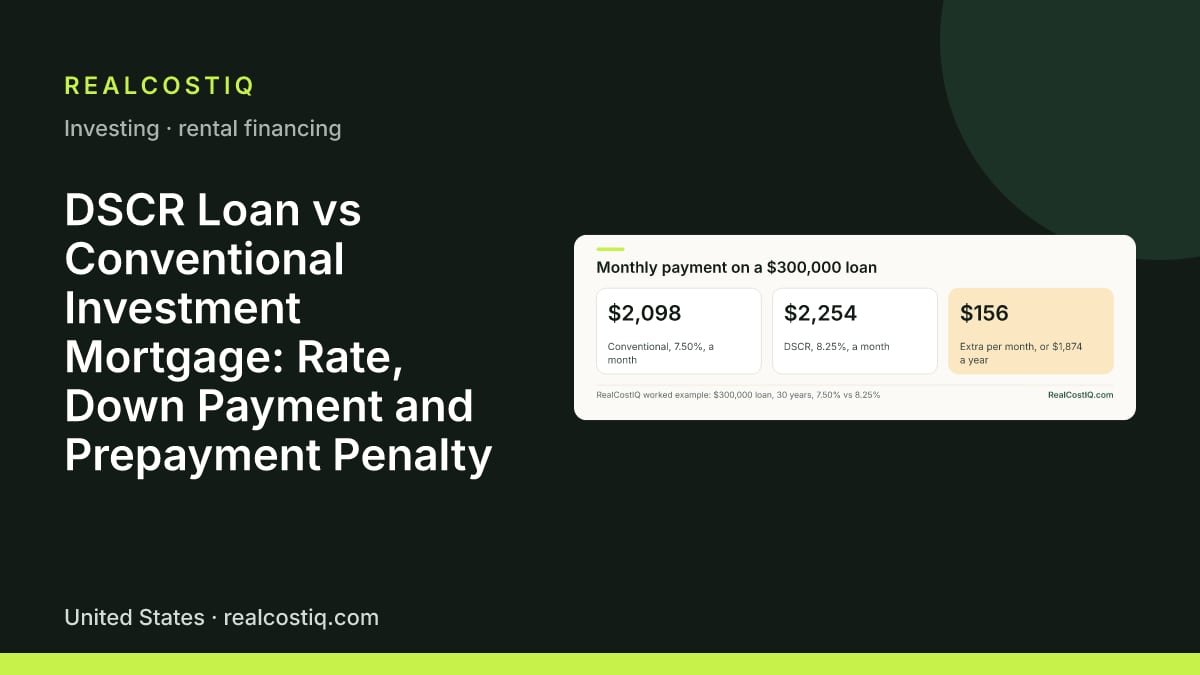
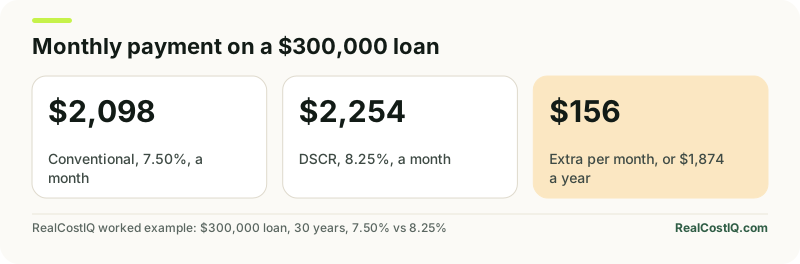
At $3,000 rent, both loan types pass a 1.0 test. The DSCR loan leaves you $156 a month worse off than the conventional loan: $2,254 against $2,098. That is $1,874 a year, or $9,369 over five years. The rent has to carry a heavier payment.
At $2,400 rent, the story changes. The ratio is 0.86 on the DSCR loan, below the usual floor. Some lenders offer loans under 1.0, but Rize Mortgage says those come with higher rates and larger down payments. The conventional loan at 0.91 is not a DSCR product, so that ratio does not apply to it. A conventional lender looks at your income. If your income is strong, you may still get approved even though the rent does not cover the payment. You would then pay the gap out of your own pocket every month.
The prepayment penalty, in dollars
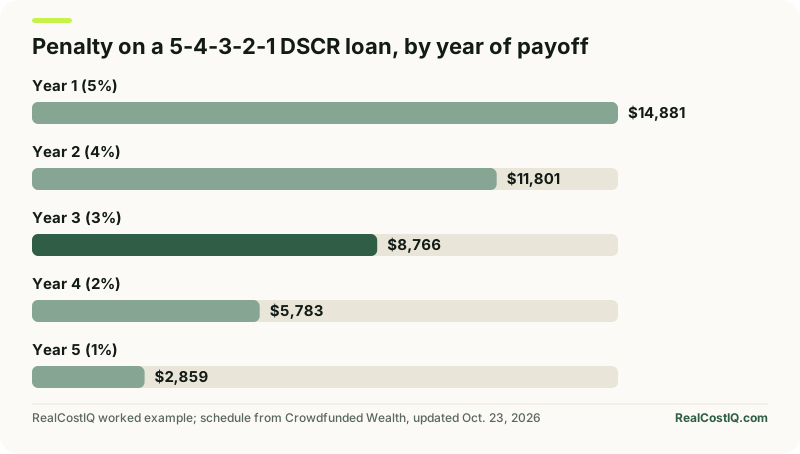
A prepayment penalty is a fee you owe if you pay the loan off early. Paying off means selling the house or refinancing into a new loan. Crowdfunded Wealth's refinance guide, published May 19 and updated October 23, 2026, calls the standard schedule a 5-4-3-2-1 step-down. The fee is 5 percent of the balance you still owe in year one, 4 percent in year two, then 3, 2 and 1 percent. After year five it is zero. The fee is taken from the balance at payoff, not from the original loan.
The same site's conventional-loan guide lists no prepayment penalty for conventional investment loans. A lender in the BiggerPockets thread said the same in October 2026.
Other penalty shapes
Lenders in the BiggerPockets prepayment thread (March 2024; anecdotal, and rates have moved since) listed several shapes. Most were 5-4-3-2-1 or 3-2-1. Others were a flat 5 percent for five years, or six months of interest, often on 80 percent of the balance. One lender said a no-penalty loan costs the 5-4-3-2-1 rate plus 1.125 points. Lenders quoted a 1-year penalty at 0.125 to 0.5 points of rate. A third said 3-2-1 costs about 0.125 points more than 5-4-3-2-1. Lenders also warned that some loans charge the fee on extra principal payments, not only on full payoff. Read that clause.
Some states limit these penalties. Posters in that thread named Alaska, New Mexico, Kansas and Pennsylvania (for small loans). That is lender talk, not law, so check your state before you count on it.
| Payoff in year | 5-4-3-2-1 at 8.25% | Loan balance (8.25%) | 3-2-1 at 8.375% | Loan balance (8.375%) |
|---|---|---|---|---|
| 1 | 5%: $14,881 | $297,616 | 3%: $8,930 | $297,674 |
| 2 | 4%: $11,801 | $295,027 | 2%: $5,903 | $295,147 |
| 3 | 3%: $8,766 | $292,216 | 1%: $2,924 | $292,399 |
| 4 | 2%: $5,783 | $289,165 | none | $289,411 |
| 5 | 1%: $2,859 | $285,852 | none | $286,164 |
| 6 and later | none | - | none | - |
The fee is shown on the balance at the end of the year, a simple stand-in for the balance on the day you pay off. Real fees will differ by a few hundred dollars.
The sum jumps out. Sell in year two and a 5-4-3-2-1 loan costs $11,801. That is more than a year of the entire extra payment. Crowdfunded Wealth makes a related point about refinancing. On its $300,000 example, a year-three refinance costs a $9,000 penalty. With $9,000 in closing costs added, the refinance needs about 49 months of savings to break even. A sale or refinance inside two years, it says, would destroy value.
Total extra cost: when does the DSCR loan stop hurting?
Now put the two costs together. The extra cost of the DSCR loan is the higher payment you make each month, plus the penalty on the day you leave. Compare that with the conventional loan at the same exit date. The table below does it for two penalty choices.
| Exit at end of year | Extra payments, 5-4-3-2-1 | Penalty, 5-4-3-2-1 | Total, 5-4-3-2-1 | Total, 3-2-1 |
|---|---|---|---|---|
| 1 | $1,874 | $14,881 | $16,755 | $11,121 |
| 2 | $3,748 | $11,801 | $15,549 | $10,285 |
| 3 | $5,622 | $8,766 | $14,388 | $9,497 |
| 4 | $7,496 | $5,783 | $13,279 | $8,764 |
| 5 | $9,369 | $2,859 | $12,228 | $10,954 |
| 6 | $11,243 | $0 | $11,243 | $13,145 |
| 7 | $13,117 | $0 | $13,117 | $15,336 |
Extra payments are the monthly gap to the 7.50% conventional loan ($156 a month at 8.25%, $183 a month at 8.375%). They are mostly extra interest. The 3-2-1 total includes its own penalty (3%, 2%, 1% of the balance).
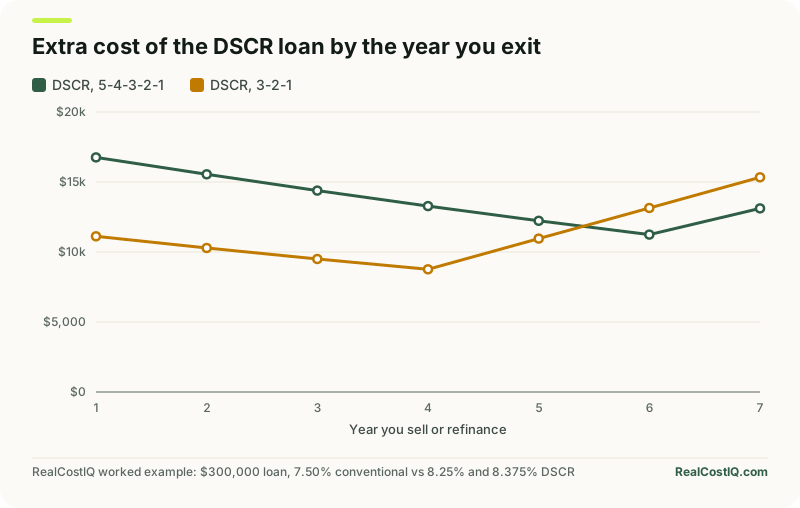
Three things stand out. First, the extra cost never drops to zero while you hold the loan. It is at least $11,000 for any exit on the 5-4-3-2-1 loan, and at least $8,700 on the 3-2-1 loan. That is the price of not qualifying on income. If you qualify conventionally, you are paying thousands of dollars for flexibility you did not need.
Second, the lowest-rate choice is not always the cheapest. A 5-4-3-2-1 loan wins only if you hold six years or longer. If you think you might sell, refinance or switch lenders in three years, the 3-2-1 choice saved about $4,900 here: $9,497 against $14,388. Third, after the penalty ends, the cost keeps growing at the monthly gap. In year seven the extra cost is $13,117 on the cheaper-rate loan. Every year you stay adds $1,874. A DSCR loan you keep a long time is expensive even with no penalty.
When each loan makes sense
A conventional loan usually wins when
- You are a W-2 employee with steady pay and a DTI that leaves room. The BiggerPockets replies lean this way: most respondents recommend conventional if you qualify on income, because the rate is lower and there is no prepayment penalty.
- You have fewer than ten financed properties.
- You may sell or refinance within five years. No penalty means you can move when rates drop.
- The rent is weak. A DSCR ratio under 1.0 pushes you into higher rates and larger down payments.
A DSCR loan can win when
- You are self-employed and your tax returns show low income after write-offs. A conventional lender counts what is on the return.
- You have hit the ten-property limit, or your DTI is full.
- You want the property in an LLC. The BiggerPockets poster who answered on this topic said DSCR loans suit LLC ownership, BRRRR refinances and borrowers who cannot qualify on income. BRRRR means buy, rehab, rent, refinance, repeat.
- You expect to hold for six years or more, so the penalty is a sunk cost that has already run out.
A DSCR loan is a tool for a specific problem. It is not a smarter version of the same loan. If you do not have that problem, you pay for a fix you do not use.
Seven questions to ask before you pick
- What is the rate with a 5-4-3-2-1 penalty, a 3-2-1 penalty and no penalty? Ask for all three on one page. The BiggerPockets lenders said the spread between them runs from about 0.125 points to more than a point of fees.
- How is the ratio calculated? Rent over PITIA, or net income over the loan payment? The answer can move you across the 1.0 line.
- Which rent do you use: the lease or the appraiser's market rent? Rize Mortgage says it is the lower of the two on a rented house.
- Does the penalty apply to extra principal payments, or only to a full payoff?
- Is the penalty waived if I refinance with you? One lender in the BiggerPockets thread said theirs is.
- Does my state limit the penalty? Ask the lender to say so in writing.
- What are the points and fees? A lower rate sold with points can cost more than the table shows.
Then run your numbers on the investment property cash flow calculator with each rate, and check the price against the cap rate calculator. The cap rate ignores financing, so it tells you whether the house is a fair buy before the loan changes the picture. If the deal only works on the lower payment, the loan is carrying the deal, and that is the moment to slow down.
What this example leaves out
- Closing costs and points. A DSCR loan may charge origination points. A conventional loan may charge the loan-level adjustments described above. Both change the cash you need.
- Reserves. Crowdfunded Wealth lists six months of the new payment for a conventional investment loan, plus more for other financed properties. Rize Mortgage lists 3 to 6 months of PITIA for DSCR. Cash set aside is cash that is not earning anything.
- Interest-only and other payment plans. Many DSCR lenders offer them. They lower the payment and change the ratio.
- Rate moves. If rates fall by a point, a conventional owner can refinance for free. A DSCR borrower in year two faces a fee first. Crowdfunded Wealth's own example refinances a 9.25 percent loan to 7.5 percent and still needs about four years to pay back the fees.
- Taxes. Interest on a rental is generally deductible against rent. That helps both loans. It is outside this post, which is about the loan.
Source quality is mixed. Two of the pages come from a content site and a lender's marketing blog. The federal home loan data they cite is the strongest number in the post, and even that covers loans that closed in 2025. The forum posts are lenders talking, with a self-interest in selling the loan. Treat all of it as a range to test, and let a written quote settle the question.