The inspection report came back with the words "foundation crack." Your stomach drops. You have a few days left on your inspection deadline, a signed contract and a house you may love. This post gives you a plan for those days: who to call, what a crack can mean, what the repair might cost, and how to turn the answer into a price cut or a walk-away.
It does not repeat how to read a repair quote. The guide on what a foundation repair estimate covers does that line by line. This post is about the buying decision that comes first.
What the inspector can and cannot tell you
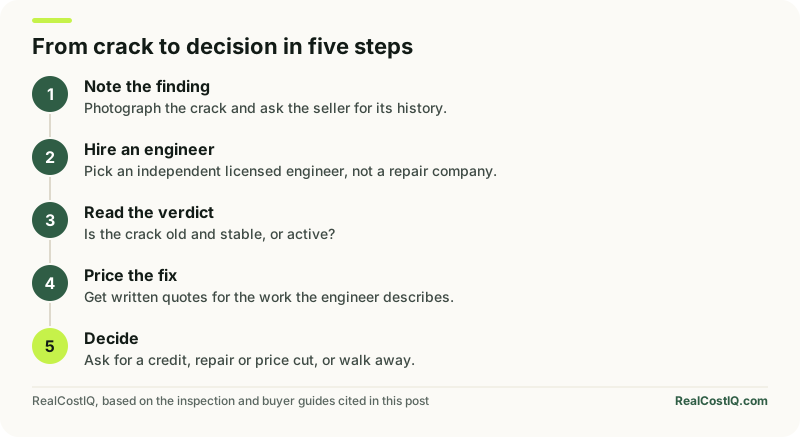
A home inspector looks at the whole house in a few hours. When the inspector sees a crack, the job is to point it out, not to explain it. The report often says something like "recommend evaluation by a structural engineer." That line is not a verdict. It means the inspector was not willing to judge the crack.
An inspection guide from InspectAndTest, published June 4, 2026, draws the line this way. The inspector spots signs of trouble. A licensed engineer decides what caused them, how serious they are and what repair is needed. The same guide says to escalate to an engineer when the inspector finds large foundation cracks, walls that bow or lean, sagging floors, doors or windows that no longer line up, or cracks wider than about a quarter inch with one side pushed out of line (InspectAndTest, home inspection and the structural engineer).
That list matters because it moves you away from the crack alone. A crack is one clue. The doors, the floors and the walls around it are other clues. A real-estate guide, last updated October 13, 2026, makes the same point. It says crack width and direction should never be judged alone, and it asks you to look for sloping floors, sticking doors, gaps around windows, and walls pulling away from ceilings (Best Utah Real Estate, foundation cracks: what to check first).
Cosmetic crack or active movement
Think of two groups. The first group is cosmetic. These cracks formed when the concrete dried and shrank, or when a new house settled a little in its first years. Then they stopped. They may let in a little water, but the house is not shifting. The second group is active movement. The soil under part of the house is giving way, or water or soil is pushing on a wall, and the crack grows over time.
The same real-estate guide lists the kinds of cracks you may see. Settling or curing cracks form as concrete dries or a building settles. Stair-step cracks run through brick or concrete block, usually along the mortar lines. Other cracks come from water pressure, weak soil or poor drainage, from digging nearby, or from broader movement that leaves parts of a wall bulging or out of line. It also says a crack that comes back through an old patch, or a new crack beside an old one, points to movement that is still going.
| What you see | What it may mean | What to do |
|---|---|---|
| Thin vertical hairline, no other signs | Often shrinkage or early settling; can let in water | Mention to the engineer; seal and watch |
| Stair-step crack through block or brick | May point to settling or soil that is giving way | Engineer visit before the deadline |
| Horizontal crack along a basement wall | Often soil or water pushing on the wall | Engineer visit; treat as a serious sign until ruled out |
| Wall that bows inward | Wall is being pushed; may keep moving | Engineer visit; expect a repair quote |
| Crack plus sloping floors or sticking doors | Movement may reach the whole house | Engineer visit; ask for a written report |
| Old crack, patched, now reopened | Movement may still be active | Ask the seller for repair history; engineer visit |
General patterns drawn from the inspection guides cited in this post. Only an engineer who sees the house can tell you what a given crack means.
Federal housing rules treat the same ground the same way. HUD's NSPIRE foundation standard, used to inspect federally assisted housing, counts a crack as deficient when it is a quarter inch wide or more and 12 inches long or more (HUD, NSPIRE Standard: Foundation). It is a rule for a different job, not a home-buying rule, so do not use it as a pass-fail test on your house. It is useful because it shows that people who inspect buildings for a living measure both width and length, and they treat larger cracks as a sign to look at the structure.
Do not judge by width alone
A hairline crack that opened last week worries engineers more than a wider crack that has not changed in ten years. What matters is the trend. Ask the seller when the crack first appeared, whether it has been patched, and whether any dated photos exist. Ask your agent to request any repair invoices. A crack that has been the same in five years of photos is good news. A crack with no history at all is an unknown, and unknowns are what the engineer is for.
Hire the engineer before the deadline
Your contract gives you a set number of days to inspect and to object. After that, you lose the easy way out. So the first move is to book an independent engineer, today if you can. In the InspectAndTest guide, the buyer usually pays for this, because the visit is part of the inspection period. Give the engineer the inspection report and photos in advance. The home inspection cost calculator shows what the rest of your inspection budget looks like.
This Old House, in a cost guide updated June 5, 2026, puts the average foundation inspection by a structural engineer at about $600, with a typical range of $300 to $1,000. Engineers charge $100 to $500 an hour, and most visits take one to two hours (This Old House, foundation inspection cost). The InspectAndTest guide says $400 to $800 for a standard home visit in its Colorado Front Range market. Extra drawings or analysis cost more. The site's foundation repair cost calculator carries a wider range for an engineer's report, $300 to $2,000, because some jobs need testing.
Think of it this way. An engineer's visit costs about 0.2 percent of a $300,000 house. It buys you a written opinion that can change the price by tens of thousands of dollars. It also might say the crack is fine, and then you proceed with a clear mind.
Who not to call first
Foundation repair companies often offer a free inspection. Be careful. The InspectAndTest guide warns that a contractor earns money by recommending repairs, so the visit is not independent. Use a contractor to price the fix the engineer describes, not to decide whether a fix is needed. Redfin's buyer guide, written July 31, 2025, gives the same order of steps. Hire a licensed structural engineer, not just a general home inspector, ideally during due diligence. Then get a quote from a reputable repair company to learn the likely cost and how invasive the work will be (Redfin, when to walk away from foundation issues).
What the repair might cost
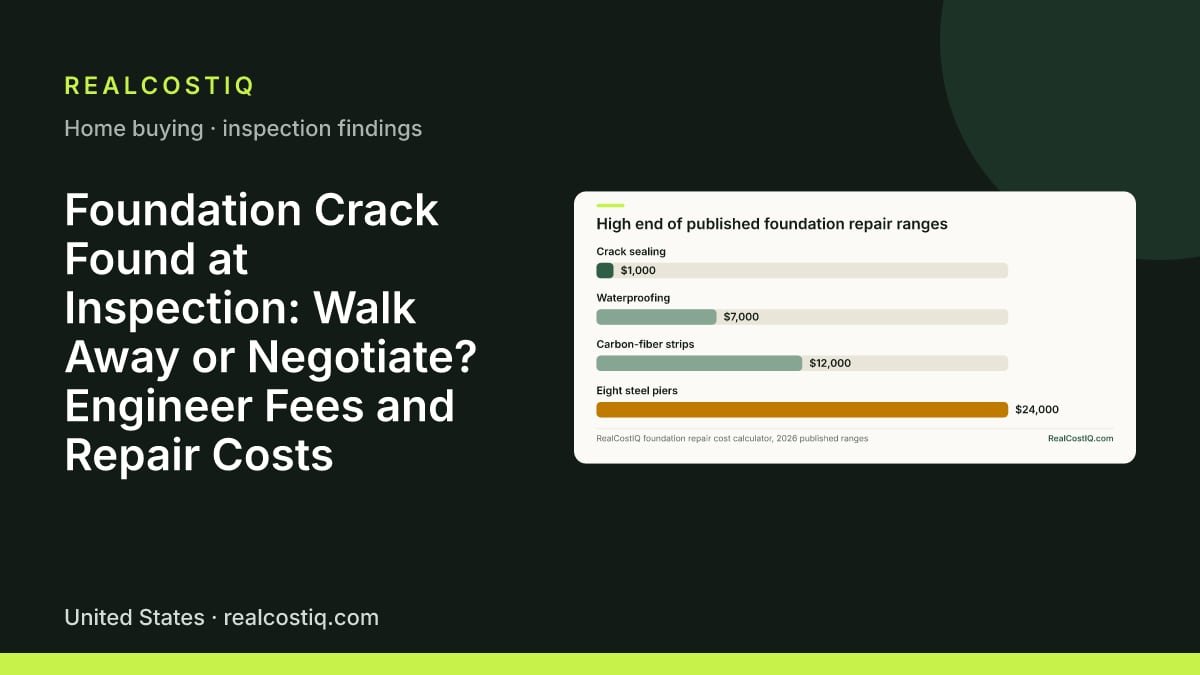
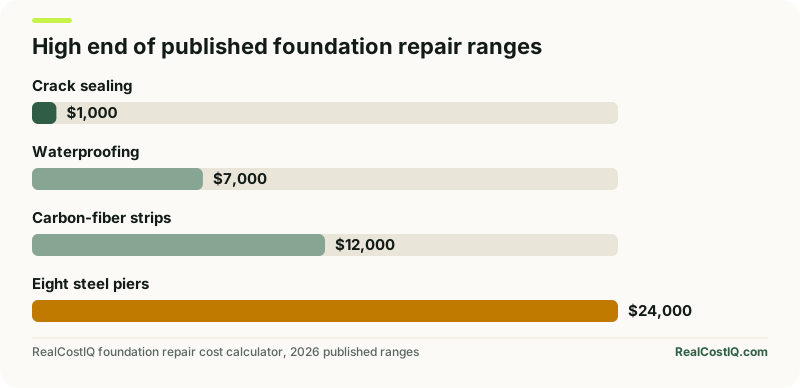
Foundation repair is not one price. A thin crack can be sealed for a few hundred dollars. A settled corner can need steel piers driven under the house. The site's calculator draws on 2026 published ranges. It shows crack sealing or epoxy injection at $200 to $1,000, waterproofing and sealing at $2,400 to $7,000, carbon-fiber strips on a bowing wall at $4,000 to $12,000, and steel piers at $1,000 to $3,000 for each pier. Eight piers therefore cost $8,000 to $24,000. A house that needs lifting and leveling can run $20,000 to $30,000. Use the calculator for your own scope. It also lists the engineer, the permit and drainage work as separate lines.
The site's calculator uses a three-tier ladder to show the stakes. Minor, early-stage work runs $250 to $800. Moderate work with no major structural damage runs $1,000 to $12,000. Major shifting or widespread damage runs $15,000 to $100,000 or more. The InspectAndTest guide gives the high end: piering projects can run $10,000 to $40,000 or more. Those ranges overlap and the sources disagree at the edges, which is one more reason to get written quotes for the actual work.
A worked example: the same crack, three answers
Say you are buying a $350,000 house. The inspector flags a foundation crack. You hire an engineer for $600. Here are three things the report might say, and what each would mean for you. The repair numbers use the calculator ranges above.
| Engineer says | Likely repair | Likely cost | What to do |
|---|---|---|---|
| Old shrinkage crack, no movement | Seal the crack | $200 to $1,000 | Proceed; ask for a small credit if you want, or seal it yourself |
| Stair-step cracking and settling at one corner; movement is bounded | Six steel piers | $6,000 to $18,000 | Negotiate: a credit, a price cut, or a repair done before closing with a re-inspection |
| Active, ongoing movement with an unclear cause | Unknown until the cause is found | $15,000 to $100,000 or more | Strong reason to walk away unless the seller fixes it and an engineer signs off |
Hypothetical house. Six piers at $1,000 to $3,000 each is $6,000 to $18,000. Costs are published ranges, not a quote for any house.
In the first case you did the right thing and spent $600 to learn you can relax. In the second case you have a clear dollar range to bring to the seller. In the third case the cost is not a number yet. The cause is unknown, so any quote is a floor, not a ceiling. A walk-away is not a failure there. It is the contract working as it should.
What walking away costs
If you cancel inside your inspection period under the contract's contingency, you usually get your earnest money back. Your cost is what you spent on checks. One Substack write-up from May 18, 2026, about a $245,000 rental, counted about $400 for the general inspection and $550 for the engineer, or about $950 in fees, as the price of walking away (Sophia W., foundation cracks found at inspection). Your contract and state law decide the details, so read your own contingency terms and ask your agent or attorney.
How to ask for money, a repair or a lower price
Once you have the engineer's report and at least one written repair quote, you have three ways to ask. They each work in different places, and the right one depends on the repair and your loan.
- A lower price. You ask the seller to reduce the price by the cost of the work, or more if the cause is uncertain. This is clean. You take the money and handle the repair yourself on your own schedule. It also helps with your loan because the lower price shrinks what you borrow.
- A repair credit. The seller gives you money at closing. Lenders limit how much of the sales price a seller may give back, so check the limit for your loan type first. The post on repair credits after a home inspection covers those caps and how to word the ask.
- A repair by the seller before closing. This sounds simple but needs care. Ask for the engineer's scope in writing. Use a licensed contractor with permits where your area requires them. Then have the engineer or another independent person check the finished work. Redfin advises verifying seller repairs with a third-party re-inspection before or shortly after closing.
Redfin also says foundation problems can justify large price cuts, even in a hot market, and it flags a seller who did not disclose a known problem as a red flag. Whatever you ask, put it in writing before your deadline, attach the report, and ask the seller to reply in writing. A verbal promise will not protect you.
The Substack write-up shows how a buyer worked through this for a rental. A $15,000 repair on a $245,000 house, taken as a credit, lowered the effective price to about $230,000 and kept the buyer's return near the original plan. The author's rule was to negotiate only if the engineer showed the movement was bounded and stable. If the report described active, ongoing movement with an unclear cause, the $15,000 was only a floor, and the advice was to walk. That is one writer's view, not a rule. It does match the order of the advice in the other guides.
When walking away is the better call
Walking away feels like losing, but it can be the best result. Redfin lists situations where it makes sense. The repair cost is high compared with the home's value, which it treats as a warning when it is roughly 20 to 30 percent of the value. On a $350,000 house that is $70,000 to $105,000. Other reasons it lists: you would have to drain your savings or take on heavy debt to make the home livable, the house has other large problems such as an old roof, you are in a flat or falling market, or you need a move-in-ready home on a short timeline.
Add to that list a seller who refuses to cooperate. If the seller will not share repair history, will not let an engineer in, or will not put a credit in writing, you are buying a risk you cannot measure. Ask yourself one test question. If the engineer's worst-case cost happened, could I pay it and still sleep at night? If the answer is no, the deal is too tight.
How your loan can change the answer
The loan matters because the lender has to be satisfied with the house, not just you. Redfin notes that FHA, VA and USDA loans generally require a structurally sound home. Conventional loans have more room, but an appraiser may still flag a major foundation problem. The HUD handbook for FHA loans, in the Update 18 version revised August 12, 2026, tells the lender to confirm the structure and all foundations will be serviceable for the life of the mortgage and strong enough for normal loads (HUD, Single Family Housing Policy Handbook 4000.1).
In plain terms, a house with active foundation movement may not get approved, or the lender may ask for repairs first. Tell your loan officer about the report early. If the lender needs the repair done before closing, that changes who must act and when. A closing date can slip while repairs and re-inspection happen, so ask the seller to agree to a later date in writing.
Questions to ask the seller
- When did you first see the crack? The answer, and any dated photos, tell the engineer whether it is changing.
- Has it ever been repaired? Ask for invoices, permits, warranties and the contractor's name. A repair that failed is worse news than none.
- Does the basement or crawl space ever get wet? Water pushing on a foundation is a common cause of cracks. The same real-estate guide asks about dampness, mineral deposits, rust, mold smells and whether gutters and grading move water away from the house.
- Was there work or digging nearby? The same guide notes that digging, underpinning or demolition next door can cause cracks, and timing helps explain the cause.
- Will you let an engineer in, and will you review the report? A seller who agrees is more likely to bargain in good faith.
What this post does not cover
- Your house. Soil, climate, house age and foundation type change what a crack means. Slab, crawl space and basement foundations behave differently. Treat the table and the cost ranges here as a guide, not a diagnosis.
- Legal advice. The rules on contingencies, disclosure and refunds differ by state and by contract. Ask your agent or a real estate attorney what your deadline is and what it protects.
- Repair quotes. The cost ranges come from published 2026 sources, not from a contractor who has seen your house. Use written quotes for any real decision.
- Insurance. Standard homeowners policies often exclude settling and ground movement. Ask your insurer before you close if the foundation has a known problem.
A short checklist
- Count the days left on your inspection deadline today.
- Book an independent structural engineer, not a repair company.
- Send the engineer the inspection report and your own photos.
- Ask the seller for the crack's history, repair records and any dated photos.
- Get at least one written quote for the work the engineer describes.
- Tell your loan officer about the report.
- Ask in writing for a credit, a price cut or a repair, with the report attached.
- If the report shows active movement with no clear cause, be ready to walk.