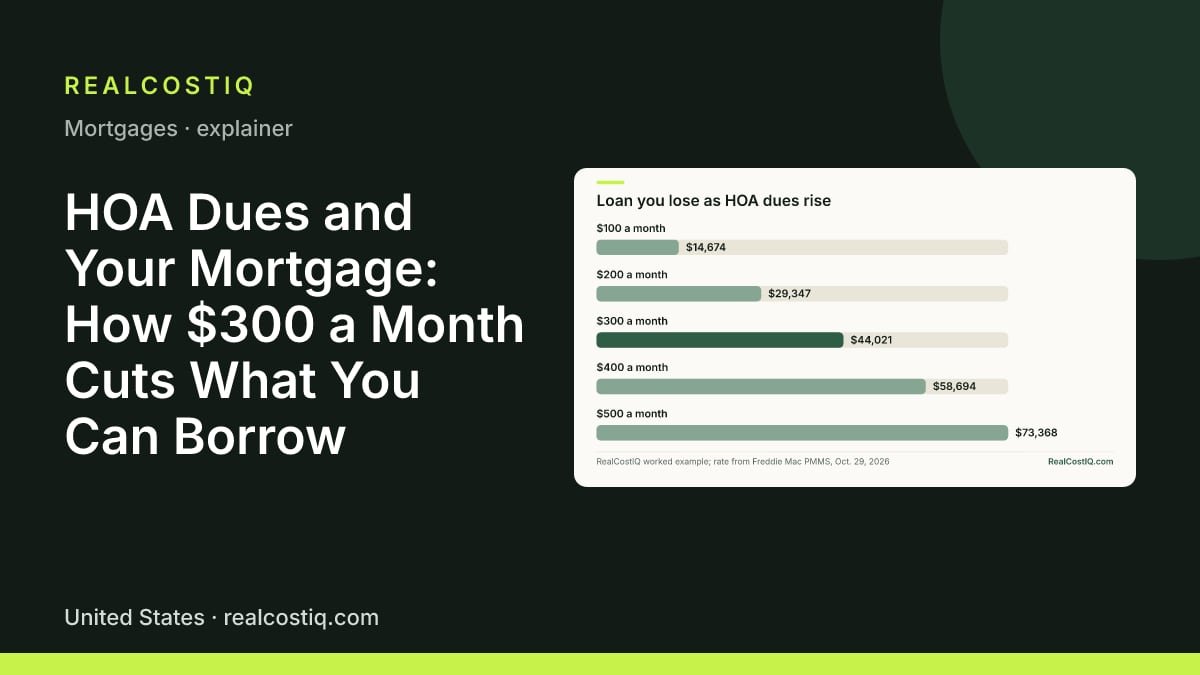
You find a condo you like at a price you can afford. Then the listing shows $300 a month in association dues. Your lender will treat those dues like part of your mortgage payment when it decides how much you can borrow. This article shows how much that costs in loan size, using round numbers you can follow. It also covers special assessments, the extra bills an association can charge owners, and where the rules come from. For typical dues in your area, see the HOA costs topic page. This article is about the effect on your borrowing, not the average fee.
Do HOA dues count in debt-to-income? Yes
A homeowners' association, or HOA, is a group that runs a shared community. Fannie Mae's glossary says the term also covers common-interest community associations, co-op corporations and similar groups. Fannie Mae is the government-sponsored company that buys many home loans from lenders. Its rules shape most conventional mortgages.
Fannie Mae's Selling Guide, section B3-6-03, says the monthly housing expense for the home you are buying is what lenders call PITIA. That stands for principal, interest, taxes, insurance and other costs. The list in that section includes homeowner's insurance, real estate taxes, mortgage insurance, ground rent, special assessments and owners' association dues. The section carries a December 16, 2020 revision date. So the dues are not a side cost. They sit in the same list as your tax and insurance.
The guide also says which utilities count. If the dues pay for utility charges that serve the common areas, they count as dues. Utility charges that apply to your own unit are excluded. If your dues include your water bill, for example, ask the association for a split. Under this rule, the unit part may not count.
Most buyers pay dues straight to the association. The Consumer Financial Protection Bureau, or CFPB, says condo and HOA fees are usually not part of your mortgage payment. You pay them to the HOA. A servicer may agree to add them to escrow if you ask, but that is uncommon. The CFPB page was last reviewed on September 11, 2024. It also says to factor the dues into your affordability. That is what this article does.
How debt-to-income works
The CFPB defines debt-to-income as all your monthly debt payments divided by your gross monthly income. Gross means before taxes. It adds that different loan products and lenders have different limits. The page was last reviewed on August 28, 2023.
For loans that follow Fannie Mae rules, section B3-6-02 sets the caps. It is dated April 2, 2025 in the guide, which was published October 7, 2026. The maximum DTI is 36 percent for manually underwritten loans, 45 percent for manual loans that meet the credit score and reserve rules in the guide's matrix, and 50 percent for loans run through its Desktop Underwriter system. Desktop Underwriter is Fannie Mae's automated review. Reserves are savings left after closing. Your lender may set lower caps than these.
For a full side-by-side of caps by loan type, see our post on debt-to-income limits by loan type. To test your own numbers, use the DTI calculator. It takes HOA dues as an input.
FHA loans count dues the same way. HUD's FHA handbook, 4000.1 (Update 18, August 12, 2026), lists HOA or condominium association fees or expenses and special assessments in the borrower's total mortgage payment. It does this for both automated and manual underwriting (sections II.A.4.a and II.A.5.d.vii(B)). It also lets the lender subtract the part of a condo fee that clearly pays for utilities, if you document it. FHA's ratio caps are in our debt-to-income limits post.
A worked example: $300 a month at 7.24%
Here are the inputs. They are made up and kept round. Freddie Mac, another large buyer of home loans, reports its weekly survey of lenders. For the week of October 29, 2026, the 30-year fixed rate averaged 7.24 percent. The prior week it was 7.32 percent. Your own rate will differ.
- Gross income: $9,000 a month ($108,000 a year).
- Other debts: $500 a month, such as a car loan and a student loan.
- Property tax and homeowner's insurance: $600 a month, the same in both cases so the only change is the dues.
- DTI cap: 45 percent.
- Loan: 30-year fixed at 7.24 percent.
Step 1: the cap. Forty-five percent of $9,000 is $4,050 a month for all debt and housing together. Step 2: subtract the other debts. $4,050 minus $500 leaves $3,550 for housing. Step 3: subtract tax and insurance. $3,550 minus $600 leaves $2,950 for principal and interest. Step 4: turn the payment into a loan. At 7.24 percent over 30 years, each dollar borrowed costs about $0.006815 a month. So $2,950 divided by 0.006815 gives a loan of $432,870.
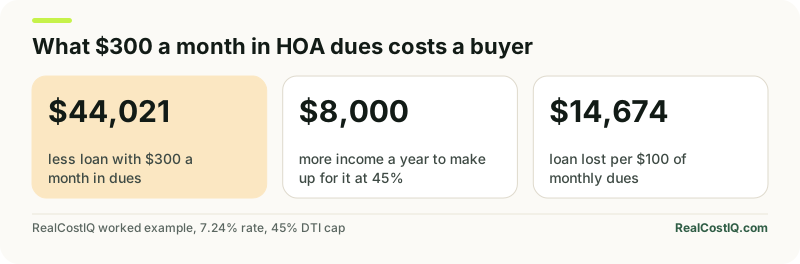
Now add $300 in dues. They come out of the same $3,550. That leaves $3,250 for housing, and $2,650 for principal and interest after the $600 of tax and insurance. Divide $2,650 by the payment factor (about 0.006815). The loan is about $388,849. The dues cut the loan by $44,021.
| Monthly HOA dues | Room for principal and interest | Maximum loan | Loan lost versus no dues |
|---|---|---|---|
| $0 | $2,950 | $432,870 | $0 |
| $100 | $2,850 | $418,196 | $14,674 |
| $200 | $2,750 | $403,523 | $29,347 |
| $300 | $2,650 | $388,849 | $44,021 |
| $400 | $2,550 | $374,176 | $58,694 |
| $500 | $2,450 | $359,502 | $73,368 |
Hypothetical borrower: $9,000 gross monthly income, $500 other monthly debts, $600 tax and insurance, same in every row. Loan = room for principal and interest divided by the 30-year payment factor at 7.24% (about 0.006815). Dollar amounts are rounded to the nearest dollar.
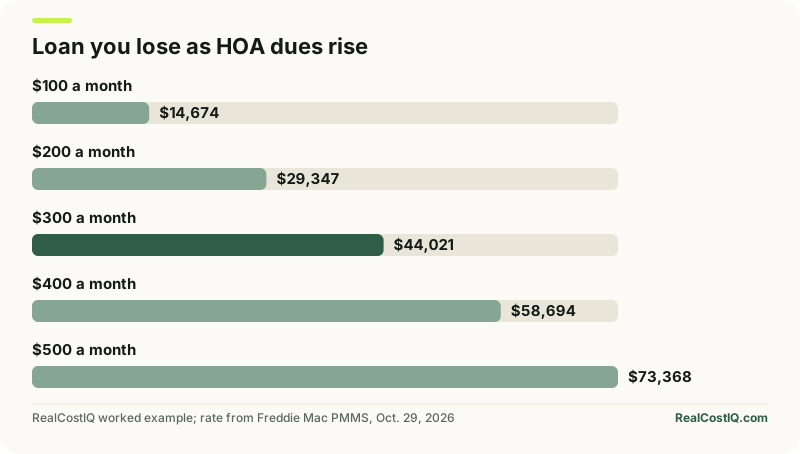
The size of the loss comes from one idea. The monthly payment is fixed at 7.24 percent for 30 years. Every dollar of dues takes a dollar from the payment room. Then 1 divided by 0.006815 is about $146.74. So each dollar of dues removes $146.74 of loan, and each $100 removes $14,674.
A higher DTI cap does not shrink the loss
A common guess is that a looser cap protects you from dues. It does not. A higher cap gives you a bigger loan to start with. But the dues still take the same dollars from it. The table repeats the example at four caps.
| DTI cap | Maximum loan, no dues | Maximum loan, $300 dues | Loan lost | Extra income needed to undo it |
|---|---|---|---|---|
| 36% | $314,014 | $269,993 | $44,021 | $833 a month ($10,000 a year) |
| 43% | $406,457 | $362,437 | about $44,021 | $698 a month ($8,372 a year) |
| 45% | $432,870 | $388,849 | $44,021 | $667 a month ($8,000 a year) |
| 50% | $498,901 | $454,880 | $44,021 | $600 a month ($7,200 a year) |
Same inputs as the first table. Extra income = $300 divided by the cap, shown per month and per year. Loan lost is the same at every cap; the 43% row differs by $1 only through rounding.
The last column shows what it takes to cancel the dues. At a 45 percent cap, you would need $667 a month more in income, or $8,000 a year. That is because only 45 cents of each extra income dollar can go to debt and housing. The lower the cap, the more extra income you need.
Debt and dues cost you the same
A $100 car payment and $100 of HOA dues use the same DTI room. Both remove $14,674 from the loan in our example. So paying off a small loan can offset dues almost dollar for dollar. If you pay off a $300 monthly debt, you win back the $44,021. Check that the debt will really be gone before you apply, because the lender counts what is on your credit report.
How big are typical dues?
Dues vary a lot. The Census Bureau's 2024 American Community Survey, published September 11, 2025, found about 21.6 million of 86.6 million owner households paid condo or HOA fees. The national median was $135 a month. Households with a mortgage had a median of $120, and those without one had $184. About 5.6 million homes (26 percent) paid under $50. About 3 million paid more than $500.
The same release says New York had the highest share of owners paying over $500, at 64 percent. A median of $135 costs about $19,810 of loan in our example ($135 times $146.74). A $500 fee costs $73,368. In a high-dues area, dues can matter as much as the price. For state-level averages, see the HOA costs topic.
Special assessments: the other bill
A special assessment is a one-time or time-limited charge on owners, on top of regular dues. Associations use them to pay for big repairs, like a roof, or to fill a short reserve fund. Fannie Mae's PITIA list names special assessments next to association dues. So does FHA's. The section gives no further detail on how a payment plan is counted. So how a lender counts one is the lender's call. Ask early.
For the building as a whole, Fannie Mae has a firmer rule. Section B4-2.1-03, revised August 5, 2026, says lenders must review each current or planned special assessment to see if it pays for a critical repair. The lender needs its purpose, approval date and status, original and remaining amounts, and expected payoff date. If an assessment is tied to a critical repair and the problem is not fixed, the project is ineligible. Routine repairs paid by assessment within the guide's limits are not treated as critical.
For you, this means two risks. First, an assessment may raise the monthly cost the lender counts. Second, an unfixed critical repair can make the whole building unfinanceable with a Fannie Mae loan, so the loan may not close at all.
Here is a simple case. Suppose a $12,000 assessment is billed over 24 months. That is $500 a month. If a lender counts it in full, the loss matches the $500 row above: $73,368 less loan. If the lender counts only the dues and leaves out the assessment, the loss is smaller. The first answer is the cautious one. Ask which one your lender uses.
| Ask | Who | Why it matters |
|---|---|---|
| Is any special assessment current, approved or planned? | HOA or seller | A planned bill raises the monthly cost you carry |
| What is it for, and how much is left? | HOA | Fannie Mae reviews the purpose, original amount and remaining amount |
| Is the repair finished? | HOA | An unfixed critical repair can make the project ineligible |
| How will you count the assessment in my DTI? | Lender | Lenders differ, and it changes your loan size |
Five ways to offset dues
- Pay off or pay down debts. One dollar of monthly debt removed offsets one dollar of dues. A $300 loan payment gone is worth $44,021 of loan in our example.
- Add income. A co-borrower with income, or documented extra income, raises the cap in dollars. At a 45 percent cap, $667 a month more offsets $300 in dues.
- Compare homes by total monthly cost. A cheaper condo with high dues can cost more than a pricier house with none. Use the mortgage affordability calculator with dues included, not just price.
- Ask for the utility split. If the dues include utilities for your own unit, Fannie Mae's guide excludes that part. Get it in writing from the association.
- Check the budget, not just the dues. Dues that are too low may signal a thin reserve fund and a future assessment. Condo projects get their own review under Fannie Mae's project rules, so look at the association's finances before the lender does.
What this example leaves out
- Rates move. The 7.24 percent figure is one weekly average. A different rate changes the $146.74 per dollar, so the loss changes too.
- We held other costs flat. In real life, a condo and a house with the same loan carry different tax and insurance. We kept $600 constant to show the dues alone.
- Mortgage insurance and down payment are not modeled. They change the payment and, for a given price, the loan. Our example sizes the loan, not the price.
- Lenders can be stricter. Fannie Mae sets maximum ratios. Your lender may set lower ones, and credit score and reserves affect which cap you get.
- FHA counts dues too, but its caps differ. We quote FHA's dues rule, not its ratio caps.
The bottom line: treat HOA dues as part of the payment from the first day you shop. Divide the dues by the monthly payment factor to see the loan they cost you, or use the DTI calculator and enter the dues. Then ask about assessments before you make an offer.