You have equity in your house and a bill to pay. A roof, a kitchen, a debt you want to clear. The bank offers two ways to borrow against the house. One is a home equity loan. The other is a home equity line of credit, called a HELOC. They sound alike and they use the same collateral. They behave very differently once the money is out.
This post does the arithmetic on one example, $50,000, using rates read on Oct. 28, 2026. It shows how much interest each product costs, how far a HELOC rate has to rise before the fixed loan wins, what happens to the payment when a HELOC's draw period ends, and which fees to ask about. It does not repeat the cash-out refinance comparison, which has its own HELOC vs cash-out refinance guide. It also does not cover using a HELOC to buy before you sell. That is in the bridge loan post.
What each one is, in the lender's own terms
The Consumer Financial Protection Bureau (CFPB) gives the short version on its home equity loan vs HELOC page, last reviewed Aug. 28, 2026. With a home equity loan you receive the money in one lump sum, and the rate may be fixed or adjustable. In practice it is usually fixed. With a HELOC you can borrow and repay and borrow again, up to a maximum. As you repay, the available credit comes back. HELOC rates are usually adjustable, so your payment moves with the balance and with the rate.
The CFPB also makes a point that people skip. If you already have a mortgage, either product is a second mortgage. You pay it in addition to the first one. Your first mortgage stays exactly as it is. That is the main reason people choose these products over a cash-out refinance. You keep the rate on the old loan, and you only borrow new money at today's rate.
A HELOC has two stages. The first is the draw period, often 10 years, when you can take money out. The Bankrate HELOC lender table for Oct. 28, 2026 lists draw periods of 10 years at five lenders, 5 years at one and 3 years at one. During the draw, many lenders only require the interest. The second stage is repayment. You can no longer borrow, and you pay back principal and interest over a set number of years.
The numbers on Oct. 28, 2026
Bankrate surveys the 10 largest banks and thrifts in 10 large U.S. markets. Its published averages assume a $30,000 loan or line, a 700 FICO score, an 80% combined loan-to-value ratio and a primary single-family home. Your offer will differ. Credit unions and online lenders often price below the big banks, and a lower score or less equity pushes the rate up. Treat the table as a map of the market, not a quote.
| Product | Average rate | Range in the survey | Rate type |
|---|---|---|---|
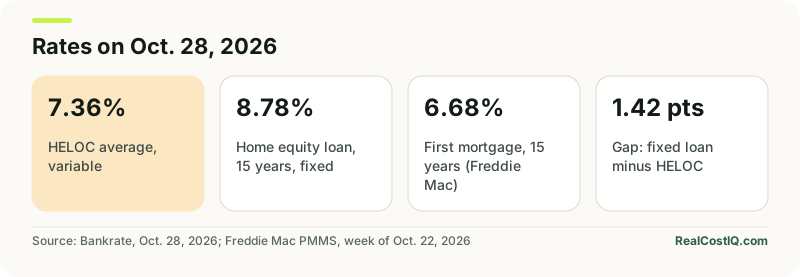
| HELOC | 7.36% | 3.99% to 11.85% | Variable |
| Home equity loan, 5 years | 8.69% | 6.00% to 10.49% | Fixed |
| Home equity loan, 10 years | 8.79% | 6.25% to 10.54% | Fixed |
| Home equity loan, 15 years | 8.78% | 7.24% to 10.75% | Fixed |
| First mortgage, 15-year (Freddie Mac, week of Oct. 22) | 6.68% | Not applicable | Fixed |
| First mortgage, 30-year (Freddie Mac, week of Oct. 22) | 7.32% | Not applicable | Fixed |
Sources: Bankrate HELOC and home equity loan rate surveys, Oct. 28, 2026; Freddie Mac Primary Mortgage Market Survey, week of Oct. 22, 2026. Bankrate figures assume a $30,000 loan, 700 FICO and 80% CLTV.
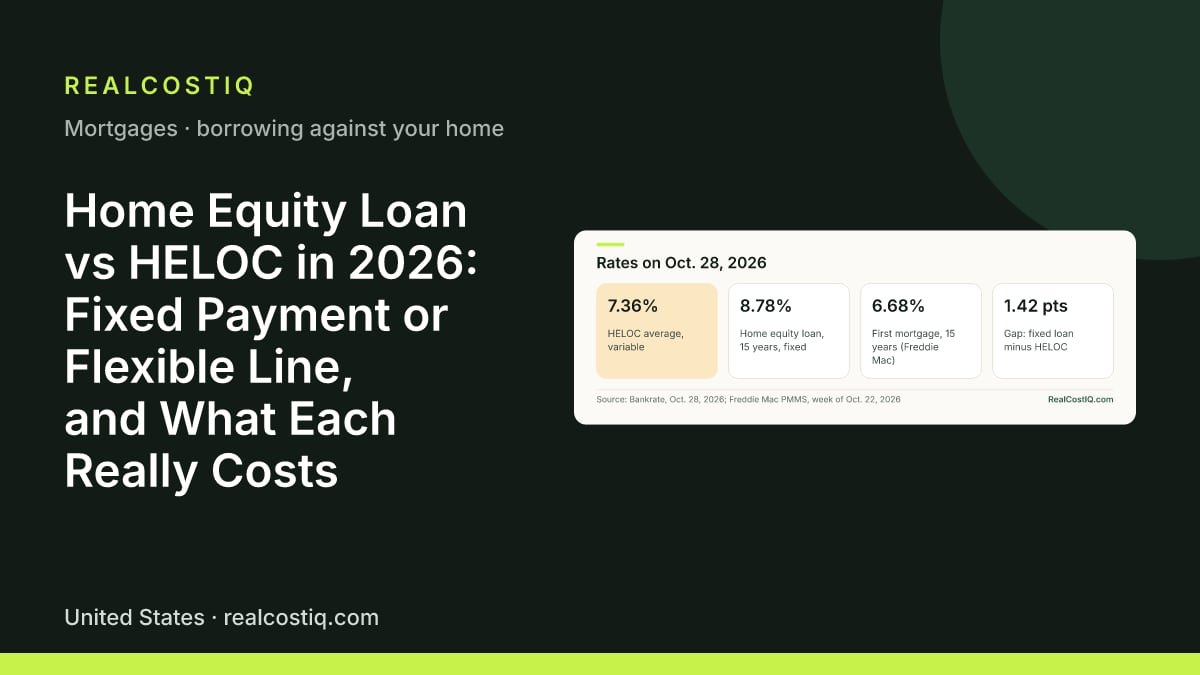
Three things stand out. First, the HELOC average sits 1.42 percentage points below the 15-year home equity loan average (8.78% minus 7.36%). You are being paid, in a lower starting rate, to carry the risk that the rate moves. Second, both products cost more than a first mortgage. The Freddie Mac survey shows the 15-year first mortgage at 6.68%. A home equity loan at 8.78% is about 2.1 points higher. A second loan is paid after the first one if the house is ever sold at a loss, so lenders charge more for it. Third, the ranges are wide. A HELOC can be priced anywhere from 3.99% to 11.85% in the same survey. That spread is bigger than the gap between the two products, so shopping matters more than choosing.
The same $50,000 borrowed both ways
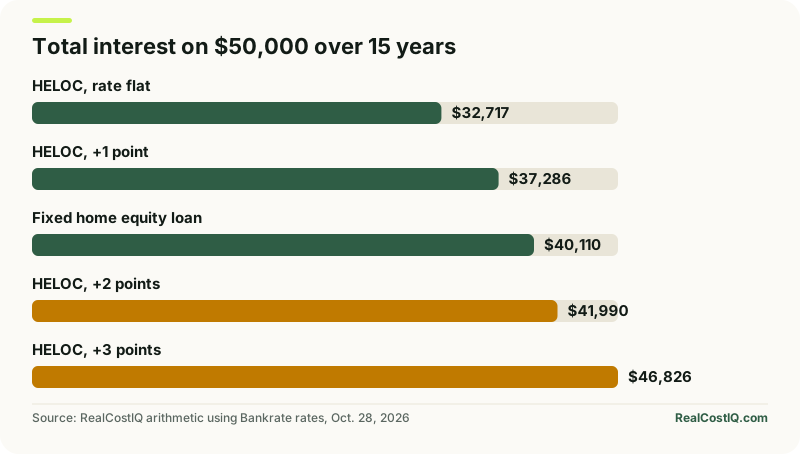
To compare fairly, we need both products to run the same length of time and to be paid down the same way. So we assume a 15-year payoff for each. The home equity loan is a standard fixed-rate loan. The HELOC is drawn in full on day one and paid down on a 15-year schedule, with the payment recalculated each year if the rate changes. That is not how most people use a HELOC. It is how you isolate the effect of the rate, which is the thing in doubt.
| Option | Rate | Monthly payment | Total interest |
|---|---|---|---|
| Home equity loan, 15 years | 8.78% fixed | $500.61 | $40,110 |
| HELOC, rate never changes | 7.36% | $459.54 | $32,717 |
| HELOC, up 1 point after year 1 | 7.36%, then 8.36% | $459.54, then about $487 | $37,286 |
| HELOC, up 2 points after year 1 | 7.36%, then 9.36% | $459.54, then about $515 | $41,990 |
| HELOC, up 3 points after year 1 | 7.36%, then 10.36% | $459.54, then about $544 | $46,826 |
| HELOC, down 1 point after year 1 | 7.36%, then 6.36% | $459.54, then about $433 | $28,288 |
Our arithmetic, standard amortization with monthly compounding, no fees included. Rate changes are scenarios, not forecasts. The 'then' payments are recalculated on the balance left after year 1.
If the HELOC rate never moves, it saves $7,393 in interest and about $41 a month. That is a real gap. But look at what it takes to erase it. A one-point rise after the first year still leaves the HELOC ahead by about $2,800. A two-point rise puts the HELOC about $1,900 behind. Solving for the exact crossing point, the HELOC rate has to step up by about 1.6 points after year 1, to roughly 8.96%, and stay there for the whole payoff. Below that, the HELOC costs less. Above it, the fixed loan costs less.
A rate does not have to jump all at once to do the same damage. We also tried a slow climb of half a point a year for four years, ending 2 points higher. Total interest came to about $40,300. That is almost exactly what the fixed loan costs. So the practical question is not 'will rates rise?' It is 'will they rise about 2 points over the next four years and stay there?' If you think so, fix the rate. If you think rates will be flat or lower, the HELOC is cheaper.
You can run your own amount, rate and term in the home equity calculator, and test a variable-rate path in the HELOC calculator. Use the rates your lenders actually quote you, not the survey averages.
The part that surprises people: the payment when the draw period ends
The example above assumed you pay the HELOC down from the start. Many people do not. During the draw period the lender often asks only for interest. On a $50,000 balance at 7.36%, interest alone is $50,000 times 7.36% divided by 12, which is $306.67 a month. That is a lower bill than the $459.54 above, and it is why a HELOC can feel cheap.
It is not cheap. After 10 years of interest-only payments you would have paid about $36,800 and still owe the full $50,000. Then repayment starts. On a 20-year repayment at the same 7.36%, the payment becomes $398.53. That is $91.86 a month more, a 30% jump. If the rate has risen to 9.36% by then, the interest-only payment would have been $390.00 and the repayment payment is $461.50. If the lender gives you only 10 years to repay, the payment at 7.36% is $589.86, almost double the interest-only amount.
| Rate | Interest-only payment | 20-year repayment | 15-year repayment | 10-year repayment |
|---|---|---|---|---|
| 7.36% | $306.67 | $398.53 | $459.54 | $589.86 |
| 9.36% | $390.00 | $461.50 | $517.90 | $643.16 |
| 10.36% | $431.67 | $494.50 | $548.37 | $670.76 |
Our arithmetic on a $50,000 balance. Your agreement sets the repayment length, so read yours.
A home equity loan has none of this. The first payment and the last payment are the same. That is what you are paying for with the higher rate. If you know that you will be tempted to make the minimum payment for years, the fixed loan protects you from yourself. If you will pay down the HELOC each month, as in the earlier table, the shock never arrives.
The rule of thumb for HELOC borrowers
Pay at least a little principal every month during the draw period, and set a date by which the balance will be gone. Then the end of the draw period is a non-event. Without that plan, you are borrowing against a payment you cannot yet see.
When spending in stages makes the HELOC cheaper, whatever the rate
The example assumed you take all $50,000 at once. A renovation rarely works that way. A contractor asks for a deposit, then payments at milestones. On a HELOC you borrow each piece when the bill arrives, and you pay interest only on what you have drawn. On a home equity loan you borrow all $50,000 on day one, and interest starts on all of it.
Take a project that costs $10,000 a month for five months. Draw $10,000 at the start of each month on the HELOC. Over the five months the balance averages $30,000, which is $150,000 of borrowed money-months. At 7.36% that is $150,000 times 7.36% divided by 12, or about $920 of interest. The home equity loan has $50,000 out for all five months at 8.78%. That is $250,000 of money-months and about $1,829 of interest. The difference is roughly $909, and the fixed loan's rate is not even the main cause. The cause is that part of the loan sat unused. (This ignores the small amount of principal a home equity loan repays in those months.)
There is a catch on the other side. Staged draws only help if you actually draw in stages. If you drain the line on day one, you are back to the earlier comparison. Equally, an unused HELOC can sit open for years as a reserve. That is useful for people who might need money but are not sure. It is a risk for people who will spend it because it is there.
Fees: where the products differ besides the rate
Bankrate's closing cost guide, published July 31, 2026, lists the fee types for these loans. They vary by lender, state and loan size. The figures below are Bankrate's ranges, shown on a $50,000 loan where the fee is a percentage.
| Fee | Range | On $50,000 |
|---|---|---|
| Origination fee | 0.5% to 1% of the loan, or a flat fee | $250 to $500 |
| Appraisal | About $350; lower or zero if the lender uses an automated valuation | $0 to about $350 |
| Title search | $75 to $200 | $75 to $200 |
| Credit report | $10 to $100 | $10 to $100 |
| Title insurance | 0.5% to 1% of the loan, or commonly $1,000 to $4,000 | $250 to $500, or more |
| HELOC annual fee | $5 to $250 | Every year the line is open |
| HELOC inactivity fee | $5 to $50 | If you do not use the line |
| HELOC rate-lock fee | About $50 to $75 | Per lock |
Source: Bankrate, home equity loan closing costs, published July 31, 2026. Bankrate says total closing costs on these loans run from about 1% to 5% of the amount, with some estimates at 2% to 5%. Many lenders waive some or all of them.
Adding the first four rows, a lender that charges everything could bill roughly $335 to $1,150 on $50,000 before title insurance. The low end is $685 if the lender orders a full appraisal. Many HELOC lenders charge little or nothing up front, and Bankrate says HELOCs usually have fewer closing costs than home equity loans. But HELOCs can carry ongoing charges that a home equity loan does not, including annual fees, and they can charge an early closure or cancellation fee. The Bankrate HELOC page lists annual, application, cancellation and early closure fees as things lenders may charge.
Fees change the math in two ways. On a loan you will hold for 15 years, a $1,000 fee is small next to $7,393 of interest difference. On a loan you will pay off in two years, the fee is the whole story. If you plan a quick payoff, a HELOC with no closing costs will almost always beat a home equity loan with $1,000 of them, because the interest you would save is tiny. Ask each lender for the total cost in dollars, in writing, and ask whether the closing costs come back if you close the line in the first two or three years.
Two risks that are not about the rate
The lender can shrink or freeze a HELOC
A home equity loan is paid out. Once the money is in your account, the lender cannot take it back. A HELOC is a promise to lend, and the lender can change that promise in limited cases. The official commentary to Regulation Z, the federal rule for open-end home loans, says a lender may freeze the line or lower the credit limit when there is a significant decline in the value of the home, and in a few other cases. You can read the rule on the CFPB's Regulation Z page. The practical lesson is simple. If you need a fixed pot of money for a bill that is already due, a line that can be cut is a poor tool. Draw what you need early, or take the loan.
Both put the house at risk
Both loans are secured by your house. If you cannot pay, you could lose your home. Using the house to pay for a vacation, a car or a credit card you will run up again turns an unsecured debt into a secured one. Moving debt from a 24% card to a 7% line saves interest. It also changes who can take your house if you fall behind. Do that only with a plan to stop the old balances from coming back.
If you are already behind on your mortgage, the CFPB tells you to talk to a housing counselor before taking either product. Its page gives a number that connects you to a HUD-approved agency: (855) 411-2372.
Is the interest tax deductible?
Sometimes. The IRS says in Publication 936 (2025 edition, for 2025 returns) that interest on a home equity loan or HELOC is deductible only if the money is used to buy, build or substantially improve the home that secures the loan. Interest on money used for other purposes is not deductible. The cap is the first $750,000 of home mortgage debt for loans taken after Dec. 15, 2017, counting your first mortgage together with the new one. The publication does not say that limit is permanent, and it points readers to IRS.gov/Pub936 for later changes.
The rule is the same for both products, so it does not favor one. It does matter for the 'cost' question. A kitchen remodel may produce a deduction if you itemize. A tax bill or tuition payment does not. We are not tax advisers, so check with one before relying on a deduction. The deduction only helps if you itemize, and for many households the standard deduction is larger.
Which one fits which situation
| Your situation | Better fit | Why |
|---|---|---|
| One known bill, such as a roof or a debt payoff | Home equity loan | You borrow the exact amount. The payment never changes. |
| A project paid in stages over months | HELOC | You pay interest only on what you have drawn so far. |
| You expect to repay within 1 to 3 years | HELOC with no closing costs | Fees matter more than the rate over a short hold. |
| You expect rates to rise 2 points or more and stay there | Home equity loan | The fixed rate wins once the HELOC rate passes about 8.96%. |
| You cannot afford the payment to change | Home equity loan | A HELOC payment moves with the rate and with the end of the draw. |
| You want a reserve you may never use | HELOC | An unused line costs little, but check for annual and inactivity fees. |
| You will make interest-only payments for years | Home equity loan | It forces principal to be paid. The HELOC repayment shock is avoided. |
| Your lender offers a HELOC with a fixed-rate lock option | HELOC, locking each draw | You get the flexible start and a fixed rate on money you have drawn. Ask about the lock fee. |
Our reading of the arithmetic above, not a rule. Individual lender terms vary.
The last row is worth a phone call. Bankrate lists a rate-lock fee of about $50 to $75 as a common HELOC charge. Not every lender offers a lock, and the ones that do may lock the rate only on part of the balance. If yours does, you can draw for the first stage of a project at the variable rate and lock the amount you intend to carry for years.
When neither is the right product
Both products add a payment on top of your mortgage, so they depend on your current mortgage being reasonable. If your first mortgage rate is far above today's 7.32% for a 30-year loan, replacing it may beat adding a second loan. The HELOC vs cash-out refinance guide works through that choice, including the rate on the old money. If you are buying a new home before selling the current one, the bridge loan post covers the timing trap, which is that many lenders will not open a HELOC on a house that is already listed.
For smaller amounts you may not need either. A $5,000 repair does not justify a loan that puts a lien on your house and carries appraisal and title fees. A personal loan or a saved reserve has no lien. The unsecured rate is higher, but on a small balance the total interest gap is a few hundred dollars, and the fees on a home equity loan can cancel it.
What to ask every lender before you sign
- What is the rate today, what is it tied to, and what is the margin? For a HELOC, the rate is an index plus the lender's margin. The margin is the part that does not change.
- Is there a cap on how high the rate can go, and how much it can change at once? A lifetime cap tells you the worst case.
- How long is the draw period, and what is the repayment period afterward? A 10-year draw with a 10-year repayment is a bigger shock than a 10-year draw with 20 years.
- Is the payment during the draw interest-only? If so, ask for the principal-and-interest figure too, so you see the full number.
- What are all the fees, in dollars? Include the origination fee, appraisal, title work, any annual or inactivity fee, and any fee for closing the line early.
- Does the lender refund closing costs if I close the account early? Bankrate notes that lenders often ask you to repay closing costs they covered if you close the account early.
- Can I lock part of the HELOC balance at a fixed rate, and what does it cost?
- Is there a prepayment penalty? Bankrate lists one among the charges a HELOC lender may apply if you pay off the balance early in the repayment phase.
- What combined loan-to-value ratio will you lend to? This tells you how much you can borrow. Take your first mortgage balance plus the new loan, divide by the home's value, and compare it with the lender's limit.
Get quotes from at least three lenders on the same day, with the same loan amount and the same assumed credit profile. Include one credit union and one lender that is not a big national bank. The spread within one survey is large enough that the best offer in your town may beat the average by a full point.
The bottom line
On Oct. 28, 2026, a HELOC starts 1.4 points cheaper than a fixed home equity loan, and on $50,000 that is worth about $7,400 over 15 years if the rate holds. The fixed loan wins only if the HELOC rate climbs about 1.6 points and stays there. Staged spending adds roughly $900 more to the HELOC's side on a five-month project, and the draw period's end adds a payment jump you can plan around. The home equity loan earns its higher rate when you want certainty: one amount, one payment, one end date.
If you can name the exact amount and the exact date you will have it paid, take the loan. If you cannot, take the line, and decide now how you will pay it down. Then price your own numbers in the home equity calculator before you apply.