You found the house you want. Your current home is not sold. You need cash for the down payment on the new place, and you will pay two housing bills until the old one closes. There are three common ways through: borrow against the old home with a bridge loan, borrow against it with a home equity line of credit (a HELOC), or ask the seller of the new home to wait with a sale contingency. Each one costs money in a different way, and each one has a trap.
This post puts numbers on all three using one example, so you can see them side by side. It also explains the rule that decides whether a lender counts your old mortgage payment against you. Our bridge loan calculator works out the all-in cost of one bridge loan. This guide is about choosing between the three routes before you run the numbers.
The example we use for every number
Say your current home will sell for $500,000. You owe $250,000 on it. You are buying a $600,000 home and want to put 20% down, which is $120,000. That leaves a new mortgage of $480,000. The old home will take about 4 months to sell and close. These are round numbers made up for the example. Your own figures will differ, but the shape of the answer will not.
The new mortgage matters too. Freddie Mac reported that the average 30-year fixed rate was 7.32% for the week ending October 22, 2026 (Freddie Mac, Primary Mortgage Market Survey). At that rate a $480,000 loan has a principal-and-interest payment of about $3,297 a month, before taxes and insurance. Hold that number in mind. It is what the lender will test against your income.
Your equity is the part of the home you own: $500,000 minus the $250,000 mortgage is $250,000 on paper. You cannot borrow all of it. Lenders usually let your total loans reach about 80% of the home's value. At 80%, the limit on the old home is $400,000. Subtract the $250,000 you already owe and you can borrow up to $150,000. That is more than the $120,000 you need. If a lender caps you at 75%, as at least one bridge lender does, the limit is $125,000, which is just enough (JVM Lending, how to buy a house before you sell, updated Feb. 9, 2024).
Option 1: The HELOC, cheapest, but only if you open it early
A HELOC works like a credit card backed by your house. You get a limit, you draw what you need, and you pay interest only on what you have drawn. Bankrate's survey put the national average HELOC rate at 7.36% as of October 21, 2026. The page says HELOCs usually have low or no closing costs, and that most lenders allow borrowing up to 80% of the home's value minus the mortgage, with some going to 85% or 90% (Bankrate, current HELOC rates).
The rate is usually variable, tied to the prime rate. The Federal Reserve's H.15 release showed the prime rate at 7.00% on October 26, 2026 (Federal Reserve, H.15 Selected Interest Rates). If prime moves, your rate moves with it. On a four-month loan that risk is small.
Now the cost on our example. You draw $120,000 for four months at 7.36%. Interest is $120,000 x 0.0736 x 4/12, which is about $2,944. That is the cost with little or no closing fee. If you repay in two months, it is about half that. Your monthly payment while the line is open is interest only, about $736 a month on $120,000 at that rate.
The trap: most lenders will not open a HELOC on a listed home
The HELOC has one big problem. SoFi's guide says many lenders will not open a HELOC on a home that is already listed for sale (SoFi, what is a bridge loan, published April 30, 2026). Bankrate's bridge loan page says the same thing: you may be ineligible for a HELOC if the home is listed (Bankrate, bridge loans, published Jan. 28, 2026). The JVM Lending guide goes further and says sellers will not be able to get one once the home is listed, so they should apply beforehand.
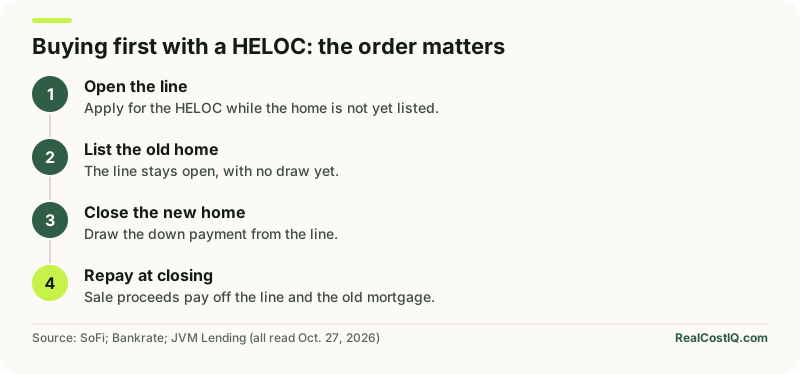
Think about what that means in practice. Most people decide to buy first only after they find the house. By then the old home may already be on the market. If you plan to use a HELOC, you must open it before you list, even though you may not need it for months. Opening a line you may never use is cheap, since closing costs are low, but you do have to plan ahead. We do not have a lender-by-lender list of these rules. Every lender sets its own, so ask yours before you list.
There are other catches. The line must be approved on your income and credit, and the lender will want your home's value. A drawn HELOC also adds a monthly payment to your debts when the new lender checks you. Our HELOC calculator shows the draw, the payment and the cost of keeping a line open.
Option 2: The bridge loan, costlier, but built for this
A bridge loan is a short loan, secured by your old home, that you repay when that home sells. Bankrate says terms usually run six to twelve months, with some as short as three, and that rates run from the prime rate up to prime plus two percentage points. It also says many lenders want 15% to 20% equity and charge closing costs that can run to thousands of dollars (Bankrate, bridge loans). SoFi lists rates of 6% to 12% and closing costs of 1% to 5% of the loan (SoFi).
Use prime at 7.00% (Federal Reserve, October 2026). Prime to prime plus two points is 7% to 9%. On $120,000 for four months, interest is $2,800 at 7% and $3,600 at 9%. Closing costs of 1% to 5% are $1,200 to $6,000. So the all-in cost is about $4,000 at the low end and $9,600 at the high end. The rate range comes from Bankrate and the fee range from SoFi, so the two ends of the table mix sources. That is why we show a range and not one number.
Not every bridge lender prices it that way. The JVM Lending guide describes a program with a fee of 2.3% to 2.4% of the old home's sale price, paid when that home sells, covering up to 75% of its value, with no payments due in the meantime. On a $500,000 sale, 2.3% is $11,500. That is higher than the loan-style range above, but you make no payments while you wait. That page was last updated in February 2024, so treat its numbers as an example of one structure, not a current quote.
| Route | Rate or fee used | Interest | Fees | Total |
|---|---|---|---|---|
| HELOC | 7.36% (Bankrate, Oct. 21, 2026) | $2,944 | Low or none | about $2,944 |
| Bridge loan, low case | 7% (prime) + 1% fee | $2,800 | $1,200 | $4,000 |
| Bridge loan, high case | 9% (prime + 2) + 5% fee | $3,600 | $6,000 | $9,600 |
| Bridge program with a sale-price fee | 2.3% of $500,000 | In the fee | $11,500 | about $11,500 |
| Sale contingency | No loan | $0 | $0 | $0 in fees, but see below |
Interest = $120,000 x rate x 4/12. Prime of 7.00% is from the Federal Reserve H.15 release of Oct. 27, 2026 (rate for Oct. 26). Fee ranges come from SoFi and JVM Lending. Individual quotes vary by lender, credit score and equity.
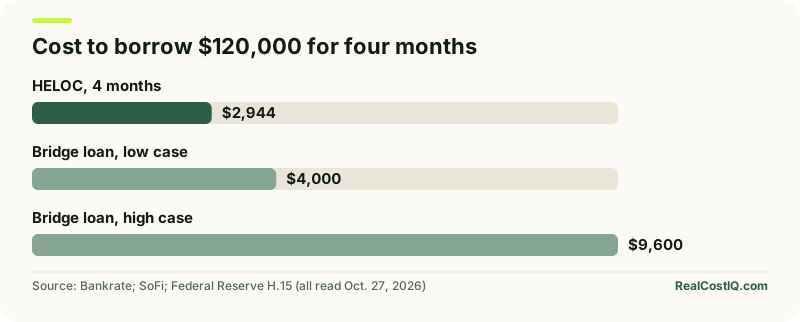
In plain terms: the bridge loan costs more than the HELOC by about $1,000 to $6,700 in this example. That is the price of flexibility. You can get a bridge loan after you have found the home. Few lenders offer them. SoFi, for one, says it offers HELOCs but not bridge loans, so you may need a specialist lender. Use the bridge loan calculator to enter your own term, rate and fees.
Option 3: The sale contingency, no loan, but a different cost
A sale contingency is a line in your offer on the new home. It says the purchase depends on your old home selling by a set date. If it does not sell, you can walk away without losing your deposit. It costs no interest and no loan fees. The cost is that you may not win the house.
From the seller's side, a contingent offer carries risk. The seller must wait, and your sale could fall apart. In a hot market, a seller can pick a cleaner offer. Our guide to real estate contingencies explains the common forms, including the kick-out clause. A kick-out lets the seller keep marketing the home and give you a short window to drop the contingency if a better offer arrives. If you cannot, you lose the house.
Here is the hidden cost people miss. A sale contingency does not fix the loan problem. The new lender still has to approve you. If your old home is not under contract, the lender counts the old mortgage payment too. That is the next section, and it is the main reason people reach for a bridge loan or a HELOC even though a contingency looks free.
The rule that decides whether you qualify: two payments
Lenders compare your monthly debts with your monthly income. The result is your debt-to-income ratio, or DTI. When you own two homes at once, the lender must decide whether to count both mortgage payments. Fannie Mae, the company that buys many conventional mortgages, gives the rule in its Selling Guide, section B3-6-06, dated September 2, 2026.
If your current home is pending sale but the sale will not close before your new loan does, the lender must count the current payment and the new payment, using the full housing payment of principal, interest, taxes, insurance and association dues. The payment of the current home does not have to be counted if you give the lender the signed sales contract for your current home and show that any financing contingencies have been cleared (Fannie Mae, Selling Guide B3-6-06). The JVM Lending guide states the same test in plain words: proof that all contingencies have been lifted on a fully signed contract.
Let us see what that does. Say you earn $11,000 a month. The new home costs $3,997 a month for principal, interest, taxes and insurance (our $3,297 plus $700 of taxes and insurance). Your old home costs $1,800 a month. If you draw $120,000 on a HELOC at 7.36%, add $736 of interest.
- Old home not under contract: $3,997 + $1,800 + $736 = $6,533, which is 59% of $11,000. That is above the 50% ceiling for Fannie Mae's automated review that our debt-to-income limits guide covers.
- Old home under contract and cleared: $3,997 + $736 = $4,733, which is 43% of $11,000. That fits within the usual ceilings, before counting any car loans or cards.
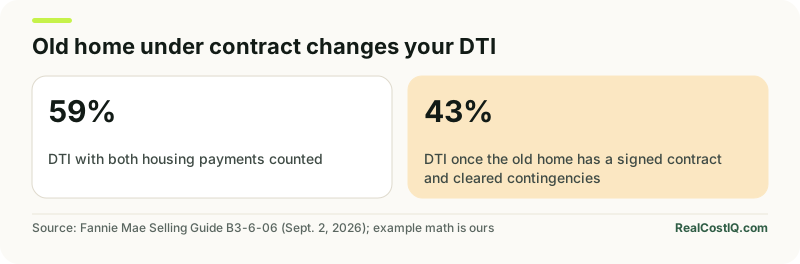
The point of the example is the gap. The signed contract on the old home can move you across the line. That is why a quick sale, or at least a contract, matters more to approval than the loan type does. It also means a sale contingency and a contract on your old home work together: once the old sale contract is firm and its financing contingencies clear, the lender can drop the old payment. Until then, a bridge loan or HELOC adds a payment but not a fix.
One more point: a lender can still count a draw from a HELOC or a bridge loan as new debt, and sometimes counts the payment on it. How depends on the lender and the loan program. Ask your loan officer, in writing, how the funds will be treated before you sign a contract on the new house.
Side by side: which route fits which situation
| HELOC | Bridge loan | Sale contingency | |
|---|---|---|---|
| Cost in the example | about $2,944 | about $4,000 to $9,600 | $0 in fees |
| When you must act | Before the old home is listed | After you find the new home | When you write the offer |
| Main risk | Lender refuses once listed | Highest cost; few lenders offer it | Seller says no, or kicks you out |
| Payments while waiting | Interest on what you draw | Varies: some defer payments | None |
| Helps you qualify? | Adds a payment | Adds a payment or fee | No, unless old sale is under contract |
Costs from our four-month, $120,000 example. Lender terms vary. The qualification row follows Fannie Mae Selling Guide B3-6-06.
Here is how to read the table. If your home is not listed yet and you think you may buy first, open the HELOC now. It is the cheapest option and costs little to hold. If your home is already listed, a HELOC is probably off the table, so compare a bridge loan against a contingent offer. If the market is hot and the seller will not take a contingency, the bridge loan is the tool built for that.
Do not forget the costs that all three share. You will pay the old mortgage, taxes, insurance and utilities while you own both homes. At $1,800 a month, four months is $7,200, which can be more than the loan fees themselves. You will also pay the costs of selling. The cost to sell calculator in the related list below estimates those. A bridge or HELOC does not remove any of them. It only lets you start the second purchase before the first sale ends.
Risks to weigh before you pick
- The old home does not sell. All three routes assume a sale in about four months. If it takes eight, the HELOC costs about $5,900 and the bridge loan costs more, since its interest doubles too. Plan for a slower sale, and have a price you will accept.
- Your home is the collateral. A bridge loan and a HELOC are both secured by the old home. If you cannot repay, the lender can foreclose on it.
- Rates change. A HELOC rate is variable. A bridge loan may be fixed or variable. Read the rate terms.
- Prepayment fees. SoFi notes that HELOCs can carry prepayment fees. Ask whether a bridge loan does too, since you plan to repay early.
- Equity. Lenders want 15% to 20% equity in the old home, per Bankrate. If you owe more than about 80% of its value, neither loan may be available.
A short plan
- Work out your cash need: the down payment plus the extra months of two housing payments. In our example that is $120,000 plus about $7,200.
- Check your equity: home value times 80%, minus what you owe. If it does not cover the cash need, a bridge loan and a HELOC will not either.
- If your home is not listed, ask your lender about a HELOC this week and keep it open and undrawn.
- If your home is listed, ask for bridge loan quotes and get the all-in cost: interest, fees and any prepayment charge.
- Ask your mortgage lender in writing how a HELOC or bridge draw is counted, and what proof it needs to drop the old payment.
- If the seller will take a contingency, compare its price in lost leverage against the loan cost. Often the cheapest route is the one with a firm contract on the old home before you close on the new one.
A caution on sources. The rates and fees above come from Bankrate, SoFi, the Federal Reserve and Freddie Mac, read on October 27, 2026, plus one broker guide from 2024. SoFi's own disclosures on the page are dated June 2024. None of these is a quote for you. A real quote depends on your credit score, your income and your lender. This post is general information, not financial or legal advice.