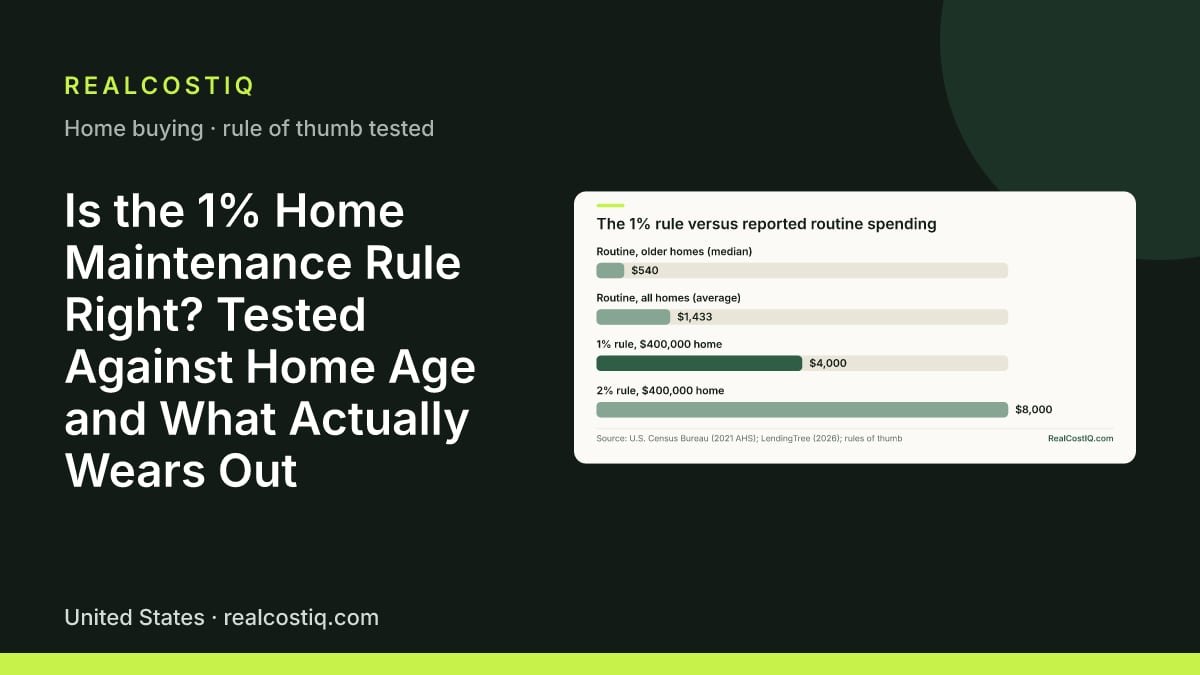
Most advice on home upkeep gives you one number: save 1% of your home's value every year. On a $400,000 house, that is $4,000. Some sources say 2%, which is $8,000. This post tests those numbers. It checks them against what owners actually spend, against how old the house is, and against how long a roof, a water heater and an air conditioner really last.
The short result is that the rule is a decent guess for the average house and a poor guess for any single house. Part of the problem is that the rule ties your budget to the price of your home. A roof does not cost more because your lot sits in an expensive town. The rest of this post shows the numbers, then gives a simple way to build a better budget.
What the 1% rule says and where it comes from
The rule is simple. Take your home's current market value. Multiply it by 1%. Put that much aside every year for repairs and upkeep. Some writers raise it to 2% for older homes or harsh climates. Some lower it to 0.5% for new homes. You will see all three numbers online. They are all rules of thumb. None of them comes from a law or a lender requirement.
Here is the round-number example we will use through the whole post. A home is worth $400,000. At 1%, the budget is $4,000 a year, or about $333 a month. At 2%, it is $8,000 a year, or about $667 a month. At 0.5%, it is $2,000 a year. Our home maintenance calculator lets you change the home value, age and size to see how the range moves.
Two words need a definition. Routine maintenance means small, regular jobs: changing furnace filters, cleaning gutters, fixing a leaky faucet, painting a room. Replacement means swapping out a big part that has worn out, such as a roof or an air conditioner. A good budget has to cover both. The 1% rule tries to cover both with one number, and that is where it gets into trouble.
What owners actually spend
The best test of a rule is real spending. The U.S. Census Bureau looked at the 2021 American Housing Survey. Owners of homes built before 1950 spent a median of about $1,800 a year on upkeep, which covers both improvements and routine maintenance. Routine maintenance alone had a median of about $540 a year. A median is the middle value: half of owners spent more and half spent less (U.S. Census Bureau, Cost of Improving and Maintaining Older Homes Higher for New Owners).
The same Census story gives a size yardstick. Routine maintenance ran about $200 a year for every 500 square feet of living space. On a 2,000-square-foot house, that is about $800 a year. That is one fifth of the $4,000 the 1% rule suggests for our $400,000 home.
A LendingTree analysis, reported by IBTimes on October 19, 2026, reached a similar picture. Routine maintenance on owner-occupied homes averaged $1,433 a year. For homes built before 1940 it was $1,706. For homes built in 2022 and 2023 it was only $173 a year (IBTimes, reporting a LendingTree analysis of home improvement costs). An average is the total divided by the number of homes, so a few big bills pull it up.
Harvard's Joint Center for Housing Studies counted spending on both improvements and maintenance, using the 2023 American Housing Survey. Owners of homes built before 1960 averaged about $6,000 a year. Owners of homes built in 2010 or later averaged $4,500. That gap of roughly 35% is real, but it is smaller than the 2x that the 2%-for-old-homes rule suggests (The Mortgage Point, reporting the Harvard JCHS analysis). Those totals also include remodeling, such as new decks and room additions, not just fixing worn parts.
| Measure | Per year | What it covers | Source |
|---|---|---|---|
| 1% rule on a $400,000 home | $4,000 | Everything, as a savings target | Rule of thumb |
| 2% rule on a $400,000 home | $8,000 | Everything, for older homes | Rule of thumb |
| Routine maintenance, older homes, median | $540 | Small regular jobs only | Census 2021 AHS |
| Routine maintenance, all owned homes, average | $1,433 | Small regular jobs only | LendingTree, 2026 |
| Routine maintenance, 2022-23 builds, average | $173 | Small regular jobs only | LendingTree, 2026 |
| Upkeep, pre-1950 homes, median | $1,800 | Maintenance plus improvements | Census 2021 AHS |
| Maintenance plus improvements, pre-1960, average | $6,000 | Includes remodeling | Harvard JCHS, 2023 AHS |
| Maintenance plus improvements, 2010 or later, average | $4,500 | Includes remodeling | Harvard JCHS, 2023 AHS |
The 1% and 2% rows are rules of thumb. Every other row is reported spending from the sources named. The rows measure different things, so compare them with care.
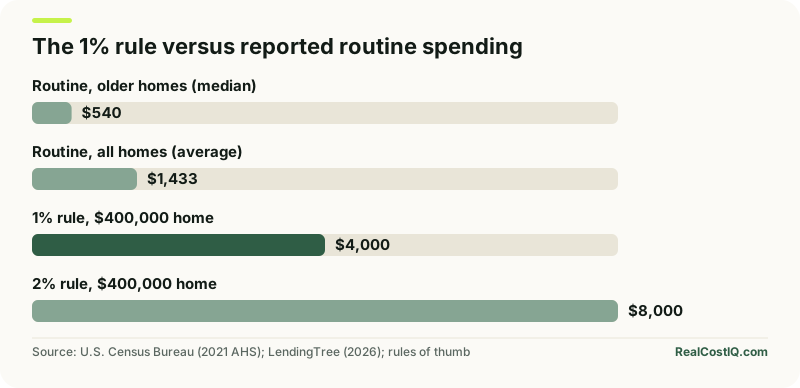
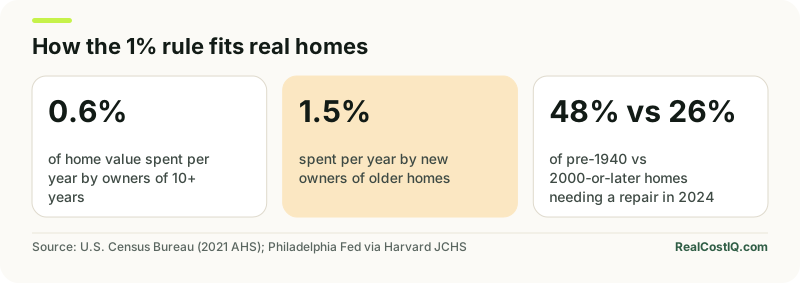
So the first test comes back this way. In a normal year, owners spend far less than 1% of their home's value on routine upkeep. The Census story also shows that new owners of older homes spent a median of $3,900 a year, against about $1,500 for owners who had been there ten years or more. As a share of home value, new owners spent a median of 1.5% and long-time owners spent 0.6%. Recently bought homes get a catch-up bill. After that, spending falls.
The rule hides the real problem: big items come in lumps
If owners spend so little, is the 1% rule too high? Not necessarily. The reported averages mostly count what people paid, not what they should have saved. Many owners put off repairs. A 2025 Federal Reserve Bank of Philadelphia report found that 48% of owner-occupied homes built before 1940 needed at least one repair in 2024, against 26% of homes built in 2000 or later. The estimated repair cost averaged $5,200 for the older homes and $3,600 for the newer ones (as reported by the same Harvard JCHS and Mortgage Point coverage). Low spending can mean low need. It can also mean work that has not been done yet.
The bigger issue is timing. Routine upkeep is small and steady. Replacements are large and rare. A roof might cost $12,000 once in 30 years. In the other 29 years it costs nothing. An average over many homes smooths that out. Your one house does not smooth it out. You either have the cash in the year the roof fails, or you borrow.
Let us put prices and lifespans side by side. InterNACHI, a home inspector trade group, publishes a life expectancy chart for house parts. It says its numbers are guidelines only, and that they assume regular maintenance and normal wear. For the three biggest items it lists: architectural asphalt shingles 30 years (3-tab shingles 20 years), a conventional water heater 6 to 12 years, and a central air conditioner 7 to 15 years (InterNACHI, Standard Estimated Life Expectancy Chart for Homes).
For prices we use Fixr, a cost-estimate site, as a planning guide. Its pages updated in January 2026 put an asphalt shingle roof at about $12,000 on average, with most jobs from $8,000 to $16,000 (Fixr, asphalt shingle roof cost). It puts a 40-gallon water heater at about $1,650 installed, with a range of $700 to $2,300 (Fixr, 40-gallon water heater cost). Its central air page, updated August 2025, puts a 3-ton unit at about $5,500 to $10,000 when the ducts are in good shape (Fixr, central air conditioner installation cost). These are national averages. Your quote will differ, so use them to size a plan, not to price a job.
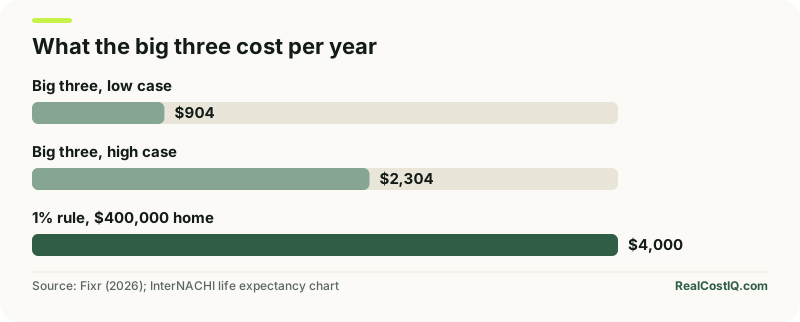
Now the math. A sinking fund is money you set aside a little at a time for a bill you know is coming. To find the yearly amount, divide the price by the years of life. Short life makes the yearly cost higher. Long life makes it lower. We use the short and long ends of each range to get a low and a high figure.
| Part | Price used | Life used | Per year |
|---|---|---|---|
| Roof, architectural shingles | $12,000 | 30 years | $400 |
| Roof, 3-tab shingles | $12,000 | 20 years | $600 |
| Water heater, long life | $1,650 | 12 years | $138 |
| Water heater, short life | $1,650 | 6 years | $275 |
| Central air, low price, long life | $5,500 | 15 years | $367 |
| Central air, high price, short life | $10,000 | 7 years | $1,429 |
| Big three, low case | $904 | ||
| Big three, high case | $2,304 |
Low case: architectural roof, long-life water heater, low-price long-life air conditioner. High case: 3-tab roof, short-life water heater, high-price short-life air conditioner. Dollar figures are rounded. This leaves out the furnace, appliances, paint, floors and windows, for which we did not have a current priced source.
The big three alone need about $900 to $2,300 a year. Add routine upkeep of about $800 to $1,400 a year (the Census and LendingTree figures above), and the total lands between roughly $1,700 and $3,700. The 1% figure of $4,000 sits just above that, so for a mid-age house with these three parts, 1% is a sensible and slightly generous target. The 2% figure of $8,000 is more than these items need, unless you also plan to replace a furnace, floors, windows or siding, or the house needs catching up.
The bad year: when everything wears out at once
The yearly average hides the year that hurts. Picture a house built 25 years ago that still has its first 3-tab roof, its first air conditioner and a water heater that is 12 years old. All three are at or past the end of the lives listed above. Nothing about that is unusual. Houses are often built with all their parts new on the same day, so the parts age together.
Replace all three that year. The roof is $12,000, the water heater is $1,650, and the air conditioner is $5,500 to $10,000. The total is $19,150 to $23,650. That is about five years of the 1% budget on a $400,000 home, spent at once. Stretch the bills over a few years and the fear goes away. Land them all in one year, with no savings, and you borrow at credit card or home equity rates.
This is the strongest argument for the rule, and also the best argument against treating it as a yearly budget. The money is not for each year. It is for the lump. If you save $4,000 a year for ten years, you have $40,000, which covers the bad year twice. If you have owned the house for two years, you have $8,000 and the bad year takes you to zero and beyond.
There is a related buying tip here. If you are about to buy a house, the ages of its roof, air conditioner and water heater tell you more about your first-decade costs than its price does. Our guide on repair credits for an old roof or HVAC at inspection shows how to turn an aging part into a price cut or a credit before you close.
Where the rule breaks: home age
Age changes the answer in two ways. First, parts wear out in order. A brand new house has new everything, so almost nothing comes due for years. A 15-year-old house has a roof and heating and cooling parts getting close to their limits. A 40-year-old house may be on its second roof and its third air conditioner. In the Harvard data, replacement projects such as roofing, siding, windows, insulation and heating and cooling were 39% of spending on pre-1960 homes against 24% on homes built in 2010 or later (as reported by The Mortgage Point).
Second, the money you need to save does not rise with the age of a house as fast as the rules say. Replacement prices do not depend on how old the house is. A new roof costs the same on a 10-year-old house and a 60-year-old house of the same size. Older houses just need it sooner and more often, and may have problems under the surface, like old wiring or plumbing.
| Home age | Rule of thumb | Dollars a year | Fit |
|---|---|---|---|
| Under 10 years | 0.5% to 1% | $2,000 to $4,000 | Too high for spending, fine for saving toward the first roof and AC |
| 10 to 20 years | 1% | $4,000 | Good. Water heater and AC start to come due |
| 20 to 40 years | 1% to 2% | $4,000 to $8,000 | Good to start at 1%. Raise it if roof and AC are original |
| 40 years or more | 2% or more | $8,000 or more | Depends on what was already replaced. Inspect first |
The percentages are rules of thumb used widely online. The fit column is our judgment from the spending data and lifespans above. It is not a measured result.
Notice what the table says. The best rule is not about how old your house is. It is about how old its parts are. A 50-year-old house with a new roof, new heating and cooling system and new water heater has a lower near-term bill than a 20-year-old house that kept every original part. That is why we suggest listing the parts, not guessing from the year built.
Where the rule breaks: home price and place
The second weakness is that the rule uses your home's value as the base. Value is mostly land and location. Maintenance cost is mostly materials and labor. Compare two houses with the same size and the same 25-year-old roof. One sits in a town where it is worth $250,000. The other sits in an expensive metro where it is worth $600,000. The 1% rule gives $2,500 a year for the first and $6,000 for the second. The roof costs about the same for both.
Labor prices do vary by region, so the pricier metro may pay somewhat more for the same job. But the gap in value is far larger than the gap in cost. The result is that the rule under-saves for cheap homes and over-saves for expensive ones. If you own a lower-priced older house, 1% may be too little. If you own a high-priced newer home, 1% may be too much. Size in square feet tracks the real cost better, which is why the Census figure of about $200 per 500 square feet a year is useful as a floor for routine work.
Condos, townhomes and homes in a homeowners association change the picture again. The association often pays for the roof and outside walls, so your own budget covers less. But you pay in monthly dues and possible special assessments. Do not apply the rule to those without checking what the dues cover.
A better budget in four steps
- List the big parts and their ages: roof, heating and cooling system, water heater, siding, windows, major appliances. If you are buying, the inspection report and seller disclosure will tell you.
- For each part, find the replacement price from a local quote or a cost guide, and a life range from a source such as the InterNACHI chart. Subtract the age to get years left. A part already past its listed life is a bill to plan for now.
- Divide each price by its years left to get a yearly amount, then add them up. Add routine upkeep: start near $0.40 per square foot per year (the Census yardstick), and raise it if the house is old or you do little yourself.
- Compare the total with 1% of the home's value. Use the higher of the two for the first few years. Put it in a separate savings account so it does not get spent on other things.
Here is that method on the 25-year-old house from the bad-year example. Roof due now, $12,000. Water heater due now, $1,650. Air conditioner due now, say $7,750 (the middle of the range). That is $21,400 due now, so a plan that spreads it over three years costs about $7,100 a year, plus about $800 for routine upkeep on 2,000 square feet. That is about $7,900 a year for three years, which is closer to the 2% figure. After the parts are replaced, the bill falls to a few thousand a year. So a house can need 2% now and 0.5% later.
If you want the whole monthly picture, with taxes, insurance and upkeep together, the true cost of homeownership calculator puts maintenance next to the mortgage payment. That helps when you are deciding how much house you can afford, since a budget that only counts the mortgage will fall short.
What the rule gets right
It would be unfair to dismiss the rule. It does three useful things. It reminds first-time buyers that costs do not stop at the mortgage. It gives a starting number when you know nothing else. And across the whole stock of homes, 1% is in a believable range for a typical house, once you count both small jobs and saving for the big three.
Its failures are failures of use, not of math. People treat it as a yearly bill they can skip in a good year. They apply it to a brand new home and then feel rich. Or they apply 1% to a house with an original 28-year-old roof and are surprised. A rule of thumb is a starting point. When you have the real ages and prices of your parts, replace the rule with them.
What to do next
- If you are shopping, ask for the age of the roof, air conditioner and water heater before you set a maintenance budget. Ask for the permit record of the last replacement.
- If you own, start the savings account now. Even $250 a month is $3,000 a year and takes the shock out of a failed part.
- If you have a bad year coming, price it with the home maintenance calculator and compare it with 1% of your home's value. Use the larger of the two for your first few years.
- Do not borrow against the house for routine upkeep unless you have no choice. Home equity rates were near 7.4% in October 2026 according to Bankrate, so interest adds up.
We limited this post to what we could source. We did not find a current priced source for furnace replacement, siding, floors, paint or major appliances, so those are left out of the table. If your list includes them, add them the same way: price divided by years left. Prices and lifespans change over time, so check the dates on the sources below.