This post is about the cost of mortgage insurance after tax. It is not tax advice. It does not tell you whether to itemize your return or how to plan your taxes. A tax professional can do that for your situation. What it does is show, with round numbers, what the deduction is worth on a loan.
What changed, in one table
First, a few terms. Private mortgage insurance, or PMI, is a policy on a home loan. The Consumer Financial Protection Bureau, or CFPB, says it protects the lender, not you. A lender usually asks for it when you put down less than 20 percent. FHA loans, VA loans and USDA loans have their own versions. The fee on an FHA loan is called a mortgage insurance premium, or MIP. On a VA loan it is a funding fee. On a USDA loan it is a guarantee fee. This post calls them all mortgage insurance.
The tax code treats these premiums as a kind of mortgage interest, but only in some years. The rule has switched on and off. Here is where it stands, based on the law and the IRS publications read for this post.
| Tax years | Deductible? | Source of the rule |
|---|---|---|
| 2007 through 2021 | Yes, with an income limit | 26 U.S.C. 163(h)(3)(E) |
| 2022 through 2025 | No | Section 163(h)(3)(E)(iv) ended it for amounts paid after December 31, 2021; IRS Publication 936 (2025) says it expired |
| 2026 and later | Yes, with an income limit | Public Law 119-21, section 70108, for tax years beginning after December 31, 2025 |
A tax year is the calendar year the premiums were paid. A 2026 deduction is claimed on the tax return you file in early 2027.
The 2025 law is Public Law 119-21, often called the One Big Beautiful Bill Act. It became law on July 4, 2025. Section 70108 of that law changes the rules for qualified residence interest. In plain terms, it says the old end date for the mortgage insurance rule "shall not apply." The change takes effect for tax years that begin after December 31, 2025. So 2026 is the first year the deduction is back.
The IRS has not yet published the final 2026 version of its home mortgage interest guide, Publication 936. The draft version is on irs.gov, marked as a draft. It says the itemized deduction for qualified mortgage insurance premiums "has been reinstated for tax year 2026." The final 2025 version of the same guide still says the deduction expired. That is correct for 2025. It is not wrong. It is just about a different year. Because the 2026 guide is a draft, the details could change before it is final.
The example: a $380,000 loan with PMI
Take a $400,000 home. You put down 5 percent, which is $20,000. The loan is $380,000. Because the down payment is under 20 percent, the lender asks for PMI.
How much is the PMI? It depends on your credit score and down payment. This site's PMI calculator uses a published rate card from National Mortgage Insurance Corporation. For a score of 740 to 759 and a 95 percent loan-to-value, the card shows 0.53 percent of the loan per year, at the 30 percent coverage lenders usually require on a loan like this. Loan-to-value is the loan divided by the home price. On $380,000, 0.53 percent is $2,014 a year, or $167.83 a month. Your own quote will differ. Insurers price each loan, and the card is from 2022. The steps behind the number, and the month PMI ends, are in how PMI is calculated.
Next, the loan payment. Freddie Mac says the average 30-year fixed rate was 7.40 percent for the week of October 8, 2026. At that rate, the principal and interest payment on $380,000 is $2,631.04 a month. In the first year, about $28,000 of what you pay is interest. Interest is the fee for borrowing. You will need that number soon, because it counts toward your deductions.
Now the tax part. The deduction lowers your taxable income. So its value is your PMI cost times your tax rate. A tax rate here means your top tax bracket, the rate on your last dollar of income. All three cases below are made-up households, used only to show how the math works.
| Household | Itemized total with PMI | Standard deduction | Itemize? | Tax saved per year | Per month |
|---|---|---|---|---|---|
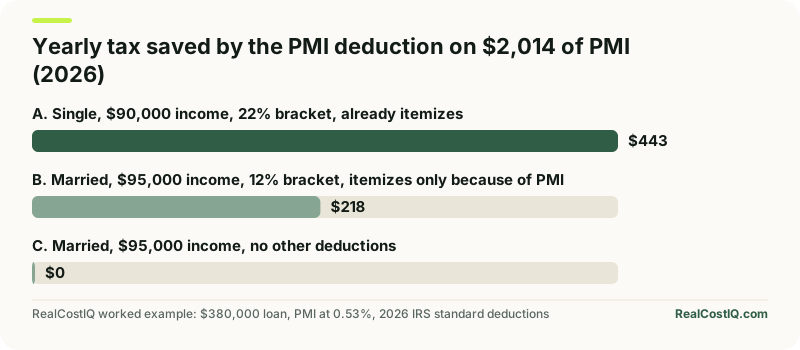
| A. Single, income $90,000, 22% bracket | $30,014 ($28,000 interest + $2,014 PMI) | $16,100 | Yes, even without PMI | $443 | $37 |
| B. Married, income $95,000, 12% bracket, $4,000 other deductible taxes | $34,014 ($28,000 + $4,000 + $2,014) | $32,200 | Yes, but only because of PMI | $218 | $18 |
| C. Married, income $95,000, no other deductions | $30,014 ($28,000 + $2,014) | $32,200 | No, standard deduction is larger | $0 | $0 |
Hypothetical. PMI is $2,014 a year (National MI rate card, 0.53% of $380,000). First-year interest is about $28,000 at 7.40% (Freddie Mac PMMS, week of October 8, 2026). The 2026 standard deductions are $16,100 for single filers and $32,200 for married couples filing jointly (IRS, IR-2025-103). The 22% and 12% brackets are the 2026 brackets for taxable income of $50,401 to $105,700 (single) and $24,801 to $100,800 (married filing jointly), also from IR-2025-103. The $4,000 in other deductible taxes is an assumption.
How each case works
Case A. A single filer with $90,000 of income already has $28,000 of mortgage interest. That is far above the $16,100 standard deduction, so this person itemizes anyway. The $2,014 of PMI is a pure add-on. At a 22 percent rate it saves $443 a year, or about $37 a month. That cuts the monthly PMI cost from $167.83 to about $130.91.
Case B. A married couple has a higher bar to clear. The 2026 standard deduction for a couple is $32,200. Their mortgage interest plus $4,000 of other deductible taxes is $32,000. That is just below it. Without PMI they would take the standard deduction. With PMI, their itemized total is $34,014. That beats $32,200 by $1,814. Only that $1,814 is new tax savings, not the full $2,014. At a 12 percent rate, it saves $218 a year, or about $18 a month.
Case C. The same couple, but with no other deductions. Mortgage interest plus PMI comes to $30,014. That is below $32,200. They take the standard deduction. The PMI deduction saves them nothing. They still pay the full $167.83 a month.
The lesson is simple. The deduction is worth the most to people who already itemize and have a high tax rate. It is worth the least, or nothing, to couples near the standard deduction. A couple with a 12 percent rate saves about 12 cents per dollar of PMI at best.
Who can claim it
The IRS draft guide and the law set out several tests. Based on those sources, you need all of these:
- The insurance must be "qualified." The law lists four kinds: mortgage insurance from the Department of Veterans Affairs, the Federal Housing Administration, or the Rural Housing Service, and private mortgage insurance as defined in a 1998 law, the Homeowners Protection Act.
- The loan must be for buying, building or improving the home. The IRS draft says the insurance must be in connection with home acquisition debt. Acquisition debt is money borrowed to buy, build or substantially improve a home. A cash-out loan used for something else does not fit.
- The home must be your main home or second home. The loan must be secured by it. A rental property does not count.
- The insurance contract must be from 2007 or later. The law excludes mortgage insurance contracts issued before January 1, 2007.
- Your income must be under the limit. More on that next.
- You must itemize. The deduction goes on Schedule A, which is only for itemizers.
The income limit: it shrinks, then stops
The limit uses your adjusted gross income, or AGI. AGI is your total income minus a few set adjustments. It is shown on your tax return. The law says your deduction is cut by 10 percent for each $1,000, or part of $1,000, that your AGI is over $100,000. If you file as married filing separately, the numbers are $500 and $50,000.
So at $100,000 or less you get the full amount. At $109,000 or more you get nothing. In between, it falls in steps. The IRS draft guide confirms the end point: over $109,000 ($54,500 if married filing separately), you cannot deduct your premiums.
| Your AGI | Share allowed | Deductible PMI |
|---|---|---|
| $100,000 or less | 100% | $2,014.00 |
| $100,001 to $101,000 | 90% | $1,812.60 |
| $101,001 to $102,000 | 80% | $1,611.20 |
| $102,001 to $103,000 | 70% | $1,409.80 |
| $103,001 to $104,000 | 60% | $1,208.40 |
| $104,001 to $105,000 | 50% | $1,007.00 |
| $105,001 to $106,000 | 40% | $805.60 |
| $106,001 to $107,000 | 30% | $604.20 |
| $107,001 to $108,000 | 20% | $402.80 |
| $108,001 to $109,000 | 10% | $201.40 |
| Over $109,000 | 0% | $0.00 |
Computed from the phaseout in 26 U.S.C. 163(h)(3)(E)(ii). Hypothetical $2,014 of PMI. The $100,000 and $109,000 amounts are fixed in the law text read for this post.
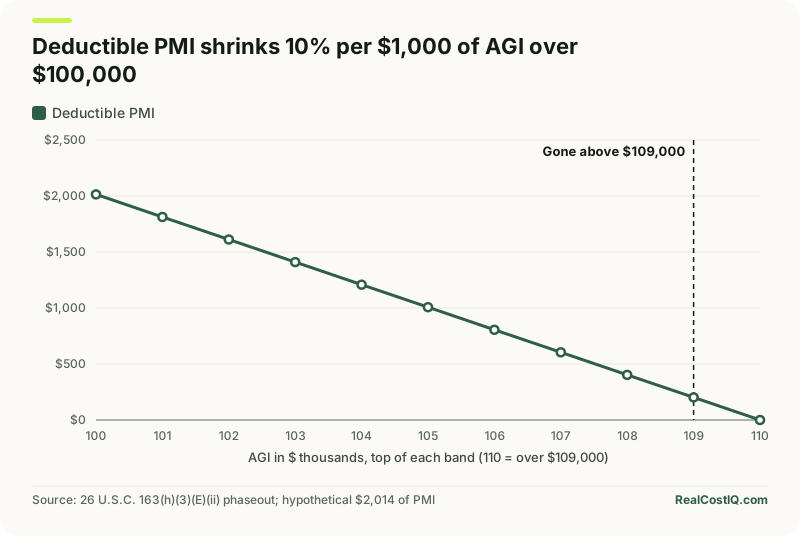
Here is one example. Say your AGI is $104,500. That is $4,500 over $100,000. The law counts each $1,000 or part of it, so that is 5 steps. Five steps of 10 percent is 50 percent. You keep half: $1,007 of the $2,014. At a 22 percent rate, the tax saving is about $222 a year. That is about $18 a month.
Notice what this means for many buyers. A household with two good incomes can pass $109,000 fast. Those buyers get no deduction at all, even though they pay PMI.
The itemizing rule: why many people get nothing
Every tax return has a choice. You can take the standard deduction, a flat amount that depends on your filing status. Or you can itemize, which means adding up specific costs such as mortgage interest and certain taxes. You use whichever is bigger. The PMI deduction counts only if you itemize.
The IRS set the 2026 standard deduction at $16,100 for single filers, $24,150 for heads of household, and $32,200 for married couples filing jointly. It announced these figures on October 9, 2025. They are high enough that most households do not itemize. The IRS statistics show how many. For tax year 2023, about 15.1 million of 160.6 million returns itemized deductions. That is about 9.4 percent. Tax year 2023 is the latest year in the IRS tables read for this post. The standard deduction has risen since then, so the 2026 share could be lower.
A mortgage helps. Interest on a large loan can push a household over the line. In the example above, $28,000 of interest alone beat the single filer's standard deduction by a wide margin. It nearly matched the couple's. But a smaller loan, a lower rate or a short time in the home changes that. Look at what your own interest and tax bills add up to before you count on this deduction.
FHA, VA and USDA loans: how the fees are treated
The law names these programs as qualified mortgage insurance. That means their fees can be deductible, under the same income limit and itemizing rule. But their fees work differently from PMI, so the details matter.
FHA loans
FHA loans have two charges. The first is an upfront premium paid when the loan closes. HUD, the federal housing department, set it at 1.75 percent of the base loan amount in its Mortgagee Letter 2023-05. On a $380,000 base loan, that is $6,650. The second is an annual premium, paid in monthly pieces. The same letter set it at 0.55 percent a year for a loan up to $726,200 with a term over 15 years and a loan-to-value over 95 percent. That means a down payment under 5 percent. On a $380,000 FHA loan with less than 5 percent down, that is $2,090 a year, or about $174 a month. At exactly 5 percent down, as in the example above, the letter's rate is 0.50 percent, or $1,900 a year. Those rates date from a letter effective March 20, 2023, so check HUD for any newer ones.
The IRS draft guide has a special rule for premiums paid up front. If you pay a premium that covers future years, you spread it over the shorter of the loan term or 84 months. The 84 months start in the month you got the insurance. So the $6,650 upfront premium, spread over 84 months, is about $79.17 a month. If you closed in July 2026, six months of it fall in 2026. That is about $475 you could deduct for 2026. The monthly premium you pay during the year is deductible as paid.
VA and USDA loans
The IRS draft guide says VA mortgage insurance is commonly called a funding fee. For the Rural Housing Service, it is called a guarantee fee. The fees can be paid in cash at closing or rolled into the loan. According to the draft, they can be deducted fully in 2026 if the insurance contract was issued in 2026. The 84-month spreading rule does not apply to them. If the amount is not on your Form 1098, the draft says to ask the insurance issuer. That is a point to check with your servicer, since a missing number is a common stumbling block.
How to claim it, and what to keep
Your lender or servicer sends a Form 1098 each January. It is the Mortgage Interest Statement. It shows the interest you paid, and often the mortgage insurance premiums too, in a box marked 5. The IRS draft guide says you claim qualified premiums on line 8d of Schedule A. A worksheet in the draft guide figures the amount if your income is over $100,000.
Keep three things. Keep your Form 1098. Keep your loan closing papers, which show which kind of insurance you have and when the contract began. Keep your income figures for the year, because they decide how much of the deduction you can take. Tax software walks you through the line items, but it only knows what you tell it.
Remember the guide is a draft. The IRS says drafts often get changes before the final version. If the final 2026 guide or the Schedule A instructions differ from what is written here, follow the final IRS text.
What this does to the cost of owning with PMI
The honest take is that the deduction is a modest help. In the example, PMI costs $167.83 a month. The deduction cut that by $0 to $37, depending on the household. That is real money over several years. It is not enough to change a decision between a larger down payment and a smaller one.
Two other tools may matter more. First, you can look at the whole monthly cost, not just PMI. The true cost of homeownership calculator adds up the loan payment, taxes, insurance and upkeep. Second, you can see how PMI changes with your credit score and down payment in the PMI calculator. That page explains how PMI is priced. This post does not repeat it.
Some buyers use a second loan to avoid PMI. That is called an 80-10-10 loan or a piggyback. It splits the debt into a first loan for 80 percent, a second loan for 10 percent, and a 10 percent down payment. The 80-10-10 piggyback calculator compares it with a single loan that has PMI. The interest on a second loan is mortgage interest too, so the tax rules differ. The guide to piggyback loans versus PMI walks through the trade-offs.
What this post does not cover
- Whether you should itemize. That depends on all of your deductions, not just the mortgage. The tax return decides it, and a tax professional can help.
- The home mortgage interest deduction in general. That has its own limits on how much debt counts, covered in mortgage interest deduction in 2026: how much it really saves. This post only uses first-year interest of about $28,000 as an input.
- Property tax and state tax deductions. The $4,000 in Case B is an assumption. Other limits apply to those taxes.
- How long you pay for PMI. That is a question about cancelling the policy, which has its own rules.
- Lender-paid PMI. Here the lender pays the premium and charges you a higher rate. You do not pay the premium separately. This post did not read a source on how that is reported, so ask your lender what appears on your Form 1098.
The short version
Mortgage insurance premiums are deductible for tax year 2026, after four years when they were not. The law is Public Law 119-21, section 70108. To use it, you need qualified insurance on a loan for your main or second home. You must itemize, and your AGI must be $100,000 or less for the full amount. Above that it shrinks by 10 percent per $1,000, and it ends at $109,000.
In dollars, on a $380,000 loan with $2,014 of yearly PMI, the deduction saves about $443 for a single filer at the 22 percent rate who already itemizes. It saves about $218 for a married couple at the 12 percent rate who just barely clear the standard deduction. And it saves nothing for a couple who do not. Run your own numbers before you count on it.