This post is about the property side of the deduction: how much a mortgage's interest can lower a tax bill, and what rules decide it. It is not tax advice, and it does not tell you whether to itemize. A tax professional can look at your whole return. What follows is arithmetic on one round-number loan, using rules read from the IRS and the law on October 17, 2026.
The example: $400,000 at 7.40 percent
Take a $400,000 loan with a 30-year term. The rate is 7.40 percent, which is Freddie Mac's average 30-year fixed rate in its survey released October 15, 2026. Freddie Mac is a government-backed mortgage company. Your rate will differ, so treat this as a typical case, not a quote.
The site's amortization calculator gives a principal and interest payment of $2,769.52 a month. Amortization is the schedule that splits each payment between interest and principal. Interest is the fee for borrowing. Principal is the part that pays down the loan. Early on, most of each payment is interest. In the first 12 payments, $29,474.17 goes to interest. That is about $2,456 a month.
Interest falls every year, because the balance falls. Here is the interest paid in selected years of the loan, from the same schedule.
| Loan year | Interest paid in the year | Share of the year's payments |
|---|---|---|
| Year 1 | $29,474 | 89% |
| Year 5 | $28,184 | 85% |
| Year 10 | $25,930 | 78% |
| Year 15 | $22,672 | 68% |
| Year 20 | $17,961 | 54% |
| Year 30 | $1,295 | 4% |
Computed with the site's amortization engine: payment $2,769.52 a month, $33,234 a year. A calendar tax year will not match a loan year unless you close on January 1.
One caution. Loan years are not tax years. If you close in July, your first tax year has only about six payments. Your lender reports the real number for each calendar year on a form we will cover below.
What the deduction really saves
The common shortcut is to multiply the interest by your tax rate. On $29,474 at 24 percent, that gives $7,074. It is wrong for almost everyone, and it is wrong in a way that always overstates the saving.
Here is why. If you did not own a home, you would still get the standard deduction. The IRS set it at $16,100 for single filers, $24,150 for heads of household and $32,200 for married couples filing jointly for tax year 2026. It announced those amounts on October 9, 2025. Your mortgage interest only changes your tax by the amount it pushes your itemized total *above* that flat figure.
A marginal rate is the tax rate on your last dollar of income. For 2026, the IRS says a single filer pays 24 percent on taxable income over $105,700, and a married couple filing jointly pays 22 percent on taxable income over $100,800 and 24 percent over $211,400. Taxable income is what is left after deductions. The saving from the extra deduction is the extra amount times that rate.
| Item | Single filer, 24% rate | Married couple, 22% rate, no other deductions | Married couple, 22% rate, $10,000 other deductions |
|---|---|---|---|
| Mortgage interest, year 1 | $29,474 | $29,474 | $29,474 |
| Other itemized deductions (assumed) | $0 | $0 | $10,000 |
| Itemized total | $29,474 | $29,474 | $39,474 |
| 2026 standard deduction | $16,100 | $32,200 | $32,200 |
| Itemize? | Yes | No, standard is bigger | Yes |
| Amount above the standard deduction | $13,374 | $0 | $7,274 |
| Tax saved because of the mortgage | $3,210 | $0 | $1,600 |
| Shortcut answer (interest times rate) | $7,074 | $6,484 | $6,484 |
Hypothetical households. Savings are the amount above the standard deduction times the stated rate, assuming the whole amount falls in that bracket. The $10,000 of other deductions is an assumption. Standard deductions and bracket starts are from IRS release IR-2025-103. Interest is year one of the $400,000 loan at 7.40%.
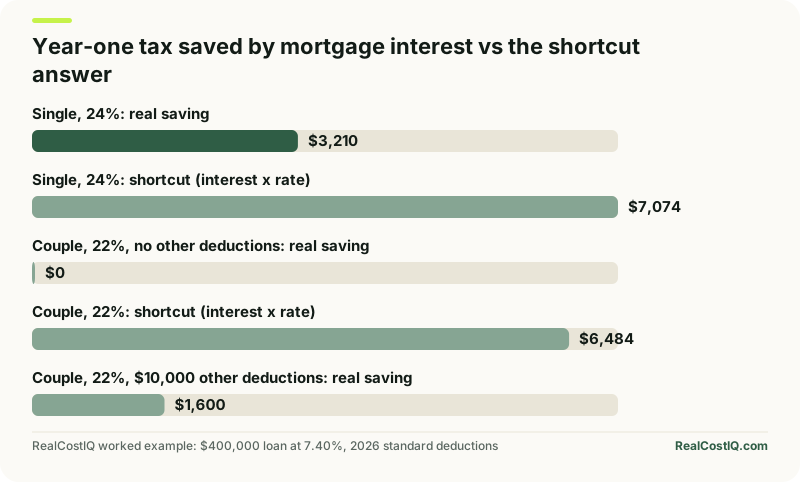
Look at the middle column. A married couple with a $400,000 loan and no other deductions gets nothing from the mortgage interest deduction. Their $29,474 of interest is less than their $32,200 standard deduction. They would take the standard deduction anyway. The shortcut says they save $6,484. The real answer is zero.
In the last column, the same couple has $10,000 of other deductible costs, such as state taxes and gifts to charity. Now their itemized total is $39,474. That is $7,274 above their standard deduction. At 22 percent that saves $1,600. Notice that the mortgage did not earn that whole amount alone. The other $10,000 helped it clear the bar. This post does not split the credit between them.
The state and local tax deduction, often called SALT, is one of the other deductions that couples usually count. It has a cap. The site's SALT deduction calculator shows how the cap works for your state and property tax bill. This post only uses it as an input.
The saving shrinks as the loan ages
Because interest falls each year, the deduction falls too. And it falls faster than the interest, because the standard deduction does not move. Take the single filer in the 24 percent bracket. Hold the 2026 standard deduction of $16,100 fixed. The standard deduction is adjusted for inflation each year, so the real figure will rise, which makes the later numbers a best case.
| Loan year | Interest | Above $16,100 | Tax saved at 24% |
|---|---|---|---|
| Year 1 | $29,474 | $13,374 | $3,210 |
| Year 5 | $28,184 | $12,084 | $2,900 |
| Year 10 | $25,930 | $9,830 | $2,359 |
| Year 15 | $22,672 | $6,572 | $1,577 |
| Year 20 | $17,961 | $1,861 | $447 |
Assumes no other itemized deductions, a constant 24% rate and a constant standard deduction. Real incomes, rates and deductions change over 20 years.
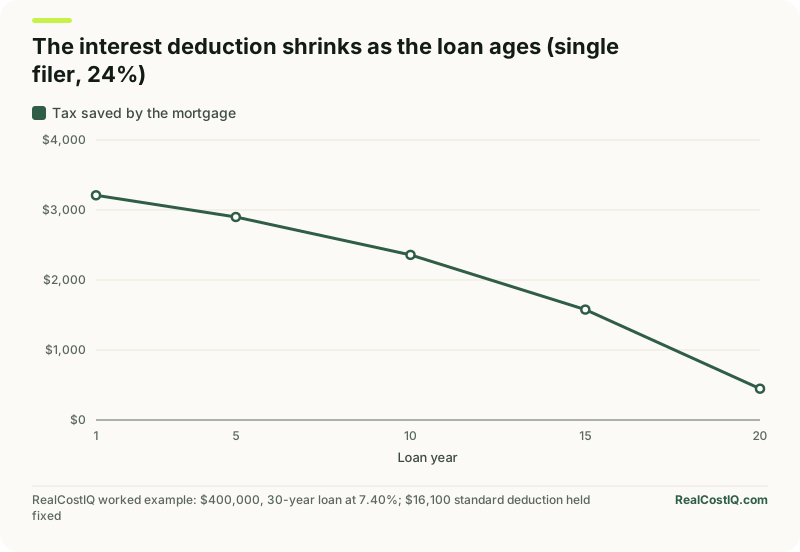
By year 20 the saving is under $450 a year. The loan still has plenty of years left. But the interest has almost caught up with the standard deduction, so there is little left above it. Many owners stop itemizing well before the loan ends.
That makes the deduction a modest discount, not a reason to carry a bigger loan. In year one, the single filer pays $29,474 of interest to save $3,210 of tax. For every dollar of interest, the deduction gives back about 11 cents. The rest is a real cost. The site's true cost of homeownership calculator adds up the full monthly bill, including taxes, insurance and upkeep, if you want the whole picture.
The $750,000 limit, and what happened to it in 2025
Not all of your mortgage debt counts. The tax code only lets you deduct interest on a capped amount of "home acquisition debt." That is a loan you took out to buy, build or substantially improve your home. The home must secure the loan, which means the lender can take it if you stop paying.
Here is the cap, based on the IRS publication and the law text.
- $750,000 for loans taken out after December 15, 2017. It is $375,000 if you are married and file a separate return.
- $1,000,000 ($500,000 if married filing separately) for older loans taken out on or before December 15, 2017. The IRS calls these grandfathered debt. The IRS also treats a main home as older debt if you signed a written binding contract before December 15, 2017 to close before January 1, 2018, and the purchase closed before April 1, 2018.
- The limit covers your main home and one second home combined. It is not $750,000 per home.
The $750,000 limit began with a 2017 tax law. That law set it to end after 2025. Many guides still say it would "expire" and the old $1 million limit would return. That is out of date. Public Law 119-21, signed on July 4, 2025, changed this in section 70108. Among other edits, it struck the words "and before January 1, 2026" from the tax code, and it changed the heading from "2018 Through 2025" to "Beginning After 2017." The change applies to tax years that begin after December 31, 2025. In plain terms, the $750,000 limit no longer has an end date.
The IRS draft guide for 2026, Publication 936, says the same thing in its reminders: you can deduct home mortgage interest on the first $750,000 of debt, with higher limits for debt taken before December 16, 2017. The 2026 guide is still a draft. The IRS marks it "not for filing," and drafts can change before the final version. The final 2025 guide is the one to use for the 2025 return.
How does the limit work in practice? If your loan is over the cap, you deduct only part of the interest. Say you borrow $900,000 to buy a home. The cap covers $750,000 of it, which is 83 percent. You could deduct roughly 83 percent of the interest. The IRS guide has a worksheet for the exact figure. A $400,000 loan, like our example, is far under the cap, so all the interest counts.
Home equity loans and cash-out refinances
A home equity loan or line of credit is a loan secured by your home that you take out after you own it. The rule here changed in 2018, and it is still in place. The IRS draft guide for 2026 says it plainly: no matter when the debt was taken out, you cannot deduct the interest on a loan secured by your home to the extent the money was not used to buy, build or substantially improve that home.
The test is how you used the money, not what the lender calls the loan. Two cases show the difference.
- A $60,000 home equity line used to add a bedroom. The money improved the home that secures the loan. The interest can count as acquisition debt, and it adds to the same $750,000 limit.
- A $60,000 home equity line used to pay off a car loan or a wedding. The money did not go into the home. The interest is not deductible.
A cash-out refinance works the same way. It replaces your old mortgage with a bigger one and hands you the difference. The IRS guide says secured debt used to refinance acquisition debt is treated as acquisition debt, up to the old balance. The cash you take out follows the use-of-funds test. If you spend it on the house, it counts. If you spend it elsewhere, it does not. Keep records of where the money went.
Points: usually spread over the life of the loan
Points are fees you pay up front to lower your rate. One point equals 1 percent of the loan. On a $400,000 loan, one point is $4,000. The IRS says you generally cannot deduct the full amount of points in the year you pay them. Instead you deduct them equally over the life of the loan. That is the default.
There is an exception. You can deduct points in full in the year paid if you meet a list of tests in the IRS guide. They include that the loan is to buy or build your main home, that paying points is normal in your area, and that the points are shown as a percent of the loan on your closing papers. The IRS guide has a flow chart (Figure B) for this. Points on a second home cannot be fully deducted in the year paid.
Here is the spread-out case. $4,000 of points over 360 months is $11.11 a month, or $133 a year. For the single filer at 24 percent, that is worth about $32 a year, and only if they itemize. It is small. Points can still make sense for other reasons, such as a lower payment. The tax part is a footnote.
Form 1098: where your number comes from
Your lender sends you a form each January called Form 1098, the Mortgage Interest Statement. The IRS instructions for the form say a lender must file one when it receives $600 or more of mortgage interest from you in a year. The form is filed per mortgage, so two loans means two forms.
The boxes that matter to most owners are these:
- Box 1 shows the mortgage interest you paid in the year, not counting points.
- Box 2 shows your outstanding principal on January 1. For a new loan, it shows the amount you started with.
- Box 5 shows mortgage insurance premiums of $600 or more. Mortgage insurance is a fee some borrowers pay that protects the lender. For the 2026 tax rules on it, see is PMI tax deductible in 2026. It has its own income limit.
- Box 6 shows points paid on the purchase of your main home, when they meet the form's conditions. Points on a refinance, a home equity loan or a second home are not reported here.
If you paid less than $600 of interest, or never got a form, you can still count interest you actually paid, if the rules above are met. You just need your own records.
Who gets little or nothing from it
A few patterns show up in the math above. They are about arithmetic, not about what anyone should do.
- Married couples with a smaller loan. Their standard deduction is $32,200. Interest on a loan under roughly $435,000 at 7.40 percent falls below it in year one. At $435,000, year-one interest is about $32,000.
- Owners late in the loan. As the table showed, interest falls toward the standard deduction.
- Owners with low-rate loans. A loan at 3 percent has far less interest than one at 7.40 percent. The same $400,000 at 3 percent has year-one interest of about $11,900, below every 2026 standard deduction.
- Buyers who close late in the year. Only a few months of interest land in the first tax year.
The reverse is also true. A single filer or a head of household with a large loan clears the bar quickly. So does anyone with high state and local taxes, big charitable gifts or both.
Second homes, rentals and home offices
The deduction covers a main home and one second home. The IRS guide says a second home is a home you choose to treat as your second home. If you rent it out, you must also use it as a home during the year for it to count. If you have more than one second home, you can treat only one as the second home in a given year.
Interest on a rental property is handled in a different way. It is a business expense, and it is not part of this deduction or its $750,000 limit. This post does not cover rental taxes.
What this post does not cover
- Whether you should itemize or take the standard deduction. That depends on your whole return. A tax professional can answer it for you.
- Income tax planning and retirement choices. Those are outside this site's scope.
- State income tax rules. Some states let you deduct mortgage interest on a state return, and some do not. This post covers federal rules only.
- Business or rental use of a home. Different rules apply.
- Mortgage insurance rules in depth. One post covers them: is PMI tax deductible.
The short version
For 2026, home mortgage interest is deductible on up to $750,000 of acquisition debt, and that limit is now permanent under Public Law 119-21. Older loans keep a $1 million limit. You get the deduction only if you itemize. Home equity interest counts only if the money went into the home. Points are usually spread over the loan's life.
In dollars, on a $400,000 loan at 7.40 percent, year-one interest is about $29,474. A single filer in the 24 percent bracket with no other deductions saves about $3,210. A married couple with no other deductions saves nothing. A couple with $10,000 of other deductions saves about $1,600. The saving falls every year as the interest falls. Run your own loan through the amortization calculator before you count on a number.