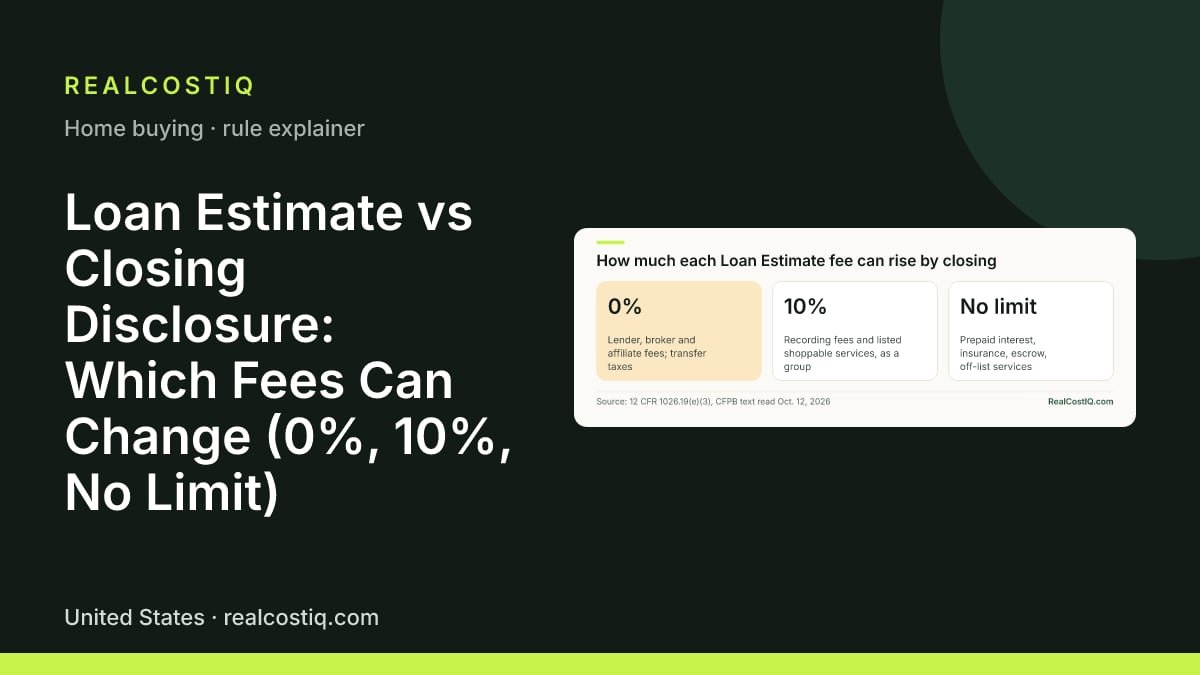
The Loan Estimate is not a promise that every number will be the same at the table. It is a baseline. Regulation Z sets how far each line can move from it. Some fees you thought were fixed can rise with no violation if a rule allows it. Some small drifts are overcharges the lender owes you back. The difference comes down to two things. One is which of three buckets the fee sits in. The other is whether something happened after the estimate that lets the lender reset the baseline. This post walks through the buckets as the rule states them (read on the CFPB's copy of 12 CFR 1026.19 on 2026-10-12). It covers the events that reset the baseline, the timing of the Closing Disclosure, a worked example with a refund, and a line-by-line way to compare the two forms.
Why the Loan Estimate is a baseline, not a final bill
The lender must deliver the Loan Estimate within three business days after receiving your application. Regulation Z then tests the lender's estimates after the fact. A charge is in good faith if the amount you actually pay does not exceed the amount first disclosed, except where the rule allows it. The official interpretation adds that the amount tested is the final charge paid or imposed at consummation or settlement, whichever is later. (Consummation means the day you become legally bound to the loan.) That detail matters. Say a fee is collected at closing and partly refunded after recording. It is tested at the lower, final amount. The rule's own example is a recording-fee estimate of $100 collected at closing, an actual recording fee of $70 and a $30 refund. The fee you paid is $70.
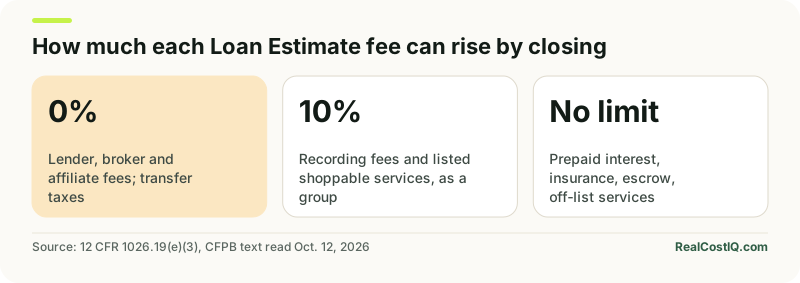
The CFPB's plain-language answer to "can my final mortgage costs increase" sorts the same rule into three groups. The lender can increase some costs by any amount. It can increase some by up to 10 percent. It cannot increase some at all. The CFPB also notes that it is illegal for lenders to deliberately underestimate the costs on a Loan Estimate. The tolerance rule is the enforcement side of that. It is how a mismatch gets measured.
The three buckets: 0%, 10% and no limit
Each fee on the Loan Estimate belongs to exactly one bucket. The bucket depends on who is paid, whether the lender required the service, and whether you were allowed to shop for it. The table below follows paragraphs (e)(3)(i), (ii) and (iii) of the rule and the CFPB's consumer summary of them.
| Bucket | What goes in it | How far it can move without a valid reset |
|---|---|---|
| 0% (cannot increase) | Fees paid to the lender, a mortgage broker, or an affiliate of either. Fees for a required service where the lender did not let you shop, even if the provider is unaffiliated. Transfer taxes. Lender credits (a smaller credit counts as an increase). | No increase. Each charge is tested on its own. |
| 10% (cumulative) | Recording fees, plus third-party services the lender required and let you shop for, when you used a provider on the lender's written list or did not choose one. An affiliate of the lender is never in this bucket. | The sum of the whole bucket may rise by 10%. One line can rise by more than 10% as long as the total stays inside. |
| No limit (best-information rule) | Prepaid interest, property insurance premiums, amounts placed in escrow, third-party services you chose from outside the lender's list, property taxes and third-party services the lender did not require. | Any amount, provided the estimate was based on the best information reasonably available to the lender when it was given. |
A fee is "paid to" a person only if that person keeps it. If the lender collects a fee and passes it straight to a third party, it is not treated as paid to the lender. Source: CFPB's text of Regulation Z section 1026.19 and its Official Interpretation, read 2026-10-12.
The 0% bucket is tested line by line
In the 0% bucket, each charge is compared with its own estimate. Say the origination fee on the Loan Estimate is $1,200. The lender cannot charge $1,250 on that line and call it offset by an appraisal fee that came in lower. The rule's example of a lender credit makes the same point from the other side. Say the Loan Estimate promises $750 of lender credits and only $500 is provided. The shortfall is treated as an increased charge to you. A credit is a negative charge, so a credit that shrinks is a cost that grows.
The 10% bucket is tested as a sum
The 10% bucket is the one most buyers misread. The limit applies to the total of the charges in the bucket, not to each line. The official interpretation gives the rule's own example. Say a $300 settlement agent estimate sits inside a $1,000 bucket. The settlement agent fee can exceed $330 with no violation, so long as the whole bucket stays at or below $1,100. A fee left off the estimate can also join the bucket. A $10 notary fee that was not estimated is fine if the bucket total stays within the cap. Now say an estimated service is not used, such as a $100 pest inspection that was never ordered. Its estimate is removed from the baseline before the comparison. So skipping a service shrinks the cap as well as the cost.
Why "provider not on the list" matters
Some services are required by the lender, but the lender lets you shop for them. Examples are the settlement agent, survey or pest inspection. For these, the lender must give you a written list of providers. Pick someone from the list, or pick no one, and the fee sits in the 10% bucket. Pick a provider that is not on the list, and the fee moves to the no-limit bucket. It is then no longer compared with the estimate at all. That is a real trade-off. Shopping outside the list can save money, but it removes the protection. The CFPB's Loan Estimate explainer tells buyers they can choose a provider from the list or look elsewhere. It also says to check with the lender about any provider not on the list.
The fees with no cap, and why they still shift
The no-limit bucket is not a free pass for the lender. The estimate has to be consistent with the best information reasonably available at the time. The official interpretation shows both sides. Say the lender knows the loan must close on the 15th but estimates prepaid interest from the 30th. That under-disclosure is not in good faith. Say it reasonably estimates a 30th closing and the loan actually closes on the 1st of the next month. That complies. A homeowner's insurance premium that the lender requires but forgets to include is a failure. An omitted flood insurance premium on a property that is near but not in a required flood zone is not.
In practice, these lines move for ordinary reasons. The closing date shifts and prepaid interest changes. The insurance quote you finally bind differs from the placeholder. The escrow deposit is recalculated. Property taxes and the first escrow deposits are not capped, because the county and the insurer set them, not the lender. Use the comparison method later in this post to tell these apart from the lines that should not have moved.
What lets a lender reset the baseline
Paragraph (e)(3)(iv) lists the reasons a lender may use a revised estimate in place of the original. After a valid reason, the actual charge is compared with the revised figure, not the first one. The reasons are narrow. The revision is allowed only to the extent the reason actually raised that charge.
| Reason | What the rule says | Illustration |
|---|---|---|
| (A) Changed circumstance affecting settlement charges | An extraordinary event beyond anyone's control, information the lender relied on that was inaccurate or changed, or new information the lender did not rely on. | A $200 appraisal fee quoted for a single-family home becomes $400 when the appraiser finds the home sits on a farm, which has a different fee schedule. |
| (B) Changed circumstance affecting eligibility | You become ineligible for a charge previously disclosed because a changed circumstance affected your creditworthiness or the value of the property. | A credit event or a lower appraisal that makes a previously quoted charge unavailable. |
| (C) Revision requested by the consumer | You ask for a change to the credit terms or the settlement that raises an estimated charge. | Switching loan type or changing the down payment, which the CFPB lists as a change in circumstances. |
| (D) Interest-rate-dependent charges | Points or lender credits change because the rate was not locked when the Loan Estimate was issued. A revised Loan Estimate is due within three business days after the rate is locked. | You lock the rate a week after the first estimate: the points and credits are re-quoted for the locked rate. |
| (E) Expiration | You indicate an intent to proceed more than 10 business days after the Loan Estimate was provided, or more than any longer period the lender stated. | No justification is needed beyond the lapse of time. |
| (F) Delayed settlement on a construction loan | For new construction closing more than 60 days out, only if the original Loan Estimate clearly said it could be revised until 60 days before consummation. | A builder's schedule slips and costs are re-quoted. |
The appraisal example in row (A) is the Official Interpretation's own; the other illustrations are this post's plain-language readings of the rule text. Sources: section 1026.19(e)(3)(iv) and the CFPB's consumer page on whether final costs can increase, both read 2026-10-12. The CFPB lists the same consumer-side examples (changing loan type or down payment, an appraisal that came in different, a credit change, income that could not be documented) as a "change in circumstances".
Three limits keep this from becoming a loophole. First, the revision counts only to the extent the reason actually raised the cost. The interpretation's own example is a consumer-requested rate lock extension. The revised Loan Estimate may show a new extension fee. But the fee cannot exceed what the lender charges in its usual course of business. The lender cannot use the occasion to pass through unrelated increases. Second, the lender must document the original estimate, the reason, and how the reason affected the cost. Third, a lender may send a revised Loan Estimate just to keep you informed, even if it cannot use it to reset the baseline.
The timing of a revised Loan Estimate
The general rule is that a lender relying on a revised estimate must send a revised disclosure within three business days of receiving enough information to show that one of the valid reasons applies. Two timing limits sit on top. A revised Loan Estimate may not be provided on or after the date the lender provides the Closing Disclosure. You must also receive it no later than four business days before consummation. If it is mailed rather than handed to you, you are treated as having received it three business days after it was mailed. A reset that arrives late cannot be used for the good-faith comparison, so the original numbers keep governing. Suppose the lender uses a revised estimate that it sent after a reason arose. Then the rule allows the revised figure to appear on the Closing Disclosure itself.
A rate lock is the reset event many buyers meet first. Say you lock after the Loan Estimate. The lender then has three business days to send a revised version that reflects the locked rate, points and credits. Say you lock on or after the date the Closing Disclosure was already provided. The lender cannot send a revised Loan Estimate. It must give a corrected Closing Disclosure at or before closing. What happens when the lock runs out is a lender-policy question, not a tolerance question. It has its own post: when a rate lock expires before closing.
The three-day Closing Disclosure rule and the three events that restart it
You must receive the Closing Disclosure no later than three business days before consummation. For this purpose, a business day is every calendar day except Sundays and legal public holidays. So Saturday counts. The rule's example: if closing is set for Thursday, hand delivery on Monday satisfies it. Mail or other delivery that is not in person is treated as received three business days after it is sent. The exception is when the lender can show you actually received an emailed copy earlier. Under the interpretation, mailing on the Thursday before a Thursday closing works. Mailing on the Monday does not.
The CFPB's page states the purpose plainly. The three-day window lets you compare the final terms and costs with those estimated in the Loan Estimate. You can also ask your lender questions before the closing table. If the comparison turns up a change, what happens next depends on what changed. Most changes only require a corrected Closing Disclosure that you receive at or before closing, with no new waiting period. Only three changes require a corrected form and a fresh three-business-day wait before you close.
- The annual percentage rate (APR) becomes inaccurate under the Regulation Z accuracy test. The rule's example: a disclosed 7.00% APR that is 7.10% on closing day is still accurate under the test. A corrected form is then due by closing, with no delay. A 7.15% APR is inaccurate. The lender must delay closing so you receive the corrected form three business days before consummation.
- The loan product changes, so the disclosed product type becomes inaccurate. An example is moving from a fixed rate to an adjustable rate.
- A prepayment penalty is added. That is a fee for paying off the loan early.
A change in a fee, even a large one, is not on that list. A fee that rises at the last minute does not by itself restart the three-day clock. This is why the tolerance comparison matters on the day you receive the Closing Disclosure. You may have no waiting-period remedy. But you have a refund remedy if the increase was outside the buckets.
Worked example: a bucket overrun and the refund
The example below is hypothetical. The fee names are real categories. The dollar amounts are invented to show the arithmetic and are not a typical cost for any area. Assume no valid reset event occurred between the Loan Estimate and the closing.
| Charge | Bucket | Loan Estimate | Closing Disclosure | Over the limit? |
|---|---|---|---|---|
| Origination fee (lender) | 0% | $1,200 | $1,250 | Yes, by $50 |
| Appraisal (lender's chosen company, unaffiliated, borrower could not shop) | 0% | $600 | $600 | No |
| Transfer tax | 0% | $1,500 | $1,500 | No |
| Title services (from lender's written list) | 10% group | $1,800 | $2,050 | Counted in the group below |
| Survey (from the list) | 10% group | $450 | $450 | Counted in the group below |
| Pest inspection (from the list) | 10% group | $120 | $120 | Counted in the group below |
| Recording fees | 10% group | $250 | $310 | Counted in the group below |
| 10% group total | 10% group | $2,620 | $2,930 | Yes, cap is $2,882, over by $48 |
| Prepaid interest | No limit | $620 | $810 | Not tested (closing date moved) |
The 10% cap is 110% of the estimated group total: $2,620 times 1.10 is $2,882. The actual group total of $2,930 is $48 above it. The 0% bucket excess is the $50 origination increase. Total owed back: $50 plus $48 equals $98. Prepaid interest is outside both tested buckets so the $190 increase does not count toward a refund, assuming the estimate was based on the best information available.
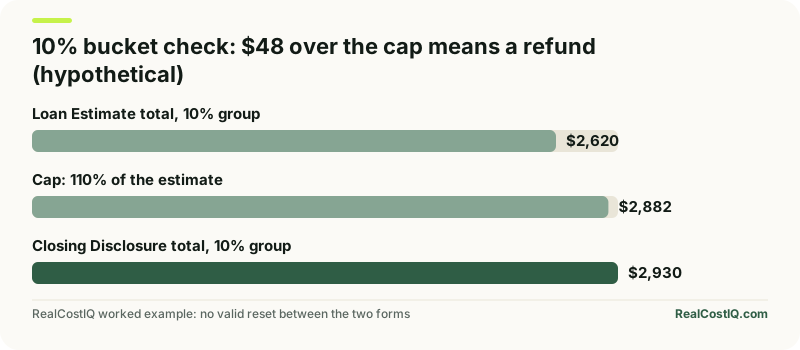
Notice what the example shows. The title line rose by $250, roughly 14% on its own. That alone is not a violation. What mattered was the group. The four lines together rose by $310, or 11.8%, and the cap allowed $262. Notice also that the 0% overage and the 10% overage are added to produce the refund. The rule's own illustration does the same arithmetic with different numbers. Four 0% charges are over by $30, $25, $25 and $15 (a $95 excess). A 10% group is over by $90. Together they produce a $185 refund.
If the lender can document a valid reset for any of these lines, the comparison changes. Suppose a changed circumstance raised the title services estimate. Suppose the lender sent a revised Loan Estimate within three business days of learning of it. Then the title line in the 10% group would be revised, and the group would be tested against the revised figures. This is why you should ask for the written explanation of each increase. If there was a revised Loan Estimate, compare against the latest one, not the first.
How a refund is paid, and by when
Paragraph (f)(2)(v) is the cure provision. Say the amounts you paid exceed the limits in the 0% or 10% buckets. The lender is treated as complying if it refunds the excess to you no later than 60 days after consummation. It must also deliver or mail a corrected Closing Disclosure showing the refund within the same 60 days. In practice, the refund does not have to happen at the table. The rule gives the lender a window after closing to find the error and send the money. The CFPB's consumer page says the same in plain language. If costs increased beyond the allowed limits and there was no change in circumstances, you are entitled to a refund of the amount above the limits.
The rule governs what the lender must do. It does not set out a way for you to enforce it beyond the refund. If the lender says the increase was permitted, ask which reset reason applies. Ask for the revised Loan Estimate that documents it. If the answer is unsatisfying, the CFPB's page on errors in closing documents says to raise it with your lender or settlement agent. It also notes you can submit a complaint to the CFPB. A real estate attorney can tell you whether the facts support more than that. This post cannot.
Comparing the two forms line by line
The CFPB's Closing Disclosure explainer tells buyers to check that several items match the latest Loan Estimate. These are the loan term, purpose, product and loan type; the loan amount and interest rate; the estimated total monthly payment; and the closing costs and cash to close. For fees, it says the "Services Borrower Did Not Shop For" should be similar to the Loan Estimate. The prices in "Services Borrower Did Shop For" should match what you agreed to pay. The steps below turn that into a routine for the day the Closing Disclosure arrives.
- Compare against the right Loan Estimate. Use the most recent revised Loan Estimate, not the first one. Keep every revised copy in one folder. A revised version is the baseline only if it was issued for a valid reason.
- Sort every fee into a bucket. On page 2 of the Closing Disclosure, mark each line 0%, 10% or no-limit using the table above. Lender, broker and affiliate fees are 0%. So are transfer taxes and any service where the lender picked the provider and you had no choice.
- Check the 0% lines one by one. Any increase needs a reason from the reset list. Also check lender credits. A smaller credit is an increase.
- Add the 10% lines. Add up the Loan Estimate figures and multiply by 1.10. Compare that with the Closing Disclosure sum. Remove an estimated service that you did not use from the baseline.
- Ask about every no-limit line that moved a lot. Prepaid interest follows the closing date. Insurance and escrow follow your quotes. A big move is not a violation, but it deserves an explanation.
- Check the rate, product and prepayment penalty. These three drive the restart rules. Anything that differs from the Loan Estimate here is worth a same-day call.
- Put the questions in writing. Email the lender or settlement agent a numbered list. A written answer is what you will rely on if there is a refund later.
To see what a closing-cost line should roughly look like before you compare, run your price and state through the closing costs calculator. To see what a points or lender-credit change does to your payment, use the mortgage points break-even calculator. Neither replaces the lender's own figures. Both help you tell a normal drift from an outlier.
What the tolerance rule does not do
- It does not cap your cash to close. Cash to close includes your down payment, prepaid items, escrow deposits, seller credits and adjustments. Only the tested fees are limited.
- It does not give you a right to cancel for a fee increase. The three-business-day restart applies to the APR, loan product and prepayment penalty, not to fees.
- It does not cover amounts the lender never controlled. Property taxes, third-party services the lender did not require, and providers you chose outside the list are outside the tests.
- It does not stop a lender from revising for a valid reason. A real change in your file can reset the baseline, and the rule expects that.
- It does not apply to every loan. HELOCs, reverse mortgages and certain other loans get different disclosures.
For the home-buying steps around the disclosures, the first-time home buyer guide covers the timeline from offer to closing. The CFPB's checklist for the closing window also tells buyers to confirm that closing costs have not increased by more than what is allowed. It tells them to ask about any fee they do not understand. That is the whole routine: know your bucket, know the reset events, and keep every version of the estimate.