What happens if your rate lock expires before closing
Your lender picks one of three paths, and your lock agreement says which. You can pay to extend the lock and keep your rate. You can re-lock at today's market rate, which may be higher or lower. Or you can close late if the lender allows it, usually at the market rate. Federal rules do not choose for the lender. The best move is to ask about extension terms before the lock is close to running out. Most lenders want the request before the lock expires, and some want it days earlier.
Rate lock extension fees: what two lenders publish
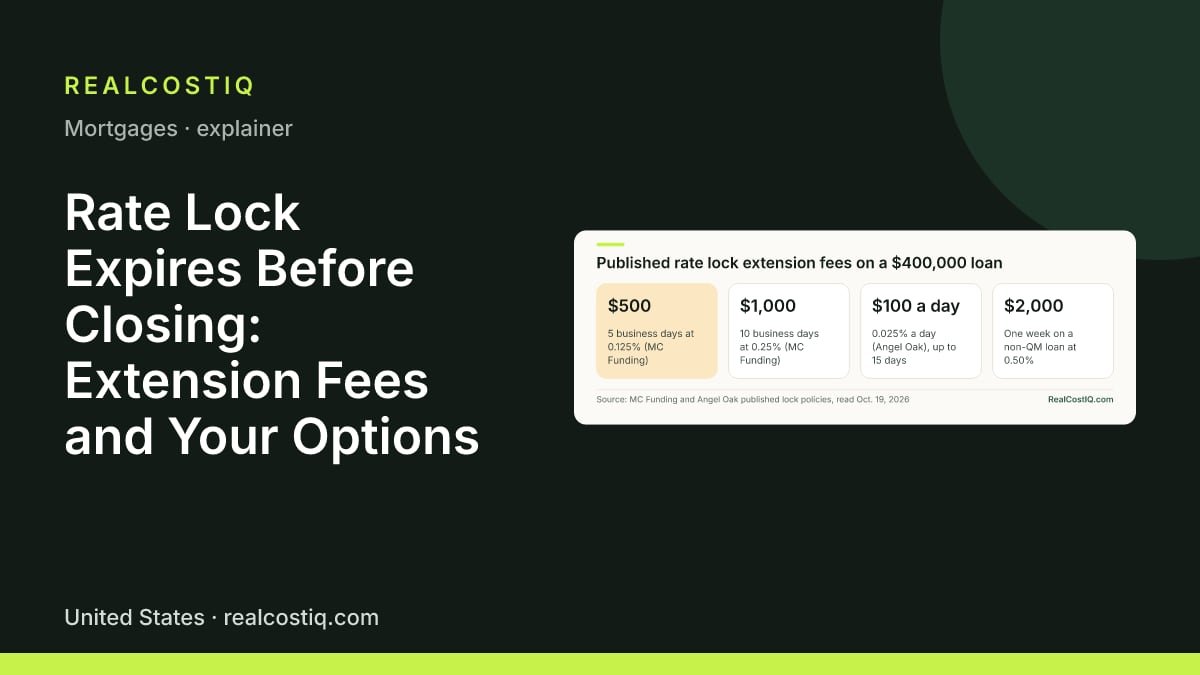
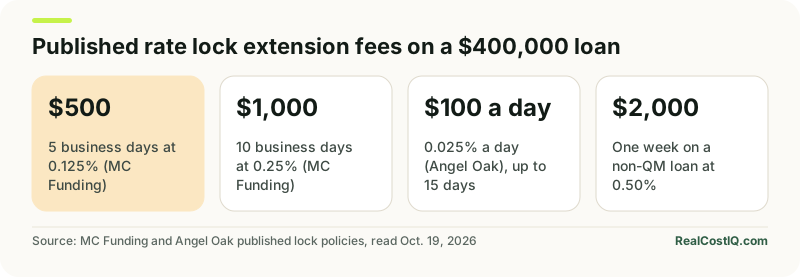
Extension fees are quoted as a percent of the loan amount. The CFPB does not publish a typical fee. These two figures come from lenders' own written policies, which are meant for mortgage brokers. They show the shape of the pricing, not what your lender will charge. Retail banks may price differently.
| Lender policy | Published fee | Cost on $400,000 | Limits |
|---|---|---|---|
| MC Funding, standard extension (policy v01302023) | 0.125% for 5 business days | $500 | Must be requested before the lock expires |
| MC Funding, standard extension (policy v01302023) | 0.25% for 10 business days | $1,000 | More days trigger a re-lock at worst-case pricing |
| MC Funding, non-QM loans | 0.50% for one week | $2,000 | One extension only |
| Angel Oak Mortgage Solutions (2024 policy) | 2.5 basis points (0.025%) per day | $100 a day, so $500 for 5 days and $1,500 for 15 days | Two extensions, 15 days total on most programs |
Source: each lender's published wholesale extension and rate lock policy, read 2026-10-19. These are two examples from broker-facing documents, not a survey and not a typical fee. A basis point is one hundredth of a percent. Dollar amounts are the stated percentage times a $400,000 loan. Ask your own lender for its schedule.
The pattern in both: a short extension costs a fraction of a point, and the price per day rises with the length. If the lock has fully expired, the same two policies treat it differently. Angel Oak's says an expired lock re-locks at its worst-case pricing with a 0.25 percent re-lock fee, for up to 15 days. MC Funding says extensions are not available once the lock has expired. So ask for the extension before the last day.
A mortgage rate lock is a promise with a clock on it. Say closing slips past the last day of the lock. What happens next is written in your lock agreement, not in a federal law. That is the most useful fact on this topic. It is easy to miss because lock terms are often described as if every lender used the same ones. This post splits the topic into three parts. First, what the CFPB (the Consumer Financial Protection Bureau, a federal agency) and Regulation Z (the federal rule on mortgage disclosures) say about locks, read on 2026-10-12. Second, what is lender policy, which you must get in writing. Third, what a delay costs in monthly payment on a named loan size, computed with this site's mortgage engine. It quotes extension fees only from two lenders’ own published policies, shown above, and gives no float-down price because no source states one.
What a rate lock actually holds
A lock keeps your interest rate the same between the offer and closing. That is the CFPB's definition. It holds only if you close within the set time and nothing changes in your application. The CFPB adds that locks are typically available for 30, 45 or 60 days, and sometimes longer. An unlocked rate can change at any time. Two conditions can end the protection. One is the clock. The other is your file. If your loan amount, credit score or verified income changes, the locked rate can still change.
The CFPB lists four common reasons a locked rate moves anyway. You change the kind of loan or the size of the down payment. The appraisal (the value check on the home) comes in higher or lower than expected. Your credit score changes, for example because you opened a new loan or missed a payment. Or your lender could not document overtime, bonus or other income. None of those is a lock expiry. Each is a separate way the lock can stop applying. That is why buyers sometimes lose a rate with days still left on the lock.
The Loan Estimate is the form that lists your loan terms and costs. It tells you whether the rate is locked and for how long. The CFPB points buyers to the top of page 1. It does not tell you what an extension would cost. It does not show what you pay for your lock period, or whether a different period would cost more or less. The agency says so directly. Ask the lender those questions.
What federal rules say, and what they leave to the lender
Regulation Z, at 12 CFR 1026.19, is a disclosure and fee-tolerance rule. It caps how far many closing costs can rise from the Loan Estimate. It does not set a lock length, an extension price or a float-down. What it does say about locks falls into four points. All come from the CFPB's copy of the rule and its Official Interpretation.
- A lock after the Loan Estimate triggers a revised Loan Estimate. Say the rate was not locked when the Loan Estimate was provided. Then the lender must give a revised version. It must show the new rate, the points, lender credits and other rate-dependent charges. The deadline is no later than three business days after the date the rate is locked. If the rate was already locked when the original was provided, the points and credits are compared against the original.
- A lock after the Closing Disclosure triggers a corrected Closing Disclosure. The Closing Disclosure is the final cost form. The lender may not send a revised Loan Estimate on or after the date it provides the Closing Disclosure. If the lock happens then and makes the Closing Disclosure wrong, the lender must give you a corrected one at or before closing.
- A lock that changes the APR enough can restart the three-day wait. APR is the yearly cost of the loan, shown as a rate. Suppose the lock makes the disclosed APR wrong under Regulation Z's accuracy test. Then the corrected disclosure must reach you at least three business days before closing.
- An extension you ask for is a valid reason to reset the estimate. The Official Interpretation (comment 19(e)(3)(iv)-2) gives a rate lock extension as an example. The revised disclosures may show a new extension fee. But the fee may be no more than the fee the lender charges in its usual course of business. The lender may not use the extension to justify unrelated changes to other charges.
Read point four carefully. The rule does not say a lender must charge for an extension. It does not say a lender must offer one, or charge any set amount. It says that if the lender charges its usual fee, that fee is a fair reason to revise the estimate. The lender cannot use the extension as cover to pass through other increases. The price itself comes from the lender's rate sheet or your lock agreement. The same is true of lock lengths, re-lock pricing after expiry, and float-down features. The CFPB says rate lock policies vary by lender. It gives a list of questions to ask, not a list of answers.
| Question | Set by | Where to find it |
|---|---|---|
| Is my rate locked, and for how many days? | Disclosed on the Loan Estimate | Top of page 1 of the Loan Estimate |
| How long can the lock be? | Lender policy | Lender's lock options; ask for shorter and longer periods and their cost |
| What does an extension cost? | Lender policy (the rule caps it at the lender's usual fee when used to reset the estimate) | Lock agreement; ask in writing |
| What rate applies if the lock expires? | Lender policy | Lock agreement; ask what happens if closing is delayed and the lock expires |
| Can I get a lower rate if rates fall? | Lender policy (float-down is optional) | Lock agreement; ask what happens if rates go down |
| Must I get a revised Loan Estimate when I lock? | Federal rule: within three business days | 12 CFR 1026.19(e)(3)(iv)(D) |
| Does a changed APR or product restart the 3-day wait? | Federal rule | 12 CFR 1026.19(f)(2)(ii) |
Source for the federal rows: the CFPB's text of Regulation Z section 1026.19 and its Official Interpretation, read 2026-10-12. Source for the lender-policy rows: the CFPB's page on rate locks, which says policies vary by lender and lists questions to ask, read the same day.
What happens when the lock expires
The CFPB's consumer page names the downside directly. A lock may be expensive to extend if your transaction needs more time. The agency does not say what a lender does at expiry, because lenders differ. The possibilities fall into a few shapes. Your agreement tells you which one you have. This section lists the shapes as questions to ask. It does not claim any of them is common. Confirm any term that is not in your agreement in writing.
- A paid extension. The lender holds the original rate for extra days in return for a fee. This is the case the rule covers. The fee can appear on a revised Loan Estimate, capped at the lender's usual fee.
- A re-lock at current pricing. The lock lapses. The loan is then priced at the market rate on the day you re-lock. If rates rose in between, your rate rises. If they fell, it may fall.
- An expired lock with no stated path. If the agreement says nothing, the CFPB's question applies: what if my closing is delayed and the rate lock expires? Ask before you need the answer.
The CFPB also advises buyers who fear the lock is too short to ask about a longer lock now. The agency does not say what a longer lock costs. It does not say if it is cheaper than a later extension. So ask for both prices. The agency's own list of questions includes whether a shorter or longer lock is available and at what cost. Whether you can switch mid-process is, again, lender policy.
Float-downs and the cost of locking early
A lock cuts both ways. The CFPB notes that a rate lock may lock you out of a lower rate if rates fall after you get your loan offer. A float-down is a feature some lenders add to a lock. It allows a one-time cut in your rate under conditions the lender sets. The CFPB's page does not define it. So whether it exists is up to the lender. So are its cost, how far the rate must fall, and how many times you can use it. The CFPB's question list is the right script: if I lock my rate and interest rates go down, what happens?
The smart way to judge a float-down offer is to price what it protects against. The next section does that with a loan-size example. Freddie Mac's Primary Mortgage Market Survey shows how big weekly moves can be. The 30-year fixed-rate average was 7.40% as of October 15, 2026. That was the same as the week before and up from 6.27% a year earlier. These are averages of applications for conforming loans to borrowers with good credit and 20% down. They are not a quote for you. Rates can still move by that much or more in a week, which gives a sense of scale for a 30-day lock.
What a delay costs: a worked example
Everything in this section is hypothetical. The loan is a $400,000 30-year fixed mortgage, from a $500,000 price with $100,000 down. The starting rate of 7.40% matches the Freddie Mac weekly average for October 15, 2026. The other rates are illustrative moves from it, not forecasts. The payments are principal and interest only. They come from the same engine as the site's mortgage calculator.
| Rate | Monthly P&I | Difference vs 7.40% | Difference over 5 years | Total interest, 30 years |
|---|---|---|---|---|
| 7.15% (market falls 0.25) | $2,701.63 | -$67.89 | -$4,073.40 | $572,586 |
| 7.40% (your locked rate) | $2,769.52 | baseline | baseline | $597,027 |
| 7.65% (market rises 0.25) | $2,838.06 | +$68.54 | +$4,112.40 | $621,701 |
| 7.90% (market rises 0.50) | $2,907.22 | +$137.70 | +$8,262.00 | $646,600 |
Computed with calculateMortgage (src/lib/calculators/mortgage.ts) at a $500,000 price, $100,000 down, 30 years. Differences are monthly payment times 60 months. Taxes, insurance and mortgage insurance are not included. The rates other than 7.40% are illustrative.
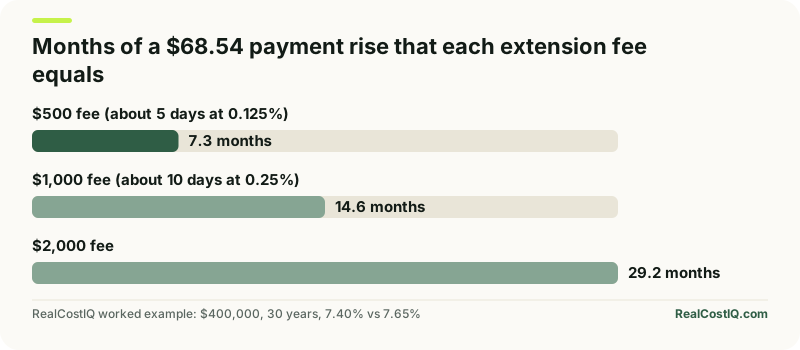
Say the lock expires and the market has moved up a quarter point. The payment rises by $68.54 a month, or $4,112.40 over five years. That is the cost of not having an extension. If you can buy an extension for less than that, it pays off only if the rate rise actually happens. If the market has moved the other way, you want the float-down or a re-lock. The break-even math is simple: divide any fee by the monthly saving.
| Placeholder fee | Months of $68.54 it equals | Reading |
|---|---|---|
| $500 (about 5 days at the published 0.125%) | 7.3 | Pays back in under 8 months if the market had risen 0.25 point |
| $1,000 (about 10 days at 0.25%) | 14.6 | Pays back in about 15 months |
| $2,000 | 29.2 | Pays back in about 29 months, inside a 5-year horizon but only if the rate rise actually happens |
The $500 and $1,000 rows match the published 0.125% and 0.25% fees on a $400,000 loan from the table above; the $2,000 row is a round number for comparison. These are not typical fees. The same division works with any real quote. Where a point of rate is bought with a fee instead, see the mortgage points break-even calculator.
Two cautions keep this from being a rule of thumb. First, the table compares a payment difference to a one-time fee. You cannot know if a rate rise will happen during your delay. So the fee is insurance against an outcome, not a sure loss. Second, an extension might change the APR on the Closing Disclosure enough to make it wrong under Regulation Z. Then the disclosure rules above can add their own three-business-day wait. So ask the lender whether the extension will change the APR before you agree to it.
How to avoid paying for the delay
The cheapest extension is the one you never need. The steps below come from the CFPB's questions and from how Regulation Z handles the timeline. None of them guarantees a lender will waive a fee.
- Match the lock period to your contract dates, with a cushion. Count from the lock date to the closing date in the contract. Then ask what the next longer lock period costs. The CFPB says to make sure the lock is long enough to cover the time until you close.
- Ask the six questions before you lock, and get the answers in writing. What does it mean if I lock today? What lock period does this Loan Estimate provide? Is a shorter or longer lock available, and at what cost? What if my closing is delayed and the lock expires? Under what conditions could my rate still change? What happens if rates go down?
- Find out who controls the delay. Common sources are appraisal scheduling, title work, insurance binding and your own documents. Turning in documents quickly is the part you control. The purchase contract may let you ask for a later closing date. Ask the lender about the lock before you agree to move the date.
- Do not change the file during the lock. The CFPB's list of reasons a locked rate can move includes a new loan, a missed payment, a change in down payment, and income that cannot be documented. Avoid new credit and keep your paperwork consistent.
- Know your last safe day. Mark the lock expiry on your calendar. Add the lender's cutoff for asking for an extension. That cutoff is lender policy and may be earlier than the expiry itself.
- Ask about APR before accepting an extension. An extension that moves the APR enough to make the disclosed APR wrong can add a new three-day wait on the Closing Disclosure. If the lender has already sent the Closing Disclosure, ask whether a corrected one will be needed.
- Compare the extension with a re-lock. If the market has fallen, a re-lock may beat a paid extension. If it has risen, the extension is worth more. Price both before choosing.
If the delay is a job change, a layoff or another income event, the underwriting side is covered in the posts on buying with a new job or an offer letter and in the first-time buyer guide's section on locking. Underwriting is the lender's check of your income and credit. Whether to lock at all once you are under contract is a bet on rates. The CFPB frames it in two lines. An unlocked rate can change at any time. A locked rate can lock you out of a lower one.
What this post cannot tell you
- It cannot tell you what your lender charges. Extension fees, lock lengths and float-down terms are not in any rule or agency page read for this post. The fee table shows two lenders’ published policies, and the break-even table is math on those and one round number.
- It cannot predict rates. The 7.40% starting point is a published weekly average. The other rates are illustrations. Freddie Mac's survey uses applications from borrowers with strong credit and 20% down, so it is not your rate.
- It is not legal advice. The rules here come from the CFPB's published text. The lender's agreement controls your own lock.
- It does not cover adjustable-rate or non-conforming loans. The payment table is a 30-year fixed example. The related ARM vs fixed-rate calculator covers the other type.