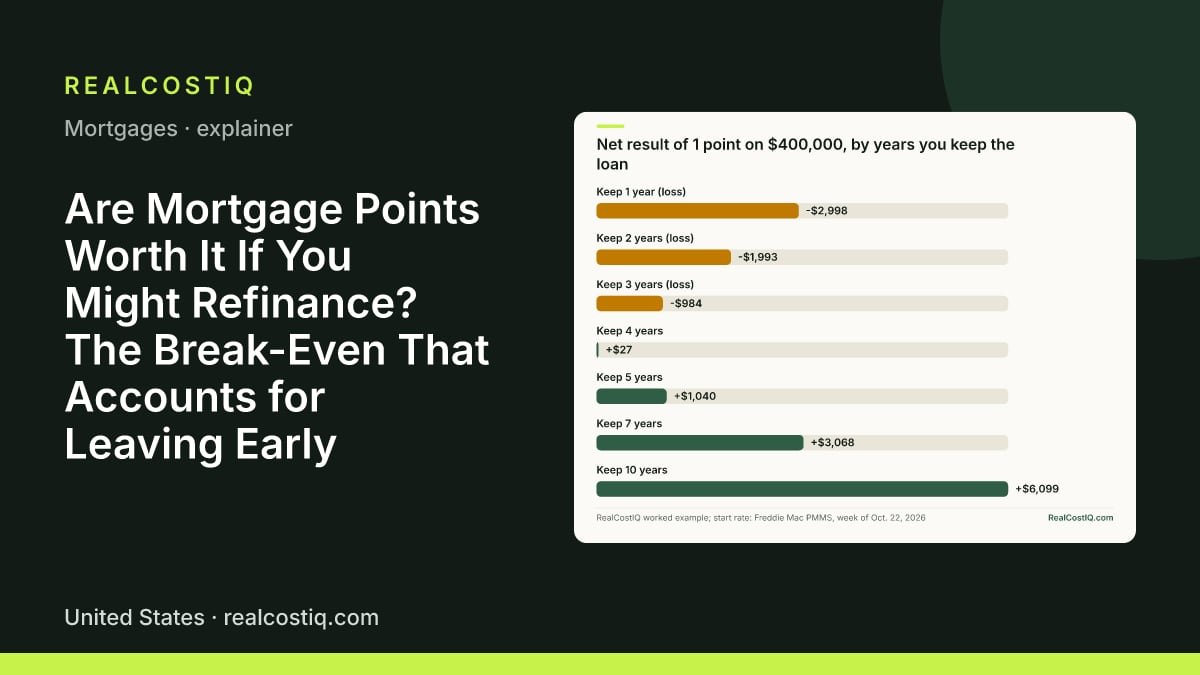
This post is about one question: what happens to the money you pay for points if you leave the loan early? You can leave in two ways. You can sell the home. Or you can refinance, which means taking a new loan to pay off the old one. The mortgage points break-even calculator now has a box for this, labeled "How many years will you keep this loan?" The rates in this post come from Freddie Mac's weekly survey, read October 25, 2026. The week of October 22 showed 7.32% for a 30-year fixed loan.
One point on a $400,000 loan, step by step
Start with round numbers. You borrow $400,000 for 30 years. Your lender quotes 7.32% with no points. That is Freddie Mac's average rate for the week ended October 22, 2026. Your monthly payment for principal and interest is $2,747.72. Principal is the money you borrowed. Interest is what the lender charges for lending it.
Now the lender offers a trade. Pay one point, which is $4,000 (1 percent of $400,000), and the rate drops to 7.07%. The monthly payment falls to $2,680.04. That is $67.68 less each month. The size of the cut is an assumption. Lenders differ, and a point often buys about a quarter of a percentage point. A lender quoted in a forum thread that I read said a point usually lowers the rate by 0.25 to 0.375 points (BiggerPockets, thread from late 2022). Ask each lender for its own prices.
How long until the savings repay the $4,000? Divide the cost by the monthly saving. $4,000 divided by $67.68 is 59.1, so on payments alone you need 60 months. There is a second gain that most quick break-even math skips. A lower rate also means a lower loan balance when you leave, because less of each payment goes to interest. Count that, and the break-even is month 48. Both views are useful, and I label which is which below. After the break-even month, every month is a gain.
The break-even depends on how long you stay
Most break-even articles stop at one number. The next table goes further. For each possible stay, it adds up the monthly savings, adds the smaller loan balance you would pay off at that date, then subtracts the $4,000 cost. The calculator's horizon box does the same. A horizon is just the day you expect the loan to end.
| Years you keep the loan | Payments saved | Lower balance at payoff | Points cost | Net result |
|---|---|---|---|---|
| 1 year | $812.18 | $189.63 | $4,000 | -$2,998 (behind) |
| 2 years | $1,624.35 | $382.91 | $4,000 | -$1,993 (behind) |
| 3 years | $2,436.53 | $579.34 | $4,000 | -$984 (behind) |
| 4 years | $3,248.70 | $778.31 | $4,000 | +$27 (even) |
| 5 years | $4,060.88 | $979.13 | $4,000 | +$1,040 (ahead) |
| 7 years | $5,685.23 | $1,382.85 | $4,000 | +$3,068 (ahead) |
| 10 years | $8,121.76 | $1,976.90 | $4,000 | +$6,099 (ahead) |
| 30 years | $24,365.27 | $0 | $4,000 | +$20,365 (ahead) |
Computed 2026-10-25 with the standard monthly payment formula (the same one the site's points calculator uses). The rate cut of 0.25 points per point is an assumption, not a quote. Net result = payments saved + lower balance at payoff - points cost. On payments alone (no balance), the break-even is month 60.
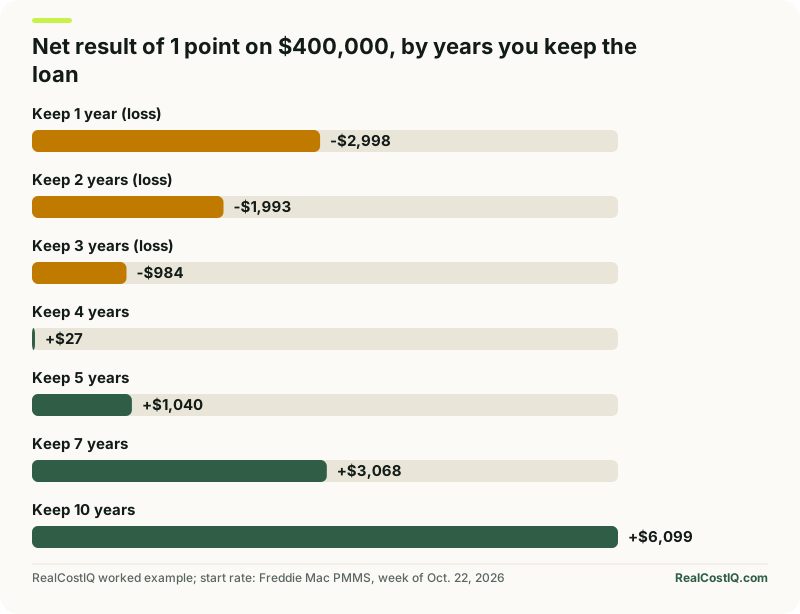
Read the shape. The loss shrinks by about $1,000 a year until year 4, then turns into a gain of the same size. That is why a point is a bet on time. If you keep the loan 10 years, the point earns $6,099. If you leave after 2 years, it costs $1,993. Same lender, same rate, same $4,000. Only the date you leave changes.
Does the break-even change with the rate?
Very little. I ran the same one-point, quarter-point trade at four starting rates. The break-even stays near four years. This is a handy rule: one point for a quarter-point cut breaks even in about four years, at almost any rate.
| Rate with no points | Monthly saving | Break-even, payments only | Break-even, counting lower balance |
|---|---|---|---|
| 5.00% | $60.70 | 66 months | 49 months |
| 6.00% | $63.91 | 63 months | 48 months |
| 7.32% | $67.68 | 60 months | 48 months |
| 8.00% | $69.41 | 58 months | 48 months |
Computed 2026-10-25, 30-year loan. Payments-only months are rounded up from 65.9, 62.6, 59.1 and 57.6. A deal that prices a point at a smaller rate cut breaks even later.
What does change the answer is the price of the point. If your lender gives only a 0.125-point cut for a full point, the saving is $33.92 a month and the break-even doubles to about eight years (95 months, counting the lower balance). Two points for a half-point cut breaks even at the same 48 months as one point for a quarter. So always compare the cut you get per point, not the headline rate.
The refinance trap: points you paid on a loan you replaced
Why would anyone leave a loan in year 2? Because rates move. Freddie Mac's 30-year average was 5.98% in the week of February 26, 2026. It reached 7.40% in the weeks of October 8 and October 15. A buyer who closed in the spring at 6.4% would have been watching that number climb. A buyer who closes now at 7.32% may be hoping it falls back. If it does, a refinance becomes tempting.
Here is what that does to a point. Say rates fall in year 2 and you refinance at month 24. You paid $4,000 up front. You saved $67.68 for 24 months, which is $1,624.35. Your loan balance is also $382.91 lower than it would have been, which counts in your favor. The old loan is gone, so the saving ends. Net, the point cost you $1,993. Nothing you do later brings the rest of the $4,000 back.
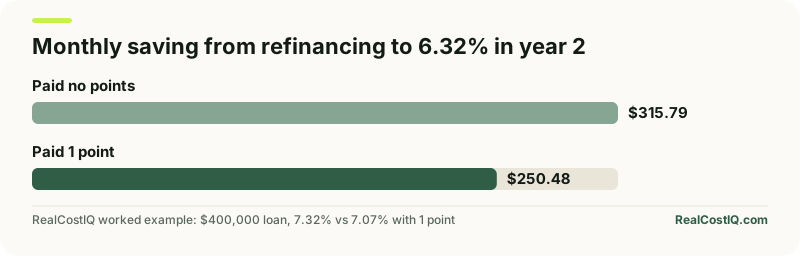
There is a second cost that most guides skip. Because your rate is already lower, a refinance saves you less. Take month 24 and a new rate of 6.32%, a one-point drop from 7.32%. Think of a new 30-year loan on whatever balance is left. A borrower with no points saves $315.79 a month on the new loan. A borrower who bought the point saves $250.48, because that loan started at a lower rate. The point cut the refinance saving by $65.31 a month, or about a fifth. In plain terms, the point and the refinance are doing the same job. You paid for the same savings twice.
Payments only, or counting the balance?
A lower rate means less of each payment goes to interest, so the point loan pays down principal a bit faster. At month 24 its balance is $391,690, against $392,073 with no points. That is $383 less owed. At month 36 the gap is $579. When you sell or refinance, you pay off the balance, so that gap is real money. The table counts it. If you leave it out, the year-2 loss is $2,376 and the break-even is month 60. That is the cautious view, and it is the one that older break-even tools show. The calculator now shows both: its "Break-even if you sell or refinance" row counts the balance. Even with the extra principal, a year-2 exit loses almost $2,000.
How often do rates fall enough to tempt a refinance?
You cannot know. But history shows the risk is not small. I used Freddie Mac's weekly 30-year averages, which start in 1971. For every week since January 1, 1990, I looked at the lowest weekly rate over the next three years. In about 51 percent of those weeks, the rate fell at least a full percentage point below that week's level at some point within three years. In about 75 percent it fell at least half a point. Within one year, the figures were 20 percent and 58 percent.
| Time window | Fell at least 0.5 points | Fell at least 1 point |
|---|---|---|
| Within 1 year | 58% | 20% |
| Within 2 years | 69% | 42% |
| Within 3 years | 75% | 51% |
Computed 2026-10-25 from Freddie Mac's PMMS weekly history (April 1971 to October 22, 2026), counting weeks from January 1, 1990 that have a full window ahead. It is a count of past weeks, not a forecast. It measures a dip at any point in the window, not the rate on the day you would refinance.
A refinance has its own costs, usually thousands of dollars in closing costs, so a half-point dip does not always justify one. The guide on whether refinancing is worth it shows how to test that. A one-point drop usually does. Points break even in about four years, so a one-point dip in the first three years is exactly when you would be tempted to leave and lose on the points. History puts that near one in two for a start date in any given week. Today's rate is near the top of the past year's range (5.98% to 7.40%), which makes a dip more thinkable. That is a reason for caution, not a prediction.
Lender credits: the same trade in reverse
A lender credit flips the deal. You accept a higher rate. The lender gives you cash to cover your closing costs. The Consumer Financial Protection Bureau describes it as paying less now and more over the life of the loan (page last modified October 1, 2024, read October 25, 2026). Using the same pricing in reverse, a $4,000 credit raises the rate from 7.32% to 7.57%. The payment goes from $2,747.72 to $2,816.06, which is $68.33 more each month.
The break-even is the mirror image. You take $4,000 up front, then pay $68.33 more each month, and your loan balance is higher when you leave. Counting all three, the credit wins if you leave before month 48. Leave in year 3 and you are ahead by about $982. Keep the loan 5 years and you are behind by $1,045. Stay a full 10 years and you are behind by $6,124. On payments alone, the break-even is 58.5 months.
| Pay 1 point | No points, no credit | Take 1 point of credit | |
|---|---|---|---|
| Rate | 7.07% | 7.32% | 7.57% |
| Cash at closing | +$4,000 you pay | $0 | $4,000 you receive |
| Monthly principal and interest | $2,680.04 | $2,747.72 | $2,816.06 |
| Best if you keep the loan | More than 4 years | Unsure | Less than 4 years |
Computed 2026-10-25. Real pricing varies by lender and day. Ask each lender for quotes with and without points or credits, and for the same number of points, as the CFPB advises.
The CFPB gives advice for people who do not know how long they will stay: if you are unsure how long you will keep the loan or when you might refinance, consider skipping both points and credits, especially if you have the cash for closing. That is the middle column of the table. It is a fine answer. It makes no bet on the date you leave.
A way to decide: three questions
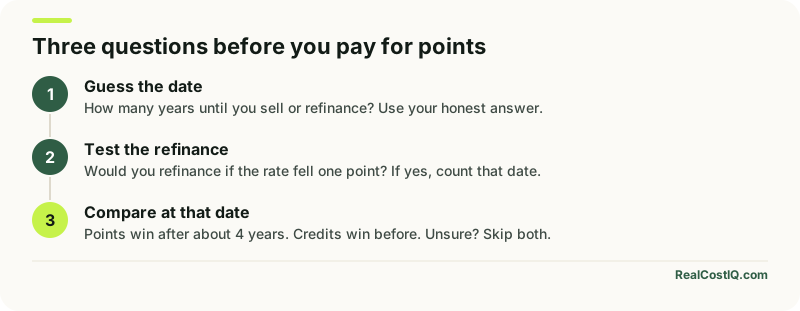
- How long will I probably keep this loan? Be honest. The National Association of Realtors reports that sellers in its 2025 survey had owned their homes a median of 11 years, a record, partly because many owners were holding low-rate loans (NAR, published November 3, 2025). That is the long-tenure case. If you took your loan at 7.32% and expect rates to fall, your loan may not last that long. The question is about the loan, not the home.
- Would I really refinance if the rate fell one point? If yes, treat your holding period as the time until that happens. In Freddie's history, a dip of that size followed about one week in two within the next three years. Points make most sense if you would not bother to refinance, for example because your credit, income or equity would make a new loan costly.
- Do I have the cash, and is it better used elsewhere? Points use cash that could cover reserves, repairs or a larger down payment. A bigger down payment can remove mortgage insurance and does not depend on the date you leave. The mortgage refinance calculator helps you test a later refinance against the loan you are about to take.
Two side notes: taxes and seller-paid buydowns
Taxes. If you itemize deductions, points can be deductible. IRS Publication 936 (2025 edition, read October 25, 2026) says that on a purchase of your main home you can generally choose to deduct the points in the year paid if you meet its tests. On a refinance you usually spread them over the new loan's life. When a loan ends early, the unspent part can generally be deducted that year. There is an exception: if you refinance with the same lender, you spread the leftover over the new loan instead. Many buyers use the standard deduction, so this may not apply to you. A tax professional can say. It should not be the reason to buy points.
Seller-paid buydowns. A seller or builder can pay for a temporary rate cut, such as a 2-1 buydown, which lowers the rate for the first one or two years only. That is a different product, covered in the post on 2-1 temporary buydowns. A temporary buydown has no break-even trap because someone else paid for it. Points are permanent and you pay for them.
What this post does not know
- Your quote. The 0.25-point cut per point is an assumption. Some lenders give less. Use your Loan Estimate.
- Closing costs on a refinance. The year-2 numbers leave them out for both borrowers, since both would pay them. They raise the bar for refinancing, which helps the case for points a little.
- Future rates. The history count shows how often rates dipped in the past. It does not say they will fall from 7.32%.
- Other loan types. The math is for a 30-year fixed loan. On a 15-year loan the same one-point, quarter-point trade breaks even at about 50 months counting the lower balance (72 on payments alone). Adjustable-rate loans change the story again.
The short version: write down the date you expect the loan to end before you let anyone sell you a point. If it is past year 4 and you would not refinance for a one-point dip, points can pay. If you are unsure, skip them, or take the credit.