You get a windfall, such as a sale of another home, a bonus, or an inheritance. You pay $50,000 toward your mortgage. Then the next bill arrives, and it is the same as before. Many owners are surprised by that. The payment does not drop on its own. A recast is the fix that does lower it, and it keeps your rate. A refinance is a different tool that can also lower it, but it replaces the whole loan. This post prices all three paths on one loan. It does not tell you to recast or to refinance. It shows what each one costs and what the rules are.
A worked example, with round numbers first
Here are the terms. You owe $300,000 on a fixed-rate loan at 6.00 percent. The 6.00 percent is an example, not a forecast. You have 25 years left, which is 300 monthly payments. The monthly payment on principal and interest is $1,932.90. Principal is the part of your debt that you still owe, not counting interest. You now pay a lump sum of $50,000. A lump sum is one large payment made at once. Your balance becomes $250,000.
There are three things you can do next. Each one uses the same $50,000.
- Do nothing more. Keep paying $1,932.90. Because the balance is smaller, the loan ends early. This is what an extra payment does.
- Recast. To recast means to ask the servicer to re-amortize the loan. Re-amortize means to recalculate the payment so the smaller balance is paid off by the original end date. The rate and the end date stay the same. The payment falls.
- Refinance. To refinance means to take out a new loan and use it to pay off the old one. The new loan has a new rate and its own closing costs. Closing costs are the fees to set up a loan, such as the lender's fee, the appraisal and the title work.
| Path | Balance | Monthly payment | Months left | Interest paid from today | Up-front cost |
|---|---|---|---|---|---|
| Keep as is (no lump sum) | $300,000 | $1,932.90 | 300 | $279,871 | None |
| $50,000 lump sum, no recast | $250,000 | $1,932.90 | 209 (17 years 5 months) | $153,214 | None |
| $50,000 lump sum, then recast | $250,000 | $1,610.75 | 300 | $233,226 | Up to $250 fee |
| $50,000 lump sum, then refinance to 7.40% for 25 years | $250,000 | $1,831.25 | 300 | $299,374 | $7,500 to $15,000 |
Hypothetical loan. Payments and interest use the standard fixed-rate loan formula, the same math as this site's amortization and refinance calculators. The $250 recast fee is the top of the range on PennyMac's fee schedule and the figure Onity lists. The 7.40 percent rate is the Freddie Mac 30-year average for the week of October 8, 2026, unchanged on October 15. The closing cost range is 3 percent to 6 percent of the loan, per Freddie Mac. The 25-year refinance term matches the time left on the loan.
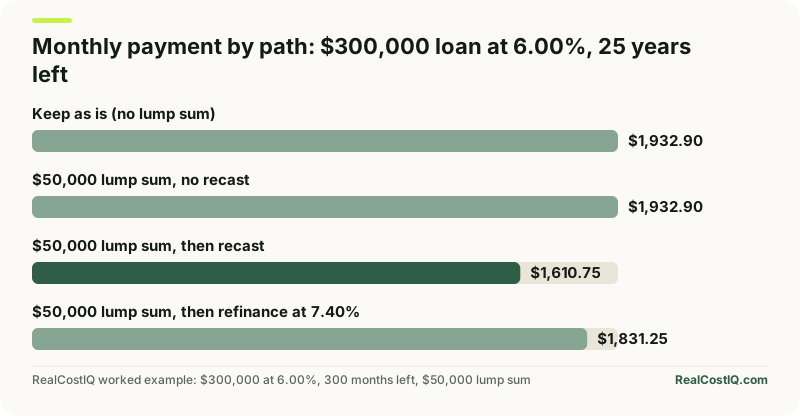
Read the table one row at a time. The first row is where you started. The second row keeps the old payment, so the lump sum works by shortening the loan. You save the most interest this way, about $126,657 against the first row, and the loan ends 91 months early. But your monthly bill does not change.
The third row is the recast. The payment drops by $322.15 a month, from $1,932.90 to $1,610.75. You still pay 25 years, so the interest is higher than in row two. It is still $46,645 lower than the first row. The fee of up to $250 is paid back by the first month's lower bill.
The fourth row is the refinance. In this example the new rate of 7.40 percent is higher than your old 6.00 percent. The payment drops by only $101.65, and you pay $7,500 to $15,000 to get it. Interest rises to $299,374, which is above row one. For a loan with a low rate, a refinance moves the wrong way.
What if your rate is higher than today's?
The answer flips when the old loan has a higher rate than the new one. Take the same $300,000 balance, 25 years and $50,000 lump sum, but with an existing rate of 8.00 percent. That is a made-up rate for the example. The refinance is again at 7.40 percent.
| Path | Balance | Monthly payment | Months left | Interest paid from today | Up-front cost |
|---|---|---|---|---|---|
| Keep as is (no lump sum) | $300,000 | $2,315.45 | 300 | $394,635 | None |
| $50,000 lump sum, no recast | $250,000 | $2,315.45 | 192 (16 years) | $193,352 | None |
| $50,000 lump sum, then recast | $250,000 | $1,929.54 | 300 | $328,862 | Up to $250 fee |
| $50,000 lump sum, then refinance to 7.40% for 25 years | $250,000 | $1,831.25 | 300 | $299,374 | $7,500 to $15,000 |
Hypothetical loan with the same method as the table above. Rates are examples, not forecasts.
Now the refinance has a lower payment than the recast, by $98.29 a month. Its interest, plus the closing costs, is $306,874 to $314,374. That is below the recast's $328,862. So a refinance can win on total cost here. The price is the cash at closing. Break-even is the number of months of savings it takes to repay what you spent to get them. Against the recast, the break-even is about 77 months at $7,500 of closing costs and about 153 months at $15,000. It only pays off if you keep the loan that long. The site's guide to whether refinancing is worth it goes into break-even in full, and the refinance calculator runs your own numbers.
Which loans can be recast
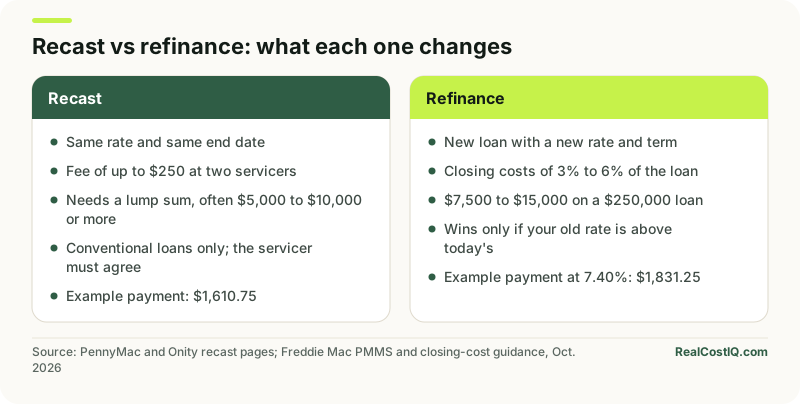
Recasting is a conventional loan tool. A conventional loan is one that is not backed by a government program such as FHA or VA. Two servicers' own pages say so. Freedom Mortgage says only conventional loans are eligible and that VA, FHA and USDA loans are not. Onity Mortgage, the company that used to be PHH Mortgage, says the loan must be conventional. It says FHA, VA and Ginnie Mae loans usually do not qualify, and neither do home equity lines, commercial loans, adjustable loans that can negatively amortize in an interest-only period, or loans with an active buydown. A buydown is a payment made to lower the rate for the first years.
I looked for a primary government source that bars recasts on FHA and VA loans. I did not find one that I could open today. I could not read the HUD handbook text or the VA lender handbook, and the Ginnie Mae guide would not load. So the FHA and VA point rests on the servicers' own published rules. If you have one of those loans, ask your servicer. You can still pay a lump sum on those loans. It just will not lower the bill by itself.
For loans that Fannie Mae owns, the Servicing Guide (section C-1.2-01, dated November 13, 2024) has a step for exactly this case. When the borrower asks that a loan be re-amortized to lower the payment after a substantial principal curtailment, the servicer completes Form 181, the Agreement for Modification, Re-Amortization, or Extension of a Mortgage. A curtailment is a payment toward principal beyond what is due. The guide also says a re-amortization is not counted as a loan modification when the loan is later checked for modification help. The page gives no fee and no minimum. I tried to read Freddie Mac's guide section on partial prepayments, but its text did not load today, so I do not cite it.
What servicers publish: minimums, fees and timing
The servicer is the company that collects your payments. Fannie Mae's guide page gives no fee and no minimum, so the servicer sets them. Two servicers publish theirs.
| Term | PennyMac | Onity Mortgage (formerly PHH) |
|---|---|---|
| Minimum lump sum | At least $10,000 | Usually at least $5,000 |
| Fee | $250, sent with the payment; fee schedule says up to $250 (revised 3/18/2026) | $250 where applicable; it can vary by state |
| Timing | Up to six weeks after it gets the payment and the fee | Agreement mailed within 10 business days of the request; sign within 30 days; account updated within 10 business days after it gets the signed agreement and fee |
| Loan must be | Current for the whole process | Current or paid ahead |
| Rate and end date | Rate and payoff date do not change | Rate and loan term stay the same |
| Credit check | Not stated | None needed |
From PennyMac's recast FAQ pages and fee schedule, and Onity's recast page. Neither page gives a date of publication; PennyMac's schedule shows a revision date of March 18, 2026. Terms change, so call your servicer. PennyMac says a wire or certified funds start the process fastest, and a standard check may need bank statements that slow it.
Notice that the $50,000 in the example clears both minimums by a wide margin. A $6,000 payment would clear Onity's usual floor but not PennyMac's. Freedom Mortgage's page gives no number. It says the fee can be several hundred dollars, and that not all lenders offer recasting. That last point matters most. Recasting is a service the servicer agrees to provide. Onity's page says the agreement goes out only if your request is approved. So a recast is a request, not a right.
What a refinance costs
A refinance is a new loan, so it has the costs of a new loan. Freddie Mac says to expect to spend 3 percent to 6 percent of your loan principal. Its list of costs includes government recording fees, the appraisal, the credit report, the lender's origination fee, title services, tax service fees, a survey, attorney fees and underwriting fees. On a $250,000 loan, 3 percent is $7,500 and 6 percent is $15,000. That is where the ranges in the tables come from.
The rate matters as much as the fees. Freddie Mac's weekly survey (PMMS) put the 30-year fixed average at 7.40 percent on October 15, 2026, the same as the week before and up from 6.27 percent a year earlier. The 15-year average was 6.71 percent. Those are averages. Your rate depends on your credit, your down payment and your lender. A refinance only lowers the rate if your current rate is above what you can get. In the first example it was below.
Recast versus extra payments
The two are not rivals. They answer different questions. Extra payments answer: how soon can I be debt free? Paying the lump sum and keeping the old payment ended the loan 91 months early in the first example. A recast answers: how low can I make the monthly bill? Recasting keeps the end date and lowers the bill. You can do the first and then ask for the second, or do the first and skip the second.
The site's early payoff calculator shows what a monthly extra amount does to your end date. The guide on paying off your mortgage early covers whether to do it at all. One more check before any lump sum: look for a prepayment penalty. The Consumer Financial Protection Bureau (CFPB) says some loans charge a fee if you pay off all or part of the loan early. It can apply if you pay a large amount at once. Small extra payments usually do not trigger it, but the CFPB advises checking with your lender. Read the fine print of your loan. If you are still deciding whether to borrow at all, the post on paying cash vs. a mortgage prices that choice.
What to ask your servicer before you send money
- Is my loan type eligible for a recast? Do you offer recasts at all?
- What is the minimum lump sum, and is there a maximum as a share of my balance?
- What is the fee, and when is it due?
- Do you need the request before or after I send the payment? Is there a deadline after the payment?
- Does my loan have a prepayment penalty?
- How long does it take, and which payment amount do I owe in the meantime? PennyMac says to keep making regular payments while the recast is processed.
- Does the change apply to principal and interest only? Escrow is the money held for taxes and insurance, and it is a separate amount.
- How does the new payment compare with the one in my own amortization table? You can build one with a loan calculator and check the servicer's number.
Nothing here says a recast or a refinance is right for you. A lump sum also has other uses, such as an emergency fund or other debt. The point is that the tools are different. A recast lowers the bill and keeps the rate. A refinance can change the rate, and it has a bigger price. Compare them with your own loan.