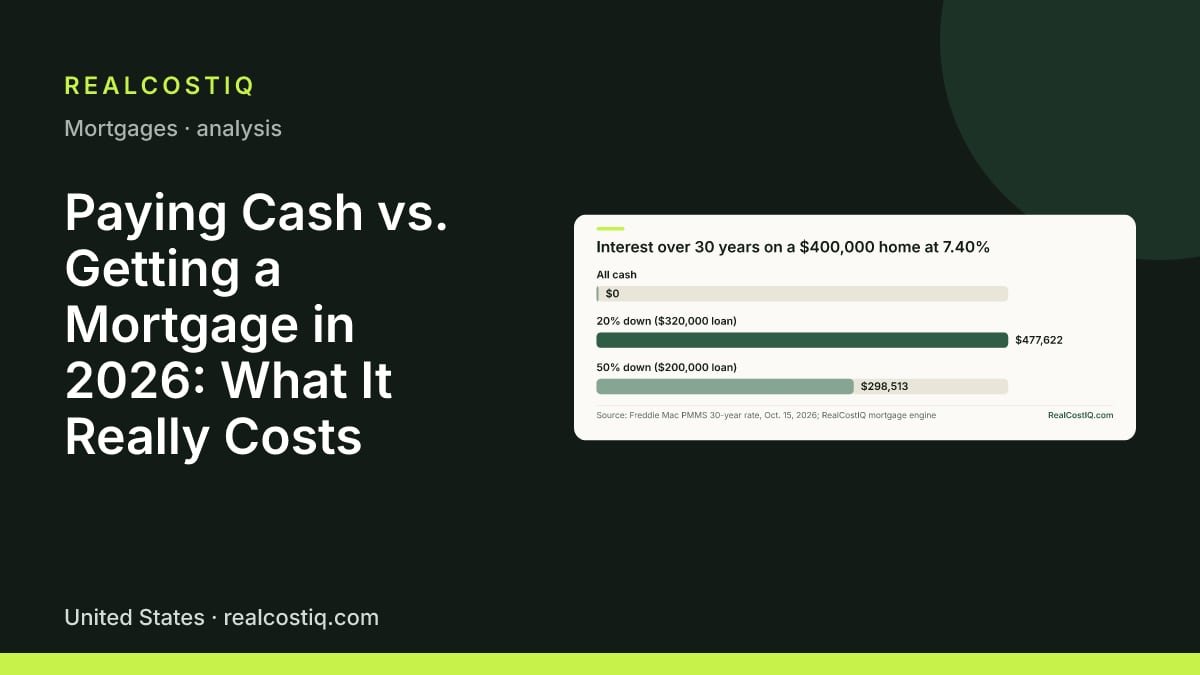
The question sounds simple. If you can pay cash for a house, why borrow at 7.40 percent? The answer is that cash is not free. The money you put into the house is money you cannot spend or save in another way. A loan costs interest, and cash costs flexibility. This post puts numbers on both for one house. It does not tell you which to choose. The right answer depends on your other bills, your savings and your comfort with risk.
A worked example: $400,000, cash against 20% down
The home costs $400,000. Freddie Mac's Primary Mortgage Market Survey (PMMS) put the average 30-year fixed rate at 7.40 percent in its release dated October 15, 2026. The 15-year rate was 6.71 percent. This is a national weekly average. Your own rate will differ with your credit, your down payment and your lender. I use 7.40 percent as an example, not a forecast.
Three buyers want the same house. The first pays $400,000 in cash. The second puts down 20 percent, which is $80,000, and borrows $320,000 for 30 years. The third puts down half, which is $200,000, and borrows $200,000 for 30 years. The monthly payment below covers principal and interest only. Principal is the part of the debt you still owe. Property taxes, insurance and upkeep are the same for all three buyers, so they are left out.
| All cash | 20% down | 50% down | |
|---|---|---|---|
| Loan amount | $0 | $320,000 | $200,000 |
| Monthly principal and interest | $0 | $2,215.62 | $1,384.76 |
| Interest in year 1 | $0 | $23,579 | $14,737 |
| Interest in the first 5 years | $0 | $115,410 | $72,132 |
| Interest over 30 years | $0 | $477,622 | $298,513 |
| Closing costs (site estimate) | $5,825 | $8,225 | $7,325 |
| Cash needed at closing | $405,825 | $88,225 | $207,325 |
| Cash left compared with the cash buyer | $0 | $317,600 | $198,500 |
Computed with the site's mortgage engine (src/lib/calculators/mortgage.ts) and closing-cost engine (src/lib/calculators/closing-costs.ts). Inputs: home price 400,000; down payment 400,000, 80,000 or 200,000; term 30 years; rate 7.40%; conventional loan; no state tax. Rate: Freddie Mac PMMS, 30-year fixed, release dated 2026-10-15, read 2026-10-18.
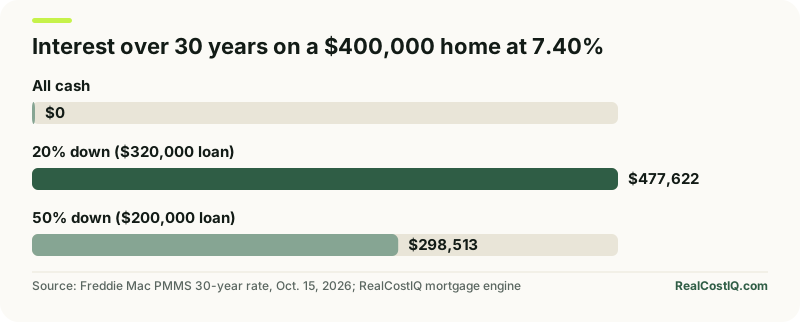
Look at the 20 percent column first. The loan costs $2,215.62 a month. In year one, $23,579 of the $26,587 you pay goes to interest. Only $3,008 pays down the loan. Interest is front-loaded. That means the early payments are mostly interest. After five years the balance is still $302,474. The site's amortization calculator shows that split month by month for any loan.
Now the cash buyer. There is no loan bill. There is also $317,600 less in the bank than the 20 percent buyer has after closing. That is the real price of paying cash. The house is a good place to hold value, but it is a poor place to find money in a hurry. To get equity back out, you must sell the home or borrow against it.
What the cash saves, and what it does not
The site's closing-cost engine lists nine items for a standard purchase. At $400,000 with 20 percent down, they total $8,225. At $400,000 in cash they total $5,825. The $2,400 difference is one line, the loan origination fee. The engine sets it at 0.75 percent of the loan, so $320,000 gives $2,400. That is the site's modeled figure, not a quote. The Consumer Financial Protection Bureau (CFPB) describes origination charges as upfront fees charged by your lender, such as application, origination and underwriting fees. A cash buyer has no lender and pays none of them.
The other eight lines stay. In the engine, title insurance is $2,000, a title search is $300, an inspection is $400, two months of prepaid property tax is $800, prepaid homeowners insurance is $1,200, recording is $125 and escrow or attorney work is $500. The engine also keeps an appraisal fee of $500 in the cash case. A cash buyer does not need a lender's appraisal. CFPB's loan estimate page says the lender uses an appraisal to decide how much your home is worth. So the cash column could be about $500 lower still, if you skip it. Put differently, paying cash cuts the closing bill by about 30 percent here. It does not cut it to zero.
An inspection is a different job. CFPB says a home inspection is different from an appraisal, but you generally need both. It also says that if the sales contract is contingent on a satisfactory inspection, you have the right to cancel the sale without penalty if you are not satisfied with the results. That advice does not change when you pay cash. In fact, a cash buyer has no lender who will check the home's value or condition. The inspection may be the only independent check you get.
Title insurance also still matters. CFPB's page on owner's title insurance says you may want to buy an owner's policy, and that it protects the homeowner if someone sues and says they have a claim against the home. It also notes that lenders typically require only a lender's policy. With no lender, the owner's policy is the one that protects you. These are the costs of paying cash that people forget.
Cash is not a one-way door: delayed financing
Some buyers pay cash to win a bid and plan to borrow afterward. Fannie Mae has a rule for that. It is called the delayed financing exception, and it sits in section B2-1.3-03 of the Selling Guide, which I read today. The page is dated December 10, 2025. It lets a borrower who bought a home with cash take out a cash-out refinance soon after, if certain steps are met.
- The purchase must have been an arm's-length transaction. That means a sale between unrelated parties at market terms.
- A settlement statement must confirm that no mortgage financing was used to buy the home.
- The title report must show no existing liens on the property.
- The source of the cash used for the purchase must be documented, for example with bank statements.
- The new loan can be no more than the documented amount of the borrower's initial investment, plus financed closing costs, prepaid fees and points.
- The loan must meet the maximum loan-to-value limits for cash-out loans, based on the current appraised value, and cash-out pricing applies.
The exception applies to a home bought within six months. The Selling Guide measures that window from the purchase date to the date the new loan is disbursed. I did not read the loan-to-value figure, so I give none here. Two points matter. First, you do not get all your cash back, only up to what you documented putting in. Second, a cash-out refinance is a new loan. It has its own rate and its own closing costs, set when you apply. That rate may be higher or lower than today's 7.40 percent. So a cash purchase plus a quick refinance is a plan with a cost and a rate you cannot lock in today. Other lenders and loan types may have their own rules.
The trade in plain math: interest paid against cash kept
Here is the core of the choice. The 20 percent buyer pays $23,579 in interest in year one on $320,000. That is a cost of about 7.37 percent on the borrowed money in that year. The cash buyer has no such cost. But the cash buyer has used up $320,000 that the other buyer still has.
What could that kept money earn? I do not know your rate, and I am not telling you where to put it. So here is simple arithmetic with two labeled assumptions. These are not forecasts and not advice. If the kept $320,000 earned 3.00 percent in one year, that is $9,600 before tax. At 5.00 percent, it is $16,000 before tax. Either number is less than the $23,579 of year-one interest. To match that interest, the money would have to earn about 7.37 percent in the year, before tax.
| Measure | Amount in year 1 |
|---|---|
| Mortgage interest, 20% down (site engine) | $23,579 |
| If the kept $320,000 earns 3.00% (assumption) | $9,600 |
| If the kept $320,000 earns 5.00% (assumption) | $16,000 |
| Rate needed to match the interest | about 7.37% |
Simple one-year arithmetic: $320,000 x 3.00% = $9,600; $320,000 x 5.00% = $16,000; $23,579 / $320,000 = 7.37%. Before tax and before any fees. The 3.00% and 5.00% are example inputs chosen for illustration, not predictions or advice.
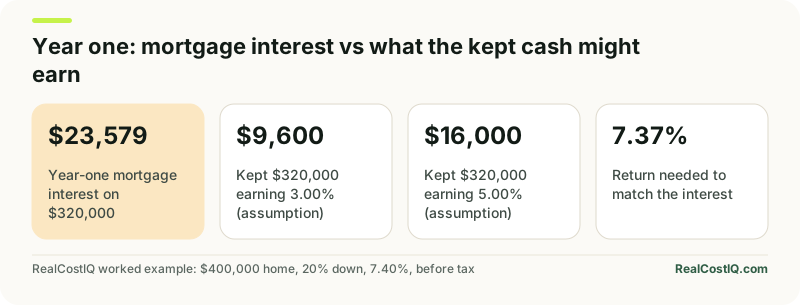
The table leaves things out on purpose. Earnings are taxed. The loan interest may help on a tax return in some cases. Prices and rates change. Money earning a steady return can also lose value in other ways. The point is smaller than a verdict. The loan has a known cost in year one. The kept cash has an unknown, uncertain return. Whether the known cost is worth the uncertainty is your call.
On taxes, one sentence. The IRS lists qualified home mortgage interest among the interest that is deductible as an itemized deduction, and for homes bought after December 15, 2017 it limits the debt counted to $750,000. Whether that helps you depends on whether you itemize, so it is a question for a tax professional. The site has a separate post on the mortgage interest deduction.
Liquidity: the part a spreadsheet misses
Liquid means easy to turn into spendable money. Savings in a bank are liquid. Equity in a home is not. The cash buyer in the example has put $405,825 into one asset. If a roof fails, a job ends or a medical bill arrives, that money is behind a wall. The wall has a door, but it costs time and fees. You can sell, which takes months. You can take a home equity loan or a cash-out refinance, which needs approval and closing costs. Lenders can say no, and rates can be high when you need the money most.
The mortgage buyer holds $317,600 more. That money can cover the monthly payment for a long time. At $2,215.62 a month, it covers more than 11 years of payments. That cushion is the real product the mortgage sells. You pay for it with $23,579 of interest in year one, which falls each year as the balance falls.
There is a middle path, shown in the 50 percent column. Putting down half cuts the loan to $200,000 and the payment to $1,384.76. Year-one interest falls to $14,737. The buyer still keeps $198,500 more than the cash buyer. You can pick any split between zero and all. Use the site's true cost of homeownership calculator to add taxes, insurance and upkeep, which every buyer pays whether they borrow or not.
If you already own a loan: a different question
This post is about buying. If you already have a mortgage and wonder about paying it off early, that is a separate question with its own trade. The site's guide on paying off your mortgage early covers it. And if you buy with a loan and later get a large lump sum, a recast can lower your payment without a new rate. The recast versus refinance post prices that.
How common is paying cash?
NAR's existing-home sales release for September 2026, dated October 13, 2026, says cash sales accounted for 27 percent of transactions. That was unchanged from the month before and down from 30 percent a year earlier. NAR notes that this share comes from its monthly REALTORS Confidence Index survey. So roughly one in four homes sold in September was paid for in cash. That is a lot. It is not the majority, and most buyers still borrow.
The share matters for one reason. In a market with many cash buyers, a seller may favor a cash offer, because there is no loan to fall through. That is a negotiating point, not a rule. You can ask for a lower price in return for the speed, and your lender may offer a fast close. Nothing here says cash wins the bid. It says the option has value to some sellers.
A short checklist if you are weighing it
- Write down the cash you would have left after closing under each option. Count the emergency fund first.
- Price the loan at today's rate and at a rate one point higher and one point lower. Rates move weekly.
- List the closing costs that stay even with cash: title, inspection, prepaid tax and insurance.
- Get the inspection. A cash buyer has no lender looking at the home.
- Decide whether you might want to borrow later. If so, read the delayed financing rule and ask a lender about its own terms.
- Ask a tax professional how the mortgage interest and your own return interact.
The numbers in this post will age. The rate here is from one week in October 2026, and the closing costs are the site's model, not a quote. Rerun them with your own price and rate before you decide. Neither path is wrong. They trade a known interest bill against flexibility and risk. Your own budget, savings and other debts decide which trade fits.