The inspector's radon test came back at 6.8. Your agent says it is a big deal. The listing agent says it is a small fix. Both are partly right. This post gives you the steps in order. First you check that the number is real. Then you price the fix. Then you decide how to ask the seller to pay for it.
It covers one finding only. The real estate contingencies guide explains how inspection deadlines work. The repair credit post explains the lender limits on seller credits. This post does not repeat either one.
What the number means
Radon is a radioactive gas. It forms when uranium in soil and rock breaks down. You cannot see, smell or taste it. It moves up through the ground and seeps into a house through cracks and gaps in the foundation. Any house can have it. New houses, old houses, houses with a basement and houses without one.
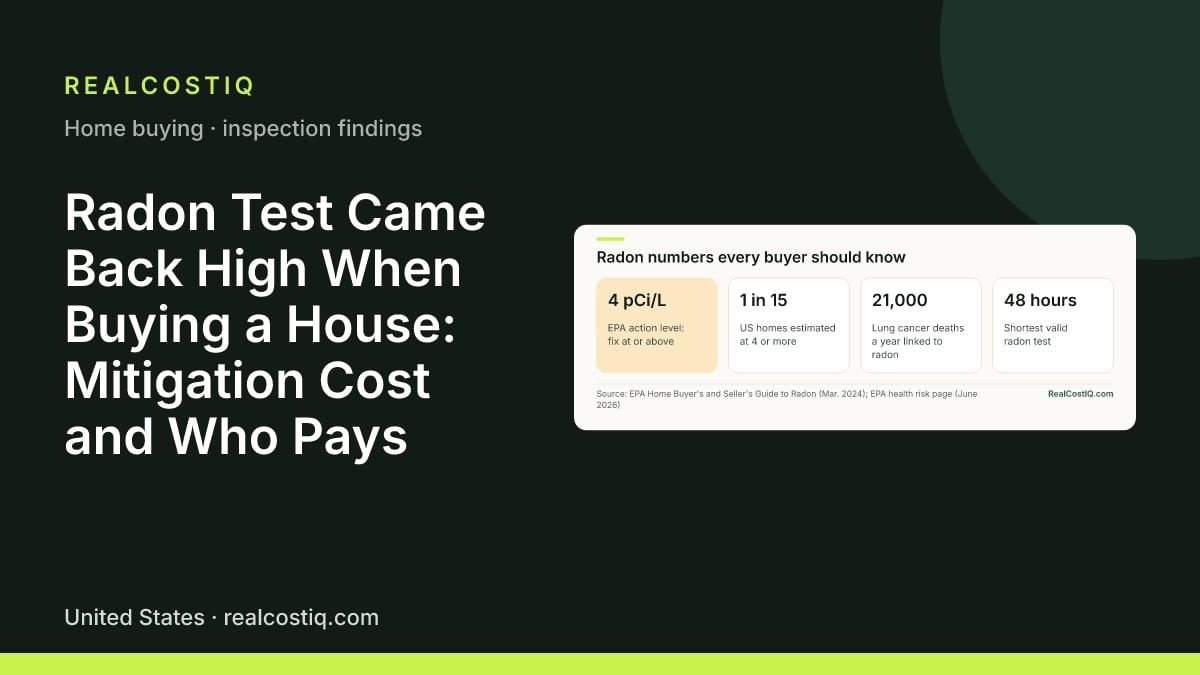
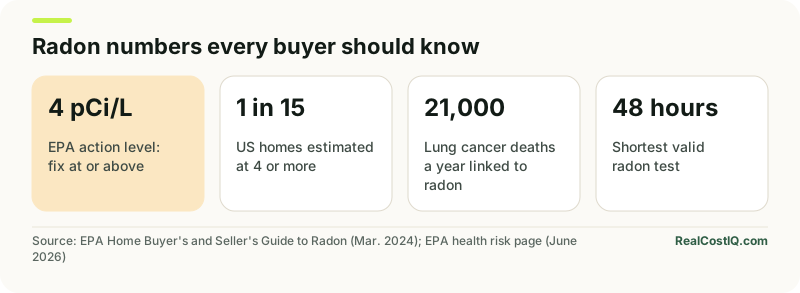
A radon test reports picocuries per liter of air, written pCi/L. A picocurie is a tiny unit of radioactivity. You only need to know the scale. The EPA's home buyer's guide, revised March 2024, puts the average indoor level at about 1.3 pCi/L. Outdoor air is about 0.4. The EPA says to fix a home when the level is 4 pCi/L or higher. It calls that the action level.
How common is a high result? The same guide says nearly one out of every 15 homes in the United States is estimated to be at 4 pCi/L or more. So you are not buying a strange house. You are buying one of a group of homes that is large enough to have a standard fix.
Why the EPA takes it seriously
The EPA's health page, last updated June 24, 2026, says radon causes about 21,000 lung cancer deaths a year. About 2,900 of those are people who never smoked. It calls radon the second leading cause of lung cancer. For people who smoke, the risk is much higher. At 4 pCi/L, the EPA's table shows about 62 in 1,000 smokers getting lung cancer over a lifetime. The same page gives 7.3 in 1,000 for people who never smoked.
Those are lifetime estimates for a person who lives in the house for years. They are not a forecast for you. They are the reason the EPA treats 4 as a line to act on. The EPA also says no level of radon is safe. A result between 2 and 4 is below the action level, but the EPA says to consider fixing it too.
| Result (pCi/L) | What the EPA says | What it means for your deal |
|---|---|---|
| Below 2 | Low. Reducing levels below 2 is difficult. | No action needed. Retest if you finish the basement later. |
| 2 to 3.9 | Below the action level. Consider fixing. | Optional ask. Many buyers still request a fix. |
| 4 to 7.9 | Fix the home. | A standard fan system usually works. Ask the seller to pay. |
| 8 or higher | Fix the home. | Get more than one quote. A larger system may be needed. |
Source: EPA Home Buyer's and Seller's Guide to Radon (March 2024 revision) and EPA health risk page. The last column is our reading, not an EPA rule.
Step one: confirm the result
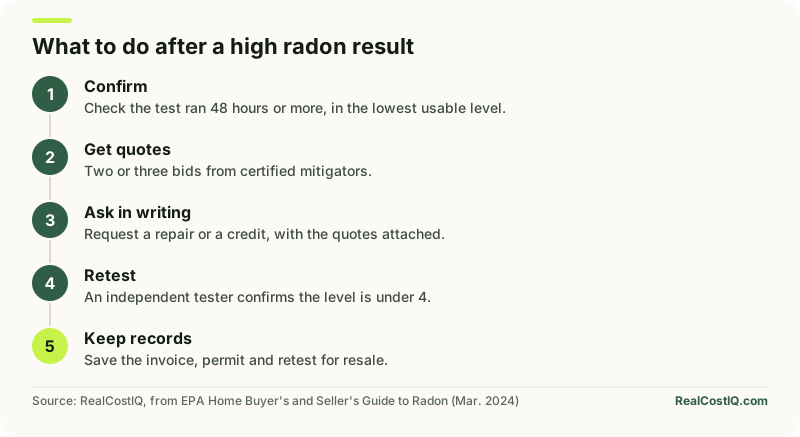
Radon levels change from day to day and season to season. A short test can read high or low. Before you spend a dollar on a fix, check that the test was done right. The EPA's guide gives a checklist for home sales. Here are the points that matter most.
- The test ran at least 48 hours. Some devices need longer. A seven-day charcoal canister, for example, needs seven days.
- Doors and windows stayed closed. The EPA calls this closed-house conditions. For a test shorter than four days, they should be closed for 12 hours before the test starts. They should stay closed during it, except for normal coming and going.
- The device sat in the lowest level you could use. That means the lowest space you might use as a bedroom, den, play area or workshop. It does not have to be finished. If the inspector tested the first floor and you plan to use the basement, test the basement.
- Someone watched for tampering. A seller who opens windows can lower the number. The EPA suggests devices that log readings hour by hour, motion detectors, and a signed non-interference agreement.
- The result is an average of two tests, or one continuous monitor. The EPA's real estate guide lists three short-term options. You can run two tests side by side for at least 48 hours. You can run one test and then a second right after it. Or you can use a continuous monitor for at least 48 hours. In the first two, you fix the home if the average is 4 or more. With a continuous monitor, you fix it if the average level is 4 or more.
Close calls need extra care. The EPA says that if the average of two short tests is 4.1, there is about a 50 percent chance that the true year-round average is a bit above or a bit below 4. So a 4.1 does not prove a problem. A 6.8 is different. It is well above the line, and a retest is unlikely to bring it under 4.
If you have time, a long-term test is the best check. It stays in place for more than 90 days. Most home purchases do not have that much time, so the EPA built the short-term rules for them. If the contract has a long closing, ask whether a long-term test fits in.
Who should run the retest
Use a tester who is not paid by the seller and not paid to install fixes. The Minnesota Department of Health, whose page was last updated April 22, 2025, suggests a licensed radon professional as an unbiased third party. Many states license or certify radon testers. Your state radon office can give you a list. A professional test often runs $150 to $800, based on HomeAdvisor's 2026 cost page. A mail-in kit costs less but gives you less proof of how it was done.
Step two: what the fix costs
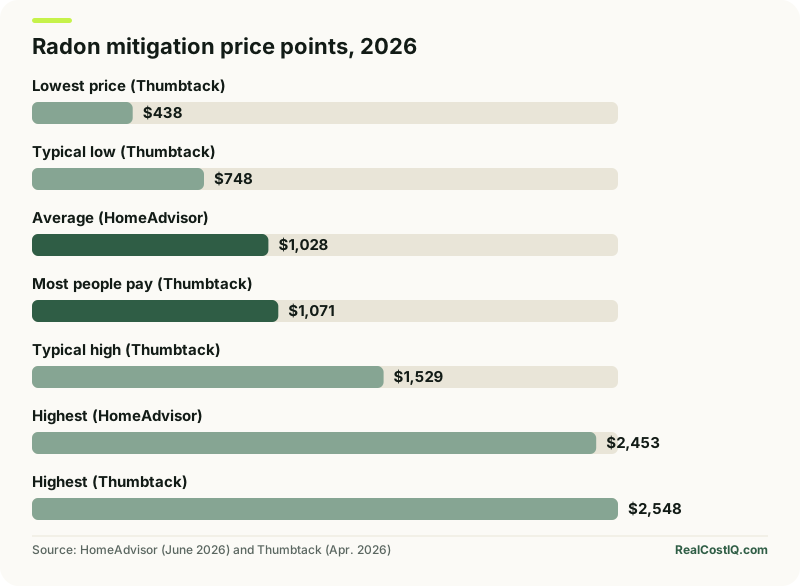
The EPA publishes no prices. Its guide to radon reduction says only that most homes can be fixed for about the same cost as other common home repairs. For dollars, you need other sources. Two cost sites give figures from 2026.
| Measure | HomeAdvisor (updated June 19, 2026) | Thumbtack (updated April 9, 2026) |
|---|---|---|
| Average or typical price | $1,028 average | $1,071 most people pay |
| Usual range | $786 to $1,274 | $748 to $1,529 |
| Lowest and highest | $395 to $2,453 | $438 to $2,548 |
| Fan (active) system | $1,000 to $3,000 | Not split out |
| No-fan (passive) system | $500 to $2,500 | Not split out |
HomeAdvisor's usual range ($786 to $1,274) covers all jobs. Its fan-system band is $1,000 to $3,000. Thumbtack does not split by system type. We show each source as published. Prices are national. Your local quote is the one that counts.
What the system is
The most common fix is called active sub-slab suction. A contractor drills a small hole through the basement or ground-floor slab. A pipe goes into the gravel or soil under it. A fan pulls the gas from under the house and sends it out above the roof line. The EPA calls this the most common and usually the most reliable method. Some systems reduce radon by up to 99 percent.
A passive system has the pipe but no fan. It relies on natural air movement. The EPA's table shows typical radon reduction of 30 to 70 percent for a passive system and 50 to 99 percent for an active one. Passive pipes are usually part of new construction, so a fan can be added later. In an older house with a result above 4, you are likely to be quoted a fan system.
What moves the price up
- Crawl space. A crawl space needs a sealed plastic sheet over the dirt. Thumbtack says homes with a crawl space cost more than homes with a basement alone. HomeAdvisor lists crawl space encapsulation at $1,500 to $15,000 if you need the whole space sealed.
- More than one suction point. A large or divided foundation can need two or more pipes. The EPA says the number depends on how easily air moves in the stone or soil under the floor. Often one point is enough.
- A mix of foundation types. Many houses have a basement under one part and a slab or crawl space under another. The EPA says this may need a combination of methods.
- Well water. If the home uses a private well, the water can carry radon too. HomeAdvisor lists water treatment at $1,200 to $5,000. Ask for a water test if the house has a well.
- Permits. HomeAdvisor lists permits at $25 to $150, depending on the town.
- Looks. A pipe on the outside wall costs less than a pipe run inside a closet. Ask where the pipe will go and how it will look.
You can price your own case with the radon mitigation cost calculator. It takes the foundation type and shows the range for the system you are quoted. Use it to check a contractor's bid. Do not use it in place of a bid.
What it costs to run
The fan runs all day, every day. HomeAdvisor puts a typical fan at 100 to 300 watts, and the added electric cost at $30 to $300 a year. The system also pulls some heated or cooled air out of the house. The EPA says most systems cause some loss of conditioned air. It says this may raise your utility bills a little. Fans may last five years or more, and most warranties do not go beyond five years. HomeAdvisor says to expect a fan replacement about every 5 to 10 years.
Step three: who pays
No federal rule says who pays for radon mitigation. The EPA's real estate guide says that if the test finds a high level, the buyer and seller should discuss the timing and the cost. The Minnesota Department of Health says the same in plain words. Buyers and sellers can agree on whether to test, whether to install a system, and who pays for each. The buyer decides what level is acceptable.
So the seller does not have to pay. But sellers often agree. A high radon result is on paper now. It will show up again when the next buyer tests. Many sellers would rather fix it and move on. Your contract and your state's forms set the starting point. If the contract says nothing about radon, you are asking, not enforcing.
Three ways to get it paid
| Option | How it works | Good for | Watch out for |
|---|---|---|---|
| Seller installs before closing | The seller hires a qualified mitigator. A retest follows. You close if the result is under 4. | Buyers who want it fixed on day one and want no cash up front. | The seller picks the cheapest bidder. Ask to approve the contractor and the plan. Insist on an independent retest. |
| Credit at closing | The seller pays you a set amount at closing. You hire the mitigator after you own the house. | Buyers who want to choose the contractor and the pipe location. | A lender may cap seller credits. The first quote may miss a second suction point. Ask for a little more than the quote. |
| Price reduction | The sale price drops by the cost of the fix. | Cases where a lender will not allow a credit. | The lender's appraisal must still support the lower price. It lowers your loan by a little. |
Seller credits are limited by loan type. The limits are set out in the repair credit post linked above. A credit cannot exceed your actual closing costs on most loans.
A lender can matter here. On some loans, a seller credit counts against a cap. A seller repair can also need a completion report on an FHA or VA loan. Ask your loan officer before you write the ask. The repair credit post lists the limits by loan type.
A worked example with round numbers
You are buying a house for $400,000. The inspector's two-test average is 6.8 pCi/L, taken in the basement. You plan to use the basement as a play room. You get two bids for a basement fan system. They are $1,200 and $1,600. The pro test fee for a retest is $250.
- Pick the number to ask for. Take the higher bid, $1,600, and add the $250 retest. That is $1,850. Asking for the high bid leaves room if the seller counters low.
- Pick the form. If you want to choose the contractor, ask for a $1,850 credit at closing. If the seller wants to handle it, ask for a repair by a qualified mitigator with an independent retest.
- Set the test. Write that the retest must show under 4 pCi/L. Better, write under 2, since the EPA says most systems can reach 2 or below.
- Add the running cost. Plan for $30 to $300 a year in power. Over ten years that is $300 to $3,000. It is small beside the price of the house, but it is real.
The seller counters with $1,000. You now have a gap of $850. That is less than half of one percent of the price of the house. Most buyers close that gap and move on. If the seller will not move at all, you can still decide whether $1,850 is worth the house you want. For most buyers it is.
What to put in the contract amendment
The EPA's guide says a sale contract should say who tests, what kind of test, when, and who pays. It should also say when mitigation will happen and who pays for it. After a high result, an amendment (a signed change to the contract) is the right place for this. Ask your agent or attorney to word it for your state. These are the points to cover.
- The result and the test. State the test date, the device, the average, and where it sat.
- The fix. Name who does it. Say the mitigator must be state-licensed or certified where the state requires it. In states that do not, ask for a national certification.
- The standard. Write that the work must follow the state rules or, where there are none, the EPA's consensus standards.
- The warning device. A good system has a gauge or alarm that shows when the fan stops. The EPA lists it as a feature to ask for.
- The retest. Say who runs it, when, and that the tester is independent. The EPA says to retest after the fix to confirm the level dropped.
- The pass mark. State the number the retest must beat. If it fails, the seller or the mitigator adjusts the system until it passes.
- The warranty. Many mitigators guarantee a result for a set time. Ask whether the guarantee passes to you when you buy.
- The deadline. Tie the work to a date before closing, or hold money in escrow for it.
- Your out. If the seller declines, say what happens. Under a typical contingency you can cancel and get your deposit back. Check the exact terms and dates in your own contract.
Timing is your leverage
Your strongest position is during the inspection period. That is the window when you can still ask for repairs, ask for credits or walk away. After it ends, you have a finding but no easy exit. So check your contract's dates today. Look for the number of days, and whether radon is listed in the clause or needs its own.
Do not wait on the seller. Order the retest the day you get the result. Get two or three bids at once. Most mitigators give a quote in a day or two after a site visit. Then make one clear written ask. A single complete ask with quotes attached is easier to accept than a long email.
Is high radon a deal breaker?
Usually not. Look at the facts. About one house in 15 tests at 4 or more. The fix is a known job. Cost is near $1,000 for most houses. After the fix, the EPA says levels in most homes can be brought to 2 pCi/L or below. A buyer in a BiggerPockets thread with replies dated November 5, 2025 described a condo where the seller installed a system and the retest came back at 0.9. A broker and an investor in that thread said a mitigation system had no effect on value in their markets. That is anecdote, not data, but it fits the EPA's view of radon as a repair.
There are cases where you should slow down.
- The result is very high. A reading of 20 or more is rare. Get a mitigator to look before you commit.
- The retest fails after a fix. If a system does not bring the level under 4, ask the mitigator for a written plan to adjust it.
- Several defects at once. Radon plus a wet basement plus foundation cracks is a different deal from radon alone. Total the costs. The home inspection cost calculator shows what a full inspection and add-on tests cost, so you can budget the rest of your checks.
- The seller refuses any role and will not let you retest. That does not prove a problem, but it limits your choices.
- A very high fix bid with no site visit. The EPA says a contractor should inspect the home before giving an estimate and should explain the work in detail.
Choosing the mitigator
The EPA recommends a qualified mitigation contractor, because the work takes technical skill. It says that without the right equipment or know-how you could raise the radon level or create other hazards. It adds that if you do decide to do it yourself, your state radon office can point you to training. Many states license or certify radon professionals. Start with your state radon office. Then ask each bidder the questions in the EPA's checklist.
- Can you show proof of state or national certification?
- Do you carry liability insurance and hold the needed licenses?
- Will you inspect the house before the quote?
- Is a warning device included?
- Is a test after installation included?
- Do you guarantee a result below 4 pCi/L, and for how long?
- Can you show before-and-after results from past jobs?
The EPA also says to compare more than price. A cheaper system can cost more to run and look worse. It may not last as long. Read the contract, and make sure it matches the bid.
After you close
A radon system needs very little care. The EPA gives three tips. Check the gauge or alarm now and then to see the fan is running. Expect to replace the fan after five years or more. And retest at least every two years to be sure levels stay low. Retest after you remodel, too. If you finish a basement, test before the work starts and again after it ends. The EPA says it is cheaper to put in a radon system before or during a renovation than after.
Keep the paperwork. Save the invoice, any permit, the warranty and the retest report. When you sell, give them to the next buyer. A documented fix with a low retest turns a flagged item into a plus. The EPA says to save the results and any steps taken, and that this could be a positive selling point.
Your checklist
- Read your contract for the inspection deadline today.
- Confirm the test followed the EPA checklist. Retest if it did not.
- Get two or three bids from certified mitigators.
- Price them against the radon mitigation cost calculator.
- Ask your loan officer how a seller credit or repair fits your loan.
- Send one written ask: repair or credit, with quotes, a retest and a pass mark.
- Order the independent retest and keep every document.